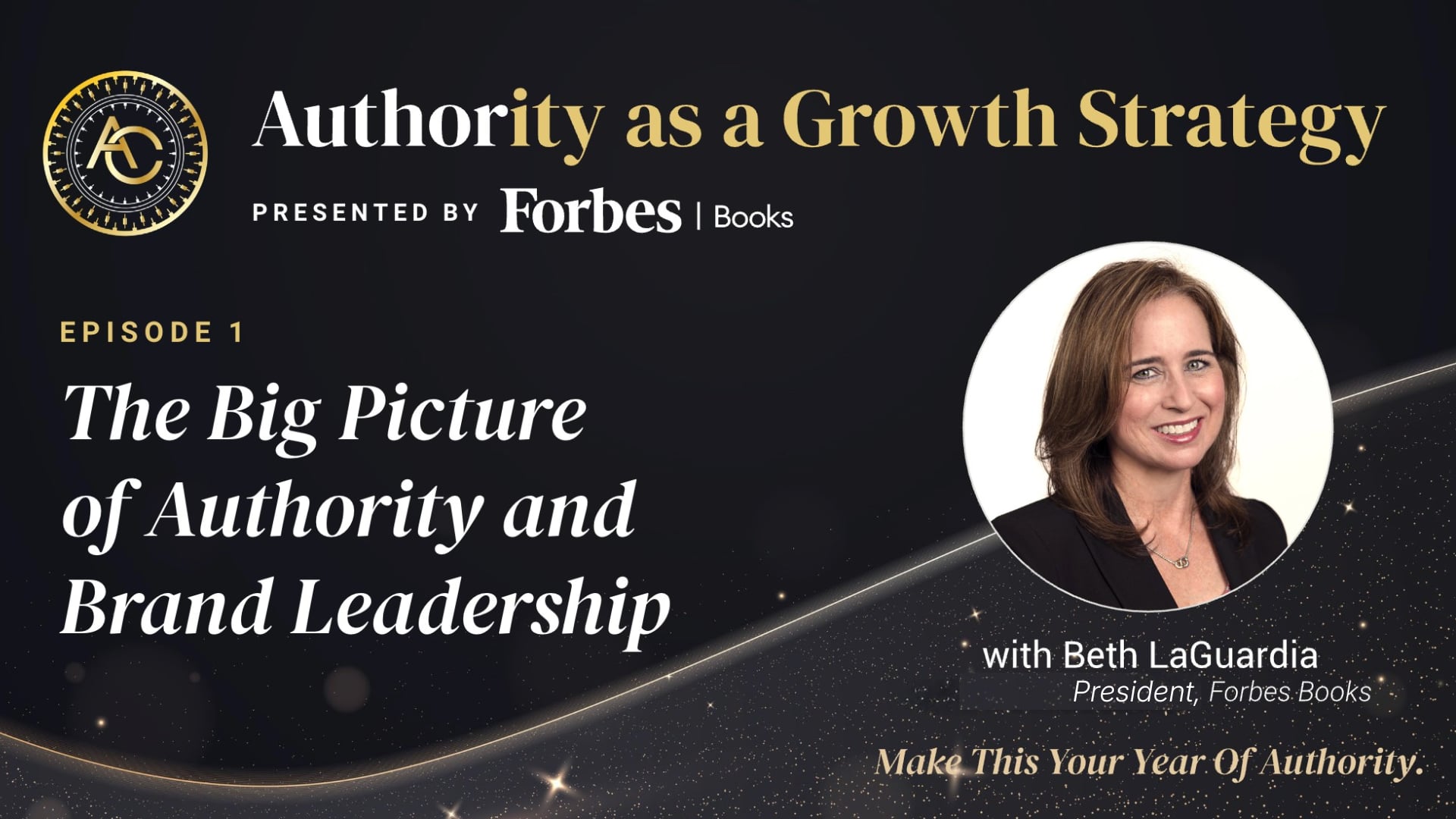
In the first episode of Authority as a Growth Strategy — a Forbes Books series presented by The Covert Code — host Anna Covert sits down with Beth LaGuardia Cooper, newly appointed President and longtime Chief Marketing Officer of Forbes Books. With 30 years of marketing experience across product management, brand strategy, and high-performance team building, Beth brings a rare perspective on what it takes for leaders to show up, get found, and be trusted in an increasingly AI-driven world.
This conversation doesn’t just scratch the surface. It goes deep on the intersection of authority, artificial intelligence, buyer behavior, and what it really means to lead with thought leadership in 2026 — the Year of Authority.
Why Trust Has Become the Currency of Modern Business
If there is one word that anchors this entire conversation, it’s trust. As Beth explains, the rise of AI has fundamentally shifted how consumers make decisions — and trust is at the center of it all.
Every day, buyers are using AI to shortcut research, compile information, and evaluate options faster than ever before. But the speed of discovery comes with a new challenge: how do you know what to believe? With so much content flooding every channel, consumers are increasingly looking for trusted guides — credible experts whose information is verifiable, consistent, and backed by a real reputation.
“We all, as buyers, are using AI every day,” Beth explains. “We’re asking for information to be compiled, and then we have to figure out if we trust it.”
This is where thought leadership becomes not just a luxury-to-have but a business imperative. When your name, your expertise, and your consistent message are woven throughout the digital landscape — from your website to earned media to podcasts — you become the kind of trusted source that AI engines surface when buyers are searching for answers.
SEO, AEO, and the Rise of Generative Engine Optimization
Anna and Beth take a fascinating dive into the evolution of how people search for information online, walking through three distinct waves that every leader needs to understand right now.
The first wave is SEO — search engine optimization — which has been the foundation of digital discoverability for the past 20-plus years. The second wave is AEO, or answer engine optimization, which began emerging around 2020 as platforms started delivering direct answers rather than just links. The third and most current wave is GEO: generative engine optimization. This is the world we are living in right now, where AI-powered engines like ChatGPT and Google’s AI Overviews are synthesizing information and generating direct responses to user queries—often before the user ever visits a website.
What does this mean for leaders trying to build authority? According to Beth, it means that showing up in these engines requires factual, concise, and consistently accurate information across every platform you own—your website, your social profiles, and your directory listings. It also means prioritizing earned media, because roughly 50 percent of what answer engines surface comes from non-paid sources: blogs, podcasts, and trusted third-party outlets.
The practical takeaway? Search yourself the way your audience would. Know how you appear. And make sure that what comes back is accurate, current, and trustworthy.
Real Life Still Matters: The Power of Community and In-Person Connection
In a world that feels increasingly digital, both Anna and Beth are emphatic about something that no algorithm can replicate: the power of real human connection. Communities, relationships, speaking engagements, networking events — these are not going away. In fact, they are becoming more valuable precisely because so much of our lives have moved online.
Beth makes a point that resonates deeply: as a thought leader, you have the opportunity to tell a truly human story—one that brings emotion, wisdom, and lived experience that no AI can replicate. That human element is your competitive edge, and it’s also the foundation of the kind of trust that turns an audience into a loyal following.
The Operator vs. The Thought Leader
One of the most powerful reframes in this episode is the distinction between being an operator with something to sell versus a thought leader with something to teach.
Beth is clear: consumers can smell the difference. When you lead with value — when you put your insights, your frameworks, and your wisdom into the world without expecting something in return — you build a brand that draws people in rather than pushing them away. You move people further down the funnel before they ever raise their hand. You get to the conversation before your competitors even know it’s happening.
This is not about ego. It’s about commitment to impact. It’s about recognizing that your expertise has the power to change someone’s trajectory—and then choosing to share it.
AI as a Tool, Not a Replacement
The conversation takes a candid turn when Anna and Beth discuss the temptation—and the risk—of over-relying on AI for content creation. Beth shares a telling anecdote: while AI can get you about 70 percent of the way there on creative work, it tends to plateau. It lacks the ability to iterate with the nuance and depth that a skilled human brings.
The same is true for thought leadership content. AI can help with inspiration, with research, with drafting. But it cannot replicate the original thinking, the contrarian insight, or the one-plus-one-equals-five leap that comes from a seasoned expert who has sat with a problem for decades.
Beth also sounds a caution every business leader should hear: be careful about which AI tools and platforms you adopt. Your data — and your customers’ data — is your responsibility. Before plugging any new AI solution into your tech stack, know who built it, who backs it, what their data protection policies are, and what happens if they shut down.
The Authority Maturity Model and the Blueprint Process
Forbes Books takes a customized approach to authority building, starting with what they call the “authority maturity model”—an assessment of where a leader is in their authority journey, what their strengths are, where the gaps are, and what their goals look like.
The centerpiece of the strategy is almost always a book—not because selling copies is the goal, but because a book is the ultimate authority asset. It is 200 pages of your voice, your framework, your philosophy. It signals credibility to journalists, conference organizers, podcast hosts, and potential clients before you ever say a word. It opens doors that nothing else opens.
Beth is refreshingly honest about ROI: you are not going to get rich from book sales. But you will get speaking engagements, board appointments, media opportunities, high-value client relationships, and a lasting asset that serves your brand for years.
News Jacking and Staying Relevant
Beth introduces the concept of newsjacking—the art of connecting your thought leadership to trending news stories in real time. Forbes Books’ media team combs through the day’s most relevant news every single day, looking for opportunities to bridge their authors’ expertise to what the world is already talking about.
The goal is not to chase headlines for their own sake but to show up where your audience’s attention already is—demonstrating that you are plugged in, that you care about what they care about, and that your perspective adds value to the conversation they are already having.
Final Thoughts
This episode sets the stage beautifully for the entire Authority as a Growth Strategy series. Beth and Anna depict a noisier, faster, and more competitive landscape that rewards genuine, consistent, and service-oriented leaders.
Authority is not about being the loudest voice in the room. It’s about being the most trusted one. And in 2026, trust is built through visibility, through earned credibility, through human connection, and through the kind of sustained thought leadership that only comes when a leader is willing to put themselves—and their real expertise—out into the world.
Ready to elevate your authority? Click the URL for a free digital copy of The Authority Advantage, available now for Covert Code listeners:
https://books.forbes.com/free-resources/the-authority-advantage/?rpaname=annacovert
🎧 LISTEN ON ALL PLATFORMS
Spotify: https://open.spotify.com/show/0UcnL4g…
Apple Podcasts: https://podcasts.apple.com/us/podcast…
Amazon Music: https://music.amazon.com/podcasts/d15…
iHeart Radio: https://www.iheart.com/podcast/269-th…
YouTube Music: https://www.youtube.com/@thecovertcodepodcast
🌐 FOLLOW THE COVERT CODE
Website: https://thecovertcode.com/
Instagram: https://www.instagram.com/covertcodeofficial
Facebook: https://www.facebook.com/thecovertcode
LinkedIn: https://www.linkedin.com/company/covert-code-official
📚 ABOUT HOST ANNA COVERT
Anna Covert is the host of The Covert Code Podcast and author of The Covert Code – Mastering the Art of Digital Marketing and The Solar Coaster. With over two decades of experience in digital marketing and business strategy, Anna has worked with top-tier companies like Microsoft, Apple, and IBM and leads Covert Communication, Hawaii’s largest digital agency. Through The Covert Code Podcast, Anna brings together industry leaders, innovators, and entrepreneurs to share insights on business growth, leadership, and the strategies that drive success in today’s evolving marketplace.
ANNA’S WEBSITES
The Covert Code: https://thecovertcode.com/
Anna Covert: https://annacovert.com/
Covert Communication: https://covertcommunication.com/
Reactium: https://reactium.io/
⚠️ Affiliate Disclaimer: Some of the links above may be affiliate links, which means we may earn a small commission if you choose to make a purchase through them at no additional cost to you. We only recommend resources we genuinely believe in and personally support.
Episode 1: The Big Picture of Authority
Host: Anna Covert | Guest: Beth LaGuardia Cooper, President & CMO, Forbes Books
This Covert Code podcast is in partnership with Forbes Books. Aloha! My name is Anna Covert. In this episode of Authority as a Growth Strategy — a Forbes Books series presented by The Covert Code — the topic is the big picture of authority and brand leadership. My very special guest is Beth LaGuardia Cooper, newly appointed President and long-time CMO for Forbes Books. Beth is best known for building data-driven marketing engines, smart martech strategies, and high-performance teams. Today, we're breaking down how buying behavior has shifted, how trust is earned, and where real leaders are leaning in. Thanks so much for being here today, Beth.
Thank you, Anna, I'm thrilled to be here. And congratulations on the success of your book, The Covert Code, as well as the podcast — terrific success.
Thank you so much. I'm just really thrilled to be here and so blessed to have Forbes Books and to have this special series, because I think my experience was transformative and I hope that others are going to really be able to share their story and mission as well. So to kick us off, can you give us the cliff note version of the Beth story? Because it's such an amazing career — how did you get to where you are now as newly named President?
You bet. Well, the cliff notes — I've been in marketing for 30 years. In my career I've pretty much done it all, from product management and pricing to brand strategy to marketing communications across a variety of industries. Most recently, having been at Advantage for four years, I've had the opportunity to put all of that work into practice with our many CEO authors — like you — who are working to build their brand and make a bigger impact with their purpose, their mission, and the message that they're willing to share. That led to, most recently in January, Adam Witty — our CEO and founder — asking me to take over the role as President. I've been on the promise side of things for the past four years, and now I'm on the delivery side. It's my job to make us better, to grow and scale what we do in the most efficient and innovative way possible. At the end of the day, it really comes down to leading people effectively to open those doors so they can do their best work.
I know that 2026 is the Year of Authority for you guys, and I think that couldn't come at a better or more important time, because behavior is shifting dramatically. People are really scared out there — they're not sure who to trust. What are you seeing? How is AI transforming buying behavior?
You said a big word there — trust. It's something that is really nicely complemented by thought leadership. We all, as buyers and as consumers, are using AI every day, all the time. We're using it to shortcut things we do, to complete routine tasks, and we're asking for information to be compiled that we then have to sift through and figure out if we trust and use in our lives. A big part of the future of AI is going to be finding the trusted guides — finding the experts with citations and reputation behind them that we feel comfortable using. Trust is a big one. We also need to think about how we're being discovered, because all of us are beginning to use answer engines to get information. The information that comes back is going to include advertising, links, and content from a variety of sources — and that is changing how we show up to buyers. As consumers, we're not necessarily visiting a website to compare brands anymore. We're doing it right there in the answer engine, and the information we find there is going to lead us very far down the funnel.
I love that, because there's kind of three waves: there's SEO, which we commonly know about — search engine optimization — going on for about 20 years now. Then AEO, or answer engine optimization, which started to emerge around 2020. And right now we're right in the throes of GEO — generative engine optimization. When you go and Google someone, you're starting to see AI-generated comparison results at the bottom. There's a lot of opportunity here, but also a lot of risk. What are your thoughts on how to navigate this? How are we going to be seen and found in these engines?
I'm really locking in on a few things. One is making sure that you have factual information that is concise and easy for answer engines to pick up — specific, accurate, and consistently used across all platforms you own, like your website, social profiles, and directory sites. I also recommend making sure that you show up in earned media, because about 50% of the content that answer engines surface comes from non-paid sources — blogs, podcasts, trusted third-party media outlets. We want that information to be current, covering trending topics your audience is searching for. And search yourself the way your consumers would — just as we did with SEO, know how you show up and how others do as well. Beyond that, real life matters. We have communities, relationships, and speaking opportunities where you can show up authentically. Those are not going away. You're never going to be replaced by a human telling a story that's relatable and brings emotion and twists wisdom with experience.
I think that's right. A lot of leaders have previously wanted to step back — they didn't want to be in the limelight. But the only way to really be a leader today is to be out front, to be your true self, so people can see you and experience you — through the blogs, through the book, through whatever the outlets are. That's the only way people are really going to trust you.
It's not about having an ego. It's about being committed to getting your message out so other people can experience it. Doing that means adopting a thought leadership mindset over a mindset of being an operator with something to sell. You need to put your message out in a way that reaches people way down the marketing funnel. Be a thought leader, serve something greater, make a bigger impact — and bring people into your funnel who you never would have had the opportunity to talk to before because they were making a decision before you even knew about it.
There are over 250,000 websites that go live every single day worldwide. When you're thinking about whether Google is going to see you — the answer is no, unless you have enough online reputation and authority to make an imprint. What is that combination that you tell a CEO about how to really become a guide and influence the buying decision?
It starts with knowing what ends you have in mind. What are your goals? Who is really your audience? What is your message? Let's crystallize it and make sure it's differentiated and valued by your audience. My bachelor's degree is in economics, and it comes into play every day — you have buyers and sellers and you need to meet where value is shared. Having an ear to the ground, serving your audience, and giving them value without expecting value in return is a part of thought leadership. It allows you to frame your narrative, gets solutions into the marketplace, and the benefits — the return on investment, or return on authority — will come because you're paying attention to the right things. It's like reciprocity: you can't get something unless you give something.
I remember when I first was going to write my book and people were like, "Why would you want to tell people how to do what you do?" I said, "Because then they'll never want to do it on their own." Once someone sees what I do, they realize they could do it themselves — but they don't want to. And I wrote the book because I needed to reach more people faster. I had people crying to me on the phone about how much they'd been losing to digital ad fraud. When my book came out we were at 30% fraud — now just a year later we're at 60% digital fraud. The story is even more important now.
We're talking about thought leadership — original thought from people who are there to make it better until the end. On the other side, we need people to walk us through all this information overload and understand what to trust. Our outputs are only as good as our inputs, and our inputs are biased because we ask questions from our own limited perspective — we don't see everything behind us. We do need those other voices, those trusted circles, those advisors who help us see around corners and challenge us to think bigger.
As a growth leader, in the next 2 to 3 years, what organizational shifts and strategies are you most bullish about investing in?
Honestly, this is the age of thought leadership. Getting out there as a teacher to have an impact — building community in a way that gets us ahead of others in our category. We ourselves do it; we practice what we preach. Having that value-oriented approach where you consider yourself a partner to others — because you believe in your mission and you want people to have this information — being a thought leader gets you the brand you're aiming to build and gets you close to your audience. You see firsthand what their issues are, what their questions are, what they care about. Those are winning solutions. I would also say AI toolset talent and doubling down on the team — people at the top. And focusing on real-life community is a big part.
I think AI can be an equalizer in a lot of cases — and even more reason that you need the agency or the authority or the leader, because if everyone can use AI and everyone can equalize their copy, then everyone kind of looks the same. And if everyone looks the same, how is the AI engine going to compare you to anyone?
The ability to level up, the ability to come with limited resources and act like a much bigger team — amazing leaps and bounds will come from that, especially for solopreneurs. But for bigger organizations: we're not putting our head in the sand. This is very disruptive. We're going to have to remake and rethink what our organizations look like. How are we as leaders going to lead this strategy into the future in a way that brings forward the next generation of workforce? That, I think, is a responsibility we also have.
What should people be thinking about in terms of AI-proofing their business? What else is there besides building up skill sets?
Building up skill sets, working the muscle. Making sure we leave space for innovation, for testing, for an empowering culture where people feel they can be part of the strategy. And this leaves all this space for what we're going to crave — community. In-person opportunities. Talking to a human who can relate to us and really feel what we're feeling. We're absolutely going to appreciate that more — those qualities and skill sets and assets that are, by nature, AI-proof. It's leaning in both ways. And then there are things that are going to be truly disrupted, and we should test them rather than sidestep them.
I think another thing I'd really caution people about — every day clients call me with their new AI thing. There are so many solutions, and it's easy to think you have to do something now. But you don't know who's behind these AI solutions. This is your data — your customers' data — that you're responsible for. You can't just hook in any CRM and try it out. Who is this company? Who backs them? Do they have data protection and privacy in place? What happens if they go under? What about your clients' data?
You're smart, smart, smart and looking out for that. Let's take a deep breath, everyone. We know it's happening and it's going to be fast and furious. And you don't want to be caught up — just like the crypto thing. People are so anxious that they can be taken advantage of quickly. But what you can't be taken advantage of quickly on is writing a book. It's a time-tested improvement strategy that has built authority — the number one way we've built authority for generations.
Right. And when you think about it — a book is 200 pages of you talking about what you believe in, how you do what you do, what makes you different, how to frame the problems and solutions you serve. It's unbeatable. And even if people don't open it — the fact that you've written a book on the topic, how many places do you go where a guest is introduced and the very first statement is that they've written a book? That is a way of saying: highly credible, someone to be listened to, someone who views themselves as a teacher more than a seller. That's what separates you.
Absolutely. The fact that a book can be your biggest accelerant, your number one marketing asset — when you start peeling that back, when you see the ways you can use this as the ultimate business card for you and your business, it's just unbeatable. And it is very doable. When you come out on the other side, you've got this lasting asset that serves you for years and years.
You guys talk about the authority maturity model — tell me about that and how it fits into your framework and overall strategy.
We assess where you are in your authority building and what your strengths are. Where are there gaps? What are your goals? Some people's goals are not to grow their business but simply to inspire generations to come. That begins to set the tone around what makes sense to use as the tools in the toolkit. We'll build a blueprint working with people based upon their unique challenges, strengths, and goals. Most of the time, the book is a centerpiece to that — but not always. We also work with folks who have books already, or who just need to crystallize their message and know what their brand really stands for. We take you with the on-ramp you're on and look to accelerate that in the best way possible. And it's a partnership — we'll constantly strategize to keep up with changes and help you be the first through the corners ahead.
Beth, tell everyone how to get in touch with you and what are the next steps for someone who wants to reach out?
You can find me on LinkedIn. The first step is a complimentary discovery consultation — we talk about what this looks like, answer all your burning questions, and determine together if we'd like to take a very small first step, which is building a book plan together. That's where we talk about what this could look like and bring it to life in a very detailed way — a 40-plus page deliverable. No obligation. The easiest way to get there is to go to the Authority Company dot com, where we house our entire portfolio of brands. You can find the link to contact us in the navigation.
And I will mention that my blueprint was really, really valuable. When I first reached out, I wasn't even done writing — I was at 57,000 words — and Samantha said, "You should stop writing." I said, "But I have more to say!" But one of the things I really appreciated was that my editor Heather told me: no one cares how you got there. We just care that you're here now. That was very liberating. So I think it's a great exercise for anyone to go through. There will be a link on the website and below on YouTube. And the next segments will dive into additional topics, so be sure to stay tuned. Thank you so much, Beth!
Thank you. And I'll see everyone in the pixels. Aloha!