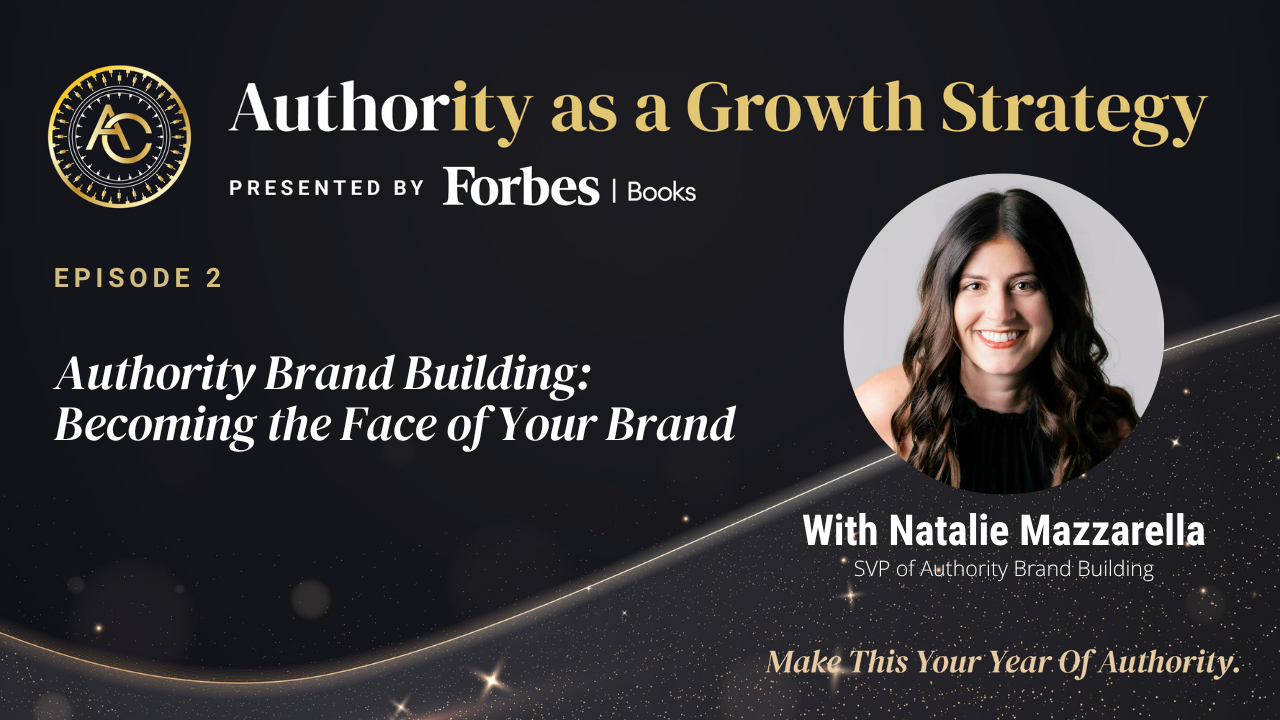
In Episode 2 of Authority as a Growth Strategy — a Forbes Books series presented by The Covert Code — host Anna Covert sits down with Natalie Mozzarella, Vice President of Authority Brand Building at Advantage Media. With 15 years of experience shaping global brands including Gucci, Tiffany & Co., and Burberry — and three years dedicated to helping CEOs and executives step into their personal authority — Natalie brings a luxury brand perspective to the world of thought leadership that is as sharp as it is practical.
The conversation covers everything from why personal brand is no longer optional for leaders, to how AI is fundamentally reshaping the earned media landscape, to the very real cost of staying invisible in 2026.
Personal Brand Already Exists — Whether You’ve Built It or Not
One of the most powerful insights Natalie opens with is also one of the most sobering: your personal brand exists whether you have invested in it or not. The question is simply whether you are the one shaping it.
For many business leaders, all of their financial capital, creative energy, and professional focus has gone into building their companies. The idea of turning the spotlight on themselves can feel uncomfortable, even egotistical. But the reframe Natalie offers is important: your personal brand is not about you. It is about the value you have accumulated over a career and your commitment to making it accessible to the people who need it.
And if you are choosing not to actively shape your brand, something is still being said about you. Your LinkedIn profile is saying something. The absence of a media presence is saying something. In the age of AI-powered search, your digital footprint — or the lack of one — is speaking loudly to every potential client, partner, speaking booker, and journalist who looks you up.
The 60-Point Trust Gap That’s Costing CEOs Business
Natalie cites a striking statistic from an annual PwC consumer trust study: 90 percent of business leaders and CEOs believe that consumers trust their corporations — but in reality, only 30 percent do. That is a 60-point gap between perception and reality, and it is growing year over year.
The implication for leaders is stark. A corporation, no matter how established or well-regarded, cannot generate the kind of trust that a person can. People trust people. When a CEO or executive steps forward as the face of their brand — sharing their perspective, their story, their values — they become a bridge between the institution they lead and the humans they serve.
The real ROI of personal brand building, Natalie argues, is not vanity metrics. It is the closing of that trust gap. And every day a leader remains invisible, they are leaving opportunity, leads, and revenue on the table.
Authority Is Recognized, Not Claimed
One of the most memorable lines of the episode comes from Anna: “Authority is recognized, not claimed.” Natalie builds on this beautifully, articulating the balance between owning your own narrative and earning recognition from credible external sources.
Yes, it matters what trusted outlets, journalists, and industry peers say about you — that earned media is a signal of credibility that cannot be faked. But if you are not doing the foundational work of defining your brand, clarifying your message, and showing up consistently in the places your audience lives, no one else is going to do it for you.
How AI Is Changing the Way Authority Is Discovered
The episode takes a particularly timely turn when Anna raises the question of AI and how it is reshaping discovery. Natalie makes an observation that every leader needs to hear right now: AI-powered search results are increasingly prioritizing earned media for individual people.
What does that mean in practice? If someone goes to an AI chat interface and types your name, the engine is going to pull from whatever credible, earned media exists about you — interviews, press coverage, podcast appearances, published articles, and yes, your book. If that content doesn’t exist, the engine has very little to work with. And if you are showing up nowhere, you are being left out of conversations that could be driving business your way.
Not All Earned Media Is Created Equal — But All of It Has Value
Anna and Natalie have a candid conversation about the realities of earning media coverage — including the fact that it is not always free. Having a publicist or a team with established media relationships is a genuine advantage.
Natalie’s perspective is nuanced and reassuring: even smaller, more niche publications have value. Media breeds media. A local newspaper feature or industry publication piece may not carry the domain authority of the Wall Street Journal, but it creates momentum. It builds your interviewing muscle. It generates shareable content. And it may be read by exactly the right journalist who is working on a larger story and looking for your voice.
The Teacher vs. The Seller
Natalie echoes a theme from Episode 1 that is clearly central to the entire Forbes Books philosophy: the distinction between showing up as an operator with something to sell versus a teacher with something to teach. Consumers today — especially younger consumers who have grown up with social media and can sniff out inauthenticity in seconds — are not interested in being sold to. They want to be taught. They want to be inspired.
This is the mindset shift that unlocks personal brand. It’s the shift from “how do I look good?” to “how do I add value?” And when a leader makes that shift, the brand that emerges is not manufactured — it is the natural expression of who they already are and what they have spent a career learning.
Where to Start When You Don’t Know Where to Start
For leaders who feel overwhelmed by the scope of building a personal brand, Natalie offers a grounding piece of advice: start internally. Pay attention to how you already show up for your team, your employees, your board, and your partners. What language do you use? What values do you express? What problems do people bring to you because they trust your perspective? That internal feedback is the raw material of your external brand.
Anna adds a practical suggestion: create a “bragging folder” — a dedicated space where you save every email, message, or note in which someone has thanked you, praised your work, or expressed the value you brought to them. Over time, this becomes a goldmine of insight into where you provide real, meaningful value — and it becomes the foundation of a brand that is grounded in evidence, not invention.
Final Thoughts
This episode makes clear that personal brand building is not a luxury reserved for celebrities or already-famous executives. It is a leadership responsibility — and in 2026, it is becoming a competitive necessity. The leaders who are willing to step forward, define their narrative, and consistently show up as trusted voices in their field are the ones who will be found, remembered, and chosen.
The tools, the platforms, and the AI landscape will keep changing. But the human desire for a credible, relatable, trustworthy guide — that is not going anywhere.
Ready to elevate your authority? Click the URL for a free digital copy of The Authority Advantage, available now for Covert Code listeners:
https://books.forbes.com/free-resources/the-authority-advantage/?rpaname=annacovert
🎧 LISTEN ON ALL PLATFORMS
Spotify: https://open.spotify.com/show/0UcnL4g…
Apple Podcasts: https://podcasts.apple.com/us/podcast…
Amazon Music: https://music.amazon.com/podcasts/d15…
iHeart Radio: https://www.iheart.com/podcast/269-th…
YouTube Music: https://www.youtube.com/@thecovertcodepodcast
🌐 FOLLOW THE COVERT CODE
Website: https://thecovertcode.com/
Instagram: https://www.instagram.com/covertcodeofficial
Facebook: https://www.facebook.com/thecovertcode
LinkedIn: https://www.linkedin.com/company/covert-code-official
📚 ABOUT HOST ANNA COVERT
Anna Covert is the host of The Covert Code Podcast and author of The Covert Code – Mastering the Art of Digital Marketing and The Solar Coaster. With over two decades of experience in digital marketing and business strategy, Anna has worked with top-tier companies like Microsoft, Apple, and IBM, and leads Covert Communication, Hawaii’s largest digital agency. Through The Covert Code Podcast, Anna brings together industry leaders, innovators, and entrepreneurs to share insights on business growth, leadership, and the strategies that drive success in today’s evolving marketplace.
ANNA’S WEBSITES
The Covert Code: https://thecovertcode.com/
Anna Covert: https://annacovert.com/
Covert Communication: https://covertcommunication.com/
Reactium: https://reactium.io/
⚠️ Affiliate Disclaimer: Some of the links above may be affiliate links, which means we may earn a small commission if you choose to make a purchase through them at no additional cost to you. We only recommend resources we genuinely believe in and personally support.
Episode 2: Authority Brand Building — Becoming the Face of Your Brand
Host: Anna Covert | Guest: Natalie Mazzarella, VP of Authority Brand Building, Advantage Media
This Covert Code podcast is in partnership with Forbes Books. Hello, my name is Anna Covert, and on this episode of Authority as a Growth Strategy — a Forbes Books series presented by The Covert Code — the topic is Authority Brand Building: becoming the face of your brand. My very special guest is Natalie Mazzarella, Vice President of Authority Brand Building at Advantage Media. With 15 years of experience shaping global brands such as Gucci and Tiffany and Co., today she helps leaders step into authority with intention. We'll be talking about how personal brand is now a leadership mandate and how authorship becomes an inflection point where wisdom becomes legacy. Thanks so much for being here today.
Thanks for having me on. I'm excited as well.
Great. So to start us off — a little Natalie cliff notes. You've had an amazing journey in your career. How did you get from where you were to where you are right now?
I like to call it the scenic route. I've had the pleasure of being with Advantage Media for the last three years as VP of Authority Brand Building. Previously I had an agency background — I worked in a public relations and communications agency that worked predominantly in luxury consumer goods. Gucci, Tiffany and Company, Burberry — the list goes on. I've also worked in CPG, some cannabis, a little bit of everything. My client list has been everything from Prada to pot to potato chips. About ten years as an executive director on the agency side. Prior to that I worked in-house for a women's retailer called Loft — an Ann Taylor brand — at their corporate headquarters in New York. And if you dial back even further, I'm actually a licensed cosmetologist. That's my scenic route. I started my own studio salon, which is how I paid for the remainder of my education, and it was a crash course in client service and managing people that has significantly shaped my professional life since. All of it led me to working with CEOs and business leaders to help tell their stories.
That's really interesting. We actually have something in common — after business school in Boston I moved to Hawaii, and one of the business plans I wrote was for a cosmetology school for Paul Brown Institute. So this topic of being the face of your brand is right in line with what you learn about hair and everything you put together — your brand is so much more than a logo. When you talk to a CEO, how do you help them define their personal brand and really grab hold of it?
It's a really challenging thing for business leaders to think about because they've spent so much time — financial capital, calories, everything — building their businesses. And then all of a sudden you're saying, okay, now it needs to be about you. There's an ego component that's difficult to get over, because it feels self-serving and silly and unfamiliar. But whether or not they've invested in their personal brand, it exists — because it's who you are. It's everything you've done in your career. It's your mission and vision as a leader, what you're hoping to leave as a legacy. All of that is part of your personal brand. It's a matter of understanding the pieces and getting them organized. I start with a conversation, because we learn the most from sitting down and really trying to understand what our authors are hoping to achieve. And internally, we often say there are two different ways to look at yourself as a business owner: there's an operator with something to sell, and there's a teacher with something to teach. Consumers are smart — they know when they're being sold to, and they're not interested in that. What they want is to be taught, to be inspired. That's where personal brand comes in.
And I think what people get held up on is that they're so passionate about so many things — they think they should be talking about so many things. But you can't be everything to everyone. You have to drill down to what you're going to feel comfortable with as your elevator speech. And that becomes the clarity for this brand persona.
Exactly. And I'd argue that your personal brand should change if you want it to have longevity. Humans evolve every day, and the world we live in also evolves. Your why doesn't necessarily have to change, but maybe how you're talking about it or approaching it as it relates to what's going on in the world may evolve — and that's an important thing. Personal brands aren't concrete; they should be evolutionary. They should adjust as you continue to develop. That's kind of where the fun lives — it becomes a journey that you never really end, and there's no achieving a destination. It's the process of it, which is really fun work.
I 100% agree. Almost 95% of people who work with us update their logo. And I always take a lot of extra time to say — all your favorite brands: Starbucks, Uber, all of them have evolved. A lot of times the consumer doesn't even notice; it just feels more natural, more on brand. You change your haircut, you change your sofa. It's okay. It just means you've outgrown it. So — a lot of CEOs are hesitant about becoming the face of their brand. What does that hesitation cost them?
PwC does a study every single year on consumer trust. The most recent stat: 90% of business leaders and CEOs believe that consumers trust their corporation — when in reality that number is 30%. That is a 60-point swing, and it's increasing from the previous year. The math is telling us that consumers are not trusting a corporation. But people do trust people. The real ROI — or the real risk for a CEO who doesn't put themselves forward as the face of their brand — is that they're not doing everything they can to establish trust with their core audience. They're leaving opportunity and leads and money on the table.
That really segments into the year of authority branding for 2026. And with AI in everything, you can't even turn around without someone talking about it. That's even more reason why you have to do it now. Making an AI version of yourself is not the answer.
Absolutely. One of the most common questions I hear is, "I don't even know where to begin." And the takeaway is: even if you're choosing not to think about your personal brand, some version of it exists, whether you've put effort into it or not. It could be as simple as your LinkedIn profile — it's saying something. If you're showing up nowhere, that's saying something too. And AI-optimized search results are now overtaking standard Google search. People can do separate searches within AI. And AI is valuing earned media results for individuals. If you go to an AI chat and say "tell me about Anna Covert," it's going to pull information, but it's going to prioritize earned media — media coverage that stems from putting yourself forward as a thought leader or an author. All of these things are interconnected. The decision to do nothing means you're going to be very, very far behind.
And for leaders out there who are listening — there's a concern about aging out, or being overqualified, or qualifications not being enough anymore. In today's world you need to constantly prove that you are a thought leader, and the only way to do that is to commit to some kind of visibility. We always say that authority is recognized, not claimed. Tell me more about what the difference is and what people misunderstand about personal branding.
The whole idea of "it's more important what others say about you than what you say about you" — receiving press coverage is one component of establishing thought leadership. But as a publicist, I'd counter that argument: if you're not owning your own brand and your own narrative, no one else is going to want to talk about you. Yes, it matters what credible outlets say about you. But if you're not taking time to develop your brand and amplify it on your own, you're going to miss opportunities. The foundational first step is to sit down and establish a personal brand. Here's my mission statement, my purpose, my target audience, my logo — but also: what words do I use? What words do I not use? What platforms do I show up on? What color palette do I wear? All of those things contribute to building a personal brand.
And I think some leaders might get overwhelmed — oh, well, I'm writing a book, what am I going to say? But you can start by thinking about how you're showing up to your employees or to your partners. What do they see? How are you expressing leadership internally? That can be a great place to start playing with these concepts before you push them out.
Absolutely. No one is going to understand your business and your purpose as a CEO more than the people who work with you and for you every day — your board, your stakeholders, your team. A common question I hear is: how does my personal brand connect to my company? In a lot of cases, yes — you are the face of your business, and you're an individual looking to inspire trust and provide value. The business is the sales engine of that. And if you're thinking about where to begin, trying out language in internal memos, lunch and learns, communications with your company — they're going to be the ones who can provide feedback on whether your purpose as a CEO and leader has a through line to your external thought leadership.
I was just on another podcast talking about creating a "bragging folder" in your email — every time someone writes thanking you or acknowledging something you've done well, put it in a folder. So that later when you're thinking "what am I really great at? What value do I bring?" you can go there and be reminded. But there's a big difference between being the owner of an agency — like I specialize in digital marketing, which was the bridge to my book — versus being a CEO of a big corporation where it's not your company. Where do you fit in? What have you done, and how is that leveraged for what you want to become?
I love the folder idea. I used to print out well-wishes from clients because it just makes you feel good, especially in those moments of insanity where you need to be reminded that you know what you're doing. Asking your team is also a great way to go about it — "What do I do well? How do I help you?" The people closest to you can help answer those questions even in the moments where it's hard to answer yourself. And to kind of circle back on the media and algorithms — you know, Google lost their antitrust lawsuit in October 2025, but they weren't really penalized much and won't have to sell YouTube. They are in control of search, and it's changing. That can be stressful. But having a brand like Forbes Books or Entrepreneur — those ranks that are being established — that's a big difference when you're picking a publisher. What that authority carries is real.
And as people are earning other types of earned media, we're hearing pushback from big companies about whether they'll allow crawling on their sites. Is this something you're evaluating in terms of where media comes from? Do people need to be concerned?
A couple of things. When it comes to earned media and search result value, big name outlets like the Wall Street Journal, New York Times, Forbes, Entrepreneur — they carry vast domain authority and brand recognition. But your smaller outlets, while they don't carry the same level of cachet, still have tremendous value. Media breeds media. I remind people of this all the time. A local newspaper or niche industry publication might not have a billion-person readership, but it can lead to bigger opportunities. Getting started with smaller publications builds your interviewing muscle, creates shareable content, and puts you on the radar of journalists who may be working on a larger story. There are fewer journalists and editors today, a lot of freelancers working across multiple publications — you never know what a smaller interview can lead to. There's no bad opportunity.
That's a great answer. And I think something important for listeners to understand: earned media doesn't necessarily mean it's free. There's value in having a publicist or a company like Advantage with these relationships. It's like traditional advertising in a way. Even I — with all my connections as the largest agency in Hawaii — struggled to get earned media here after my book launched. It was really a struggle. So you have to find different ways to pivot and think about whose partnerships you're engaging with.
Exactly. There are so many variables — what's happening in the media cycle at any given point can throw a monkey wrench into outreach efforts. The holiday season can be difficult. If there's a natural disaster, all other media coverage stops. There's just a million things that can play into it. That's why you have partners, publicists, and people who can do that for you. It's not free in the sense that you need a team behind you who can help support you through that process.
Well, this has been such a wonderful conversation, Natalie. Thank you so much for being here. And I will see everyone in the pixels. Aloha!
Thank you so much. Aloha!