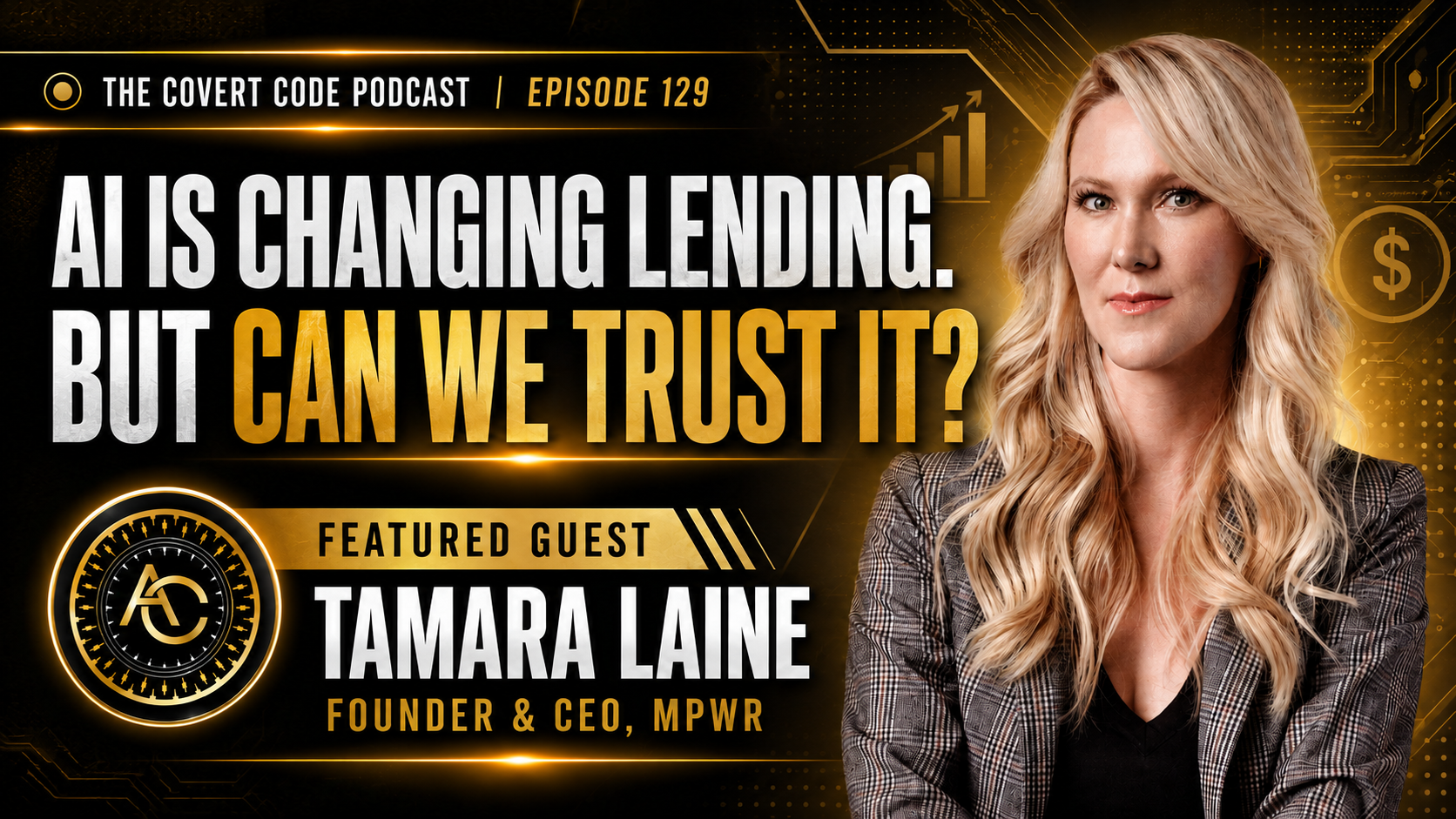
AI Is Changing Lending. But Can We Trust It?
Featuring Tamara Laine, Founder & CEO of MPWR
Artificial intelligence can analyze enormous amounts of information faster than any human underwriter.
But should it decide whether you qualify for a mortgage?
Should an AI determine whether an entrepreneur receives access to capital?
And what happens when an algorithm misunderstands someone’s financial life?
Those questions are becoming increasingly important as AI moves deeper into banking and financial services.
In this episode of The Covert Code Podcast, Anna Covert sits down with Tamara Laine, Founder & CEO of MPWR, to discuss the future of AI-powered lending, financial inclusion, privacy, regulation and why human judgment still matters when technology begins influencing consequential financial decisions.
Traditional Credit Was Built for a Different Economy
One of the fundamental problems Tamara wants to solve is surprisingly simple:
The workforce changed.
Credit models largely didn’t.
Traditional lending systems were designed around a borrower with relatively predictable employment, often represented by a W-2 salary and conventional credit history.
Today’s economy looks very different.
People freelance.
They own businesses.
They work multiple jobs.
They drive for gig platforms.
They create digital content.
They work as fractional executives.
They may generate considerable income without receiving a traditional paycheck every two weeks.
Yet unconventional income can still look like risk when evaluated by systems designed for another era.
A Credit Score Is Only a Moment in Time
Traditional credit reports provide valuable information.
But they also provide a snapshot.
Tamara argues that someone’s financial credibility can be difficult to understand from a single moment.
A borrower could have experienced fraud.
A divorce.
A temporary layoff.
A medical expense.
A period of business investment.
Any of those events can affect the financial picture at the precise moment the report is pulled.
MPWR’s approach is to bring together a larger set of trusted data points to help lenders see patterns and trends rather than relying exclusively on a static snapshot.
Is someone’s financial position improving?
Declining?
Stable?
What does the broader financial behavior indicate?
The goal is a more complete picture.
AI Can Help Prepare the Decision Without Making It
One of the most important distinctions in Tamara’s approach is what MPWR does not ask AI to do.
It doesn’t independently make the final underwriting decision.
That boundary matters.
AI is excellent at many analytical and organizational tasks.
It can process information quickly.
It can identify missing data.
It can assemble information for human review.
It can help reduce repetitive manual work.
But AI models can still hallucinate, misunderstand information and produce unreliable outputs.
The consequence of a mistake becomes much more significant when the decision affects someone’s ability to buy a home or obtain financing.
Tamara summarizes the philosophy simply:
AI prepares. Humans decide.
The Human-in-the-Loop Model Matters
We’ve discussed the importance of human oversight frequently on The Covert Code Podcast.
AI can dramatically increase what a capable professional can accomplish.
But that doesn’t eliminate the need for expertise.
In fact, it may make expertise more important.
A knowledgeable professional can recognize when something looks wrong.
They can challenge an assumption.
They can ask a better question.
They can determine whether the technology has overlooked important context.
Someone without that expertise may simply accept the result.
That becomes especially dangerous in regulated industries.
Not Every Piece of Data Belongs Inside AI
Financial systems handle some of the most sensitive personal information businesses can possess.
That doesn’t mean every piece of that information should be given to an AI model.
Tamara explains that MPWR deliberately separates extremely sensitive information, including Social Security numbers, from the AI layer.
The broader principle is important for every business deploying AI:
Does the AI actually need access to this information?
More data isn’t automatically better.
If information creates unnecessary risk without contributing meaningfully to the task, there may be no reason for the model to see it.
Build AI Around Permission, Not Unlimited Access
MPWR also limits what individual agents can access.
Instead of giving one AI agent every available piece of information and allowing it to operate freely, agents are restricted to particular information and responsibilities.
This is conceptually similar to the principle of least privilege in cybersecurity.
A person or system should have access to what it needs to perform the job—and not necessarily everything else.
Tamara uses email as a practical example.
An AI assistant doesn’t necessarily need complete access to every message, attachment and contact in someone’s inbox.
A separate workflow could forward specific items to the agent when action is required.
That creates a boundary.
Boundaries matter when AI systems become increasingly capable of taking action rather than merely generating text.
Trusted Data Becomes More Important as AI Gets Better
An AI system is only as useful as the information feeding it.
Tamara describes MPWR’s agents as an orchestration layer that can bring together trusted third-party data used within the lending process.
The agent doesn’t simply search the internet for an answer.
It operates within defined information environments.
That helps reduce one of the most familiar problems with generative AI: hallucination.
If the information isn’t present, the system should not invent an answer simply because the user asked for one.
That sounds obvious.
Anyone who has spent significant time using generative AI knows it isn’t always how general-purpose models behave.
Regulation Can Actually Encourage Innovation
Technology companies often portray regulation as the enemy of innovation.
Tamara sees another side.
Investors dislike uncertainty.
Early-stage investors may be evaluating what a company and its market will look like five or ten years in the future.
If nobody knows what AI regulations will ultimately permit, prohibit or require, that uncertainty itself becomes a risk.
Clear standards can provide companies and investors with a framework for building responsibly.
In financial services, many data-protection requirements already exist.
The challenge is evolving those frameworks as new AI capabilities create new risks.
Should Businesses Collect the Data Simply Because They Can?
Anna raises another issue that extends well beyond financial services.
Businesses have become accustomed to collecting enormous quantities of customer information.
Marketers especially love data.
But availability doesn’t automatically create necessity.
Businesses should ask:
- Why are we collecting this information?
- How does it improve the customer experience?
- Where is it stored?
- Who can access it?
- Which vendors receive it?
- Can the customer correct it?
- Can it be deleted?
- What happens if the vendor experiences a breach?
- Does AI truly need access to it?
The cheapest data breach to resolve is the one involving information you never needed to store in the first place.
AI Is a Junior Analyst, Not the CEO
One analogy from the conversation is especially useful.
Think of AI like a junior analyst.
A junior analyst can do tremendous work.
They can research.
Organize.
Compare.
Draft.
Calculate.
Summarize.
But someone experienced still needs to review the work.
And the training doesn’t stop simply because the analyst produced one good result.
AI similarly requires feedback, correction and continuing guidance.
Ignoring that feedback loop is one of the easiest ways to turn a powerful productivity tool into a source of bad information.
The Bigger Risk May Be What AI Does to Human Thinking
Tamara spent part of her career as a journalist.
Writing, research and critical thinking were skills she developed through years of practice.
Now AI can generate an editorial, research a topic or summarize information in seconds.
That’s incredibly useful.
But Tamara raises an uncomfortable question:
What happens to those skills if we stop practicing them?
She intentionally continues writing without AI at times, including writing by hand, specifically to preserve abilities that technology could otherwise begin replacing through convenience.
What Happens to the Next Generation?
The concern becomes even larger for children who may never develop the original skill before technology begins performing it for them.
Previous generations had to research.
Find sources.
Compare them.
Determine which information was credible.
Students increasingly receive an answer immediately.
The question isn’t whether AI should disappear from education.
It won’t.
The challenge is teaching students to interrogate the answer.
Where did this information come from?
Is the citation real?
Is the source trustworthy?
What perspective is missing?
What assumptions did the system make?
Those may become some of the most important literacy skills of the next generation.
AI Should Expand Education, Not Shrink It
The conversation explores an interesting tension.
AI can tailor learning experiences to an individual student.
A lesson could potentially be presented visually, verbally, interactively or through a completely customized experience.
That could make education dramatically more accessible.
But personalization has a downside if it only gives people more of what they already know they like.
Part of education is exposure.
We discover interests because somebody shows us something we didn’t know existed.
If an eight-year-old designed every dinner, they might choose macaroni and cheese every night.
The role of a parent is partly to put something unfamiliar on the table.
Education works the same way.
The New Economy Requires New Financial Infrastructure
MPWR’s larger mission reflects a change that’s already happening throughout the economy.
The traditional career path isn’t disappearing entirely.
But it’s no longer the only model.
A professional may have several clients.
An entrepreneur may run multiple businesses.
A creator may have six different revenue streams.
A senior executive may serve several companies fractionally.
Those people can have excellent earning power while appearing unusual to systems built around a single employer and traditional salary.
Financial infrastructure needs to understand that reality without abandoning responsible risk management.
What Is a Fractional Executive?
Tamara also explains a professional model that’s rapidly becoming more common.
A fractional executive is an experienced C-suite leader who operates as part of a company but isn’t necessarily employed there forty hours per week.
A company may have a fractional CMO, CFO, COO or another specialized executive working ten or fifteen hours each week.
Unlike a consultant who may primarily advise or complete a defined project, a fractional executive generally assumes ongoing responsibility for strategy, execution and outcomes.
This can give small and midsize organizations access to experienced leadership without the cost or need for another full-time executive.
What The Frac?
Tamara and fellow fractional executive Nicole Zeno turned that experience into their own show, What The Frac?.
The podcast began as a way to explain fractional leadership and has grown into broader conversations about marketing, technology, business growth, entrepreneurship and the changing C-suite.
It’s also another example of something Tamara clearly values: education.
Whether through investigative journalism, fintech, speaking or podcasting, much of her work involves making complicated ideas easier for people to understand.
What Does Success Look Like for MPWR?
MPWR’s goals aren’t simply about deploying more AI.
Tamara describes the company’s key performance indicators around three major outcomes:
- Increase customer acquisition
- Reduce risk and write-offs
- Reduce manual underwriting work
The company is targeting major reductions in repetitive manual activity so underwriting can happen faster while humans continue making the consequential decisions.
That distinction may ultimately determine whether AI becomes a trusted part of regulated finance.
The Future of AI Depends on Trust
There are countless exciting things AI can do.
That’s no longer the difficult question.
The harder questions are:
What should it do?
What information should it see?
What decisions should remain with people?
Who is accountable when something goes wrong?
And can we reconstruct exactly how a consequential outcome was reached?
The companies that answer those questions thoughtfully may ultimately be more successful than the companies racing to automate everything first.
Because efficiency creates adoption.
But trust creates longevity.
Watch the Full Episode
Watch the full conversation with Tamara Laine on The Covert Code Podcast.
Connect with Tamara Laine on LinkedIn.
Learn more about MPWR and its approach to policy-bound AI for regulated lending.
And follow Tamara and Nicole Zeno on What The Frac?.
AI Is Changing Lending. But Can We Trust It?
The Covert Code Podcast
Host: Anna Covert
Guest: Tamara Laine
Founder & CEO: MPWR
Anna Covert [00:00:04]:
Aloha. My name is Anna Covert, and I'm coming to you from my battleship here on the beautiful island of Oahu.
This week on The Covert Code, the topic is AI Is Changing Lending. But Can We Trust It?
My very special guest is Tamara Laine, Founder & CEO of MPWR, a fractional C-suite executive, Emmy Award-winning journalist, business strategist, and co-host of What The Frac?
Tamara works at the intersection of AI, finance, communication and growth, helping organizations meet the needs of today with data-driven strategy, technology transformation and emerging technologies.
Today we're going to discuss how AI is transforming lending, why trust and accountability are more important than ever, and what responsible innovation looks like in the age of AI.
Thanks so much for being here today.
Tamara Laine [00:00:59]:
I'm so happy to be here. Thank you for having me.
Anna Covert [00:01:01]:
To begin, you have such a wide array of things you do.
Give us the CliffsNotes version of the Tamara story. How did you get from where you were to where you're sitting right here in this chair?
Tamara Laine [00:01:13]:
I'll do it as fast as I can.
I started my career in documentaries and moved into investigative journalism.
That's where I really got to dig into things like political corruption, and technology became part of that.
While I was reporting, one of the things I was working on involved founders and impact companies.
Then I started doing a story on ethical AI, and that's where I collided with AI.
After I left the news, I helped build a startup.
After leaving that, I decided I wanted to create a company that made a very big impact on people's lives.
That's how I came to MPWR.
Anna Covert [00:02:07]:
Tell us: What does MPWR do?
Tamara Laine [00:02:10]:
MPWR is an ecosystem for underwriting.
We create policy-bound agents for highly regulated tasks, starting with underwriting.
Our agents are action-oriented. They do the work.
They create the underwriting packages to give to underwriters.
We're strategically keeping humans in the loop while letting AI do the busy work.
Anna Covert [00:02:33]:
That could probably sound scary to some people, but there's a lot of opportunity here.
This is ultimately designed to benefit consumers too, right?
Tamara Laine [00:02:43]:
One hundred percent.
The impetus for MPWR started with seeing friends of mine getting denied loans.
I personally had trouble accessing a credit card.
I met a massage therapist who couldn't get a loan simply because she had nontraditional, inconsistent income and didn't have a W-2.
As I really looked at this problem systemically, I saw this bubbling problem of a new economy emerging in the U.S. and globally.
There are new types of borrowers.
Gig workers.
Creators.
Gen Z.
Thin-file borrowers.
Expats and newly arrived people.
A huge percentage of the U.S. workforce is now nontraditional, meaning they don't have a traditional W-2 or may have more than one job.
In traditional credit, that can look like a red flag.
But now we understand that this is simply the new consumer and the new workforce.
So how are we going to handle this large population in the financial sector?
At the same time, financial institutions are asking how to reach borrowers they don't completely understand.
I saw that as a great opportunity not only to be more inclusive, but to bring this new economy into the financial system.
Anna Covert [00:04:15]:
That makes a lot of sense.
We have so many small businesses and solo businesses now.
Something similar happened to me during COVID when I wanted to refinance my home.
It was incredibly difficult because I didn't have a traditional W-2, even though I had assets and a successful business.
Here in Hawaii, everything had changed during COVID, and the process took almost a year.
Tamara Laine [00:04:56]:
Exactly. Case in point.
My mission is helping people who are traditionally left out of the system enter the system.
But it also affects people you wouldn't necessarily expect.
I talked to someone recently whose parents were retired and couldn't buy a house because they didn't have a W-2.
They had assets.
But assets didn't translate properly when they were trying to get a mortgage.
It's fascinating how many different circumstances can make it difficult to get a good loan.
It could be an excellent founder or a retired couple.
Anna Covert [00:05:39]:
What about people who have been victims of fraud?
They may have corrected the problem, but some evidence can remain on their records.
What is your AI looking for?
What factors help create a more level playing field?
Tamara Laine [00:06:01]:
We bring hundreds of data points into our underwriting packages.
What that does is create a more dynamic picture of the person.
When your credit report is pulled today, it's essentially a point in time.
Instead of only a point in time, we're trying to create a picture of trends.
Someone could be trending up.
They could be trending down.
They could be flat.
But you're seeing a better picture of who that person is rather than a static moment.
That moment might happen right after fraud.
Right after a divorce.
Right after being laid off.
There is so much that can happen that doesn't necessarily represent the full picture of someone's financial credibility.
Anna Covert [00:06:49]:
That makes a lot of sense.
Who is your primary target audience?
Tamara Laine [00:06:57]:
We're B2B.
We sell to financial institutions, and then the financial institutions leverage our product to reach their audiences.
Anna Covert [00:07:07]:
Privacy and protection are major topics I talk about frequently.
What types of safety protocols are important here?
As we talk about ethical AI, how do you give the technology what it needs while maintaining some distance from risky or highly sensitive personal information?
Tamara Laine [00:07:32]:
One of the good things about operating in a highly regulated industry is that a lot of rules already exist around data privacy and financial information and how it passes between providers.
We're connected with third-party vendors for data, and it's a very long process.
There are policies between us and our vendors to ensure the data is safe, secure, stored correctly and not being misused.
We're fortunate in the sense that data privacy in financial services isn't a completely new frontier.
Financial information already has to be protected.
We make very deliberate choices about what AI touches and what it doesn't.
There are things you can automate while keeping certain data separated from the AI systems.
We've put a lot of time and diligence into creating that.
Anna Covert [00:08:51]:
What's an example of information you're intentionally excluding?
Tamara Laine [00:08:55]:
Social Security numbers.
Obvious information that's incredibly sensitive doesn't get touched by AI.
It's in a completely different system and passes through in different ways.
There are key elements we intentionally keep away from the AI systems.
There are already rules around this.
I'm sure as we go further, we'll discover things we haven't thought of yet.
But I believe regulation around this is important.
Anna Covert [00:09:31]:
I definitely agree.
I'm half Swedish and spend time in Sweden every year.
It's interesting watching what's happening in Europe and how they've led the charge around consumer protection.
California has been one of the closest examples here in the United States.
Data mapping becomes extremely important.
What data are we storing?
Can we correct it?
Can we modify it?
Can we purge it?
We're still at the beginning of what these policies are going to need to become.
Tamara Laine [00:10:21]:
That's something we follow closely because we're talking with customers in the EU.
We're following the EU AI policies coming out now.
Some people are very against regulation.
From my standpoint as a startup founder, regulation can be good because investors hate uncertainty.
If investors can understand what's coming next, they have more comfort investing significant capital into emerging technology over a five- or ten-year horizon.
I lean toward the idea that uncertainty can kill innovation.
Anna Covert [00:11:19]:
I agree with that.
I also think we need to question what we collect.
I'm in marketing and run an advertising agency, and marketers are known for hoarding data.
We're like chipmunks—we want all of it.
But is that the right decision for your business?
Should you collect this data?
Should you use it?
Is it valuable?
Is it risky?
From your perspective, how are people potentially using AI incorrectly or in ways that create unnecessary risk?
Tamara Laine [00:12:00]:
The elephant in the room is that we do not use AI for decisioning in underwriting.
That is risky.
It's considered one of the riskiest areas by EU standards.
AI isn't there yet.
We use a deterministic decisioning model that can uphold the policies, regulations and frameworks.
AI still makes mistakes.
Anna Covert [00:12:40]:
The hallucinations.
Tamara Laine [00:12:43]:
Exactly.
AI is good at some things.
AI should not be used for other things.
When we start trusting it to independently make decisions, that's where I become nervous.
You can trust it to do tasks.
You can use it for analysis.
That's where we focus in our company.
Trust in AI is about putting AI in its lane where it's really good and understanding where the human needs to remain in the loop.
Anna Covert [00:13:32]:
One thing I'm seeing is that people forget there's a feedback loop with AI.
They get the result and maybe it's not correct, but they never teach the technology what the right answer should have been.
The ongoing nurturing and training of these systems is paramount.
I was working with AI today on a document, going back and forth with it as a thought partner and comparing different platforms.
At one point I said, "Wait. You told me I needed to do this, but then when you built the document, you didn't do it."
And it essentially responded, "Oops. You're right. Good catch."
This was an important document.
That's why experts in the loop are so important.
Tamara Laine [00:14:24]:
Exactly.
The underlying value in our company is humans in the loop.
AI is amazing.
It really is transformative technology, and I'm thrilled to be on the cutting edge of it.
But humans still decide.
Anna Covert [00:14:54]:
I sometimes make the analogy of Santa and the elves.
The elves can build things, but they don't necessarily know what should be made.
Otherwise everybody might still be getting wooden horses.
We should be guiding what AI is doing.
Tamara Laine [00:15:12]:
I say it's like a junior analyst.
You have to train it and retrain it.
It's never really done.
Anna Covert [00:15:21]:
I'm interested in your perspective as a journalist.
I'm a writer and have written several books.
For a while I resisted AI because I like writing.
I like conceptualizing.
I like having my fingers on the keyboard.
I like the whole process.
Now that I'm using AI more, I wonder whether people lose some of those deeper conversations with themselves.
How are you thinking about AI and writing?
Tamara Laine [00:16:02]:
I was recently a keynote speaker at a conference and someone asked whether I was afraid AI would dull my expertise.
I think it's a genuine concern.
I used to write editorials in hours.
Now I sometimes think, I need to re-hone that skill.
I'm putting time aside to do that.
I'll turn off my computer and write by hand.
I want to make sure the skills I worked so hard to gain don't dull.
I think it's good for my memory too.
I'm particularly concerned about the next generation.
The expertise you and I have is something we fought hard for.
I believe AI can make lower-performing people significantly better.
But you may never reach excellence if you allow it to do all of your work and all of your critical thinking.
I think about that a lot.
How are we going to raise the next generation of leaders without making them dependent on AI?
Anna Covert [00:17:44]:
Absolutely.
My daughter just started seventh grade, and it's a really interesting time.
I have clients with older children, and one thing I hear consistently is that younger people sometimes don't have the same ability to research.
We learned it because we had to go to the library and really dig.
They don't always understand how to discern between good sourcing and weak sourcing.
I think AI could compound that.
Tamara Laine [00:18:30]:
That's a problem I've seen with interns over the last couple of years.
I'll ask for something and receive something that looks straight out of Google or ChatGPT.
It doesn't look questioned.
It doesn't look parsed through.
It looks like the first pass of whatever the search engine produced.
When I use these tools, I see a fact and ask for the source.
Where is the citation?
Give me the link.
I go to it.
I find it.
I read the article.
Then I come back.
Quite often the citations are fake or don't exist anymore.
It's easy to fabricate a website.
So we need to ask: What site is this from?
Is it credible?
Anna Covert [00:19:40]:
That brings us right back to what we trust AI with and what we don't.
What data points are you feeding into your platform to create a story that can then be reviewed by a human?
Tamara Laine [00:19:57]:
We're using third-party trusted data from legitimate sources.
You can think about our agents as an orchestration layer.
They're pulling everything together and doing some of the analytical work.
The system can identify that a data point is missing and determine whether it should pull additional approved information.
It creates the underwriting package.
One reason our agents are more trusted is that they can only operate within defined buckets of information.
If they're trying to pull something that's not there, they don't have an answer for it.
They don't make it up.
We've strategically orchestrated the underlying layer of agents so none of them have all the information at once.
One agent can't simply go rogue with everything because it doesn't have everything.
Anna Covert [00:21:22]:
So you're providing specific information and restricting what each agent can cross-reference.
Tamara Laine [00:21:34]:
Exactly.
That's the way I think systems should be constructed.
I've heard people talk about AI agents inside email inboxes.
I use an email agent that I adore.
It's called Day by Day AI.
It's inside my email, but it can't send emails.
Other people take a different approach.
They create a dedicated email account for an agent and only forward the messages that agent needs to act on.
That way the agent doesn't have access to everything.
It creates a clear firewall.
The broader purpose is preventing one agent from having access to everything.
When you're setting these systems up yourself, that's particularly important.
Enterprise systems are generally designed with more safeguards, but the thinking remains the same.
Anna Covert [00:22:56]:
That level of access can still scare me.
What I like to do now is type an email quickly and then copy it into AI and say, "Edit this."
Then I copy it back.
That saves me hours of formatting and rereading.
But we still know how to write our own email if the technology disappears tomorrow.
My concern is the kids who grow up with someone—or something—doing every step for them.
Where does the critical thinking go?
Tamara Laine [00:23:44]:
My daughter is eight.
You'll hear me say in my house several times a day, "Type, don't talk. Type, don't talk."
She grabs my phone and immediately uses voice-to-text or voice search.
These are all little things that add up.
I was asked about this at a conference and said it's a huge societal question.
It's not something I can answer.
The education system needs to grapple with it right now.
Universities need to grapple with it.
I think AI leaders need to be part of the conversation.
It's something I'm thinking about, but I don't have an answer yet because I'm watching it from both sides.
Anna Covert [00:24:42]:
I work with people in education who are looking at ways AI can curate content.
Instead of every student receiving the same textbook experience, AI could potentially present the same information differently depending on how someone learns.
There's also a shift from what people used to call "just in case" education—we learned lots of things just in case we needed them—to more "just in time" education, where information becomes available when we need it.
But how do you know what you're interested in if you're never exposed to it?
Tamara Laine [00:25:34]:
Exactly.
Think about how well you knew what you liked before college.
Part of the point of education is exposure.
Different cultures.
Different genres.
Different languages.
Different concepts.
If I allowed my daughter to tell me what she wanted to eat every day, she'd probably have macaroni and cheese and chicken nuggets forever.
We have to introduce her to other things so she can discover whether she likes them.
Anna Covert [00:26:15]:
That's where AI could be exciting too.
If you suddenly want to learn about ancient Egypt, for example, you could ask it to build a learning experience immediately.
You can quickly explore almost anything.
Tamara Laine [00:26:40]:
That's cool.
There are some skills, though, like writing, where I think the physical act matters.
There are studies about cursive and the relationship between handwriting, the brain and memory.
That's one of the reasons I still try to write even though my penmanship isn't great anymore.
Anna Covert [00:27:11]:
That's really interesting.
Tell us about your podcast.
I love the name What The Frac?
Tamara Laine [00:27:31]:
I met my co-host before I started MPWR.
We were both fractional executives.
One of our pet peeves was being called consultants.
Anna Covert [00:27:44]:
Explain what a fractional executive is for people who don't know.
Tamara Laine [00:27:46]:
A fractional executive is basically a C-suite executive in your company who isn't full time.
They act as your C-suite executive.
They're embedded in the company but don't necessarily have to be a full-time employee.
They may work with multiple companies.
It's more cost-effective and sometimes more time-effective, especially for small and midsize companies that don't need someone full time.
Even larger companies may need a specialized executive for ten hours a week to plan strategy, implement it and monitor things.
The main difference between a consultant and a fractional executive is that a consultant often comes on for a specific project with a particular outcome.
A fractional executive is doing the work, overseeing the strategy and taking responsibility for deliverables and outcomes.
They're simply not there forty hours a week.
Anna Covert [00:29:12]:
That's interesting.
Tamara Laine [00:29:12]:
It was fun.
We were calling ourselves fractional executives before the term became as popular as it is now.
Everyone was constantly asking us, "What is a fractional executive?"
We thought, let's have a podcast.
Let's teach business growth from a fractional executive perspective and bring fractional leaders onto the show.
We started doing it, and it's been really fun.
We've had great conversations, and the show has continued growing.
Anna Covert [00:30:17]:
It's similar to what happens with my advertising agency.
Clients sometimes treat us almost like an internal marketing department.
They ask, "Can you just be our marketing director?"
Anything else you're working on that you want to talk about?
Tamara Laine [00:30:35]:
MPWR is basically my whole life these days, which I'm thrilled about.
We're launching with our pilot customers.
We're in due diligence with several additional customers.
We're developing the rest of our agents.
We have several now, but we want to build the full suite.
We're hard at work on that.
I'm very passionate about it, and it's starting to grow.
I'm thrilled I had the chance to come on and chat with you.
And I'll reiterate that trust in AI is incredibly important.
Anna Covert [00:31:10]:
It is.
Things are moving so quickly.
Another thing that worries me is how people are being targeted with data, especially based on their financial position.
There can be predatory targeting on the other end of this.
This sounds like what I call one of the "good bots."
What are you ultimately going to look at to determine whether MPWR is successful?
Do you have internal goals?
Tamara Laine [00:31:59]:
Our KPIs include increasing acquisition and decreasing risk, including decreasing write-offs, while also removing manual work.
We're targeting roughly an 80% reduction in manual work so underwriting can happen faster.
Those are the KPIs we're monitoring against.
Anna Covert [00:32:24]:
Excellent.
How can people get ahold of you if they want to learn more?
Tamara Laine [00:32:30]:
Find me on LinkedIn.
I'm a little behind on my LinkedIn DMs right now, but come find me and chat with me.
I'd love to hear from you.
Anna Covert [00:32:37]:
We'll put all of the links below.
And to all of my listeners, thank you so much for joining me.
If you have not done so already, please subscribe to this channel.
We just hit more than 220,000 subscribers on YouTube, and it's because of you and your aloha.
If you love this content, share it with your friends and family so I can continue bringing great guests like Tamara here to share their wisdom with us.
I cannot wait to see you next week in the pixels.
Aloha.