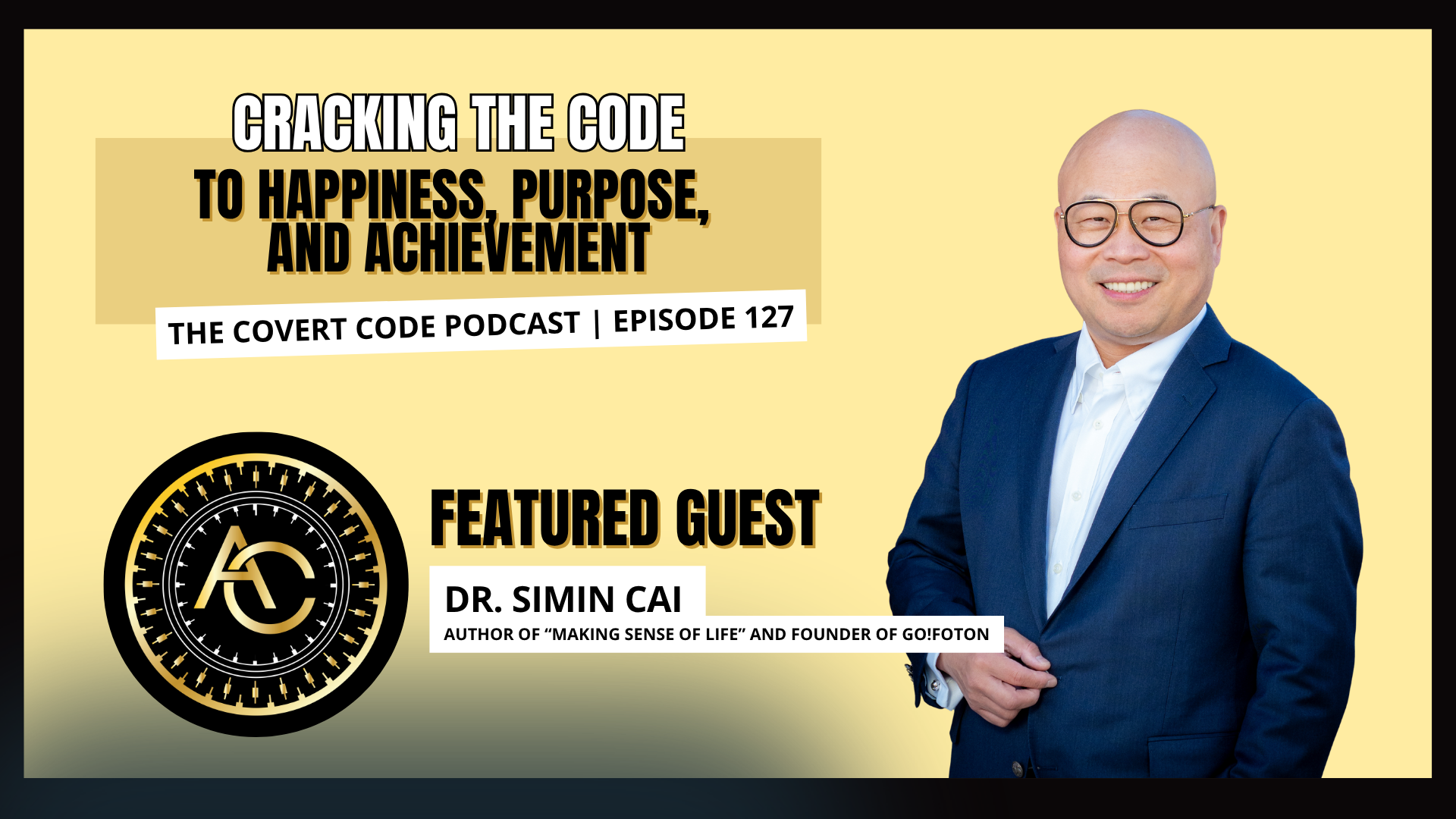
How to Be Happier While Achieving More: Making Sense of Life with Dr. Simin Cai
Featuring Dr. Simin Cai, Founder & CEO of Go!Foton, and author of Making Sense of Life
Most of us spend a significant portion of our lives pursuing two things: happiness and achievement.
We want meaningful careers, financial security, successful relationships, memorable experiences, personal growth, and the satisfaction of knowing we’re moving forward.
But somewhere along the way, many people begin treating happiness and achievement as competing priorities.
We tell ourselves we’ll be happy after we reach the next milestone.
After the promotion.
After the business succeeds.
After we make enough money.
After we finally become the person we think we’re supposed to be.
Dr. Simin Cai believes there may be another way.
In this episode of The Covert Code Podcast, Anna Covert sits down with the physicist, entrepreneur, Founder & CEO of Go!Foton, and author of Making Sense of Life: Develop Your Own Theory for Happiness and Achievement.
Their conversation explores a fascinating idea: What if we approached our lives more like scientists?
Can You Crack the Code to Your Own Life?
Dr. Cai’s career began with an interest in understanding the laws governing nature.
As a physicist, his job was to look beyond individual events and search for the underlying principles that explained why things happened.
That curiosity followed him into entrepreneurship and business leadership.
Eventually, it led him toward a much larger question.
Could the same type of thinking help us understand life?
Rather than attempting to discover one universal formula that tells everyone how to live, Dr. Cai began developing what he calls a personal theory.
It is essentially a working framework for understanding yourself, your experiences, what you value, what makes you happy, and what you want to accomplish.
Like a scientific theory, it isn’t supposed to remain frozen forever.
It evolves as new experiences give you better information.
The World and Your World Are Not the Same Thing
One of the most memorable ideas from the conversation comes from something Dr. Cai told his son when he turned thirteen.
First came the bad news:
You are not the center of the world.
The world existed before you, continues around you, and will continue without you.
Then came the good news:
You are the center of your world.
Everything you understand begins with your perspective.
Dr. Cai separates those ideas into two layers.
There is reality—the world as it actually exists.
Then there is your experience of that reality.
Your personal world is shaped by two major factors:
- What you know about something
- How you feel or judge what you know
The second component is influenced heavily by your values.
Two people can experience the same event and walk away with completely different interpretations because they possess different information, histories, desires, and value systems.
Understanding that difference can become an important part of self-awareness.
Life Is a Collection of Experiences
Dr. Cai describes life, within the scope of his book, as the collection of experiences between birth and death.
Some experiences are enjoyable.
Others aren’t.
The experiences we enjoy contribute to what we call happiness.
The things we don’t enjoy often create the motivation to change something.
When we successfully convert an idea about how something could be better into reality, that becomes an achievement.
In that sense, happiness and achievement aren’t necessarily opposites.
They are different parts of the same process.
We experience the world, determine what we prefer, make choices, change circumstances, and then learn from what happens next.
You Don’t Have to Sacrifice Happiness to Achieve More
One of the most useful ideas in this episode is also one of the simplest:
Believe that you can be happier while achieving more.
Success does not automatically require sacrificing everything that makes life enjoyable.
Likewise, prioritizing happiness does not require abandoning ambition.
The challenge is understanding what success and happiness actually mean to you instead of automatically accepting someone else’s definitions.
This connects closely with other conversations on The Covert Code Podcast about personal growth, purpose, and human experience.
In our conversation with Gideon Enok about embracing the pilgrim spirit, for example, slowing down and examining what truly matters became an important part of personal transformation.
The paths may look different, but the underlying question is similar:
Are you consciously living your life or simply moving through it?
Ask Yourself Why You Do What You Do
If someone wants to begin developing a personal theory of life, Dr. Cai recommends something surprisingly simple:
Start questioning.
Why do you do what you do?
Why do you want what you want?
Why are certain experiences satisfying while others continually frustrate you?
Those questions create distance between automatic behavior and conscious choice.
You begin moving from reacting to your life toward observing it.
And observation is the beginning of learning.
What Does Your Free Time Reveal About You?
Another practical exercise from the episode is to examine what you naturally do when nobody else controls your time.
Ask yourself:
When I genuinely have free time, where do I choose to spend it?
Your first answer may be sleep.
That could simply mean you’re exhausted.
So ask again.
What’s next?
And after that?
Look beyond the answers you think you’re supposed to give.
Observe your actual behavior.
You might discover that you naturally spend your free time reading, exercising, shopping, cooking, traveling, helping people, creating things, talking with friends, learning, building a business, watching movies, gardening, playing music, or simply sitting quietly.
There is information in those choices.
You May Not Know What Actually Makes You Happy
Most adults assume they know what makes them happy.
Dr. Cai challenges that assumption.
What we say makes us happy and what our actual behavior demonstrates may not always be the same.
That’s why he recommends observation rather than judgment.
Instead of immediately creating a list of socially acceptable answers, look at your behavior when you have freedom of choice.
Where do your attention, energy, and time naturally go?
Those patterns may reveal preferences you haven’t consciously acknowledged.
There Is No Approved Version of Happiness
Anna raises an interesting challenge during the conversation.
What about temporary sources of happiness?
Shopping, entertainment, social media, travel, or other experiences can create an immediate boost, but does that count as genuine happiness?
Dr. Cai’s answer is deliberately nonjudgmental.
If shopping genuinely makes you happy and you can responsibly support that lifestyle, enjoy it.
Eventually, you may become bored with it.
If that happens, learn something from the boredom and explore what comes next.
The purpose of his framework is not to prescribe which forms of happiness are morally or philosophically superior.
It is to help you understand your own preferences more accurately.
Your personal theory is supposed to be personal.
Experience Is an Experiment
This is where Dr. Cai’s background in physics becomes especially interesting.
Scientific discovery follows a cycle.
You conduct an experiment.
You observe what happens.
You search for patterns or structural relationships.
You develop a theory.
Then you apply that theory to future experiments to determine whether it continues to hold.
Dr. Cai believes we can use a similar approach in everyday life.
Think.
Digest.
Review.
Look for cause and effect.
Develop a working theory from the experience.
Then apply what you learned the next time a similar situation occurs.
A Theory Is Useful Because It Helps You Predict
The real value of a theory isn’t simply explaining what already happened.
It helps predict what may happen next.
If you’ve repeatedly discovered that a particular action produces a particular outcome, you can begin adjusting your future behavior.
Anna offers the simple example of arriving at work on time.
If leaving home at a certain time repeatedly results in being late because traffic is unpredictable, you eventually create a new rule:
Leave earlier.
That simple rule becomes part of your personal theory.
It helps you produce a better outcome more efficiently the next time.
But Every Theory Has Conditions
Then circumstances change.
The pandemic provided an obvious example.
A rule about commuting to the office became irrelevant when the office suddenly moved into your home.
This is why Dr. Cai emphasizes understanding the boundaries and conditions under which a personal theory works.
A belief that served you at age twenty may not serve you at forty.
A business strategy that worked five years ago may no longer make sense.
A relationship pattern that once protected you may now be limiting you.
The goal isn’t to become attached to your theories.
It’s to continually refine them.
The Road Is a Powerful Analogy for Life
Anna’s traffic example leads Dr. Cai to another observation.
Driving works because thousands of people share the same roads while simultaneously existing inside their own personal perspectives.
Every driver has assumptions about how every other driver should behave.
Problems occur when those assumptions collide.
An accident can become an unpleasant experience, but it can also provide new information.
Perhaps another driver behaves differently than you expected.
If you incorporate that information into your understanding, you may drive more defensively the next time.
Your personal theory improves.
Use Constraints to Make Better Decisions
The conversation also explores how scientific problem-solving can help with difficult decisions.
In physics, problems often begin by identifying constraints.
What conditions must be satisfied?
What variables can change?
What cannot change?
The same approach can simplify complicated personal or business problems.
Suppose you’re evaluating an employee, contractor, career opportunity, investment, or relationship.
Write down the constraints.
- What outcome is required?
- What level of quality is acceptable?
- What resources are available?
- What alternatives exist?
- What does this decision cost?
- What values cannot be compromised?
Once the constraints become visible, the problem often becomes easier to evaluate.
Hindsight Is for Improvement, Not Regret
One of Dr. Cai’s most useful comments comes while discussing decision-making.
You make the best decision you can based on the constraints and information available at that moment.
Later, with hindsight, you may discover a better option.
That’s normal.
The purpose of hindsight should be continuous improvement—not endless regret.
The new information becomes part of the theory you apply the next time.
That turns mistakes into data.
New Experiences Keep the Theory Growing
During the conversation, Anna tells Dr. Cai about lucid dreaming, something he hadn’t previously explored.
His reaction perfectly illustrates the larger philosophy behind the book.
The conversation itself became a new experience.
That experience exposed him to a new idea.
He could now choose whether to investigate it, experiment with it, enjoy it, or simply move on.
Life continually gives us new information.
The question is whether we’re paying attention.
Human Experience Becomes More Valuable in an AI World
Dr. Cai’s perspective also feels particularly relevant as technology accelerates.
His company, Go!Foton operates at the intersection of optics, photonics, communications infrastructure, and technology.
Yet his book turns attention inward toward something technology cannot define for us: what makes an individual life meaningful.
That tension appears frequently on The Covert Code.
As we discussed in our conversation about why human experiences may thrive in an AI world, increasingly powerful technology may make genuine self-awareness, human connection, experience, and purpose even more valuable.
AI can give us information.
It can’t decide what we should value.
That remains our responsibility.
Success Is Not a Destination
Perhaps the most important message in this episode is that neither happiness nor achievement needs to represent a permanent final state.
We’re continually experiencing, learning, testing, adapting, and evolving.
Something that makes you happy today may eventually stop doing so.
A goal that once felt enormously meaningful may eventually become irrelevant.
That’s not necessarily failure.
It may simply mean you’ve collected enough new experiences to update your theory.
Develop Your Own Theory of Life
There are endless books, podcasts, influencers, experts, and philosophies telling us how to be happy.
Dr. Cai proposes something different.
Don’t simply borrow someone else’s theory.
Develop your own.
Pay attention to your experiences.
Question your assumptions.
Observe where your time naturally goes.
Understand your values.
Learn from mistakes.
Identify patterns.
Test your conclusions.
And remain willing to change your theory when life gives you better information.
Perhaps making sense of life isn’t about finally discovering all the answers.
Perhaps it’s about becoming much better at asking the questions.
Watch the Full Episode
Watch the full conversation with Dr. Simin Cai on The Covert Code Podcast.
Learn more about Dr. Cai at DrSiminCai.com.
Explore Making Sense of Life: Develop Your Own Theory for Happiness and Achievement.
Connect with Dr. Cai on LinkedIn.
Learn more about Go!Foton and its work in optics, photonics, and communications technology.
Cracking the Code to Happiness, Purpose and Achievement
The Covert Code Podcast
Host: Anna Covert
Guest: Dr. Simin Cai
Book: Making Sense of Life: Develop Your Own Theory for Happiness and Achievement
Anna Covert [00:00:03]:
Aloha. My name is Anna Covert, and I'm coming to you from my battleship here on the beautiful island of Oahu.
This week on The Covert Code, the topic is Cracking the Code to Happiness, Purpose and Achievement.
My very special guest is Dr. Simin Cai, author of Making Sense of Life and Founder, President & CEO of global technology company Go!Foton.
With more than 30 years of experience as an innovator, entrepreneur, and business leader, Dr. Cai combines scientific thinking with real-world experience to explore what it really means to make the most out of life.
Today, we'll be uncovering some of those topics so you can begin developing your own theory for navigating life, redefining what success looks like for you, and creating greater happiness and a more rewarding overall life.
Thank you so much for being here, Dr. Cai.
Dr. Simin Cai [00:00:56]:
Thank you very much, Anna.
First of all, I'd like to thank you very much for having me here this evening. I very much appreciate the opportunity to make this evening an interesting part of my life journey.
Anna Covert [00:01:10]:
Thank you so much.
To kick us off, we'd like to hear the CliffsNotes version of the Dr. Cai story.
You have such an interesting background. How did you get from where you were to where you are now?
Dr. Simin Cai [00:01:23]:
It all starts with my urge to understand the laws behind things.
First, of course, it was understanding the laws behind nature. Then it became the laws behind business, and eventually it led to understanding the laws behind life.
Using your words, I basically try to crack the code.
Sometimes I call it a map. In my book, I also call it a personal theory.
That's how I started: trying to figure out the natural laws behind nature and then trying to understand the laws behind anything I deal with.
Anna Covert [00:02:14]:
Tell us a little bit about your technology company.
What does Go!Foton do?
Dr. Simin Cai [00:02:19]:
We work in fiber-optic communications.
We mainly apply photonics and optics technology to applications in the communications market and sometimes other markets, such as life sciences.
If you use fiber-to-the-home services from a carrier, you may ultimately be using products we supply to support that service.
Anna Covert [00:02:51]:
I'm sure a lot of people have had an opportunity to use technology that you've helped support because broadband is certainly the name of the game now.
It's funny because here in Hawaii we really only have a couple of major options, and it feels like every couple of years you switch back and forth depending on the rate.
Dr. Simin Cai [00:03:19]:
We're proud to help carriers deliver broadband services to consumers and enterprises.
Anna Covert [00:03:31]:
It's incredibly important.
We all remember the days of dial-up and how far away that seems now.
Today we expect everything to happen immediately.
There's actually an interesting comparison there with meaning and happiness because everything is becoming faster. Everyone is rushing to get everything done.
Tell me about the book.
Did you always plan on writing one?
What was your mission, and why did you decide to write this book now?
Dr. Simin Cai [00:04:14]:
As I mentioned earlier, I've always tried to crack the code behind anything I deal with.
To a certain level, I felt I had achieved that for my own personal journey.
I have benefited from the code I cracked, or the personal theory I developed in my own understanding.
I thought sharing that with others and helping them benefit from it would be rewarding.
That's why I wrote the book.
Anna Covert [00:05:03]:
How long have you been working on it?
Dr. Simin Cai [00:05:16]:
I've been working on it for the last two years.
I didn't have a strict deadline, so whenever I had time, because I still have a day job, I worked on it.
Eventually, I finished it.
I also received a lot of help from my publishing team, including help finding a very good writer to work with me.
That helped smooth the process.
Anna Covert [00:06:26]:
When you developed this personal theory, had you been working on the concept for a long time, or did you feel like now was an especially important time to share the message?
Dr. Simin Cai [00:06:39]:
It wasn't really about marketing timing.
It was more about where I was in my personal journey.
I had gone through this process and developed what I would call my personal framework of philosophy.
But quite frankly, with my professional credentials, I didn't think many people would necessarily read a book from me purely about philosophy.
This is also about getting what you want and achieving what you want to achieve.
It's about connecting the dots between where I am and where I want to be.
I thought applying my philosophical framework directly to life would resonate with a broader audience.
Everybody has a life.
Anna Covert [00:07:47]:
Absolutely.
Let's dive into the framework.
What can people expect when they read the book?
Dr. Simin Cai [00:07:57]:
First of all, I learned from physics.
I'll give you a summary of the framework.
When my son turned thirteen, I told him something.
First, the bad news: You are not the center of the world.
The whole world doesn't depend on you. If you're not there, the whole world is still the whole world, perhaps a little different, but still the world.
Then I told him the good news: You are the center of your world.
For you to understand the whole world, you start from where you are. The whole world surrounds you, so you are the center of your own world.
For anything and everything that comes my way, I try to understand it from those two perspectives.
For the world, it is what it is. Sometimes we call that reality.
Your world consists of two things: what you know about it and how you like it.
What you know about something relates to truth and science.
How you like it relates to your judgment.
For any judgment you make, you have a set of criteria. Sometimes we call that a value system.
The framework is about those two worlds—the world and your world.
Within your world, you try to separate what you know about something from how you feel about it.
Life is all about experience.
My scope is from birth to the end. I'm not covering the afterlife.
Anna Covert [00:10:32]:
That's your next book. That can be the sequel.
Dr. Simin Cai [00:10:35]:
I would still have to explore that because I don't have experience with it yet.
Within this period of life, it's all about experience.
Among all experiences, you can separate the ones you like from the ones you don't like.
The ones you like contribute to happiness.
The ones you don't like are things you may want to change.
When you make that change—when you take something in your world and successfully convert it into part of reality—that's achievement.
That's why the book talks about both happiness and achievement.
Anna Covert [00:11:40]:
That's interesting.
I really resonate with what you're saying.
Over the last year or two, I've become deeply invested in meditation and the transformation of the self—how we can transform or transmute things in our lives.
That transformation begins on the inside, and then the outside world can appear very different because you're looking at it through new eyes.
It becomes about what you prefer versus what you don't prefer and realizing that every experience can give you something to learn from.
Dr. Simin Cai [00:12:22]:
Exactly.
You're achieving more by converting your ideas into reality while also becoming happier.
That's the purpose of the book.
If you pay attention and understand the code behind it—using your word—or develop your personal theory or map, you can become happier while achieving more.
Or you can achieve more while becoming happier, with greater efficiency and effectiveness.
Anna Covert [00:13:02]:
That's excellent because we've all seen people who are successful but aren't happy.
Then what's the point?
If life is about experience and you've done all of this work to achieve success but you don't enjoy the experience, something is missing.
What is something listeners could do right now to begin course-correcting their map toward happiness?
Dr. Simin Cai [00:13:40]:
First, believe that you can be happier while achieving more.
Those goals don't have to conflict with one another.
There are many things you can do.
One is simply questioning.
Ask why you do what you do.
Another is trying to figure out what makes you happy.
Sometimes people say, “I don't know what makes me happy. Sometimes this makes me happy and sometimes that does.”
My suggestion is to look at what you dedicate your free time to.
Someone like me may say sleep first because I work a lot and don't get enough sleep.
But then ask: What's next?
Keep asking a little further.
Eventually, you begin to discover what makes you happy.
Anna Covert [00:15:20]:
That's important because there are so many dopamine highs, especially through social media.
There are these small experiences of micro-happiness.
You might laugh or feel better momentarily, but then it goes away.
Other people look for happiness through shopping or through finding another person or possession that they believe will make them happy.
You're talking about something more internal.
Dr. Simin Cai [00:15:53]:
Quite frankly, I'm not against the happiness someone experiences through shopping.
If that makes you happy, do it.
Some people can continue doing it.
Others may realize they need to support that lifestyle and then need to figure out how they're going to do that.
For other people, they may do it for a while and eventually become bored.
Then move on to something new.
I'm not judging what type of happiness is acceptable.
Go for whatever you genuinely feel makes you happy.
That's why my framework is personal and individually based.
You decide what makes you happy instead of letting other people decide for you.
Anna Covert [00:18:21]:
By the time someone becomes an adult, don't most people already know what makes them happy?
Is there a difference between what someone thinks they like and this deeper form of happiness?
Dr. Simin Cai [00:18:32]:
You may be surprised that what people tell you makes them happy isn't always exactly what makes them happy.
You have to explore it.
Don't simply tell yourself you already know.
There can be a difference between what something really is and what you think about it.
You can improve your understanding of what makes you happy by observing more closely.
That's why I suggest looking at where you dedicate your free time.
You may not consciously think, “I'm happy doing this.”
But unconsciously, you choose to do more of it when you have the freedom to allocate your time.
Anna Covert [00:20:13]:
What's on your personal happiness list beyond sleeping?
What did you discover while writing the book that really gets you going?
Dr. Simin Cai [00:20:24]:
Now you're getting personal.
I don't mind sharing.
Writing this book makes me happy.
Sharing something I've developed for myself and benefited from with other people makes me happy.
If our conversation gives you a new perspective or insight that helps make your life a little happier or helps you achieve more, I feel very good about that.
Anna Covert [00:21:12]:
That makes me happy too—meeting new people and getting an opportunity to share their wisdom.
I also like to sleep.
I practice lucid dreaming.
Have you ever explored lucid dreaming?
Dr. Simin Cai [00:21:31]:
I haven't explored that.
Anna Covert [00:21:34]:
It's really fun if you like sleeping.
A year ago, I could barely remember whether I'd dreamed.
After practicing and setting an intention, I can now remember three, four, or five dreams in a night.
I write them down.
Now I'm practicing lucid dreaming, where you become aware you're dreaming and can potentially take control of the experience.
Dr. Simin Cai [00:22:06]:
This itself is a new experience for me this evening.
I can explore it more.
This is what I mean when I say life is about experience.
By talking with you, I now have a new perspective and new insight that can open a door to another experience.
That's what the book is about.
Anna Covert [00:22:42]:
What's next for you with the book?
Are you planning to speak more and share this knowledge?
Dr. Simin Cai [00:22:55]:
I still have a day job, and that comes with a lot of responsibility.
I'm still passionate about that work, so fulfilling those responsibilities remains my first priority.
This is what I dedicate my free time to.
When I have free time, I like to write down what I've developed and what I've been thinking about and share it with others.
Then I'll let the experience lead me wherever it leads me.
I'm excited to be surprised by what it brings.
Anna Covert [00:23:53]:
Let's switch to achievement because you're a very successful person.
Are there daily practices or strategies from the book that listeners can apply to achieve more?
Dr. Simin Cai [00:24:18]:
Again, I go back to physics.
In physics, you conduct experiments and then try to identify structural invariance behind those experiments.
You elevate that understanding into a theory and then apply the theory back to future experiments to determine whether it holds.
The purpose of a theory is that once it holds, it gives you the capability to predict.
Learning from that, what I can share is simply to think.
Try to understand what happened.
Look for cause-and-effect logic.
Then the next time you encounter a similar experience, you can apply what you've learned to approach it more effectively.
Think, digest, and review.
Then go back to practice.
It's a cycle from experience or experiment, to personal theory, and then back to a new experience.
The purpose is improving your effectiveness and efficiency in getting what you want or becoming who you want to be.
Anna Covert [00:26:23]:
As a practical example, maybe someone has a job and realizes it's very important to arrive on time.
If they repeatedly leave home at a certain time and unexpected traffic makes them late, the experiment teaches them to leave earlier so they don't upset their boss.
Dr. Simin Cai [00:26:47]:
That's a very good example.
You learn from the experience.
If you're late once and it creates a problem, you learn that you probably shouldn't be late every day.
You should be on time.
That becomes a theory you've developed.
But the book also talks about boundaries, scope, and conditions.
The theory works under a particular set of conditions.
Then COVID happens and the condition changes.
Your theory has to be adjusted accordingly.
Driving is also a very interesting analogy.
When everyone shares the road, every person is living within his or her own world.
Every driver expects other drivers to behave according to what they believe should happen.
When those assumptions conflict, accidents can happen.
But through the accident, if you learn, you understand that other people may think differently.
You develop a better theory.
The next time you're on the road, you may be less likely to get into the same accident.
Anna Covert [00:29:09]:
That makes sense.
I actually had to terminate a contractor today who I really like personally and who had worked with my company for a long time.
I returned from a trip and reviewed some of his work.
He hadn't done several things he was supposed to do.
I put him on notice, and this wasn't the first time we'd dealt with the issue.
When I reviewed the work again, he still hadn't done the things he'd agreed to do.
It's always disappointing when people are given another opportunity and still don't choose to change.
Could that sometimes tell someone something about their own happiness?
If you're repeatedly given a clear path and still don't follow it, perhaps the job itself isn't something you want.
Dr. Simin Cai [00:30:08]:
That's right.
Try to understand the constraints.
Again, that's something I learned from physics.
When you solve problems, you start with constraints.
In your contractor example, what needs to be done?
What level of quality is required?
How many alternatives do you have?
How important is that contractor to you?
If you can itemize those constraints in your mind or write them down, you can come up with the best solution you can find at that moment.
And don't be surprised if hindsight later reveals a better solution.
That's for continuous improvement.
It's not for regret.
Anna Covert [00:31:16]:
I love that.
I release a lot of control and don't micromanage people.
We're adults, this is the job, and if there are problems, perhaps we need more training.
But if someone says they know how to do something, has demonstrated they can do it, and then repeatedly chooses not to do it, that's disappointing because other people are depending on them.
It also gives the individual information.
Maybe the work isn't something they genuinely enjoy, even if they like the money or need the job.
Dr. Simin Cai [00:32:06]:
That's right.
Anna Covert [00:32:14]:
This has been great.
How can people find your book?
Dr. Simin Cai [00:32:20]:
They can go to Amazon and search for the book's name or my name, and they'll be able to find it.
Thank you very much for asking.
Anna Covert [00:32:36]:
We're going to put a link to Making Sense of Life right below this episode.
Dr. Simin Cai is also on LinkedIn, and you can visit his personal website at DrSiminCai.com.
Thank you so much for being here today.
And to all of my listeners, thank you for joining me.
If you haven't done so yet, please subscribe to this channel.
We've just reached more than 220,000 subscribers, and I'm overwhelmed and incredibly proud of the community we've built.
It's because of you and your aloha.
Please share this content with people you think will get value from it.
I'll see you next week in the pixels.
Aloha.