The Necessary Goodbye: How Great Leaders Make Tough Decisions
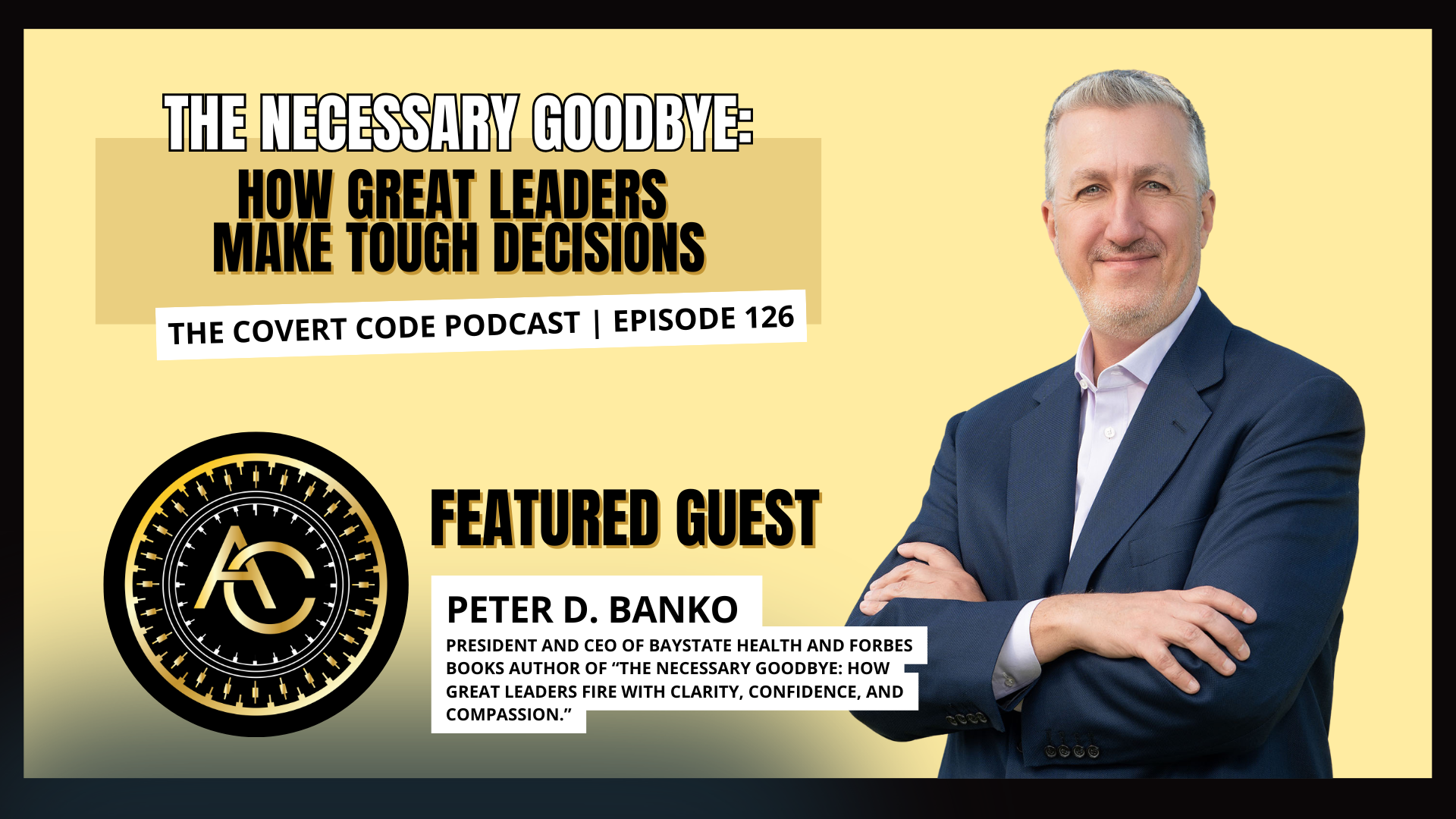
Featuring Peter D. Banko, President & CEO of Baystate Health and author of The Necessary Goodbye
Leadership is often defined by the people we hire, develop, inspire, and promote.
But some of the most consequential moments in leadership involve a very different responsibility: knowing when a working relationship needs to end.
In this episode of The Covert Code Podcast, Anna Covert sits down with Peter D. Banko, President & CEO of Baystate Health and author of The Necessary Goodbye: How Great Leaders Fire with Clarity, Confidence, and Compassion.
The conversation explores what happens before, during, and after one of leadership’s hardest decisions—and why firing someone should rarely begin with the termination itself.
The Leadership Skill Nobody Teaches
Peter’s book was approximately ten years in the making.
An executive coach first encouraged him to write about the subject after recognizing that Peter had spent much of his career building teams, leading organizational turnarounds, developing executives, and occasionally having to let people go.
The problem was obvious: leaders are expected to manage employee performance, yet most receive very little education about how to handle the moment when performance does not improve.
The first time Peter had to terminate someone, he remembers the experience as awkward.
That is hardly unusual.
New managers receive training on budgets, strategy, operations, compliance, and sometimes communication. Far fewer are taught how to sit across from another human being and tell them their employment is ending.
Peter wrote The Necessary Goodbye to help fill that gap.
The Goal Is to Avoid the Necessary Goodbye Whenever Possible
Despite the title, Peter emphasizes that much of the book is actually about preventing termination.
Good leadership begins long before an employee fails.
It begins with hiring the right person, clearly defining expectations, developing people, maintaining regular communication, providing feedback, and identifying problems early enough to correct them.
Leaders sometimes become desperate to fill a vacant position and begin evaluating candidates by whether they can simply perform the basic functions of the job.
Peter argues that leaders should slow down.
Hiring the wrong person quickly can create far more disruption than waiting for the right person.
Clear Is Kind
One idea that runs throughout the conversation is the importance of clarity.
Ambiguous feedback may feel compassionate in the moment because the leader avoids an uncomfortable conversation.
But unclear expectations leave the employee without a realistic opportunity to improve.
A leader who continually softens the message may eventually terminate someone who never fully understood that their job was at risk.
That is unfair to everyone involved.
The employee deserves to know where they stand.
The team deserves a leader willing to address performance problems.
Customers deserve an organization capable of delivering on its promises.
And the leader has a responsibility to protect the organization as a whole.
When Is Enough Enough?
One of the hardest leadership questions is deciding when continued coaching becomes avoidance.
Peter recommends asking several questions:
- Have I clearly explained what needs to change?
- Have I given the employee a reasonable opportunity to improve?
- Have I provided the support or resources they need?
- Is another leader seeing something I am missing?
- Would outside support help?
- Can this situation realistically be fixed?
Sometimes the answer is yes.
Sometimes a person needs coaching, development, mentorship, a different role, or a different environment.
But leaders eventually have to distinguish optimism from reality.
Keeping someone indefinitely in a role that does not fit them can be unhealthy for both the organization and the individual.
Leaving Can Create an Unexpected Opportunity
Peter shares the story of one termination he later regretted.
The employee was not removed for poor performance. The organization was downsizing, and a strong leader’s role was eliminated.
That individual later went on to oversee approximately twenty hospitals around the country.
Peter’s perspective changed.
Had that person remained in the original organization, they might never have found the opportunity that ultimately accelerated their career.
A necessary goodbye does not always represent failure.
Sometimes a role, organization, or relationship has simply reached its natural conclusion.
Why Leaders Wait Too Long
When Anna asks what today’s leaders are getting wrong, Peter’s answer is straightforward: many wait too long to make difficult decisions.
Leaders often confuse caring with being nice.
Those are not the same thing.
A leader can care deeply about an employee while still acknowledging that a situation is not working.
In fact, allowing a problem to deteriorate because the conversation feels uncomfortable may ultimately be less compassionate.
Leadership requires enough courage to make decisions before circumstances force them.
Annual Performance Reviews Are Not Enough
One of Peter’s most practical recommendations is to stop relying on the annual review as the primary vehicle for performance conversations.
A once-a-year conversation cannot create the level of communication required to build high-performing teams.
Peter meets with his senior leadership team frequently and recommends regular individual conversations as well.
His organization also uses a formal succession-planning process that evaluates leaders across both performance and potential.
Regular communication accomplishes something critical: when performance reaches the point where employment may need to end, the conversation should not come as a surprise.
Workplace Archetypes Can Help Leaders Understand Behavior
One of the more unusual elements of The Necessary Goodbye is Peter’s use of twelve Jungian archetypes to help leaders think about workplace behavior.
Rather than reducing employees to simple personality labels, the archetypes provide another lens for understanding how someone’s strengths can become liabilities when taken too far.
Peter discusses examples including the Lover, Caregiver, and Jester.
A caregiver may be naturally supportive, compassionate, and attentive to colleagues. Those qualities can strengthen a team.
But taken into what psychologists sometimes call the shadow side of the archetype, caregiving can become overinvolvement or behavior that interferes with healthy boundaries.
The Jester brings humor and lightness to the workplace, which can be enormously valuable.
But humor can also cross lines and become disruptive.
The point is not that one archetype is good and another is bad.
Diverse perspectives make teams stronger. Leaders need to recognize when someone’s natural strengths are enabling the team—and when those same tendencies have begun working against it.
How to Conduct a Termination Conversation
Peter recommends approaching the conversation directly.
Do not begin with ten minutes of small talk about someone’s weekend when both people know a serious conversation is about to happen.
Explain the decision clearly.
Connect it to previous conversations and expectations.
Keep the message concise.
Then allow HR to handle the administrative details involving severance, benefits, documentation, and transition logistics.
Peter also cautions against delegating the actual termination entirely to HR.
If someone reports to you, leadership requires you to have that conversation.
Why HR Should Still Be in the Room
Although the manager should deliver the message, Peter typically has an HR leader present.
There are practical reasons.
A termination conversation may suddenly reveal information the manager did not know.
Peter recalls one employee whose spouse was eight months pregnant and another whose immigration status meant immediate termination could jeopardize a visa.
Having HR involved allowed the organization to think more broadly and make accommodations that respected the individuals while still accomplishing the necessary organizational change.
Compassion does not require reversing every difficult decision.
It may mean thinking more carefully about how the decision is implemented.
Everyone Watches How You Treat the People Who Leave
One of the strongest insights from the conversation is that termination does not only affect the departing employee.
Everyone who remains is watching.
They notice whether the employee was treated respectfully.
They notice whether the company provided reasonable severance.
They notice whether leaders were present or disappeared.
They notice whether management protected the departing employee’s dignity or immediately began criticizing them.
Peter argues that organizations should sometimes pay even more attention to how people leave than how they arrive.
Those moments communicate the company’s real values more clearly than any statement printed on a wall.
Transparency Does Not Mean Sharing Everything
After an employee leaves, remaining team members naturally want to know why.
Leaders need to communicate while still protecting confidentiality.
If someone was removed for performance, behavioral, or personal reasons, the details generally should not become office conversation.
Peter recommends treating departing employees the way any leader would want to be treated themselves.
That means acknowledging the change, giving teams space to process it, explaining what can appropriately be shared, and refusing to turn a former employee’s private circumstances into gossip.
Leadership Presence Matters More After Layoffs
Layoffs and restructurings create a different challenge.
People who remain may be grieving former colleagues while simultaneously inheriting additional work.
This is the moment when leadership presence becomes especially important.
Leaders need to remain visible and available.
Teams need time to ask questions, process what happened, and understand what comes next.
A reduction in workforce cannot simply be announced and forgotten.
Trust is rebuilt through what leaders do afterward.
AI Is Changing Healthcare—and Hiring
The episode also explores the growing influence of artificial intelligence.
Peter explains that Baystate Health is implementing technology with embedded AI and has already introduced tools such as ambient listening for physicians.
One physician told him the technology had essentially eliminated the after-hours documentation often referred to as “pajama time” while allowing the physician to see additional patients.
AI is also accelerating research. According to one academic researcher Peter references, work that previously took a month can now sometimes be accomplished in a day.
But AI is producing challenges elsewhere.
Automated resume-screening systems can reject qualified applicants before a human ever sees them.
Peter has personally encountered situations where someone appeared clearly qualified after reviewing their resume even though an automated screening process had previously eliminated them.
The lesson is similar to many conversations on The Covert Code Podcast: technology can create enormous efficiency, but leaders still need human judgment.
Connection Still Matters
Despite advances in remote work and AI, Peter believes people continue to seek genuine human connection.
When he asked employees what they wanted from the culture at Baystate Health, connection emerged as a major theme.
Employees wanted to be trusted partners.
They wanted to feel part of something larger than themselves.
Some jobs perform extremely well remotely, and Peter notes that certain teams have become both happier and more productive from home.
But other roles benefit from proximity.
Sometimes the fastest way to solve a problem is still to walk down the hall and talk to another person.
The Necessary Goodbye Is Really About Better Leadership
The title may focus on firing, but the deeper message of Peter’s book is about building stronger teams.
Hire carefully.
Set expectations clearly.
Develop people.
Talk frequently.
Address problems while they can still be corrected.
Get help when you need it.
And when a relationship can no longer work, have enough clarity and courage to acknowledge it.
Great leadership is not measured only by how enthusiastically we welcome people onto the team.
Sometimes it is measured by how thoughtfully we help them leave.
Watch the Full Episode
Watch the full conversation with Peter D. Banko on The Covert Code Podcast.
Learn more about Peter at PeterDBanko.com, connect with him on LinkedIn, and learn more about The Necessary Goodbye from Forbes Books.
🎧 LISTEN ON ALL PLATFORMS:
Spotify: https://open.spotify.com/show/0UcnL4g4J2DckqMpZg4DdB?si=NKAFJcRMSdOJlP5iebBxoA&nd=1&dlsi=50d6d5c5753a499b
Apple Podcasts: https://podcasts.apple.com/us/podcast/the-covert-code/id1733326615
Amazon Music: https://music.amazon.com/podcasts/d15bb709-a4df-43bb-9284-9e479c8574a7/the-covert-code
iHeart Radio: https://www.iheart.com/podcast/269-the-covert-code-269144900/
YouTube Music: https://music.youtube.com/channel/UCSU2Anqu1_yzb_D6IFd7i_Q
🌐 FOLLOW THE COVERT CODE:
Website: https://thecovertcode.com/
Instagram: https://www.instagram.com/covertcodeofficial
Facebook: https://www.facebook.com/thecovertcode
LinkedIn: https://www.linkedin.com/company/covert-code-official/
📚 ABOUT HOST ANNA COVERT:
Anna Covert is the host of The Covert Code Podcast and the author of The Covert Code—Mastering the Art of Digital Marketing and The Solar Coaster. With over two decades of experience in digital marketing and business strategy, Anna has worked with top-tier companies like Microsoft, Apple, and IBM and leads Covert Communication, Hawaii’s largest digital agency.
ANNA’S WEBSITES:
The Covert Code: https://thecovertcode.com/
Anna Covert: https://annacovert.com/
Covert Communication: https://covertcommunication.com/
Reactium: https://reactium.io/
⚠️ Affiliate Disclosure: Some links included may be affiliate links, which means we may earn a commission if you choose to make a purchase through them at no additional cost to you.
The Necessary Goodbye: How Great Leaders Make Tough Decisions
The Covert Code Podcast
Host: Anna Covert
Guest: Peter D. Banko
Book: The Necessary Goodbye: How Great Leaders Fire with Clarity, Confidence, and Compassion
Anna Covert [00:00:03]:
Aloha. My name is Anna Covert, and I'm coming to you from my battleship here on the beautiful island of Oahu.
This week on The Covert Code, the topic is The Necessary Goodbye: How Great Leaders Make Tough Decisions.
My very special guest is Peter D. Banko, President & CEO of Baystate Health and Forbes Books author of the bestselling title The Necessary Goodbye: How Great Leaders Fire with Clarity, Confidence, and Compassion.
With more than 40 years of healthcare leadership experience, Peter has helped transform organizations by putting people and purpose first.
Today, we'll be discussing how leaders can address underperformance, make tough decisions with compassion, and maintain trust through corporate change.
Thanks so much for being here today, Peter.
Peter D. Banko [00:00:50]:
Thank you, Anna. Thanks for having me.
Anna Covert [00:00:51]:
To begin, we like to have a little CliffsNotes version of the Peter story.
Tell us how you got to where you are right now and what you think is important for our listeners to know about you. Then we'll jump in.
Peter D. Banko [00:01:02]:
I started working in a hospital while I was in high school.
I originally volunteered to meet girls because I attended an all-boys Catholic high school.
I didn't get any dates out of it, but I did have a CEO—a nun named Sister Marie—take me under her wing.
In the middle of my college career, when I was debating what I wanted to do, she brought me into her office and told me she thought I had a knack for healthcare leadership.
I charted a course from there, and the rest is history.
Anna Covert [00:01:41]:
Tell us a little bit about Baystate Health.
Peter D. Banko [00:01:43]:
Baystate Health is an academic safety-net health system in Western Massachusetts.
As I like to say, if we don't do it, nobody else does.
We have an academic medical center and train medical students through UMass Chan School of Medicine.
We have more than 400 residents, interns, and fellows.
We're also the safety-net provider. Approximately 70 percent of our patients are Medicare or Medicaid.
We've been around for approximately 140 years and began with a doctor working from a house just north of our current main campus.
We have five hospitals and are preparing to add another facility.
We have more than 1,300 physicians and providers, most of whom are employed through our academic practice.
We also own our own health plan, so we're truly integrated.
We're able to insure people and then care for most, if not all, of their healthcare needs.
Anna Covert [00:02:45]:
It's somewhat similar to the Kaiser Permanente model, where the doctors and the system are connected.
I did some consulting work for them and was always impressed with the level of coordination.
In traditional healthcare, patients are often referred from one place to another without the same level of integration.
In an integrated system, physicians can work more collaboratively around the patient's care.
Peter D. Banko [00:03:07]:
Most of our patients aren't in our health plan, but the physicians, health plan, hospitals, and care settings are integrated.
That allows us to focus on doing the right things for quality, safety, patient experience, and hopefully affordability as well.
Anna Covert [00:03:23]:
Are you seeing major changes with AI?
I think healthcare may be one of the biggest opportunities for AI, especially when it comes to efficiency.
Peter D. Banko [00:03:30]:
We're in the process of converting to an Oracle platform with significant embedded AI.
We've already implemented some AI tools, such as ambient listening.
Primary care physicians spend a lot of what they call "pajama time," documenting charts at night from home.
One of my primary care physicians told me he doesn't have pajama time anymore because of the technology.
He's also able to see two additional patients.
He joked that the problem is that his wife is also a physician and isn't using the tools yet, so now she's sitting there documenting while he's sitting there watching her.
AI has the opportunity to complement healthcare.
I don't believe it's going to replace doctors, nurses, or the work they do, but it can help them become more effective.
Anna Covert [00:04:23]:
I think another opportunity is cross-referencing information globally.
A physician can do the best possible job, but every individual is ultimately limited by the knowledge they personally have access to.
Peter D. Banko [00:04:39]:
One of our academic researchers told me research that used to take him a month to complete can now sometimes be completed in a day.
Anna Covert [00:04:48]:
That's amazing, and it will probably become even faster.
Tell me the story behind your book.
People always ask me why I decided to write a book, so I'll throw that question back to you.
Had you been working on it for a long time?
Peter D. Banko [00:05:04]:
It was about ten years in the making.
My executive coach told me that I'd spent much of my career doing turnarounds, building strong teams, and occasionally having to let people go.
He suggested that I write a book about it because firing isn't really taught in school, and it isn't taught very well on the job.
I remember the first time I had to let someone go. It was rather awkward.
We're also seeing significant problems with workforce engagement.
Engagement in the American workforce is at a very low point.
There are large numbers of employees who describe themselves as disengaged, and a significant number of workers describe their work experience as miserable.
Because of that, many people are either watching for or actively seeking new jobs.
It felt like there was an opportunity to help leaders think more carefully about how they hire, develop, and ultimately make decisions about people.
People frequently leave their boss or their team rather than the organization itself.
When toxicity exists on a team or with a boss, employees often leave those individuals rather than the company.
Anna Covert [00:06:25]:
Those statistics are shocking.
Peter D. Banko [00:06:29]:
As a leader, it's devastating to think that such a significant percentage of the people working for organizations may want to leave.
Anna Covert [00:06:45]:
It also makes me think about the movement toward flexible work, remote work, and unlimited PTO.
When I first heard about unlimited PTO, I couldn't understand the concept.
Younger employees increasingly expect flexibility, and COVID probably accelerated that shift.
Are these workplace attitudes appearing across age groups, or are there clusters of different behavior?
Peter D. Banko [00:07:20]:
I do a video blog for our approximately 13,000 people.
I once asked them what they wanted from Baystate Health.
From a culture perspective, the most common response was connection.
People wanted to be trusted partners. They wanted to be viewed as trusted partners and feel part of something bigger.
It's difficult to create that connection when everyone is working from home.
I'm somewhat old-school about this.
There are positions where remote work makes sense and will stay remote.
For example, many of our billing and collections employees work from home, and we're finding they're both happier and more productive.
But we've also brought many functions back.
People complained initially, but after about a month someone told me, "Now I can solve a problem by walking down the hall instead of scheduling a Zoom meeting."
It's part of human nature to seek connection.
I think we'll see the pendulum swing back somewhat because people want to be part of something bigger.
Anna Covert [00:08:48]:
I think that's especially true now because so much of life takes place online.
Social media originally made us feel as if we had more friends, but in many ways it has become an antisocial network.
People scroll endlessly without really knowing one another and can end up feeling even more isolated.
Let's talk about the book.
What frameworks or techniques do you recommend for firing with confidence, clarity, and compassion?
Peter D. Banko [00:09:39]:
Much of the book is actually about not getting to that point.
You need to hire correctly.
My oldest son is in his first management job, and he told me he was just looking for people who would show up to work.
I told him he needed to look for more than a pulse.
It's okay to go slowly when hiring.
Make sure you're bringing the right person onboard.
Then spend time developing and nurturing that person.
I structured the book around twelve Jungian archetypes as a tool for thinking about people.
You can look at what works when someone is functioning well and what happens when their shadow side emerges and becomes unproductive.
More of the book is about getting things right before you have to make the termination decision.
But ultimately, when things aren't working and you've done everything you reasonably can, you have to be clear and make the move.
It's not healthy for the leader or the employee to remain indefinitely in a relationship that isn't working.
The decision is also bigger than either individual. It's about the organization as a whole.
Anna Covert [00:11:07]:
And the clients too.
I recently made some significant changes at my agency involving people who had been with us for a long time.
Things had changed and evolved, and I knew the energy wasn't right anymore.
It also wasn't right for the client.
Those decisions are hard, but sometimes you know they have to happen.
How do you know when enough is enough? How long should leaders wait?
Peter D. Banko [00:11:38]:
One thing to remember is that it's business, not personal.
I had a boss early in my career who told me he once had to fire his stepfather.
He warned me that someday I might have to fire someone close to me.
Ten or fifteen years later, I had someone working for me whose spouse was friends with my wife and whose oldest son was friends with my son.
That person was taking money from the company.
Regardless of the friendship, there are lines you have to draw.
The decision ended not only the professional relationship but also affected the relationships between our families.
Those are difficult situations.
It's important to ask yourself the right questions.
Have I done everything possible to turn this around?
What more can I do?
Do I need outside help?
Sometimes I've asked another member of my leadership team or my chief people officer to help me see something I may be missing.
Ultimately, you have to determine whether the situation can be fixed.
There's one person I let go whom I later regretted losing.
It wasn't related to a turnaround or poor performance. We had to downsize.
That person was a good leader who got caught in the reduction.
Today, that individual oversees approximately twenty hospitals around the country.
Had I not let that person go, they may have remained stuck in that original organization.
The experience freed up their future in a way that ultimately allowed them to do more.
Sometimes leaving is healthier for the individual too.
I've also personally reached points where I no longer fit an organization.
A mentor early in my career told me I'd know when it was time to leave.
I was 24 and didn't understand what he meant.
With time and experience, you begin to understand that sometimes your time in a particular place has simply ended.
Unfortunately, many people remain longer than they should because change is frightening.
Anna Covert [00:14:21]:
In advertising, changing jobs used to be almost the only way to grow.
It was often how you earned more money, more respect, and a higher title.
Do you think that's true in other industries?
Peter D. Banko [00:14:32]:
Leadership can work the same way.
My children ask where we're from or where our home is, and I tell them it can be wherever they want it to be.
To move up and do more, you often have to move or change organizations.
I was fortunate to work for one organization for seventeen years while holding four different jobs, but that's increasingly unusual today.
Anna Covert [00:14:55]:
There can be benefits to experiencing different jobs.
Before starting Covert Communication, I had a business partner for six and a half years and handled nearly every aspect of the business.
That later helped me when I started hiring people because I understood what each job actually involved.
That's another important element of leadership: knowing enough about the work to understand what's really happening.
Peter D. Banko [00:15:28]:
I was recently walking out of the office and one of our young security guards, who's attending college, asked me how I got to where I am.
I jokingly told him it was luck.
Then I explained that every experience built on the previous one.
I was once a patient transporter and worked as a nursing aide.
You learn the business from the ground up.
Later, when someone sits in a meeting and tells you how something works, you can sometimes say, "Wait a second. I actually did that job. That's not really how it works."
Anna Covert [00:15:59]:
What do you think leaders are getting wrong right now?
Peter D. Banko [00:16:14]:
I think many leaders take too long to make tough decisions.
That can apply to people or larger organizational decisions.
I was recently asked to comment on a company that reduced part of its workforce even though it was performing well financially and continuing to grow revenue.
My reaction was that they were willing to make difficult decisions before they were forced to.
I admire that.
Many organizations and CEOs aren't bold or courageous enough to act from a position of strength.
I think we sometimes confuse caring with being nice.
If you care enough, you won't simply allow problems to fester and become worse.
Leaders need enough courage to make decisions before circumstances force them.
Anna Covert [00:17:57]:
What practical steps can leaders take before termination becomes necessary?
Peter D. Banko [00:18:07]:
One mistake is relying on annual performance reviews to have important conversations.
That's not the right time or place, and frankly, many annual review processes aren't very effective.
Leaders should have regular meetings with their teams.
I meet with my senior team frequently, including significant blocks of time each month.
The more time people spend together, the more trust they can build.
Individual meetings are also important.
For newer leaders, I may meet with them every two weeks.
We use a formal succession-planning process in which we evaluate leaders based on performance and potential.
We also use a nine-box framework.
These tools allow leaders to have candid conversations along the way.
By the time a situation reaches the point where it's no longer working, the decision should not surprise either person.
Anna Covert [00:19:32]:
Those are good tips.
Large organizations have more structure, but most American businesses are small businesses with fewer than twenty employees.
Does the experience change in a smaller company?
Peter D. Banko [00:19:53]:
I actually think entrepreneurs and smaller organizations sometimes handle these issues better than large companies.
For an entrepreneur, your paycheck is directly connected to whether customers remain, whether the business grows or shrinks, and whether employees perform.
In a large organization, executives may still receive salaries even when things don't go well.
Entrepreneurs often feel the consequences much more directly.
Sports teams are another example.
A friend of mine played in the NFL and explained that professional sports teams don't tolerate consistently poor behavior or performance.
If you're toxic in the locker room, eventually the team has to deal with it regardless of who you are.
Large employers are sometimes more willing to look the other way for too long.
Anna Covert [00:21:16]:
That makes sense.
Sometimes people only begin caring when they're forced to cover for the underperforming employee or work longer because the work isn't being done.
Peter D. Banko [00:21:28]:
Exactly.
My niece is in her first management job and told me she had someone who hadn't performed well for two years.
She worried about who would do that person's work if they left.
I told her that she and everyone else were already doing the person's work.
Sometimes it can actually be better not to have someone there because their presence creates more problems than value.
Anna Covert [00:21:53]:
Let's talk about the archetypes.
Can you give us some examples and explain how leaders can use them to identify opportunities or performance gaps?
Peter D. Banko [00:22:10]:
The first archetype I discuss is the Lover.
In large organizations, you're inevitably going to encounter people dealing with substance abuse, relationship problems, and other personal issues.
Those are areas where leaders should not attempt to become therapists or experts themselves.
You need HR, legal support, and appropriate outside resources.
If someone has a substance abuse issue, it's important to help them get support while also taking appropriate organizational action.
Mental-health issues require particular care because leaders need to understand the boundaries of what they should and should not address themselves.
Another archetype is the Caregiver.
My wife and youngest son fit that archetype.
Complete strangers will tell my wife their life story within ten minutes because she is naturally wired that way.
Caregivers are excellent at helping teammates, peers, and employees.
But sometimes that caregiving tendency becomes unhealthy or crosses boundaries.
Another is the Jester.
Royal courts have had jesters throughout history for a reason.
It's important to have people at work who bring playfulness and lightheartedness.
But sometimes humor crosses lines or moves into places that aren't helpful.
All twelve Jungian archetypes contribute different perspectives that can strengthen a team.
When operating at their best, they're enabling.
But occasionally the shadow side emerges and becomes unproductive.
Leaders need to address that early.
If it moves beyond what can reasonably be corrected, that's when the necessary goodbye may become appropriate.
Anna Covert [00:25:38]:
I like that framework because it's very visual.
I can picture all of the archetypes almost like characters in a court and imagine how they work together.
Peter D. Banko [00:25:51]:
I've also used spirit animals with previous teams as another type of archetype exercise.
My primary one is the giraffe because it's visionary.
When I'm not operating at my best, I'm more like a goose—pecking at people—which isn't helpful to me or the team.
Understanding those patterns is useful.
In the book, I use examples from literature, movies, and television to help people visualize the archetypes and understand when the behavior is working and when it isn't.
Anna Covert [00:27:22]:
Is there a test someone can take to identify their archetype?
Peter D. Banko [00:27:25]:
There are tests available online. Search for Jungian archetypes and you'll find assessments.
I think identifying your own archetype is an important part of the journey.
Anna Covert [00:27:30]:
What is the right way to terminate someone?
What tips would you give leaders?
Peter D. Banko [00:27:46]:
One of the best examples is in the movie Moneyball.
The basic takeaway is that we're all adults and professionals.
We deal with bad news in our personal lives all the time.
Don't walk into a termination conversation and begin with small talk about someone's weekend.
Get to the matter at hand.
Reference the conversations you've had in the past and explain how those discussions have led to this step.
Deliver the message clearly and concisely.
I recently had to tell two internal candidates that they didn't get a key senior executive job.
In some ways, that conversation felt almost worse than firing someone because they're both highly skilled leaders.
But the approach is similar: get to the point clearly.
Termination conversations should also be relatively short.
Then hand the administrative process over to HR so they can discuss severance, benefits, and other issues.
The biggest mistake I see is managers asking HR to conduct the termination for them.
If the person works for you, that's your conversation to have.
Don't place that responsibility entirely on HR.
Anna Covert [00:29:29]:
What are your thoughts about having another person present?
I now generally have someone else involved whenever I have a particularly sensitive employee discussion.
Peter D. Banko [00:29:54]:
I always have someone from HR with me.
It also allows for a warm handoff afterward.
Having HR present can be extremely important because employees may share information during the conversation that the manager didn't previously know.
I once had to downsize a department.
One employee revealed that his wife was eight months pregnant, which nobody knew.
We were able to work with HR and make accommodations, extend the transition period, and try to help him find something.
Another employee was an immigrant who would have lost their visa if we immediately terminated them.
That wasn't fully visible to either HR or me before the conversation.
We were able to keep the person employed for another six months while they transitioned to another job.
They ultimately found another employer during that period.
Having another knowledgeable person in the room matters because unexpected circumstances can emerge that require broader thinking.
I generally have my chief people officer with me during those discussions.
Anna Covert [00:31:16]:
After significant layoffs or the departure of a key team member, how do you maintain motivation and trust?
Peter D. Banko [00:31:35]:
You need to be transparent, but there are limits.
If someone is terminated for cause, you can't share the private details with the team.
No one needs to know that the person wasn't performing, had behavioral problems, or was dealing with another confidential matter.
You need to remain respectful to the people leaving the organization.
That's difficult because people naturally fill in the blanks.
But it's how we would want to be treated if we left.
I always say it's extremely important to treat people leaving well because everyone watches how you handle those moments.
Did you take care of them?
Did you provide reasonable severance?
No one should lose their home, family security, or car because the organization needed to make a restructuring decision if there are reasonable ways to support the transition.
After layoffs or a significant departure, leaders need to become more present and available.
If a senior-team member leaves, I gather the senior team immediately afterward and talk with them.
I acknowledge positive things about the departing person where appropriate.
I may also leave the room and give the team time and space to process the change together.
Not everyone processes change immediately.
After downsizing, leadership presence becomes even more important because the remaining employees may have to do more with fewer resources.
Externally, leaders also need to think carefully about what information is shared publicly.
I used to believe extreme transparency was almost always preferable.
Today, I'm somewhat more cautious because public information can be interpreted or amplified in ways leaders didn't intend.
Anna Covert [00:34:40]:
I think AI makes that even more complicated.
A statement can be pulled into an AI system, stripped of context, and suddenly interpreted as evidence that a company is failing.
Peter D. Banko [00:34:59]:
We've experienced that.
During an acquisition, organizations make filings with state and federal agencies.
AI can pull information from those filings without understanding the full context or story.
In situations like that, AI isn't always helpful.
Anna Covert [00:35:18]:
Privacy and employee data create additional concerns.
In Europe and other jurisdictions, there are strict rules about what employee information companies can retain and what happens to that information when someone leaves.
Organizations also need to be careful about collecting sensitive information involving ethnicity, religion, relationships, medical information, and other protected categories.
Even interview notes can become relevant if a rejected candidate later alleges discrimination.
Peter D. Banko [00:36:25]:
Another challenge is that it can be very difficult to learn why someone left a previous job.
I once joined an organization and inherited an excellent leader.
We eventually promoted the person.
After the promotion, someone came forward and told us the individual had previously been convicted of a felony and served time for conduct related to their job.
That information hadn't been disclosed and hadn't appeared in the background check.
We ultimately had to let an otherwise capable leader go because the information had been falsified.
Reference calls can also be difficult because employers are often cautious about how much they can legally disclose.
On the other hand, leaders should still build teams with diverse perspectives.
Diversity of thought and experience makes teams stronger and makes me a better leader.
But hiring organizations also face limits in how much they can learn about problems that occurred in someone's previous employment.
Anna Covert [00:38:19]:
I've heard from several guests that hiring cycles are becoming significantly longer.
Executive hiring that once took a few months can now take nine months or even a year.
People apply repeatedly, go through multiple interviews, and still don't get the position.
At what point do candidates become discouraged and step out of the market entirely?
Peter D. Banko [00:39:05]:
Two of my children recently earned master's degrees, and it was difficult for them to find jobs.
It's a challenging job market.
I don't think AI is always serving applicants well.
AI screens resumes and can eliminate people.
I've had people inside our organization tell me that a neighbor applied for a position and was told they weren't qualified.
Then I reviewed the resume and thought the person was clearly qualified.
The screening process had removed them.
It's difficult for young people coming out of college or graduate school to find their first jobs.
I tell my children to get that first opportunity, do a good job, and use it to build the next one.
Executive hiring is taking longer too.
It used to be possible to run a search, interview several candidates, and fill a senior role in less than six months.
I'm finding that it's taking longer now.
Perhaps candidates are remaining in their current roles longer, maybe applicant pools aren't as strong, or perhaps leaders have simply become better at avoiding rushed decisions.
Whatever the cause, finding the right people is taking longer.
Anna Covert [00:40:39]:
That connects with conversations I've had with guests like Gina Riley, author of Qualified Isn't Enough.
Young people need to become visible beyond simply submitting something on LinkedIn.
Attend networking events.
Volunteer.
Meet people in person.
Walk into an office.
Make yourself visible beyond the online application.
Peter D. Banko [00:41:18]:
I tell my middle son something similar.
He once told me he'd sent one resume.
I told him that's great, but he probably needed to send another twenty-four.
It's a numbers game.
You have to network.
It can't all happen through email or LinkedIn.
You need to get your name out there and create enough opportunities for something to land.
Anna Covert [00:41:47]:
What's next for you now that the book is out?
Peter D. Banko [00:41:55]:
I'd like to write another book.
One possibility would focus on what it's actually like to be a CEO because I think it's one of the most misunderstood and lonely jobs.
Another would focus on turnarounds.
I've been doing turnarounds for approximately twenty years, and there's a lot people misunderstand about what a true organizational turnaround requires.
I call it a special kind of crazy.
I've worked in healthcare since 1984, after my junior year of high school.
I tell people I don't really know how to do anything else, so I'll probably keep doing healthcare.
I think we have tremendous opportunities in this country to make healthcare more accessible and affordable.
At this point in my career, I'm less interested in simply building more buildings or creating programs that people may or may not use.
I want the last part of my career to focus on making healthcare more accessible and affordable.
Anna Covert [00:43:00]:
That's a wonderful mission.
How can people find your book?
Peter D. Banko [00:43:08]:
The Necessary Goodbye is available through major booksellers, including Amazon, Target, and Barnes & Noble.
People can also find information about me and the book online.
The book is also available in selected airport bookstores through the end of August.
Anna Covert [00:43:26]:
When my first book launched, I remember seeing it in an airport for the first time.
That was such a wonderful feeling.
Peter D. Banko [00:43:36]:
We've done some weekend travel, so I've actually gone into airport stores and personally signed copies.
If you're in Denver, Newark, Orlando, or possibly some of the other locations, there may be signed books.
I've also had friends find the book in airports and send me pictures.
My cousin saw it in Phoenix.
It's very cool.
Anna Covert [00:44:00]:
We'll put all of the book links below this episode.
Thank you so much for being here.
And to everyone listening, if you haven't yet subscribed to the podcast, please do so.
We've now reached more than 220,000 subscribers, and that's because of you and your aloha.
If you love this content, like it, subscribe, and share it with people who will get value from it so I can continue attracting wonderful guests like Peter to share their wisdom with us.
I can't wait to see you next week in the pixels.
Aloha.