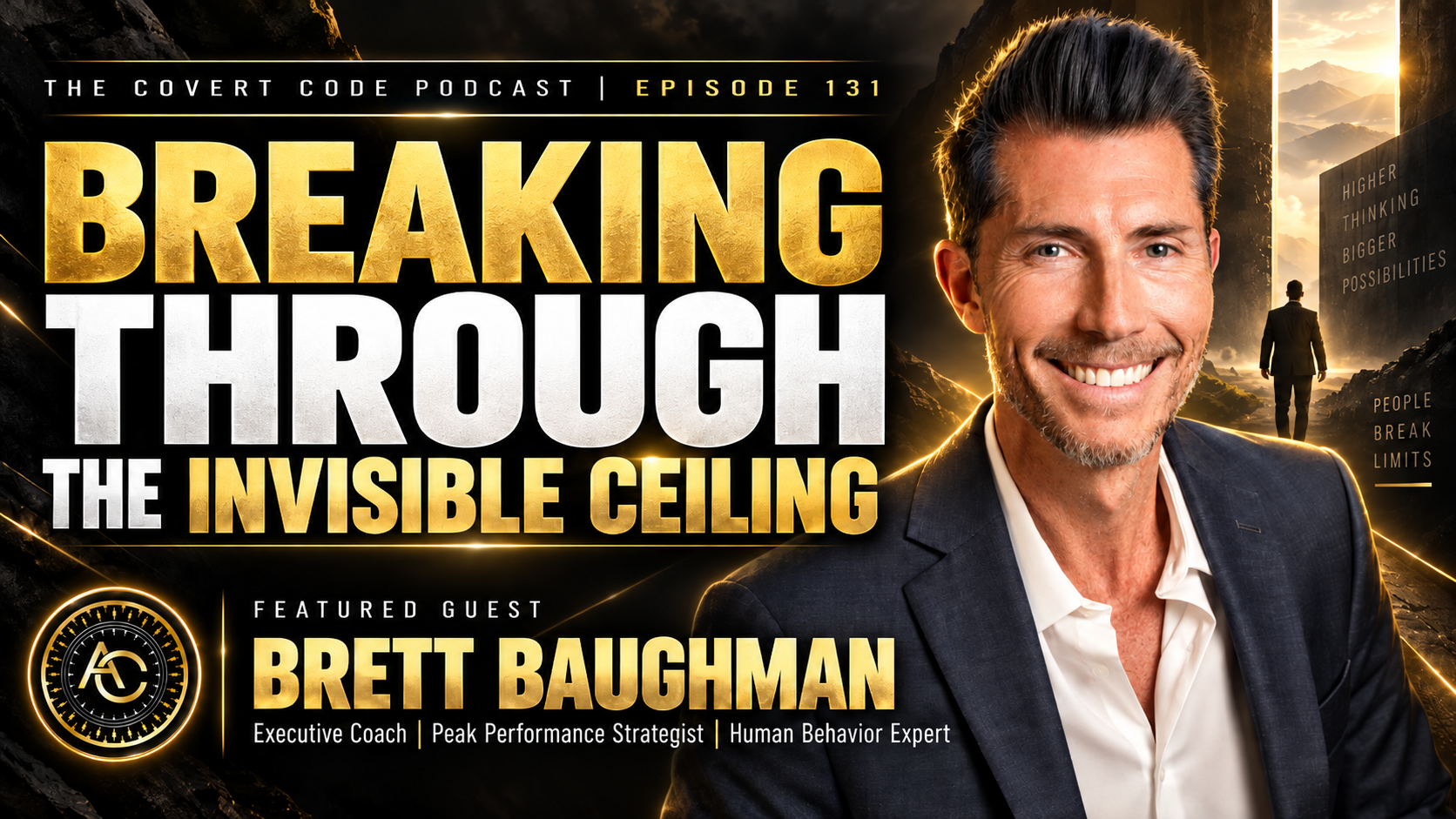
Breaking Through the Invisible Ceiling: What’s Really Holding You Back with Brett Baughman
Featuring Brett Baughman, Executive Coach, Peak-Performance Strategist and Human Behavioral Expert
Success creates opportunities.
But success can also create limitations.
The strategies that got you here worked. Your instincts were right. Your decisions produced results. Eventually, though, something changes.
You keep doing what has always worked—and suddenly it isn’t working anymore.
That’s what Brett Baughman calls the Invisible Ceiling.
In this episode of The Covert Code Podcast, Anna Covert sits down with Brett to explore limiting beliefs, Neuro-Linguistic Programming, leadership, artificial intelligence, delegation, balance, breathwork and the internal patterns that can quietly prevent high performers from reaching their next level.
What Is the Invisible Ceiling?
Most of Brett’s clients aren’t struggling because they don’t know how to succeed.
They’re already successful.
They’re executives, entrepreneurs and high performers who have built careers, teams and businesses.
The challenge appears when they reach a level where the strategies that got them there stop producing the same results.
Sometimes the ceiling comes from fear.
Sometimes it comes from limiting beliefs or stories inherited from childhood.
But Brett points out that success itself can create a ceiling.
Become good enough at something and eventually people stop questioning you. You’re the boss. You’re the expert. Everyone assumes you know the answer.
Without outside perspectives challenging your assumptions, confidence can slowly become rigidity.
And rigidity can become a ceiling.
Brett explores this idea further in his article The Invisible Ceiling: Why Your Success Is Limiting Your Next Level.
How NLP Can Help Reveal Hidden Patterns
Brett’s journey into human behavior began long before he called himself a coach.
As a young actor and musician, he became fascinated by why people behaved the way they did. Later, while building sales teams and managing businesses, that fascination evolved into studying psychology and eventually Neuro-Linguistic Programming, or NLP.
NLP gave Brett a framework for examining how thoughts, internal images, language and learned behaviors influence the actions we take.
Instead of simply asking what is wrong, Brett looks for the process underneath the behavior.
Where does the thought begin?
What picture appears in your mind?
What do you tell yourself?
What emotion follows?
And what behavior does that produce?
Once the process becomes visible, it can become easier to challenge.
The Stories We Inherit Can Become Our Reality
Consider money.
If you grew up repeatedly hearing that money is difficult to earn, there is never enough, or successful people must struggle, those ideas can quietly become part of your internal narrative.
Eventually you aren’t consciously deciding to believe them.
They’re simply there.
The same thing can happen with relationships, leadership, self-worth and success.
Breaking through a ceiling often begins by identifying which beliefs are actually yours—and which ones you’ve simply been carrying for years.
Your Business Problem May Actually Be a Leadership Problem
When something stops working, leaders frequently respond by doing more.
More meetings.
More marketing.
More technology.
More products.
More involvement.
Brett recommends stepping back first.
Ask three questions:
- What’s the plan?
- What am I delegating?
- Have I properly trained the people responsible?
Many executives unknowingly become the bottleneck inside their own organization.
Every decision runs through them.
They don’t trust anyone else to perform certain responsibilities correctly, so they keep taking the work back.
The result is frustration for the leader and limited development for the team.
AI Can Become Another Yes-Man
The conversation takes an especially interesting turn when Anna and Brett discuss artificial intelligence.
AI can be an extraordinary collaborator.
It can also become an echo chamber.
If you continually ask an AI system questions from your existing perspective, it can reinforce the assumptions you already hold.
Brett intentionally instructs AI not to simply agree with him.
He wants options rather than commands.
He wants research rather than authorship.
He wants AI to help expand his ideas—not replace his own thinking.
It’s an important distinction as businesses race to incorporate AI into nearly every part of their operations.
Don’t Automate a Mess
Brett sees another problem emerging as organizations adopt AI.
Companies feel pressure to automate simply because everyone else is automating.
But technology layered over a broken process doesn’t necessarily fix the process.
Before adding another platform, system or AI tool, leaders should examine what’s already happening.
Is the marketing working?
Are the right people in the right positions?
Are product lines profitable?
Are inefficient processes consuming resources?
Sometimes the fastest way to grow isn’t adding something.
It’s removing something.
Efficiency Begins With Subtraction
We’re conditioned to associate growth with more.
More revenue requires more products.
More success requires more hours.
More scale requires more people.
Brett frequently starts somewhere else:
What can we eliminate?
Where is time being wasted?
Where is energy disappearing?
Which responsibilities shouldn’t be yours anymore?
Removing noise can create room for the work that actually moves the business forward.
Who Are You Without Your Business?
Entrepreneurs often ask:
Who is the business without me?
Brett flips the question:
Who are you without the business?
That’s a much harder question.
When identity becomes completely intertwined with a company, every problem inside the organization becomes personal.
Leaders become reactive.
They micromanage.
They stop seeing possibilities beyond the immediate problem.
Stepping outside that identity creates room to think about something bigger: purpose, impact and legacy.
Presence Is a Performance Strategy
High performers are often physically present while mentally somewhere else.
They’re at work thinking about home.
Then they’re home thinking about work.
The result is that they’re never completely present for either.
Brett compares it to an Olympic athlete standing at the starting line thinking about Christmas gifts.
Peak performance requires presence.
Whether you’re leading a meeting, making a major decision or spending time with your family, your ability to fully inhabit that moment changes the quality of the experience.
A Simple Breathwork Reset
One of Brett’s primary tools for returning to the present is breathwork.
He recommends starting with something incredibly simple:
Inhale for four seconds. Hold for two. Exhale for six.
Repeat the process for a few minutes.
Brett also encourages clients to schedule check-ins throughout the day.
When the reminder goes off, stop.
Breathe.
Then ask yourself:
How did I intend to show up today?
Am I still operating that way?
Am I actually working on what matters?
That tiny interruption can break hours of reactive behavior.
Learn more about Brett’s transformational breathwork work through BreathHouse.
Make a List of Everything You Do
Brett offers another exercise leaders can try immediately.
Write down every responsibility you perform during a typical week.
Then identify the things you genuinely enjoy and do exceptionally well.
Look carefully at everything left over.
Why are you still doing those things?
Could they be delegated?
Could someone else be trained?
Are you holding onto them because you don’t trust someone else to do them correctly?
Your invisible ceiling may be hiding inside that list.
Stop Building Your Future One Step Ahead
Brett shares the story of a successful real estate investor who continued setting goals incrementally.
She would reach one level and then decide on the next.
Brett challenged her to stop thinking one step ahead.
Instead, imagine you’ve already achieved everything you currently want.
Now ask:
What does that future version of you want next?
What challenges that person?
What scares them?
What excites them?
That perspective allowed his client to envision a much larger operation. According to Brett, she subsequently expanded nationally and tripled her business within roughly a year.
Success Without Fulfillment Is Another Ceiling
Some of Brett’s clients have achieved extraordinary financial success and still arrive at coaching deeply unhappy.
They hit the metrics.
They built the company.
They made the money.
Something is still missing.
For Brett, one of the answers is service.
Helping another person changes your focus.
It doesn’t necessarily require writing a large check.
Mentor someone.
Volunteer.
Listen to someone who needs an ear.
Support a cause you genuinely care about.
Contribution can reconnect success with meaning.
The Goal Isn’t Simply More Success
Breaking through an invisible ceiling isn’t necessarily about making more money or building a larger company.
Sometimes the breakthrough is realizing that the definition of success itself needs to change.
What are you building?
Why are you building it?
Who are you becoming in the process?
And what kind of impact will remain when you’re finished?
Those questions move the conversation beyond performance and into purpose.
About Brett Baughman
Brett Baughman is an executive coach, peak-performance strategist and strategic advisor whose work combines leadership development, emotional intelligence, advanced communication, NLP, transformational psychology and human optimization.
Connect with Brett on LinkedIn and Instagram, or explore his Executive Coaching programs.
Brett is also co-author of Strategies for Success, a collaborative collection featuring strategies from prominent personal-development and business leaders.
Watch the Full Episode
Watch the full conversation on The Covert Code Podcast and discover how to recognize your own invisible ceilings, challenge limiting patterns and create more space for performance, purpose and fulfillment.
Learn more about host Anna Covert, explore Covert Communication, and discover more conversations at TheCovertCode.com.
Breaking Through the Invisible Ceiling: What's Really Holding You Back
The Covert Code Podcast
Host: Anna Covert
Guest: Brett Baughman
Anna Covert [00:00:03]:
Aloha. My name is Anna Covert, and I'm coming to you from my battleship here on the beautiful island of Oahu.
This week on The Covert Code, the topic is breaking through invisible ceilings.
My very special guest is Brett Baughman, an award-winning executive coach, peak-performance strategist, and human behavioral expert who has spent nearly three decades helping high-powered executives and entrepreneurs identify hidden patterns limiting their potential, expand their capacity for success, and create greater value, impact, and a legacy that extends far beyond their accomplishments.
Brett has contributed to Forbes and co-authored Strategies for Success alongside Jack Canfield, and helps leaders identify the unconscious beliefs and behaviors—or what we call the invisible ceiling—that may be holding them back from their next level.
Thanks so much for being here today, Brett.
We like to begin The Covert Code with a little CliffsNotes version of the Brett story. You're a very interesting man. Tell us how you got to where you are today.
Brett Baughman [00:01:13]:
Awesome. You know, it's funny, this is my least favorite part because I always talk about myself. I'm like, let's get to the stuff where I'm helping people.
So I'm going to try to chop this super-long story into something that's valuable for everybody.
I will say this first because this is always an important part of my story. For me, one of the most important things was my upbringing.
My parents are incredible. They're my best friends to this day. I was very blessed to have two parents who taught me early to have a voice, to be confident, and to discuss things when they happen. Rather than shying away, we communicated.
Long story short, when I was a kid, that led me into doing things that were artistic. I started acting, doing music, and performing. All these things are extremely creative and focused, and I thought that was the direction I wanted to go.
What I didn't realize until later in life was that the reason I was so interested in those things was the psychology.
When I got cast in a role, I got a script and I got to dissect why somebody did what they did, where they were coming from, and how it affected other people.
So I started really young understanding that when you do something, there is collateral damage or there is an impact—a ripple effect.
I took that into my life thinking I was going to go into the arts and entertainment. But the whole time, I kept studying psychology and really liking the mind and what was happening there.
Then I got into my early twenties. Like anybody, you're not necessarily in your career yet, but you're trying to get there. I was going out and getting jobs, and I got really good at managing people.
I was building sales teams. I was managing companies in insurance, mortgage, and real estate, and I started building a lot of call centers.
As I went through the process, I was getting a lot of success. There would be these big waves where results would go up, and then I would leave and they would dip.
I'd be hired for a consulting gig for a month or two. Results would go up, then they'd go back down.
I wasn't feeling the same level of fulfillment. I thought, something's missing.
So I started researching what I could do differently and how I could duplicate myself.
I literally thought, how do I leave myself there when I leave the job? Something's happening and part of me isn't staying.
That's when I found NLP—Neuro-Linguistic Programming.
I originally went to a seven-week training here in Las Vegas in the early 2000s thinking I was going to become a better salesperson and a better trainer.
After the first day or two, I thought, oh my God, my mind just blew open.
This isn't about the product. It's about the person and the potential.
I started understanding things I used to do naturally that I could now organize and teach to other people. I also started understanding the blind spots we have in ourselves.
I've been doing this for about 27 years now, so it's evolved a lot.
It shifted from, "Let me show you how to sell stuff," to, "Let me show you the person behind what you're selling. Let me teach you how to become the best version of yourself, understand why you're doing this, and understand how that impacts somebody else."
For me, like you, a huge thing is impact. It changed from just doing a job well to making a lasting impact.
That's led me through a lot of refinements and beautiful growth and evolution in my business.
Anna Covert [00:04:01]:
Wow. That's exciting.
Talk to us a little bit more about NLP. Tell us all about that.
Brett Baughman [00:04:13]:
The easiest way I like to explain it is that psychology is incredible. Psychology is the basis of everything, right? It's understanding the structure of our behavior and thinking.
But it can sometimes feel limiting in the sense that you may sit down with somebody, receive a diagnosis, and then feel like you've been put into a box.
With NLP, the shift is more like laser therapy. Instead of simply identifying something, you're working on radically shifting behaviors and thinking.
We're tapping into how you work at an operating level and making adjustments.
You start to organize your thinking and behavior into a process rather than simply focusing on how something feels.
When something happens, where does it start?
Somebody said something. I got a feeling. I put a negative picture in my mind. Then I started saying something to myself.
You can dissect that process.
No matter what someone is dealing with—business, health, internal or external—you can sit down and start identifying where in the process things are going wrong and make adjustments.
That's why I think of NLP as a laser version of that process.
You're reinforcing empowerment rather than putting yourself in a box.
You're never "that thing." You're presenting those symptoms in that situation.
Anna Covert [00:05:23]:
Right. So it's kind of like when people have memories from childhood around finance, love, or whatever it is.
That word has a picture in their mind that they keep bringing up, and you're really reprogramming that picture.
Brett Baughman [00:05:37]:
Exactly.
Maybe Mom and Dad struggled their whole lives around money and always said, "You're never going to have enough. The world's so difficult."
That becomes your story. It becomes your narrative.
So we have to go in there and change those anchors.
We have to give you the possibility where we don't say, "You're a person who always struggles with this."
You're struggling right now based on X, Y, and Z.
If you change X, Y, and Z, the struggle can change.
Anna Covert [00:05:57]:
Or one of those limiting beliefs that you have to struggle to succeed.
Brett Baughman [00:06:00]:
Exactly.
Anna Covert [00:06:02]:
When you went through this learning, what did you see or find in yourself that was limiting?
Brett Baughman [00:06:08]:
A couple of things.
The first thing was that I didn't understand how to organize what I was doing.
I could do something well, but if you asked me how I did it, I'd basically say, "Get out of the way and let me show you."
I couldn't articulate it.
So one of my limitations was my ability to articulate and communicate what I was thinking.
I learned how to take things you feel and turn those into things you can say and do so that you can unpack the process for someone else.
A lot of times people come to me highly stressed or overwhelmed. They're trying to figure out what to do, but they don't understand their own strategy.
Sometimes they need to stop trying to think through it. They need to get into their body and move through it.
You learn different ways of accessing a problem. Otherwise, we're incredibly linear, and that's not really how we work.
Another big thing I learned was that I could duplicate what I was doing and turn it into something I could teach someone else through an exact process, step by step.
Anna Covert [00:07:03]:
What are some steps people listening right now can use today to identify limiting patterns they might have?
Brett Baughman [00:07:13]:
There's something I talk about called the Invisible Ceiling.
Most of the clients I work with are high-performing executives. They don't come to me because they don't know what they're doing in business. They're extremely successful.
But they've reached a point where one of two things has happened.
Either they've hit their ceiling and they're saying, "This is as much knowledge as I have because I got myself here, and I don't know what else is going to take me somewhere else. There's nobody to mentor me past this."
Or they've reached a place where they're stuck, and they keep trying what worked before—but it doesn't work anymore.
They either stay there or they start to decline because of the stress.
The Invisible Ceiling is a mixture of a couple of things.
It's the negative stories of the past. It's the narratives, limiting beliefs, and fears that create a framework.
But here's something people don't always consider:
Your success can also be a limitation.
Not in a negative way. But we become so good at something that we stop pushing the boundaries.
We stop stretching.
We stop questioning.
You become the boss, so everybody becomes a yes-man to you.
Nobody questions you anymore. You don't have that outside counsel saying, "Hey, maybe there needs to be another way to do this. Let's be flexible."
Rigidity becomes your own ceiling.
You're no longer being pushed because you believe you already know the answer.
One really simple way to look at your whole life is this:
If you're feeling frustrated in an area of your life, or you're repeating a process and not getting the results, you've probably hit a ceiling.
Step back and ask:
What's my plan?
What strategy am I applying right now, and why?
Maybe you're doing something because the sales team isn't doing what they need to do. Maybe the marketing team isn't performing, so you're doing it for them.
You need to understand the plan and why you're executing it.
Then ask:
Am I delegating?
Are you hiring people? Are you bringing people in and entrusting them with responsibilities, or are you micromanaging?
Then:
Are you training them well?
It's this three-pronged approach.
Sometimes we haven't trained people well, so we don't delegate. Then we're frustrated because we're doing everything ourselves.
We tell ourselves, "Nobody can do it like me. I can't find the right people."
It becomes this cycle and ultimately a lack of trust.
When you're doing what you should actually be doing, you find a different drive and passion.
You manage and lead people differently. You do it from empowerment and opportunity rather than feeling like you're the only person who can get it right.
Anna Covert [00:10:02]:
Definitely.
I think that's common. It's almost like playing a game where if you don't pass a level, you have to repeat it.
And now with AI, I think in some ways it can become even worse because you get this echo chamber.
Whatever you tell it, it's like, "You're right. One hundred percent."
Then you're like, "Well, I'm not sure I'm right."
And it says, "You're right that you're not right."
It can become hard to get an objective opinion.
Brett Baughman [00:10:28]:
Yeah. There's too much reinforcement.
I recently spoke to a group and was teaching them how to create prompts that establish healthy boundaries with AI—to train it so it's an advisor to you and doesn't become a yes-man or yes-woman reinforcing your existing beliefs.
Anna Covert [00:10:43]:
What prompts are you using right now?
Brett Baughman [00:10:46]:
My first one is basically: Don't be a yes-man.
I tell it to be harsh and objective with me. Be brutally honest.
That's number one.
Number two, when you advise me, don't tell me what to do. Give me options.
Say, "Here are some options I see for flexibility."
Another thing is that I need it to be a collaborator.
I'm not looking for it to tell me what I'm looking for. I'm looking for actual data that can reinforce what I'm already doing.
I don't want a new idea coming in that came entirely from AI and wasn't mine.
I want it to give me ways to expand ideas that are already mine—back them up with research and data.
I don't want it to become the author.
I tell it:
You're not the author. You're my researcher.
Only respond with the things I ask you to within the framework I've given you.
I take it down very granularly.
I also want a 30,000-foot overview until I tell it to go deeper.
Give me an idea and leave it alone.
I don't want you feeding my brain a bunch of seeds I don't need.
If I say, "That's interesting. Let's go deeper," then we'll go deeper.
Otherwise, you can ask a question and suddenly it gives you three pages. It takes over your mind without you realizing it.
It's like somebody saying, "Here's a piece of paper. Draw a picture," and then handing you five crayons.
You may not want to use four of those crayons, but now they're in your mind.
You start thinking those are the only five crayons available.
But is there another box of crayons somewhere?
AI can start limiting our thinking into the framework of what we think and what it thinks, instead of asking whether there's something outside of that framework.
Anna Covert [00:12:25]:
That's really good advice.
One of the things I'm teaching my clients is that you really have to train it.
It's like Pandora.
If you want to listen to jazz and suddenly it sneaks in a song with a little country twang, if you don't tell it no, before you know it you've got a country station.
The same thing happens with AI.
You have to train it.
And if you're really going to use it, I think you should give it access to your own body of knowledge where appropriate.
I'm lucky because I have almost three decades of content, resources, articles, books, videos, and things I've written.
Have it learn your voice and your brand.
If we're talking about something I've discussed before, I don't necessarily want a generic AI opinion. Remind me how I've spoken about that subject previously.
Bring back my own knowledge so I can reuse and build upon it.
Otherwise, you get this generic AI language.
There are certain words and phrases you start seeing everywhere, and you realize that's AI lingo.
I want to use my voice.
Anna Covert [00:13:59]:
You've been in this business for a long time. How have you seen patterns changing recently?
There must be an acceleration based on AI and just consciousness in general.
What are you experiencing?
Brett Baughman [00:14:14]:
The biggest thing I notice is that people are jumping into automation very quickly.
A lot of companies feel like they have to race to be part of AI.
They're jumping in and using tools that aren't necessarily working correctly or that they haven't properly planned for.
I see companies taking a dip they didn't realize would happen because they're trying to get ahead.
Maybe you don't need to adopt everything so quickly.
Another part of it is that we're watching divisions, departments, and jobs change or disappear.
I work with a lot of wealth advisors, for example. There are things at the base level they don't necessarily need people to do anymore.
You can use a bot or AI to help plan the initial part of a financial plan or provide enough knowledge that certain beginning-level tasks change.
I'm seeing challenges in entry-level positions across accounting, law, wealth management, mortgages, real estate, and other professional careers.
There's a huge shift happening.
But I will say this: people ask, "These jobs are going away. What are we supposed to do? AI is stealing the jobs."
I've been doing this a long time, and if you're good at your job and make your role valuable, you're giving yourself a much stronger position.
You've got to show up.
If somebody isn't following through, isn't doing the job well, or repeatedly forgets what needs to be done, increasingly there may be an AI tool that can perform part of that task quickly.
That's what I see changing.
Anna Covert [00:16:33]:
It's true.
And for everyone listening, another thing to be on the absolute lookout for is what tools you're inserting into your workflow.
I specialize in security and compliance, and marketers tend to be a little more flexible around what data we can keep and how we use it.
But think carefully about your customer.
If you're putting some AI tool on top of your CRM, where is that tool from?
Who has access to your customers' data?
Think carefully before making those jumps.
Brett Baughman [00:17:15]:
Right. Like anything, read the fine print. Know what you're doing.
Anna Covert [00:17:20]:
Exactly.
What other trends are you seeing in the workforce?
Some other guests I've had on have talked about the job market and how there aren't as many opportunities.
Even for executives and high-level people, the hiring process can extend dramatically.
How are you helping motivate people through these challenging times—even when they're qualified—to keep focused?
Brett Baughman [00:18:13]:
I'll come at this from a different direction.
I've been doing this long enough that one of the things I'm good at is pattern recognition—looking at behaviors, loops, and limiting beliefs people have, consciously or unconsciously.
Most people want to do more.
"I want to grow the company."
"I want to scale the company."
"I want to learn something more."
Add more. Do more. Do more.
The number one problem is that you need to become more efficient.
The first thing you should do is cut things out.
What's not working?
Where are you wasting time?
Where is energy going that isn't serving you?
There is so much advancement and growth available by reducing the noise.
That's the first thing.
I'm helping people reduce noise.
They'll say, "Let's add an entire AI system."
And I'll say, "Wait a minute. Your marketing isn't working. You've got a couple people on the team who aren't getting their jobs done, and some product lines are messy."
Let's clean house first.
Then you're nimble and you understand what you should actually be using.
You're not just putting another blanket over a big mess.
Efficiency is the first thing we look at.
The next thing is that most executives and leaders tend to take everything on themselves.
They become the bottleneck.
The entire company becomes identified by them.
Everything has to run through them. They make every decision. They're controlling everything.
One thing I teach my clients is to ask:
Who are you without the business?
A lot of people ask, "Who is the business without me?"
They're trying to build a business they can eventually step out of. They want to manage it, be the CEO or founder, or eventually exit.
But instead of only asking who the business is without you, start thinking:
Who am I without the business?
Then you start looking at the business differently.
You start looking at other opportunities and expanding your thinking.
Who are you?
What do you want to do?
What's the legacy you want to leave?
How does the business impact the world?
How are you taking your resources and becoming a better person?
How are you using that to empower or serve other people?
It sounds contrary when your business is struggling.
But whenever you're going through something difficult, help someone else.
I'm a very faithful person, so for me, I know God is doing that for me. Whatever you want to call it, the process works the same.
When you're having a bad day or something is going wrong, help someone else.
Suddenly you feel better. You shift your mindset. You're a different version of yourself.
If there's distress in the business, step back and find out who you want to be.
Maybe you've lost yourself in the business.
You're worried. You're micromanaging. You're pushing harder into the problem.
Set it aside for a moment and come back to who you're supposed to be.
What's missing right now?
The problems may be coming from decisions at the top and unconscious patterns being repeated.
We have to step back, figure out who you need to be, and steer the ship differently.
Then start taking actions that change how you show up.
Serve others.
Leave a legacy.
Make an impact.
Train people.
Delegate.
Start seeing other people rise.
When they rise, they lift the ship with you.
They bring new ideas. They empower you. They allow you to step back.
When you only push harder into the problem, the problem becomes more constricted.
Anna Covert [00:21:52]:
Absolutely.
We talked a little bit off-camera before, but I'm a big Dr. Joe Dispenza lover. I've been to his events, and I meditate to Dr. Joe for about an hour and a half every morning.
One of the things I'm really attracted to is this idea that if you're always thinking about your predicted future or the known past, you're stuck within what you already know.
If you can't see past what you know, you're being very reactive.
Reactive behavior doesn't leave much room for faith or trust in the unknown.
Brett Baughman [00:22:35]:
One hundred percent.
The biggest challenges I see people struggling with, especially as they take on more responsibility, are balance and presence.
They're incredibly powerful.
Balance means being able to balance your life. I still have a personal life, plus I'm working.
Any skill can become a problem when it doesn't have a counterbalance.
If you're very disciplined but take it too far, you can become rigid.
If you're extremely focused, you can become controlling.
You need balance.
Then there's presence.
People are doing things, but they're not really there.
I have executives who are busy working all day. They get home with their kids or family and they're still thinking about work.
Then the next day they're doing an email or looking at their phone and thinking about something else.
You're never going to be the best version of yourself or get the best results unless you're there.
It's like an Olympic runner standing on the starting line thinking about Christmas gifts.
You're not there.
The best athletes in the world know how to stay in that moment and in that flow state.
When you come into that presence and flow state, you have greater access to the resources of your mind.
You're more aligned and connected, and you're able to make decisions.
You have that moment to set your intention and create your path.
Without that, you're reacting or worrying all the time, like a tennis ball going back and forth.
Anna Covert [00:24:04]:
Exactly.
And recognizing when you're reactive is a skill in itself because it can happen very quickly.
You can stop and recognize, wow, this is triggering me.
Then look at it as an opportunity to transform.
What are some things you're telling your clients to do to create that balance?
What techniques can people listening use today?
Brett Baughman [00:24:38]:
I'll give you two really simple ones that people can use right now, and they apply to what we're talking about with the Invisible Ceiling.
The first is breathwork.
I do breathwork all the time.
When we encounter a business problem, we immediately think, "Let's get in there. Let's work the numbers. Let's add a new line. Let's make a new service."
We immediately go to the brain.
But not every problem is going to be solved by thinking harder about it.
Most people live with some level of stress or anxiety, which means you're not always doing your best thinking.
I get my clients doing breathwork consistently.
We wake up in the morning, say a prayer, create intentionality and focus, and go into breathwork.
A really simple pattern is:
Inhale for four seconds. Hold for two. Exhale through the mouth for six.
That helps regulate your body and bring you back toward homeostasis.
You're hitting a reset button.
Now you're here.
Now you can make the decision instead of making it as the person who woke up cranky, tired, nervous, or stressed.
I recommend two to three minutes minimum just to bring your presence back.
Then you can say, "Okay, I'm back in control of the ship. I'm going to choose my direction."
I also have clients set alarms on their phones.
Depending on the person's stress level, every three or four hours an alarm says, "Check in."
No matter what you're doing, stop.
Step away.
Breathe for a minute.
Then ask:
"My goal today was to show up as this person and accomplish this goal. Am I still on that course?"
It's incredibly simple.
But it's a pattern interrupt.
It says, "Hold on. It's been four hours. Are you doing what you should be doing? How are you acting right now?"
That's a big one.
The other exercise relates directly to the Invisible Ceiling.
Make a list of all the responsibilities you have during a typical week.
Write down everything.
Marketing. Monday morning meetings. Sales. Sessions. Whatever you're responsible for.
Then take a green marker or pen and circle the things you want to do and the things you do really well.
Look at everything that isn't circled.
Why don't you like those responsibilities?
Why are you still doing them?
Are they frustrating you?
Are you not seeing the results you want?
Those are the things you should examine.
Many should potentially be delegated or handed to someone you've properly trained.
If you're not doing that, you may discover that you have a lack of trust, don't have a plan, haven't trained somebody, or are holding onto control.
You'll quickly realize how many things you're doing that you shouldn't be doing.
You've created a ceiling around yourself:
"That has to include me."
"I have to do this."
"I can't trust someone else."
"They can't get it right."
"I can't find somebody."
We tell ourselves these stories.
Once you identify them and ask why you're still doing those things, you can take action and begin creating more time for the responsibilities where you provide the greatest value.
Anna Covert [00:28:08]:
Right. I like that book, Who Not How. That's a great book.
And breathing is so underrated.
Have you ever used the Miracle of Mind app from Sadhguru?
Brett Baughman [00:28:25]:
I know him, but no, I haven't used it.
Anna Covert [00:28:26]:
It's a completely free app. It's beautiful. I'm a techie, so I love it.
There are seven-minute, 12-minute, 14-minute, 18-minute, and 21-minute options.
People say, "I don't have time to meditate."
They hear that I do an hour and a half and say, "I don't have time for that."
Listen, everyone has time for something.
Brett Baughman [00:28:52]:
You have to choose.
Do you have time to deal with problems and be stressed all day?
Or do you have time to do maybe ten minutes of this and have your day go radically differently?
Anna Covert [00:29:02]:
Absolutely.
Sometimes in the middle of the day, I'll take a little meditation snack and do seven minutes.
You can feel so much energy from that breath you're talking about.
Brett Baughman [00:29:10]:
It brings you back to the present. It's so powerful.
Anna Covert [00:29:13]:
So wonderful.
Let's talk a little bit about your book.
I know it's been out for a while and was co-authored.
I'm going to ask you the same thing everyone always asks me: Why did you take the time?
Did you always want to write a book? What was your motivation behind the book?
Brett Baughman:
A couple of things.
I've always been interested in writing a book.
I actually have another book in my brain that will come out in the future. I've been working on it for a long time. That's going to be just me and more of my manifesto.
When I really started coaching, I had been doing training since the early 2000s.
I was still a guy working at companies and getting hired to come in and do sales training. I saw myself as a sales trainer.
After that NLP training, I got a couple of mentors, including Tad James and Kelly Campbell.
They told me, "You're a coach. You should be a coach. Put your hat on, go out, and go after the things you want. Don't wait for people to come to you. Go drive the shift."
One of the things that originally held me back was thinking I didn't have all the tools I needed.
If I went to speak on a stage, I thought, "I don't have a book."
I was early in my career.
Kelly told me, "It's okay. You're going to get there. Slow down. Take your time."
But I started thinking about how I could create something I could author and use as a tool.
I decided to create a collection.
I thought, I'm going to go to some of the people who inspired me—some of my favorite authors—and ask if they'll collaborate on a book with me so I can learn from them, speak with them, and share that momentum.
Within about a week, I had 25 authors agree to participate.
Jack Canfield. Mark Victor Hansen. Dr. Ivan Misner. Kelly Campbell. Marie Diamond from The Secret.
It was this powerhouse group of incredible people.
We put the book together, and it became a great tool.
I used to tour around and speak, and the book helped give me access to people and places when I needed that early in my career.
It got me through doors.
I met people I probably never would have met otherwise.
I remember going to New York for dinner once and somebody came over to the table and said, "Hey, I have your book on my coffee table."
I thought, this is crazy.
That was very early for me.
I ended up meeting a client who is still a longtime friend.
The book planted seeds and helped me expand my reach and impact.
Anna Covert [00:31:38]:
That's nice.
What's one success story you can share—without using the person's name—about a limiting belief you helped someone identify and how it transformed their career?
Brett Baughman [00:31:50]:
I had a woman working with me who's very successful in real estate. She's a major real estate investor in both commercial and residential real estate.
We had been working together for about a year and a half, scaling her company and teams.
But she had a limiting belief around how much time and energy she could invest based on what she'd seen and experienced before.
She kept building a model that was successful and duplicating it.
I asked her, "What's your ideal end goal?"
She had been looking one step ahead.
"I want to do this next."
Then she'd accomplish it and say, "Now I want to do this next."
I told her, "This is excellent because you're succeeding at the steps. But let's look at the big picture."
I have a trademarked process called The Ideal You.
Let's go way beyond today.
Imagine you have everything you've ever wanted—every goal and dream in your career, health, and relationships.
What does that person look like?
Go there in your mind.
Now tell me:
What is that person dreaming about?
What's scaring them?
What's challenging them?
What's stretching them?
Let's start building that.
It got her outside of short-term thinking.
I asked, "What's the biggest thing you want if you remove the fear?"
She realized how big she actually wanted to scale.
I asked, "So why aren't we doing it now?"
She said, "Well, I've always done it like this."
I said, "Yes, but everything you've done has shown momentum and growth. It has scaled and scaled. What says we can't scale from five to 50 instead of one to two?"
So we started scaling.
She expanded her operation across the country and roughly tripled within a year.
It was one of those examples where the limiting belief was simply not thinking big enough.
But you need the vision and the plan.
Most people think:
"I'm in a problem. How do I get out?"
Instead ask:
What's my ideal, and how do I engineer myself to become the person who accomplishes that?
Anna Covert [00:33:54]:
I think small thinking is one of the biggest limiting beliefs.
"Why me?"
"I don't deserve it."
Low self-worth.
Those can be huge.
Brett Baughman [00:34:01]:
We tend to think only about what we already know can happen.
I've seen somebody do this, so I believe I can do this.
But we don't always think something bigger or totally different can happen.
It's like what I said earlier about the five crayons.
These are five options, but there may be a lot of other options.
Small thinking keeps us inside what we know instead of what we don't know that we don't know.
Anna Covert [00:34:34]:
Exactly.
Limiting beliefs really are limiting.
What else would you like to share with us about how we can improve our lives?
Brett Baughman [00:34:54]:
A big thing for me is that I love what I do.
I'm so blessed.
What I do is genuinely my passion. It doesn't really feel like a job or career to me because I get to help people every day.
In my work, I'm not interested in simply scaling businesses and making money.
It has to make an impact in the world.
It has to change the person, change their life, and create more fulfillment.
Through the thousands of people I've worked with, I've realized that what really matters is your fulfillment in life.
I have people who come in making $20 or $30 million a year who are incredibly unhappy.
They have everything you'd ever want on paper, and they're not happy.
One of the biggest game changers I've learned—the life hack that can give you joy right now, keep you aligned and present, and help you enter that flow state—is learning to serve.
Most people don't get out and serve.
Help people every day.
It doesn't have to be big.
It doesn't always have to be financial.
You can be an ear for somebody.
You can do a Bible study at your church.
You can show up and help an organization like the Boys & Girls Club.
Just get out and help.
I work with people who run businesses and make tremendous amounts of money who would never think of doing this.
Then suddenly they go out and serve, and it touches them.
It changes who they are.
They have new creative ideas.
They become a different person.
They're inspired in a new way that's not financial—but it can bring financial benefits too.
I had one client who was incredibly successful financially.
He kept telling me, "Brett, I just feel unfulfilled. Something's missing in my life."
He was hitting every metric he could in business, but personally he wasn't being challenged or fulfilled.
We kept asking, "What's the legacy you're leaving?"
We spent months trying to figure out what he should do.
Finally I said, "Don't force it. Just start spending more time doing things you actually love."
Most of the time we're so busy we don't do the things we love.
I love hiking. I love tennis. I love breathwork, yoga, and wellness.
When I go do those things, I continue to meet people. I continue to grow. Doors continue to open.
This client loved skiing.
He went skiing and one day saw a nonprofit bringing children with disabilities onto the mountain and teaching them to ski.
He started talking to them and learned they also take kids mountain biking, surfing, and doing other activities.
He said, "This is what I want to do."
He went and did the thing he loved, and that opened the door.
Now he's pouring himself into that work.
And it's brought joy back into his other business.
It's changed everything.
That may have been one of the best business strategies he's implemented in years—and you never would have arrived at it by simply asking, "How do I grow my business?"
Anna Covert [00:37:43]:
That's really true. I couldn't agree more.
Thanks so much for being here today.
How can people get ahold of you and learn more about what you're doing?
Brett Baughman:
The easiest way is to go to my website, just my name: BrettBaughman.com.
If you search me, fortunately and unfortunately, you'll find me everywhere.
You can find me on Instagram and LinkedIn.
And something we mentioned a few minutes ago that I'll send to you so you can put it in the show notes: I have a free hour-long breathwork journey that I share with people.
I've used it with thousands of veterans dealing with PTSD, anxiety, and depression, and I've seen people have really powerful experiences with it.
Sharing that is such a joy for me.
I'd love to share that with everybody.
Anna Covert [00:38:35]:
I would love to do one. That sounds right up my alley.
I'll tell you really quickly: when I was at Dr. Joe's event, we did something called Electric Body.
We were on the ground, and I couldn't believe the experience I was having simply from breathing.
It was amazing.
Brett Baughman [00:39:02]:
It's remarkable.
Breathwork can be an incredibly powerful gateway into experiences and states you may not have imagined.
Anna Covert [00:39:08]:
Thank you so much for being here.
And to all my listeners, if you have not yet subscribed to the channel, please do so.
We just reached 250,000 subscribers, which is incredible, and it's because of you and your aloha.
Please share this content with your friends and family so I can continue bringing great guests like Brett onto the show to share their passion and wisdom with us.
I will see you next week in the pixels.
Aloha!