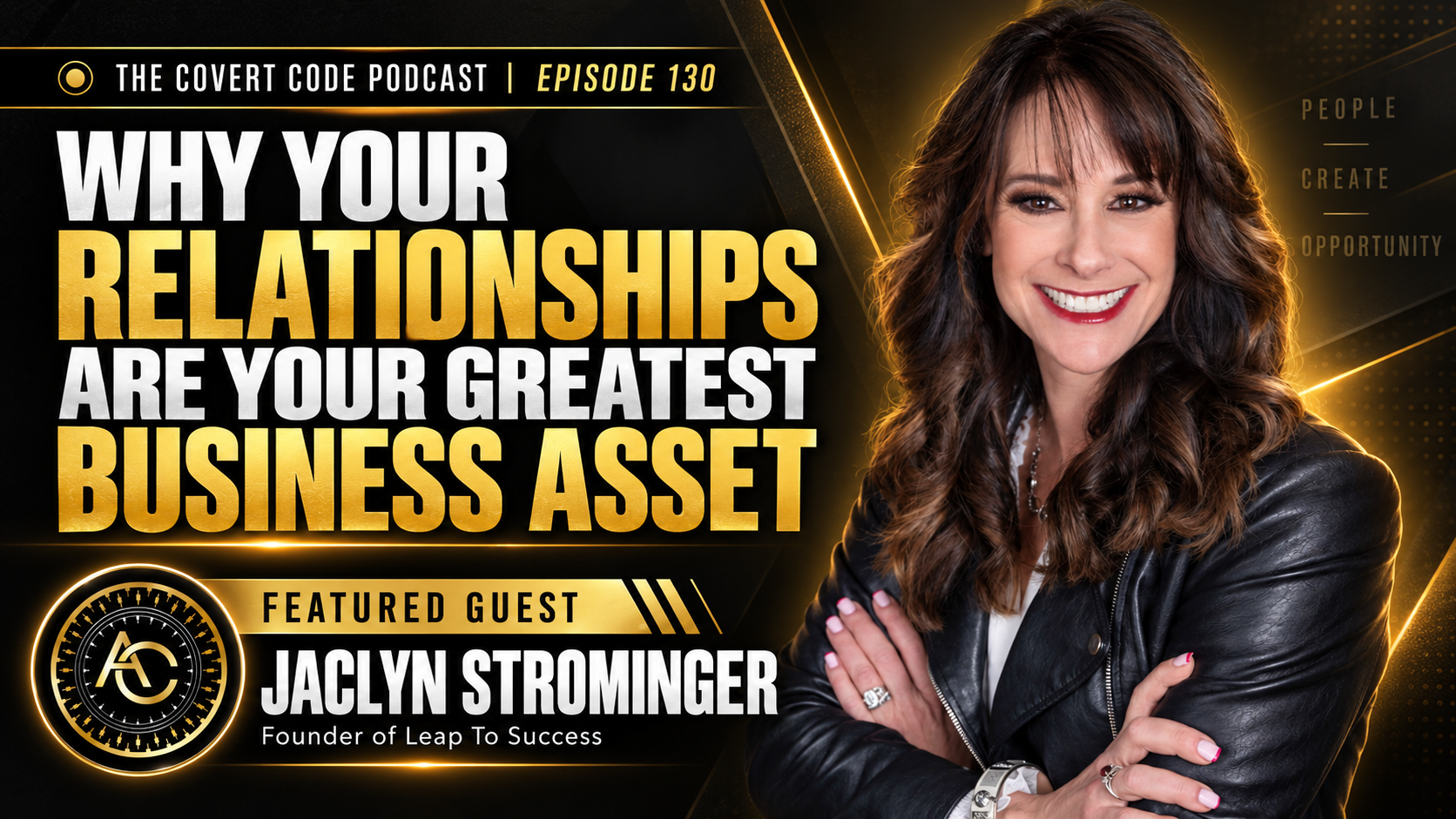
Why Your Relationships Are Your Greatest Business Asset with Jaclyn Strominger
Featuring Jaclyn Strominger, Success Strategist, creator of the Relationship Capital Formula and LEAP Framework, co-author of Charting True North, and host of Unstoppable Success
Most business owners know networking matters.
They attend events, collect business cards, add people on LinkedIn, and exchange introductions.
Then Monday arrives.
The business cards sit on a desk, the LinkedIn connections disappear into a feed, and the people they spent hours meeting slowly become names they barely remember.
Jaclyn Strominger believes that is where most networking goes wrong.
In Episode 130 of The Covert Code Podcast, Anna Covert sits down with Jaclyn to discuss why relationships may be one of the most valuable assets in business—but only when we take intentional action to build them.
Relationships Built Jaclyn’s Businesses
Jaclyn spent years building businesses through relationships.
Connecting people came naturally to her.
If someone needed a person, resource, or introduction, she was often the person they called.
Then her life changed.
After realizing she was living largely on autopilot, Jaclyn and her family made a dramatic decision: leave Massachusetts and move across the country to Reno, Nevada.
She arrived knowing almost nobody.
For someone whose business had largely been built through relationships, that presented an enormous question:
How do you rebuild a network from zero?
Two days after moving into her new home, while the moving truck was late and she was still settling in, Jaclyn attended an event with approximately 25 women.
And she started connecting.
Her business began growing quickly.
People who had lived in Reno their entire lives started telling her that she seemed to know more people than they did.
That’s when Jaclyn realized the thing she did naturally could actually be taught.
The Relationship Capital Formula
Jaclyn eventually developed a simple formula:
Relationship Capital = People × Action.
The number of people you know creates potential.
Action creates value.
You could have thousands of LinkedIn connections.
But how many people do you genuinely know?
How many relationships have you intentionally nurtured?
How many people would answer your call?
How many people immediately think of you when an opportunity appears?
The difference between a contact list and relationship capital is what you do after the connection is made.
Your Network Expands Faster Than You Think
The mathematics behind relationships becomes powerful very quickly.
Every person in your network has their own network.
One new relationship can potentially create introductions to hundreds of other people.
Then those people know other people.
This doesn’t mean treating every conversation as a pathway to a sale.
In fact, Jaclyn argues for almost the opposite approach.
Build the relationship first.
The opportunity may come later.
Connect. Engage. Offer.
Jaclyn breaks relationship-building into three practical behaviors:
Connect.
Engage.
Offer.
Connect with the person.
Actually engage with what they are saying.
Then look for something useful you can offer.
That offer may have nothing to do with purchasing your service.
It might be an introduction, article, book, resource, invitation, or piece of information related to something they mentioned.
This requires one of the most underrated skills in business:
Listening.
Stop Thinking About What You’re Going to Say Next
Many people don’t truly listen during networking conversations.
They’re preparing their own response.
Waiting to introduce themselves.
Looking for the moment when they can explain what they sell.
Jaclyn recommends deliberately slowing down.
Listen to what the other person is telling you.
Remember their name.
Notice what they need.
Then ask yourself:
Is there something useful I can offer this person?
That change transforms networking from a transaction into a relationship.
You can hear more of Jaclyn’s approach to relationships, leadership, and business momentum on her Unstoppable Success Podcast.
The Follow-Up Is Part of the Event
One of Jaclyn’s most practical lessons is something nearly every business owner can implement immediately.
If you spend two hours attending an event, be prepared to spend meaningful time following up afterward.
The event wasn’t the entire investment.
The follow-up is part of the investment.
Jaclyn sees too many people spend hours networking only to leave the cards sitting on their desks.
No personalized email.
No LinkedIn message.
No introduction.
No second conversation.
Nothing.
If you don’t follow up, much of the time and money you spent attending the event disappears.
Use More Than One Channel
People are busy.
Emails land in spam.
LinkedIn messages disappear.
Texts get forgotten.
A lack of response doesn’t automatically mean someone doesn’t want to connect.
Jaclyn recommends trying two appropriate touchpoints.
Perhaps email first and LinkedIn second.
Or email and a phone message.
If the person still doesn’t respond, don’t immediately assume rejection.
You can politely tell them you’ll follow up again at a specific future date.
Put it on your calendar or into your CRM.
Then actually do what you said you would do.
Relationship Building Needs a System
Networking often fails because it relies entirely on memory.
That doesn’t scale.
If relationships matter to your business, track them.
Use a CRM.
Use calendar reminders.
Create notes.
Document what you discussed.
Keep track of what you promised.
Technology can help support that process, but the relationship itself still needs to remain human.
Give People an Easy Way to Say No
There is another side to persistence.
Not everyone wants to build a relationship with you.
That’s okay.
Jaclyn recommends providing an easy and respectful way for someone to opt out.
You can simply tell them that if staying in touch isn’t useful, they can let you know.
That takes pressure out of the conversation.
Your job isn’t to win every person.
Your job is to intentionally build the relationships that make sense.
Stop Treating Networking Like Immediate Lead Generation
One of the easiest mistakes to make is evaluating every new person by one question:
Can they buy from me?
Jaclyn encourages business owners to take that thinking out of the first interaction.
The person standing in front of you may never become a customer.
But they may eventually introduce you to your largest customer.
They may become a partner, friend, podcast guest, resource, referral source, or advisor.
Or they may remember your expertise three years later when exactly the right opportunity appears.
Play the Long Game
Anna shares that some of her own business comes from people she hasn’t spoken with for years.
Something happens.
A person encounters a problem.
And suddenly they remember the person who can solve it.
That’s relationship capital.
You don’t always know when the investment will pay off.
Sometimes the opportunity arrives years later.
Networking Still Needs an ROI
Relationship-building is the long game.
That doesn’t mean every networking activity deserves unlimited time.
Jaclyn recommends looking closely at where you’re spending your energy.
Which events consistently produce meaningful conversations?
Where are the people you actually want to meet?
Which communities align with your goals?
Which groups have you attended repeatedly without building meaningful relationships?
Anna compares it to fishing.
If you’ve been fishing in the same cove and there aren’t any fish, eventually you need to move the boat.
Being consistent doesn’t mean continuing an activity that isn’t working.
Your Energy Enters the Room Before Your Pitch
Relationship Capital also connects directly with Jaclyn’s LEAP Framework.
LEAP stands for:
- Leveraging Communication
- Energy
- Action
- Performance
Communication includes what you say to other people—but also what you say to yourself.
Energy is how you show up.
Action is the plan you create.
Performance is the process of measuring, monitoring, and adjusting what you are doing.
People Can Feel Desperation
Jaclyn makes an important point about energy.
If you walk into every room thinking, “I need to make a sale,” people can feel it.
If you’re worried constantly about whether someone likes you, people may feel that insecurity too.
The strongest relationship-building begins when you stop approaching every interaction from scarcity.
Show up curious.
Listen.
Be useful.
Then let the relationship develop naturally.
Measure, Monitor, and Adjust
The final part of LEAP is Performance.
Jaclyn describes this as:
Measure. Monitor. Adjust.
You need to know whether the actions you’re taking are actually moving you toward the outcome you want.
This is relevant to networking, sales, marketing, and leadership.
It also reflects a recurring theme throughout The Covert Code Podcast: strong relationships and strong businesses are intentionally built, measured, and continually improved.
Your Vision and Mission Shouldn’t Live in a Notebook
Companies frequently go through elaborate exercises to create a mission, vision, and values.
Then they file the document away.
Three years later, the company has evolved.
The people have changed.
The customers have changed.
The market has changed.
But nobody has revisited the original strategy.
Jaclyn recommends periodically returning to those fundamentals.
Are they still true?
Are they still aligned with the organization you’re becoming?
Are the people you’ve hired aligned with those values?
Your People Create Your Culture
Company culture isn’t simply what leadership writes on the wall.
Culture emerges through the people inside the organization.
If leaders bring in people who consistently conflict with the company’s values, the culture changes.
Conversely, a smaller team of highly aligned people can often accomplish extraordinary things because trust, energy, and purpose work together.
Sometimes Good Leadership Means Letting People Grow Away From You
Alignment doesn’t mean everyone stays forever.
People evolve.
Companies evolve.
Sometimes someone who was perfect for the organization five years ago needs something different today.
That isn’t always a failure.
Jaclyn argues that great leaders should sometimes celebrate when someone they’ve developed becomes capable of moving on to something bigger.
If the relationship was built properly, that former employee can remain part of your Relationship Capital for years.
Your Relationships Are an Asset—If You Treat Them Like One
Your contacts aren’t Relationship Capital simply because their information exists in your phone.
The value comes from action.
Listen.
Follow up.
Offer something.
Make introductions.
Remember what people tell you.
Do what you say you’re going to do.
Stay in touch.
Know when to keep investing.
Know when to move on.
And recognize that the person who cannot help your business today may become one of the most important relationships in your career five years from now.
That’s why relationships aren’t simply part of business.
They can become one of the most valuable assets you build.
About Jaclyn Strominger
Jaclyn Strominger is a Success Strategist, creator of the LEAP Framework and Relationship Capital Formula, co-author of Charting True North, and host of Unstoppable Success.
Learn more at JaclynStrominger.com.
Connect with Jaclyn on LinkedIn, Instagram, and Facebook.
Listen to Unstoppable Success.
Learn more about Charting True North.
Watch the Full Episode
Watch Episode 130 of The Covert Code Podcast featuring Jaclyn Strominger and discover how to turn your existing network into authentic relationships, opportunities, and long-term Relationship Capital.
Why Your Relationships Are Your Greatest Business Asset
The Covert Code Podcast | Episode 130
Host: Anna Covert
Guest: Jaclyn Strominger
Creator: Relationship Capital Formula and LEAP Framework
Book: Charting True North
Podcast: Unstoppable Success
Anna Covert [00:00:03]:
Aloha. My name is Anna Covert, and this week on The Covert Code, the topic is Why Your Relationships Are Your Greatest Business Asset.
My very special guest is Jaclyn Strominger, founder of Leap To Your Success, speaker, co-author of Charting True North, host of the Unstoppable Success podcast, and creator of the Relationship Capital Formula and LEAP Framework.
For over 30 years, she's worked with leaders, entrepreneurs and high performers to help them create relationships that build influence, unlock opportunities and create long-lasting success.
Thanks so much for being here today, Jaclyn.
Jaclyn Strominger [00:00:42]:
I'm so glad to be here with you, Anna. It's such a pleasure.
Anna Covert [00:00:48]:
Thank you.
We like to begin with the CliffsNotes version.
Tell us the Jaclyn story. How did you get from where you were to where you are right now?
Jaclyn Strominger [00:00:58]:
Oh my God. CliffsNotes.
I have a couple of different stories, but the one that really solidifies where I'm sitting right now also explains how I ended up in Reno, Nevada.
I'm an East Coast girl.
Back in 2018, I was living in Massachusetts. I have two children. One is now in college, and one is literally about to go to college.
I grew up in Massachusetts, went from Massachusetts to Pittsburgh, Pittsburgh to New York City, New York City back to Massachusetts.
I was doing what we all do. I was driving my kids to school and living life.
Then one day I was listening to Katy Perry's song Roar, and I realized I wasn't roaring anymore.
I thought: Where am I going? What am I doing? I'm on freaking autopilot.
Something needed to shift.
I went home and wrote out my vision and mission.
My husband came home, and I told him we basically had to make a choice.
We were two ships passing in the night.
He was working in Boston. I was working outside Boston. We'd come home and just exist.
I didn't feel like that was what I wanted for our family.
Something had to give.
We started talking about moving.
Then while my husband was attending a conference, he asked, "What do you think about Reno, Nevada?"
I said, "Honey, Google."
I looked it up.
It said it was an up-and-coming area, great outdoors, near Lake Tahoe.
For everyone who doesn't know, Reno is nowhere near Las Vegas. It's approximately an eight-hour drive.
We came out around Memorial Day weekend.
My husband is a physician, so he was meeting with doctors.
We ended up finding a house.
On August 1, we rolled out of Massachusetts.
It happened incredibly fast.
Then I realized:
I had built businesses because I knew people.
And now I knew nobody.
If you count my realtor and the person who did my mortgage, I knew two people.
I had always been the person people called when they needed a connection.
"Do you know someone?"
I always knew somebody.
I realized I needed to take that natural skill and put it intentionally into action.
The moving truck was late.
I took a cold shower because I discovered we didn't have hot water.
And two days after moving into Reno, I went to an event with approximately 25 women.
And we took off.
Eventually, people who had lived in Reno their entire lives started telling me, "Jaclyn, you know more people than I do."
That's when I realized I needed to teach people how to build relationships.
My business took off.
That's really how I ended up in Reno and how I ended up doing what I'm doing now.
Anna Covert [00:07:03]:
That's such a great story.
I went to Bentley University in Waltham, Massachusetts, so I love Boston.
My Boston story is that we didn't have smartphones when I was there. We had MapQuest.
I'm dyslexic, so if you missed one turn, forget it.
I got a car my second year and ended up stuck in a rotary because nobody would let me out.
I was crying after about ten minutes.
A police officer noticed me, helped me out and said, "Sweetheart, if you're going to drive in Boston, you have to buck up."
I said, "Yes, sir."
Then I became a crazy Boston driver.
When I got to Hawaii, that backfired because people don't drive like that here.
But I love your story because relationship-building really is a skill that can be learned.
You also have this great podcast, and I'm excited to be on yours sometime.
Why did you decide to write the book?
You co-authored it. Did you always want to write a book?
Jaclyn Strominger [00:08:43]:
It actually goes back to relationships.
I started appearing on podcasts because being on a podcast itself is a skill.
As a success strategist, I was helping people become what I call the CEO of you.
Leadership starts there.
I appeared on different podcasts talking about leadership and eventually met Damian Andrews.
I stay in contact with a lot of people after being a guest on their podcasts.
Damian and I continued talking.
Then he saw something I posted after I started my podcast.
He said, "I think we need to start a mastermind."
I said, "I think you're right."
We tried promoting it through LinkedIn and social media, and eventually I thought, this is more pain than I want to deal with.
But we kept meeting on Zoom and having these amazing conversations.
Eventually we asked:
What if we wrote a workbook together about leadership?
We started looking at the leadership books that were already out there, and there wasn't really one structured the way we were thinking about it.
So through building this relationship, the opportunity came for the two of us to co-author a book.
We wanted to give people a framework for beginning to lead themselves through what we call authentistic leadership.
The book has several sections.
It begins with understanding yourself as an authentic leader.
There's emotional intelligence.
Who are you?
Be the CEO of you before you can be the CEO of anything else.
There are exercises around emotional intelligence and authenticity.
Then there are approximately 30 or 40 journal prompts using words such as fear, laughter, calm and other emotions.
What comes into your mind when you see that word?
What meaning have you attached to it?
Then the final portion is 30 days of reflection.
Each day, you reflect on how you showed up as a leader — whether you're leading yourself, a team or a company.
Every one of us is a leader because we have to lead ourselves first.
It's a way to close out each day so you can start tomorrow fresh.
We're also developing more around the book, including what we're calling Pathfinder and a licensing program where people can use the book within masterminds and become Pathfinder guides.
Anna Covert [00:14:31]:
That's very exciting.
Now tell me about your Relationship Capital Formula.
That's not actually in the book, right?
Jaclyn Strominger [00:14:41]:
No. That's not in the book.
It's particularly important today because we have so much social media.
The Relationship Capital Formula is:
RC = P × A.
Relationship Capital equals People times Action.
Then you can take that to the nth degree because of all the people the people you know also know.
You and I respectively know hundreds of people.
If you look at LinkedIn, I have thousands of connections.
Do I know all of them personally?
No.
But they're connections.
The key is that every one of those people has their own network.
So I meet you.
What's my action?
Maybe I invite you to something.
Maybe I introduce you to someone.
But I have to do something.
Relationship Capital is the people you know times an action.
It isn't simply shaking someone's hand.
And it's definitely not immediately unloading everything you sell onto someone.
Anna Covert:
Pitch slapping.
Jaclyn Strominger:
Exactly.
Don't do that in person either.
Think about the compounding effect.
You meet someone.
You have an action.
Then that person introduces you to six more people.
Each of those people knows hundreds of people.
The network expands incredibly quickly.
That's why building that initial relationship is so important.
The action is:
Connect. Engage. Offer.
What is the action?
That's really the heart of the Relationship Capital Formula.
Anna Covert [00:18:12]:
I still love paper business cards.
I've tried digital ones twice, but I can't remember the person once their information goes straight into my phone.
With a physical card, I remember it.
Then I can find the person on LinkedIn, follow up or send the information to my assistant.
Jaclyn Strominger [00:18:41]:
I love a memorable card.
My card has a QR code, but it also has texture.
Invest in a good card.
Another thing I tell people is to create a way to capture what you discussed with someone.
Your phone can be useful for taking notes immediately afterward.
Then you can potentially use technology or AI to parse those notes into follow-up actions.
The key thing is creating the follow-up.
I see so many people go to an event, spend two hours there and then do nothing.
The stack of cards sits on the desk.
Part of the Relationship Capital Formula is creating the action plan.
If you spend two hours at an event, be prepared to spend meaningful time on the follow-up.
You have to get the ROI from the time you invested.
Anna Covert [00:20:48]:
And a generic email sent to everyone at the event doesn't feel authentic.
Jaclyn Strominger [00:20:52]:
Exactly.
On my website, I have free workbooks.
Someone can message me and say they want the networking workbook.
It's a simple workbook with steps for knowing who you're reaching out to and how you're going to follow up.
I also have a deeper seven-day Relationship Capital Challenge.
It's free.
The reason I call it a challenge is because I want people to seriously examine where they're spending their time.
When I moved to Reno and didn't know anyone, I started attending all these different networking events.
Eventually, I had to stop and ask:
Which of these are actually worth my time?
That's part of the challenge.
Look at where you're spending time and what the ROI actually is.
If you're not getting an ROI, don't just keep attending because someone told you it takes years.
Anna Covert [00:22:56]:
It's like fishing.
If you're in the boat and you keep fishing in the same cove and there aren't any fish, eventually you have to move the boat.
Jaclyn Strominger:
Exactly.
You have to go somewhere else.
Anna Covert [00:23:34]:
I also think about what you can offer someone that doesn't immediately feel salesy.
My book has been one of the best business cards I could have.
People don't tend to throw books away.
Maybe it's the book. Maybe it's your podcast. What is the thing you can offer?
Jaclyn Strominger [00:24:07]:
That's the offer part of Connect, Engage, Offer.
You and I could be talking at an event.
You might mention something related to Forbes.
I could realize I know someone who might benefit from that.
So I offer to make an introduction.
You're offering a human to a human.
But that requires listening.
Actually listen to what someone is saying.
Remember their name.
Don't spend the conversation thinking about what you're going to say next.
Take it in.
Pause.
Think:
Is there something I might be able to offer this person?
Maybe it's a book.
Maybe it's an article.
You can follow up and say, "It was great meeting you. Based on our conversation, I thought you might enjoy this article."
Then perhaps the relationship moves to coffee or a Zoom call.
It's a process.
The place people get hung up is saying, "She's not the right client. I don't have anything to sell her."
Take selling out of it.
Maybe you simply connected and want to build the relationship.
Every relationship can potentially lead to an opportunity.
Anna Covert [00:26:25]:
Absolutely.
I get business from people I haven't heard from in years.
Suddenly someone has a problem with fraud and thinks of me.
Or they need help with a website.
Find what you can genuinely add value around and become a resource.
Jaclyn Strominger [00:26:55]:
When you become that resource for somebody, it changes the entire dynamic.
We get so caught up in needing to make a sale.
Of course we all need sales.
But think long-term.
Walk into a local store.
See what they need.
I have a client building a vegan bakery business.
I walked into a coffee shop and noticed they had baked goods from another bakery.
I asked whether they might be interested in vegan cinnamon buns, vegan donuts or other vegan products.
They initially said they already had a bakery relationship.
I said, "I'm sure you do. But I bet they're not giving you those vegan products your customers might want."
They went and got the name of the person my client should contact.
It didn't take much.
It's a contact game.
I passed the opportunity to my client.
Anna Covert [00:29:02]:
It also feels good to share what you're passionate about.
I do nonprofit work and love teaching people about website design and digital strategy even if there's no business opportunity attached.
Jaclyn Strominger [00:29:26]:
Exactly.
Building relationships is the long game.
I have business relationships and friendships I've had for years.
It doesn't matter how much time has passed.
I can pick up the phone and say, "I'm looking for somebody who needs X, Y or Z. Do you know anyone?"
Anna Covert [00:30:08]:
Now someone goes to the networking event.
They listen.
They remember names.
They follow up.
Then they don't hear anything.
How do they maintain momentum without becoming annoying?
And how do they know when to stop?
Jaclyn Strominger [00:30:41]:
Think in twos.
If I meet you today, I send a follow-up.
Use two methods.
Email and social.
Email and text.
Whatever is appropriate.
Track what you're doing.
Write it down.
Use your CRM.
Find some way to know what you've done.
Maybe the person didn't receive the email.
Maybe it went into spam.
Two days later, reach out through another appropriate channel and simply say:
"I wanted to make sure you received the message I sent."
If another couple of days pass and you still don't hear back, acknowledge that everyone is busy.
Tell them you're going to put them on your call list for next month.
Pick a date.
Put it on your calendar.
Then make sure you actually reach out on that date.
You can also give them an out:
"If you aren't interested in staying connected, please let me know. No harm, no foul."
Make it easy.
You can even make it lighthearted.
The point is to remain consistent without making it weird.
Anna Covert [00:34:01]:
That's the important part.
It's business.
You need commitment and consistency.
Jaclyn Strominger [00:34:16]:
Exactly.
Remember that it's your business.
If you've decided that building relationships is an important part of your business, then building the relationships is your responsibility.
Not everyone you meet will have the same intention.
But if your intention is to build relationships, you need to take the action.
Don't get so caught up wondering whether you're saying the perfect thing or whether they like you.
If they don't respond, don't immediately get into your head.
You're the one making the connection.
You're the one building the relationship.
Anna Covert [00:35:23]:
You can't win them all.
You move on.
It's like sampling at Costco. You're not going to love every snack. Keep going until you find one you like.
Jaclyn Strominger:
Exactly.
Some will. Some won't. So what?
It gets easier the more you do it.
Anna Covert [00:35:54]:
Let's talk about the LEAP Framework.
Jaclyn Strominger:
The Relationship Capital Formula is part of a larger system of creating an intentional action plan.
LEAP came out of the experience I had when I made that huge move across the country.
I realized how many of us become stuck on the hamster wheel.
We keep driving in circles.
LEAP stands for:
Leveraging Communication.
Energy.
Action.
Performance.
Leveraging Communication is both the communication you have with yourself and what you communicate to other people.
It's your vision.
Your mission.
Your strengths.
You need clarity around how you communicate who you are to yourself and to the world.
Then comes Energy.
How are you showing up?
How do you show up every day?
How are you showing up for yourself?
When you walk into the office, are you excited?
Are you worried about what people think of you?
How are you coming across?
Energy matters enormously.
We've all heard in sales that someone can hear your smile through the phone.
If you're not smiling, don't make the call yet.
Stand up.
Reset.
If you're walking into a room thinking, "I need a sale, I need a sale, I need a sale," people can feel that energy.
I went through a period where I was feeling desperate because I was going through the motions.
When I fixed that, it felt like the world opened back up.
Then the A is Action.
We've clarified our communication.
We know our vision and mission.
We've looked at our energy.
Now what's the actual plan?
What steps are we taking to reach that vision?
Finally, Performance.
I describe Performance as:
Measure. Monitor. Adjust.
Look at how things are actually performing.
People talk about 30-, 60- and 90-day plans and 90-day sprints.
The important part is actually measuring what happened.
If you keep fishing in the same cove and there aren't any fish, stop wondering why you aren't eating.
Move the boat.
Measure what you're doing.
Monitor it.
Adjust.
If you aren't measuring something today, put a mechanism in place so you can.
That's where the LEAP Framework came from.
It applies to personal life and business life.
And you need to revisit it.
People write a vision and mission, put it in a notebook and never look at it again.
But people change.
Businesses change.
Anna Covert [00:41:59]:
That's something I've learned doing branding.
We'll go through the brand exercise with a company, and then three years fly by.
It's still the same company, but it's not really the same company anymore.
Now I like to do an annual pulse check.
This is what we said we wanted to be.
Is that still who we are?
Is that still who we want to become?
Jaclyn Strominger [00:42:11]:
Exactly.
It matters tremendously from a leadership standpoint.
People evolve.
Companies evolve.
Companies may be created by a founder, but the culture becomes shaped by the people the company hires.
Those hiring decisions need to connect back to your values, your vision and your mission.
If you hire the wrong people, you're going to feel it.
Anna Covert [00:42:43]:
That's absolutely true.
People don't all need to be identical, but there needs to be an alignment of values and energy.
One person who is completely misaligned can create dissonance throughout an organization.
Jaclyn Strominger:
Exactly.
And sometimes alignment changes.
People change.
Companies change.
Sometimes the people who were perfect for the business at one stage aren't the right people several years later.
That doesn't necessarily mean something bad happened.
It may simply be growth.
Great leaders also need to recognize when the people they've developed are ready to grow and move on.
If you've helped someone become capable of doing something bigger, celebrate that.
Pat yourself on the back.
You've helped elevate that person.
And if you've done the relationship part well, that person may remain one of the strongest relationships you have for the rest of your career.
Anna Covert [00:46:01]:
Absolutely.
This has been such a great conversation.
How can people connect with you?
Jaclyn Strominger:
The best place is my website.
You can also find me on LinkedIn.
I'm probably more active on LinkedIn than on any of the other social platforms.
Anna Covert:
We'll include all of Jaclyn's links below.
Thank you so much for being here.
And to all of my listeners, if you have not yet subscribed to this channel, please do so.
We've reached more than 220,000 subscribers, and it's overwhelming. It's because of you and your aloha.
Please share this content with people you think will benefit from it so I can continue bringing great guests like Jaclyn onto the show to share their wisdom.
I cannot wait to see you next week in the pixels.
Aloha.