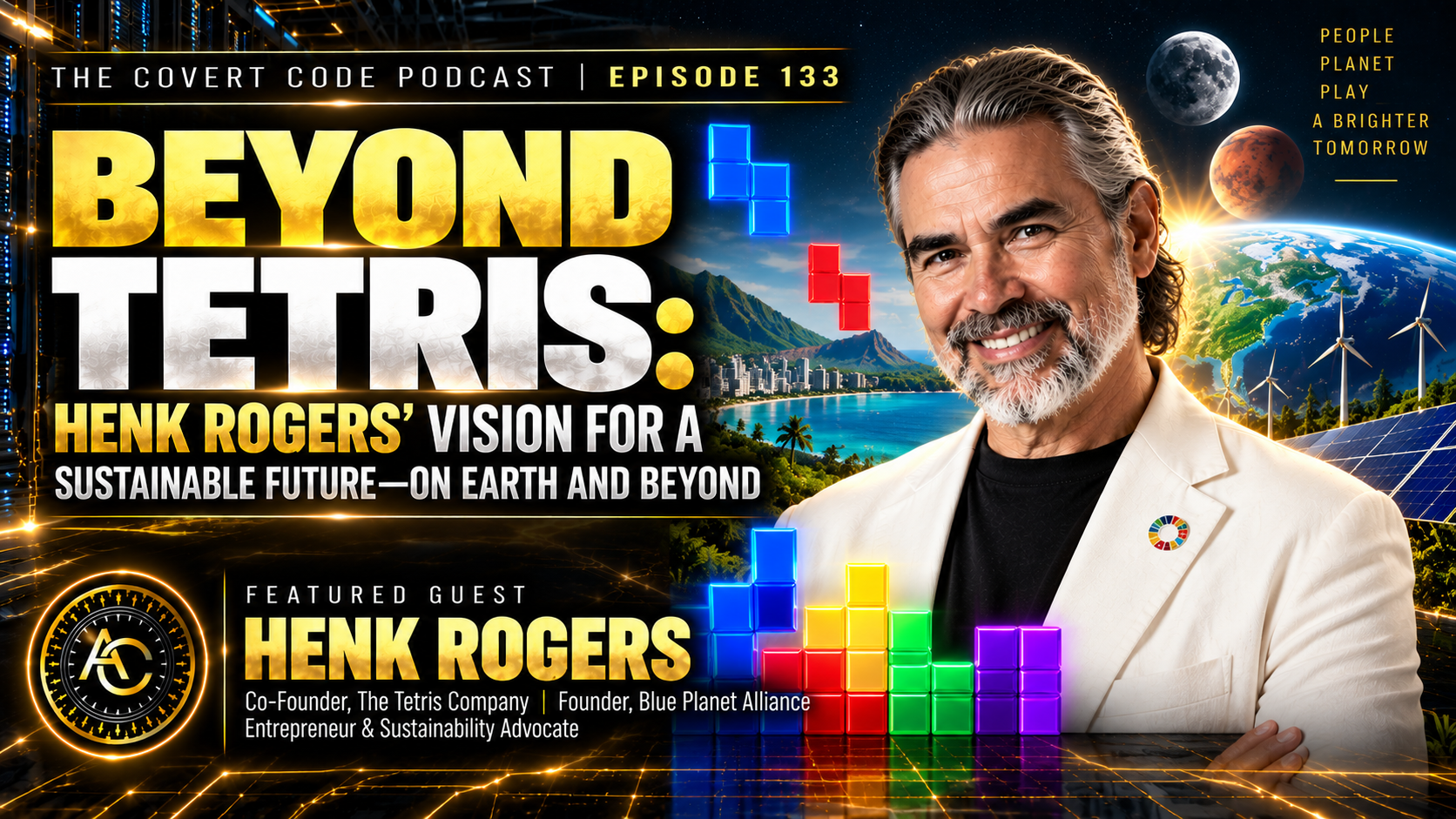
Beyond Tetris: Henk Rogers on Clean Energy, Innovation, and the Future of Humanity
What do Tetris, renewable energy, battery storage, and space exploration have in common? Henk Rogers.
When I sat down with Henk for Episode 133 of The Covert Code, I knew we had a lot to talk about. Most people know him as the entrepreneur who helped bring Tetris to the world. But here in Hawaii, we also know him for his work advancing renewable energy and for his belief that our islands can demonstrate what’s possible for the rest of the planet.
What interested me most about our conversation was how his different ventures connect. From developing new battery technologies to simulating life on Mars, Henk keeps returning to a central question: How can we create systems that allow people to live more sustainably?
The Moment That Changed Everything
In 2005, Henk experienced a serious medical emergency while playing tennis. He survived a complete blockage of a major coronary artery and found himself reconsidering what he wanted to accomplish with the rest of his life.
He had already achieved considerable success in the gaming industry. His children were grown, and he had recently sold his company. But he felt there was still important work to do.
While recovering, he began identifying the issues that would trouble him most if he never did anything about them.
One of those issues appeared in a newspaper article about the potential loss of the world’s coral reefs. Learning about ocean acidification and the role of carbon dioxide emissions gave him his first major mission: ending the use of carbon-based fuels.
He decided to begin in Hawaii.
How Hawaii Became a Renewable Energy Pioneer
Henk founded Blue Planet Foundation with an ambitious objective: help Hawaii transition to 100% renewable energy.
His original approach involved raising public awareness through a major concert. But he eventually concluded that awareness alone wasn’t enough. He wanted to create lasting change.
His organization shifted toward practical action, public engagement, and legislation.
One of the most memorable stories from our conversation was how Blue Planet Foundation involved children in the effort. Young people helped exchange approximately 300,000 light bulbs, creating opportunities for conversations with adults about energy efficiency and the future.
The organization also produced a book of children’s drawings asking Hawaii’s leaders to commit to renewable energy.
In 2015, Hawaii became the first U.S. state to establish a statutory target of 100% renewable electricity by 2045.
For Henk, Hawaii is more than a place to test renewable technologies. It’s a demonstration of what an island community can accomplish when energy security, economics, and environmental priorities align.
Why Energy Storage Is Essential
Generating renewable electricity is only part of the challenge. We also need reliable ways to store and deliver it when the sun isn’t shining or the wind isn’t blowing.
Henk’s work with Blue Planet Energy grew out of his effort to take his ranch on Hawaii Island off the electrical grid.
He wanted an energy storage solution that could support renewable electricity without introducing unnecessary environmental problems.
That search led him toward lithium iron phosphate batteries and, more recently, two technologies he discussed during our interview: sodium batteries and supercapacitors.
The Potential of Sodium Batteries
Sodium-based batteries offer an alternative to conventional lithium-ion battery chemistries. Sodium is widely available, and Henk believes the technology could eventually offer meaningful cost advantages.
He also discussed the potential for certain sodium battery designs to operate across a wide temperature range, reducing the energy required for heating and cooling.
These are important considerations for an energy system that will increasingly depend on distributed storage.
Supercapacitors and Peak Demand
Supercapacitors serve a different purpose from conventional batteries.
While batteries are useful for storing electricity over longer periods, supercapacitors can absorb and release energy very quickly. That makes them interesting for managing brief spikes in electricity demand.
Henk explained how this combination could help homes, hotels, commercial buildings, and even data centers manage their electricity requirements.
Rather than designing every part of an electrical system around the highest possible momentary demand, storage technologies can help smooth those peaks.
Hydrogen and Long-Term Energy Storage
One of the challenges of relying on solar and wind is preparing for extended periods of unfavorable weather.
At his ranch, Henk has explored using excess solar electricity to produce hydrogen through electrolysis. That hydrogen can be stored and later used in a fuel cell to generate electricity when needed.
He also sees opportunities for hydrogen in transportation, particularly for applications where battery weight and charging requirements present challenges.
Hydrogen production, storage, and transportation still involve technical and economic trade-offs. Nevertheless, Henk views it as one potential component of a broader renewable energy system.
Virtual Power Plants: Connecting Energy at the Local Level
As someone who has solar panels and battery storage at home, I was particularly interested in our discussion about virtual power plants.
A virtual power plant connects distributed resources, such as home batteries, so they can collectively support the electricity grid.
Instead of relying exclusively on large centralized facilities, utilities can use energy already stored near the customers who need it.
Henk explained that this approach could help reduce peak demand and potentially defer some distribution infrastructure upgrades.
For Hawaii, where electricity costs and energy independence remain important concerns, distributed energy storage is a particularly relevant opportunity.
Taking Hawaii’s Energy Experience Around the World
Henk’s ambitions don’t stop at Hawaii’s shores.
Through Blue Planet Alliance, he is working with island communities and other jurisdictions interested in pursuing renewable energy transitions.
During our conversation, he described bringing delegations to Hawaii that include representatives from government, utilities, regulatory agencies, and local communities.
They learn about Hawaii’s experience, visit renewable energy projects, and develop plans they can adapt for their own jurisdictions.
Henk said the program had welcomed representatives from 52 jurisdictions and helped establish international agreements and renewable energy legislation.
The underlying concept is straightforward: communities can learn from one another rather than starting from scratch.
What Space Exploration Can Teach Us About Sustainability
Our conversation eventually moved beyond Earth.
Henk has been involved in space exploration initiatives, including HI-SEAS, the Hawaii Space Exploration Analog and Simulation facility on Hawaii Island.
The facility has hosted simulated Mars missions in which small crews live in an isolated habitat, use simulated spacesuits, and experience delayed communications with the outside world.
These missions explore the practical and psychological challenges of living far from Earth.
But Henk also sees a connection to sustainability here at home.
Human settlements on the Moon or Mars would have to make extremely efficient use of limited resources. Water, energy, food, and manufactured materials would need to be conserved, reused, and recycled.
Those same principles can help us rethink how we live on Earth.
The Action App: Turning Awareness Into Action
Near the end of our conversation, Henk introduced a project that brings him back to his roots in game design.
His Action App is designed to encourage people to take practical steps toward environmental and social goals.
The idea is to begin with small activities, such as switching off an unnecessary light or picking up litter. As participants complete actions, they progress through levels and receive more substantial challenges.
Henk described plans to use artificial intelligence to suggest activities based on each person’s interests and previous participation.
He also envisions allowing users to create actions that other people can complete, encouraging participation beyond an individual’s immediate circle.
At the time of our interview, the app was in its final testing stage. Henk emphasized that he wanted to complete quality assurance before launching it.
Artificial Intelligence, Innovation, and Responsibility
We also discussed the opportunities and risks associated with artificial intelligence.
Henk sees enormous potential for AI to support scientific discovery and help address complex global challenges. At the same time, he raised concerns about the misuse of increasingly powerful technology.
His perspective reflects a theme that runs through much of his work: technological advancement needs to be accompanied by careful consideration of its consequences.
We ended up discussing everything from his grandchildren and environmental education to the possibility of creating a meditative version of Tetris.
It’s an interesting idea from someone whose career began with a game that has already captured the attention of generations.
What’s Next for Henk Rogers?
Henk’s story is a reminder that a successful first chapter doesn’t have to define the rest of your life.
After Tetris, he could have retired. Instead, he built organizations and launched initiatives spanning renewable energy, entrepreneurship, battery storage, international collaboration and space exploration.
What stayed with me after our conversation was his distinction between hope and determination. Henk isn’t simply waiting for a better future. He’s continuing to develop projects intended to help create one.
Watch or listen to the complete conversation on The Covert Code, and explore more conversations about technology, business and innovation.
To learn more about my work and upcoming episodes, visit AnnaCovert.com.
Beyond Tetris: Henk Rogers' Vision for the Future, Beyond Earth and Beyond
The Covert Code | Episode 133
Host: Anna Covert
Guest: Henk Rogers
Transcript lightly edited for readability from the automated recording. Some unclear passages and speaker changes should be checked against the video before publication.
Full Episode Transcript
Anna Covert [00:00:00]:
Aloha. My name is Anna Covert. And this week on The Covert Code, the topic is Beyond Tetris: Henk Rogers' Vision for the Future, Beyond Earth and Beyond.
My special guest is the amazing Henk Rogers, a pioneering entrepreneur, global visionary, and co-founder of The Tetris Company.
After helping Tetris become one of the most recognized games in the world, Henk turned his attention to another challenge: helping the future of our planet.
He founded Blue Planet Foundation, which helped lead the movement that helped Hawaii become the first state in the country to, by law, commit to generating 100% electricity through renewable energy by 2045.
He founded Blue Planet Energy, helping advance more sustainable battery storage technology.
Then he turned his attention to even more ways to help Hawaii by co-founding Blue Startups, a Hawaii-based accelerator that helps entrepreneurs and Hawaii's economy diversify as well as compete globally.
But he wasn't done there, and his work even extended beyond that through the Pacific International Space Center for Exploration Systems, as well as the International MoonBase Alliance, which helps us understand and explore how humans can be sustainable off-planet, while providing more opportunities to bring science, business and aerospace right here to Hawaii.
Today we're here to talk about this amazing journey beyond Tetris and how what Henk's been doing in entrepreneurship, clean energy, technology and innovation is making Hawaii become a prototype and opportunity for others globally.
Thanks so much for being here today.
Henk Rogers [00:02:00]:
Thank you for having me.
Anna Covert [00:02:01]:
So, to begin, you have such an incredible story. Tell me, what was the biggest moment that made you decide?
A lot of people would be done after Tetris. And I know you have other experience in multiple games. You have a movie about you, a book about you. When did you decide to shift toward this renewable, clean energy goal?
Henk Rogers [00:02:21]:
So it was 2005, and I had a 100% blockage of the widowmaker. That's the largest artery in your heart.
I was playing tennis at Waialae Country Club that day. I didn't feel good. They called an ambulance. They said, "We're going to take you in for observation."
Halfway to the hospital, the siren went on, and so I knew something was going wrong.
I had just sold my company a month earlier. And the first thing I thought was, "You've got to be kidding me. I haven't spent any of the money yet."
But the second thing I said was, "No, I am not going. I still have stuff to do."
And so in the recovery room—I have two stents, by the way—I started thinking.
Ninety-five percent of the people who have a 100% blockage of the widowmaker die. So I'm the lucky 5%. I survived. So I must have a reason for surviving.
I'm thinking, what did I mean by "stuff"?
I'd already made enough money so my wife didn't need me anymore. My kids were out of college, so they didn't need me anymore. I was kind of done with the normal stuff.
And then I started thinking: What is it that's going to upset me if I don't do something about it by the actual end of my life?
So I decided to find my missions in life.
The first mission came to me in the back of a newspaper in Hawaii. It said, "Oh, by the way, we're going to kill all the coral in the world by the end of the century."
What's causing that? Ocean acidification.
What's causing that? Carbon dioxide.
What's causing that? We are.
So mission number one is to end the use of carbon-based fuel.
I decided I'm going to start in Hawaii. I'm going to do this in Hawaii first. Then I'm going to do it for the rest of the world.
Anna Covert [00:04:03]:
Was it the Star-Advertiser or PBN? What paper was this article in?
Henk Rogers [00:04:07]:
It was the Star, because it was in the back of the newspaper by the obituaries. It wasn't front-page news.
It should be. We're going to kill all the coral in the world. That should be front-page news. What the hell is going on? Why are we doing this?
But no, it was just like a "by the way."
And so I realized that people aren't really thinking about this. Even people in Hawaii, where coral is such an important part of everything.
Islands in the Pacific are made out of coral. Coral has been around for hundreds and hundreds of millions of years, and 25% of the life in the ocean depends on coral.
So we cannot just callously let all the coral in the world die.
Anna Covert [00:04:49]:
That was so interesting during COVID, when we had this kind of deep breath for the world, how fast some of the coral came back. It really is one of the most resilient things around.
Henk Rogers [00:05:00]:
It is and it isn't.
If we have the bleaching effects, if that happens two years in a row, then the coral has real trouble coming back.
And then we have development, like we have in Hawaii. We add nutrients to the ocean when we do wastewater treatment. We add silt to the reef when we're doing development.
And that's where we've lost a lot of the bay. It doesn't come back unless we give it a chance.
Anna Covert [00:05:32]:
Yeah. So, living here in Hawaii, I'm not from here, but I've been here longer than anywhere else. Twenty-two years.
And while Hawaii is a wonderful place, it's not a fast place, right? Things take time. They go slower, at least in my experience, than being in New York or other places like that.
So this is a huge deal that you were able to get Hawaii to agree to this renewable goal. How did you do it?
Henk Rogers [00:05:58]:
When I got started, I had no idea what I was doing. All I knew was that I wanted to do it.
We went through a year of trying to figure out how to get the public interested in it.
We were going to do a concert with Paul McCartney on Magic Island, and I spent some money getting started on that.
Then Al Gore did his concerts all around the world. And I came to the realization that it was very nice and there was awareness, but after the concert was over, that was it.
People just went back to their lives and said, "Well, that was a nice concert."
So we decided to pivot at that point and become an action-oriented organization.
We figured out what we could do to actually achieve 100% renewable energy in Hawaii, and we decided to go for legislation.
It took us another five or six years to figure that part out. Finally, we did. We now know how to talk to the politicians in Hawaii.
We didn't just talk to the politicians, because when we talked to them, they said, "Why are you talking to me about this? I've got a lot of problems bigger than your problem."
Okay, fine. Talk to the people.
The people were saying, "Why are you talking to me about this? We've got a lot of other problems. I've got to make a living here."
So we decided to reach out to the children because it's their future that we're trashing.
This is what's going to happen if the adults in the world don't do something.
So we got the children on our side.
We had children go door to door and exchange 300,000 light bulbs, for example, thereby having a conversation between a child and an adult about the future and about saving money.
Because LEDs are about ten times more efficient than incandescent light bulbs.
We made bouquets of incandescent light bulbs and had the children give them to the politicians.
And we created a book.
The magic trick is that politicians are not allowed to receive a gift worth more than $25. So our book was $24.95, and it was a book of children's drawings asking, "Please give us 100% renewable by 2040."
I made the book a little bigger than the other books so it would stick out. And it's hardcover, so you can't throw it out.
You would see that book on every politician's bookshelf, and it was enough to get their attention.
We prevailed.
Anna Covert [00:08:52]:
That's amazing.
I have solar on my house, of course. When I get my bill from HECO and open it up, and it says negative $650 and "Do not pay this bill," you know the feeling.
I think it's what people don't realize.
And I came up with one of my concepts for business called the "shoulda, woulda, coulda" card.
If you meet with someone and you're trying to sell them solar, and they say no, you're shocked.
I started selling solar because my advertising agency was affected when we shut down the island—the whole state.
I couldn't believe it. Here we have a family, generations living there. They have this big bill. We had such low interest rates, and they just wouldn't agree.
Finally, after the second visit, I broke down and said, "I don't understand. What is it that's keeping you?"
They said, "Well, what do we do 25 years from now?"
I'm like, "Well, you'll be dead."
Of course, that wasn't the right thing to say. It wasn't my finest moment.
But on the way back home, I had a realization.
It's because of temporal discounting, one of the behavioral science concepts that helps explain why people don't save for retirement. They'd rather spend the money now than save it.
What if, instead of telling someone they could save $150, I said, "What if I gave you a Visa gift card for $200 a month? Would that change your life?"
Well, yeah.
It's different from presenting this large number that they can't understand.
Yet even now, we only have, what, 30% of Hawaii that's renewable? Which is a big deal.
Henk Rogers [00:10:30]:
As a state, we're at 40% renewable energy, which is really great. It means that we're on track.
Kauai is our poster child for how this is going to happen. Many days they're already at 100% renewable.
That's just with solar.
Can you imagine the rainiest place in the world getting its electricity from solar?
We have all of the information. We know how to do this. There's no question there. We just have to do it.
Anna Covert [00:11:03]:
What do you think is standing in the way? Are there any obstacles? Do you think we're going to achieve our goal?
Henk Rogers [00:11:08]:
We are going to achieve our goal.
It's funny because I was on a panel quite some time ago, and I said, "We're going to go 100% renewable energy by 2045."
The guy sitting next to me said, "I'm a professor at the university. This is what I study. There is no way we can go 100% by 2045."
So I took the mic back and said, "Well, I'm not as smart as this guy, so I'm going to do it anyway."
That's really the attitude we need to have.
We have to do this. There are no two ways about it. We're going to run out of fossil fuels. We have to stop climate change.
This is an existential threat, especially for islands.
If we melt Greenland, we're talking about a 30-foot rise in sea level. If you add Antarctica to that, that's a 90-foot rise in sea level.
It's much cheaper for us to fix climate change than it is to move all the cities that are within 90 feet of sea level inland somewhere.
Think of all the people who live in those coastal areas. They're all going to have to move. Where are they going to move?
Those are called migrants. We're going to have a migrant problem of biblical proportions if we don't do something about it.
We have the technology. We know how to make energy using renewable resources. We just have to do it.
There's enough money in the world. There's enough technology in the world. What's missing is willpower.
We need to sprinkle that willpower around.
At the end of the day, you can do the calculation. These are probably old numbers, but they're still numbers.
The utility spends $0.24 per kilowatt-hour for oil, and it costs them $0.08 per kilowatt-hour for wind and solar. If you add batteries, it's up to $0.12.
That is half the cost, and you're not importing anything.
If something geopolitical happens in the world and, for some reason, tankers can't get through the Strait of Hormuz, they're not going to come here. They're going to go to other places.
Islands are going to be the last place they come.
We need to have energy independence. I think this is a huge thing, and islands are waking up to this right now.
We're at the whim of the fossil fuel industry, and we can't be.
Once you have renewable energy in place, your rates are never going to go up. If anything, they're going to go down.
Every time a tanker shows up on our shore, we are taking a chance because tankers do run aground and cause ecological disasters.
If a tanker runs aground in Hawaii, you can forget your tourist industry. That is the most important industry we have.
We roll those dice every single time.
Henk Rogers [00:14:35]:
Definitely. With oil, that's it. It's over. I don't know how many years it takes to recover from something like that.
Anna Covert [00:14:44]:
All I can think of is the commercial with the soap and the little bird.
Henk Rogers [00:14:48]:
Yeah, the birds.
Anna Covert [00:14:56]:
Wow. So tell me about your battery technology. You're on the cutting edge of this technology.
Blue Planet Energy and the Future of Battery Storage
Henk Rogers [00:15:07]:
So I wasn't going to get into another business after sort of retiring from the computer game business. And I certainly wasn't going to get into a business that involved inventory, because I was in the game cartridge business, and that included inventory.
If your game didn't sell through, you were stuck with the inventory. And that's basically scrap at that point.
But the utilities were saying, "We can't go 100%."
And I said, "What do you mean you can't go 100%?"
So I decided to take my ranch on the Big Island off-grid.
We searched for a battery. We wanted a battery that wasn't going to be another disaster.
I had a longstanding relationship with Sony because I was in the game business, and they came up with something called lithium iron phosphate.
Now, in your phone and in my Tesla, there is a chemistry called NMC. That's nickel manganese cobalt.
That's the reason you can't put certain batteries inside your suitcase when you get on a plane. They can catch on fire.
And it's not fire. It's fireworks. Once it goes, it continues going until it's completely used up. That's the way fireworks work.
With NMC, there are bad actors. There's cobalt coming out of a war zone with child mining, and there's lithium coming out of Bolivia, et cetera.
Now they're talking about scraping manganese nodules off the bottom of the ocean because they want manganese.
So we need to get rid of all of that.
Lithium iron phosphate was a big step in the right direction.
We were the first ones with lithium batteries in the U.S. We did my ranch. We did this house.
Then other people started asking, "Can you do this for me? Can you do this for me?"
And so I ended up backing into the battery business.
After being in it for about ten years, the patent ran out.
The Chinese, who had ignored the patent within China all this time anyway, were able to send their cheap batteries into the U.S. market in a huge tsunami.
So I said, "Okay, I'm done."
But then I met some people who said, "We want to get into the battery business."
And I said, "Oh no, I'm getting out of the battery business."
"No, no, we want to get into the battery business."
Okay, let's see what's out there.
I took a look around, and we found two technologies that are very promising.
One is sodium. It's salt. It's a sodium battery.
It works just like a lithium battery, except there's no lithium involved. It's just salt.
Sodium Batteries: An Alternative to Lithium
Anna Covert [00:18:00]:
In Sweden, there's some stuff...
Henk Rogers [00:18:01]:
There's a couple of other things that are good about the salt battery.
The sodium battery works from minus 40 degrees Celsius to plus 65.
So that temperature range means you don't need to heat them or cool them.
That's something amazing. That's a waste of energy.
I remember when I first got my first Tesla Roadster. Underneath that little hood in the front, it's got a little space, and it's got an air conditioner up there.
I said, "You know what? I'm never going to use the air conditioner. Can we take it out and use it for something else?"
And he said, "No, the air conditioner is not for you. It's for the batteries."
So I said, "Okay, I got it."
Cooling batteries is a waste of energy.
With sodium batteries, there's nothing mined. It's salt, which is basically everywhere.
Every desalination plant has a mountain of salt waiting for something to happen with it.
So sodium-based batteries are projected to be, I don't know, 30% cheaper than lithium batteries.
They're going to be cheaper.
Anna Covert [00:19:16]:
They live a long life, right? How long do they last?
Supercapacitors and Managing Peak Electricity Demand
Henk Rogers [00:19:18]:
So anytime you have a quote-unquote battery, you have a chemical reaction.
The chemical reaction goes one way when you put electricity in, and it goes the other way when the electricity comes out.
Ions move back and forth across some membrane or something like that.
Every time that happens, the chemistry changes ever so slightly.
They last, I don't know, six or eight thousand cycles for any kind of battery.
That's always going to be a limiting factor when you have a chemical reaction.
The other battery, which is not actually a battery, that we're working on is a supercapacitor.
With a supercapacitor, there's no chemical reaction in it. It's basically electrons in and electrons out.
Traditionally, what supercapacitors are used for is when you need a burst of electricity.
You feed it a bunch of electricity, and boom, it lets go a lot.
When you're starting up a machine, turning on a microwave or anytime you're starting something up, there's a surge of electricity.
Anna Covert [00:20:39]:
Jumping a car?
Henk Rogers [00:20:41]:
Okay, it's a similar thing. Maybe like jumping a car.
When you pay for electricity, you don't just pay for the total amount of electricity that you use. You pay for the peak power that you use.
That peak demand.
When everybody comes home from work and turns on the air conditioner, that's a peak power consumption that happens early in the evening.
What we need to do is get rid of that peak.
The supercapacitor can handle the peak, and the battery can handle the long-term storage.
That's really the direction we're going in.
We have a battery that's sodium, which is cheap, and then we have the supercapacitor, which handles the peaks.
Anna Covert [00:21:32]:
Like those utility-scale systems that can manage that kind of demand?
Henk Rogers [00:21:37]:
Similar. It just handles the peak.
That's not only a problem for us as homeowners. It's also a problem for data centers.
Anna Covert [00:21:48]:
Any commercial company, right?
Henk Rogers [00:21:49]:
You will have times when there's peak demand.
That's why the utility will keep what is called a spinning reserve going.
That means they have some oil or gas turbine, and it's going just in case there's a peak, so that it's ready because they can't turn it on quickly.
They keep it going, wasting all that energy for nothing. It's basically doing nothing. It's just there in case you have a surge.
By adding all the supercapacitors, now we're handling the surge, and they can handle it instantly.
Anna Covert [00:22:33]:
It's interesting. A lot of people think, like Costco, you go and buy more of something and you get a better rate.
But it's completely opposite with power. The more you use, the higher your charges.
Anna Covert [00:22:46]:
That's why a lot of commercial companies, especially on the mainland, look at that peak.
They look at it over 14-day increments, and then that peak gets charged, sometimes $15 a kilowatt.
Henk Rogers [00:22:58]:
They charge a standby charge.
Any hotel is paying for the amount of electricity, but they're also paying for the maximum electricity they could possibly need because that may someday happen.
The infrastructure, meaning the wires and everything, needs to be built for that moment in time when it's going to use peak power.
It's like when the hotel is completely full, there's a convention, every air conditioner is on at the same time, blah, blah, blah.
We have to prepare for those moments.
If you have local storage, if the hotel has storage, or the house has storage, or the business or the utility has storage, then those peaks can be taken care of.
How Long Can Batteries Store Energy?
Anna Covert [00:23:46]:
But salt batteries, because I think one of the other problems is capacity, right?
I've heard that on a commercial level they can hold energy for a really long period of time. Is that correct? I've heard up to 50 years.
Henk Rogers [00:23:59]:
No, no, no.
For holding a charge, I think every chemical battery is sort of the same.
We're not talking about something that's going to hold the charge for that long.
You don't need to hold the charge for that long.
If it's solar, you need to hold the charge from sunny day to sunny day, at nighttime.
Or if it's wind, you have to be able to hold it during the quiet period when there's no wind.
That's not months. It's days.
Anna Covert:
And places like Alaska, though? I remember we had 45 days of rain.
If we're going to be resilient, how can we prepare? How long can a battery hold anything?
Henk Rogers:
So I live this at my ranch. I have an idea.
What we have at the ranch is enough solar so that it works on a cloudy day.
It's almost never that we don't get enough solar, but there is sometimes a week.
For those situations, you have to have a backup power source.
That backup power source could be diesel. It could be your existing fossil fuel infrastructure.
But in the case of the ranch, we thought about this.
On a cloudy day, we have enough energy. But on a sunny day, we have all kinds of extra energy.
This is a problem in Europe. There's so much solar that on sunny days they have too much electricity.
It goes into the grid, and they pay people to take their electricity on those days.
You can buy electricity when it's cheap and sell it when it's expensive.
That's a battery thing. That's a daily cycle.
Hydrogen as Long-Term Energy Storage
Henk Rogers [continued]:
But what we figured out at the ranch was: What do we do with the excess energy?
We don't have machinery or something like that at the ranch.
What do you do with the excess energy on a sunny day?
We make hydrogen.
Hydrogen is something you use simple electrolysis to make.
You break up water into hydrogen and oxygen. You keep the hydrogen.
That hydrogen you can store for a long time.
That is the long-term storage.
When you need it, you can use the hydrogen in a fuel cell to make electricity to charge your battery.
Now hydrogen has another benefit.
If we're talking about electricity, 50% of the fossil fuel that we bring into Hawaii goes to make electricity.
Twenty-five percent is jet fuel. Twenty-five percent is ground transportation.
So that ground transportation, if we all switch to electric cars, which is very nice, means we need to improve our electric infrastructure to be able to handle it.
Because each time you add a car, it's like you're adding another house.
We have electric cars. It's like we have three houses here worth of electricity.
Sedans are fine with batteries, but trucks and buses, if you fill them up with batteries, you're spending all your energy moving batteries.
So the future of trucks and buses is hydrogen.
Because it doesn't weigh so much, and you can refuel it quickly.
Trucks and buses need to be hydrogen going forward.
We should be using all the excess energy that we make from wind and solar to make hydrogen, then use the hydrogen as a backup fuel and as fuel for trucks and buses.
Virtual Power Plants and Hawaii's Solar Future
Anna Covert [00:27:52]:
One of the big things that people are dealing with, and it's happened here already, is net metering.
I'm lucky that I was net metered because I got solar in 2012.
Then in 2015, we ended net metering, and it's rolling across the country. Other places are no longer net metered, and now it's becoming a reason why people are not deciding to go solar.
I think now with storage, we still see a big benefit.
But is there some other infrastructure Hawaii needs to be able to allow more people to get solar and send it back to the grid so that we can create hydrogen?
How will we get this power somewhere to create this hydrogen?
Henk Rogers [00:28:25]:
Well, the hydrogen, I think, is grid-scale.
It's not something that we're going to have at every house. You don't need it for your house.
The future for the utility is virtual power plants.
A virtual power plant is that you put batteries in the home, and then when the demand is low, you charge the batteries.
When the demand is high, you use those batteries for whatever you need them for, to run the air conditioning.
By having batteries in every home, basically what happens is you've got energy at the end of the line.
That means you don't have to make new lines or upgrade your distribution to get to those outlying areas.
Every time you send an electron across a long distance, you're losing something.
If the electricity is already there in the form of a battery, you're being way more efficient.
I think Michael Dell's son just started a business in Texas where he's doing exactly that.
Anna Covert [00:29:34]:
New Jersey, too. The utility companies are starting to do virtual power plants. California signed legislation that they're going to start.
I think we're even ahead.
I got my batteries with the eco rebate program when we sunset our coal-burning facility.
But it's a little different because they just draw from my Powerwalls between 6:00 and 8:00 p.m. They bring them both down to 80%.
Is that going to happen? Because we had a swell program here for a while, and that didn't really do much.
There are all different kinds of things that we do and things that we don't see.
The problem for Oahu is that there's not enough resources on this island. Well, they say not enough space to put enough solar and wind to run the island.
But we have the Big Island, and there's also geothermal, right?
Geothermal Energy and Lessons from Iceland
Henk Rogers [00:30:34]:
The Big Island is huge.
It's got all the wind. It's got all the solar. And it's got geothermal.
We just have to find a way.
Anna Covert [00:30:47]:
I was just in Iceland this summer for the first time, and it was so impressive.
I couldn't believe it.
John Pitre, who I work with, was telling me that we have the exact same structure. We could do that here.
Henk Rogers [00:31:00]:
Oh, yeah.
Iceland, when they decided to go 100%, they didn't go 100%. They went 300%.
What happened was that they ended up having the cheapest electricity in Europe.
So they brought energy-hog industries into Iceland.
Their biggest industry is smelting aluminum, which is about as much of an energy-hog industry as you can get.
They import bauxite from Africa, the raw material, and they supply Europe with aluminum.
An island in the middle.
Anna Covert [00:31:37]:
They said their biggest thing was fisheries.
But their geothermal not only provides 25% of all the electricity they need, plus additional power, it also provides all the hot water and all the heat for Reykjavik.
That's the biggest city, and I think about half the people live in Reykjavik.
It's magnificent, their whole system.
They don't have to spend any energy heating anything.
It's visionary.
I was there also this summer.
Henk Rogers [00:32:16]:
I was there for the eclipse.
Unfortunately, we didn't get to see it. It was cloudy.
Anna Covert [00:32:20]:
Their weather! We saw the fjords, and it was glorious.
So Hawaii was the first prototype, but now you're not done. You're helping other places.
Taking Hawaii's Renewable Energy Model Around the World
Henk Rogers [00:32:32]:
Well, that's how Hawaii was first. Two years after we passed the law in Hawaii, California passed the same law: 100% by 2045.
Somebody asked them, "Why did you choose 2045?"
By the way, 2045 was a negotiation. We wanted 2040. The politicians were ready to give us 2050, and we settled for 2045.
California said, "Wait, 2045, isn't that the date?"
Well, it turns out to be a pretty good date because it's the 100th anniversary of the United Nations. My son pointed that out to me.
What better time to fix climate change than 2045?
Right now, we're in the SDGs, the Sustainable Development Goals, that last from 2015 to 2030.
Then from 2030 to 2045, we have another 15 years.
I want them to be called the Regenerative Development Goals.
It's where we've put back everything that we've stolen from nature and fixed everything that we've broken.
We can totally do it. There is enough money, and the benefit is going to be unbelievable.
There's so much money to be made in renewable energy. There's so much money to be made in replacing all of the infrastructure that we have now, which is going to have to be replaced anyway.
Anna Covert [00:33:53]:
It's been the greatest transfer of wealth that ever occurred in humankind, right? Transferring to renewable energy.
Henk Rogers [00:33:59]:
Yeah. I wish it was a transfer of wealth, but that may or may not happen because the oil companies, or the fossil fuel companies, are in the energy business.
They're probably going to be the ones that move over to the renewable energy business, which is fine.
Let them be in a different business.
Let them not go the way of Kodak.
They invented digital photography and then said, "No, we're in the film business."
And so where does that leave them now?
Anna Covert [00:34:36]:
That's what your book is about. If it doesn't work the way you're doing it, you have to change your direction.
Henk Rogers [00:34:40]:
Yeah, yeah.
Anna Covert [00:34:41]:
So how are we going to get the rest of the world behind this?
Blue Planet Alliance and International Collaboration
Henk Rogers [00:34:45]:
So we did California, and today 19 other states have our law.
They're going to go 100% by 2040, 2045 or 2050.
That's in a country where Washington has kind of gone weird on this whole topic, and we're still making this progress.
But to continue making bigger progress, we decided to move outside the 50 United States.
What we do is bring jurisdictions, islands and countries to Hawaii.
We show them what we did, then send them back home to do what we did in Hawaii.
So far, we've brought 52 jurisdictions.
When we bring in a jurisdiction, we bring four people: one from the government, one from the utility, one from the regulatory agency and one from the community.
And one of them has to be a woman, or we don't pay.
Our board of Blue Planet Alliance is always going to be a majority of women because I believe men got us into this, and men are not going to get us out.
This is not a time for testosterone-laden risk-taking. This is a time for, "Go clean your room. Don't come back until you're done."
That's a mother's way of getting something done.
There's no magic bullet here. This is just straight up: do it more and more and more until we're done with it.
That's the only way I can think about it.
Anna Covert [00:36:20]:
One step at a time.
Henk Rogers [00:36:22]:
One step at a time.
We've brought in 52 jurisdictions so far. We do it every six months, every May and October.
We have about 50 people in town.
They get to meet everybody who was part of the before, when it seemed impossible, and the after, when of course we're doing this in Hawaii.
We do that for two days.
Then one day we take them around the island and show them all the renewable energy projects.
Then we sequester them for one day.
"Okay, now you guys make a plan. How are you going to achieve this back home?"
On the last day, they present their plan to everybody else at the conference.
The result of this is that we've now signed 19 agreements with heads of state.
The agreement says that we agree to work together to achieve 100% renewable energy in your jurisdiction.
We've also passed six laws outside Hawaii.
The head-of-state agreement is nice, but you can get another head of state who is influenced by the fossil fuel industry and says, "Oh no, there's no such thing as climate change."
Where have I heard that before?
So we want to pass a law. Once you pass a law, it's much more difficult for people to backtrack.
What Space Exploration Can Teach Us About Sustainability
Anna Covert [00:37:49]:
Wow. So what do you think? I know we talk about AI and the data centers, and now there's an even greater need for power.
You really have your eye out in space, out there in the great unknown.
How is the learning that you're doing in space going to help us with our climate problems?
Henk Rogers [00:38:07]:
Just look at the history of space.
We wouldn't have fuel cells or solar panels if it wasn't for space.
These are just low-Earth-orbit things that we had to figure out.
When we go to space, we are in an unbelievably harsh environment.
The technologies that we have to create to survive in those harsh conditions, like the Moon, where there's a vacuum and radiation, can be used back here.
Here, we're protected from radiation by our atmosphere, and we have a magnetic field around the Earth.
Even the people who are floating above the atmosphere in the International Space Station are protected from charged particles by Earth's magnetic field.
The Moon and Mars have no magnetic field, so radiation and charged particles just hit.
If we can learn how to survive under those conditions, we can use all that technology back here.
It costs money to be the first.
That research to build the first solar panel or the first fuel cell has to be government money, because that's the only place where you have enough money.
Industry won't.
Anna Covert [00:39:35]:
They have plenty. They can contribute more than they already do.
I know that's a topic, right?
No, I agree. So what are you working on in space? Is there something exciting happening?
HI-SEAS and Simulating Life on Mars
Henk Rogers [continued]:
Frankly speaking, I'm so busy with the new battery business and moving the alliance along, meaning getting more islands and countries on board, that that's where I spend 99% of my energy.
I have a facility on the Big Island where we study living on other planets called HI-SEAS, the Hawaii Space Exploration Analog and Simulation.
We did five years of missions with NASA, Mars missions.
Four months, four months, eight months, 12 months and eight months.
A mission means six people stay in a 1,200-square-foot dome.
They go outside, and they have to wear a spacesuit.
If they communicate with the outside world, we delay that signal 20 minutes each way to simulate Mars.
When Mars is closest to Earth, it's four minutes away. When it's on the other side of the Sun, it's 26 minutes away.
So it spends a lot of time more than 20 minutes away.
NASA said, "Okay, 20-minute delay."
It means you're not having a conversation.
Try texting. It doesn't work.
You text something, and you get back something 40 minutes later.
That's not a text. That's an email.
The same thing with video mail or audio mail. You're sending something with the cadence of email.
That's how we're going to have to live with people who are living on Mars, if we get there.
The minimum mission to Mars is 22 months.
It's eight months to go, then six months to wait while Earth comes around, and then another eight months to come back.
Twenty-two months.
Six people, and they think six people is the right number. Apparently NASA has figured that out.
They're going to have to get along for 22 months.
Eight months is weightless. Then you land on Mars.
When we send somebody up to the International Space Station for eight months and they come back, they have to be rehabilitated.
But now you're landing on Mars, so you have to do stuff to survive for six months before you get another eight months to come back.
This is not for the fainthearted.
But we have to focus on this planet.
All the things that we have to do to live on another planet are things we can learn from.
By the way, in history, no colony has ever survived that depended on resupply from the home country.
If you didn't learn how to live off the land, your colony disappeared.
That's what happened.
If we're going to live on the Moon and Mars, we're going to have to learn how to live off the land.
If we can live off the land on the Moon and Mars, we can live off the land here.
At a million dollars a kilo, we are not going to send any garbage to the Moon.
Everything that we send up there will be reused somehow, or 3D-printed into new stuff, or whatever.
There will be no such thing as garbage because it's too valuable.
That is something we need to learn here, because we create waste.
By the way, here's an interesting factoid.
If you add up all the weight of all the humans in the world, it is equal to all the weight of all the ants in the world.
Anna Covert:
Really?
Henk Rogers [00:43:29]:
The same mass, the same weight of humankind.
And we create mountains of waste.
Ants do not create any waste. They consume waste.
Anna Covert [00:43:43]:
Wow. That's incredible.
Henk Rogers [00:43:45]:
We should just learn something from ants. They're much more successful than we are.
Anna Covert [00:43:52]:
They really are.
If every employee was like an ant, we would be able to solve problems real quick.
Henk Rogers [00:43:58]:
Real quick.
From Tetris to the Action App
Anna Covert [00:44:00]:
So we talk a lot about awareness, and we get these contracts and states to agree, and countries to agree.
What is it going to take?
If we think about Tetris and how it became this global phenomenon, it was getting into people's hands, like you're doing with the children.
What are some of your ideas on how we can expedite this awareness globally?
Henk Rogers [00:44:22]:
So I'm a game designer.
I go to conferences where we talk about how to solve climate change, and somebody always comes up with the bright idea, "Let's gamify this."
Then everybody looks at me, the game designer.
Do you have any idea how hard it is to get somebody to play a game that is 100% pure fun?
Now you're asking me to make a game that's going to teach you something.
No, that's too hard.
Then I started thinking about it. I said, "Wait a minute. I shouldn't give up so easily."
So I thought about this, and I've actually created a game.
You can call it a game, but MileagePlus is a game. It's a gamification of empty seats.
There were so many people with miles that when United Airlines went bankrupt, everybody knew people would still be loyal to this airline, even though it went into bankruptcy and came back out.
Because of mileage.
You could say it's gamification, but people don't think about it that way.
Okay, so here's my app.
It's called the Action App.
Basically, we give you a list of things to do, and in the beginning they're very easy.
Turn off a light switch in a room where there are no people.
Pick up a piece of rubbish and put it in the rubbish bin.
Those are small actions.
You do a bunch of those, then you go up a level.
This is called role-playing.
Now you're level two.
At level two, we give you bigger things to do.
Instead of one minute, now it takes ten minutes to do an action.
You do a whole bunch of those and go up a level again.
Now we're doing bigger things.
The AI is watching and predicting what you're most likely to do next.
It's Amazon shopping AI. It's old AI.
They know what you want. They can predict what you're going to find next.
So it's basically giving you things that you actually want to do.
At the end of that, you will have done things in a direction.
Because this is the other thing that happens to me.
I give a speech, and at the end of my speech, people come up to me and say, "Well, so what can I do?"
My answer is, "I don't know what you can do. You have to figure out what you can do and do that."
You have to figure out what it is that turns you on and go do something about that.
So the AI helps you find out what you're really interested in doing.
If you do something 20 times, it becomes a habit.
I've got a strange habit now of picking up pieces of rubbish everywhere.
Like in the elevator or in the public bathroom, I take my leftover tissue and pick up the bits and pieces.
It's a small thing, but if everybody did it, it would make a huge difference.
We can keep track of what people are doing.
Right now, we're talking to the Scouts.
They used to be the Boy Scouts. Now it's just the Scouts.
There's a huge number of Scouts in the world, I think something like 20 million, with more in other countries than in this country.
They all have to do good deeds.
Hello!
If you give them the deeds and track the deeds, that's when you know they're ready to get a merit badge or whatever it is.
Now there are two ways you can make points in the game.
One is that you do the actions that are in the game.
But you can make more points if you create an action and other people do that action.
When other people do the action, you also get points.
So instead of creating a post on Instagram where you get likes, you create an action in the Action App where you get actions.
If a million people pick up a piece of rubbish and put it in the rubbish bin, we can do the calculation.
How much good did that do?
Connecting the Action App to Global Organizations
Anna Covert [00:48:31]:
That geotagging stuff, where people were going? It's kind of similar.
Henk Rogers [continued]:
Yeah.
We're talking to the United Nations about doing it for the Sustainable Development Goals.
We've specifically created SDG-related actions.
We're talking to the Scouts. We're talking to Rotary.
We're basically going to give the app to any NGO, any nonprofit that has a good mission, to help them track what their members do.
The Sierra Club sends me an email, I don't know, once a week or so, saying, "Please, can you write your congressman?"
I've never done this.
I'm just too busy to write a letter to my congressman.
If they asked me to do something else, I'd be more likely to do that instead.
But they don't know that I never did it because they have no way of tracking.
So they just blast email after email after email.
I don't know what percentage of those emails actually result in an interaction.
Henk Rogers [00:49:36]:
It's not many.
If they knew what I was likely to do, they could ask me to do that.
I'll show up on Saturday for a protest or something else.
Anna Covert [00:49:49]:
Put a bumper sticker on your car.
Henk Rogers [00:49:51]:
Yeah. You can be creative.
Put a bumper sticker on your car.
Okay, you just created an action.
Anna Covert [00:49:57]:
And you're going to be level two before you know it. You'll be an overachiever.
Henk Rogers [00:50:01]:
There you go.
So we're about to release this. We're in the final testing.
It's exciting. It's a way for us to get everybody to do something.
Now, what good is going up a level?
My idea is that on Monday, the level fives can buy tickets to a concert or a sports event.
On Tuesday, the level fours. On Wednesday, the next level.
So the more you've done, the more good you've done, the quicker you get to buy tickets.
You get to sit in the front.
We're sorting everybody in the stadium from those who've done the most to those who've done the least.
Then there's the pressure of trying to get down there to get the seats in the front.
We can do that with many different things.
It's a way for us to sort people by how many good things they've done.
Anna Covert [00:50:52]:
For businesses, there's the environmental, social and governance score, right? But this is for people.
Bringing the Action App to Universities
Henk Rogers [00:50:56]:
Yeah, we could do it for universities.
I remember I was in Korea, and I was meeting with the president of a university. She said, "I have 25,000 girls, and I keep them for four years. And all I do in those four years is teach them how to make the world worse, because I'm teaching them how to make the world the way it is, and the world is getting worse."
"Everything that we learn in school right now is about how to make the world worse. What should I do?"
I said, "Well, sustainability should be a requirement. They should all have to study sustainability in order to graduate."
And so I'm thinking they could use the Action App to do things that have to do with sustainability and thereby get a grade.
Anna Covert [00:51:46]:
Great idea.
Henk Rogers [00:51:47]:
So, yeah.
Anna Covert [00:51:48]:
How exciting. And you're launching it soon?
Henk Rogers [00:51:49]:
Launching it soon, yeah.
I don't launch something until we've let it go through quality assurance and we don't get back any new bugs. That kind of thing.
That's the game business.
Anna Covert [00:52:04]:
It's called being a lazy developer. That means you don't ever want to have to fix a bug.
Henk Rogers [00:52:07]:
Well, that's a little bit aggressive.
When I used to be in the cartridge business, like a Nintendo cartridge, once you master up, you're in production. You have 200,000 or whatever cartridges in production.
You can't change anything anymore.
Anna Covert [00:52:25]:
Mine still work. I still have my Super Nintendo, and mine's still working.
All you can do is blow on them, and then you stick them in.
Henk Rogers [00:52:31]:
We had to test the crap out of those cartridges before finally going to final.
Because if the game comes out with a bug, inventory. Dead inventory.
Anna Covert [00:52:48]:
That's exciting.
So what else? What else are you working on that you're excited about?
How about AI? I know people are talking a lot more about it. What are your thoughts?
Artificial Intelligence: Opportunities and Risks
Henk Rogers [00:52:48]:
There are a lot of people who are nervous about AI.
Historically, there have been a lot of things that we've had to be nervous about, like TNT.
Alfred Nobel created TNT. It was great for blowing up mountains and getting at minerals, but it was also great at blowing up people.
But we're still here. The population is still increasing despite the fact that most people have access to explosives now.
The AI problem is going to be when ordinary people are going to be able to do extraordinary things.
Like if we get to the point where anybody can build an atom bomb.
Henk Rogers [00:53:51]:
Atom bombs are going to be built.
You don't want to have all knowledge in the hands of all people all the time.
Even if you have a perfect society, like, I don't know, where are the happiest people in the world? Sweden, Norway, Denmark?
You still, every once in a while, have some guy with a gun who goes crazy.
What made him do that? Who knows?
Humans are not exactly predictable.
AI has the danger of being able to do that kind of stuff, but it also has the ability to do things that we can't do now, like solve cancer or fix climate change and all these things.
We need to use AI for what it's good at, for doing good things in the world.
There's too much inequality in the world, but that's another topic.
If everybody in the world was middle class, just think of how big the economy would be if we didn't have poor people.
Instead, what we have is a couple of people who are so rich that they don't know what to do with the money.
That inequality needs to be balanced in the world.
I guess that was the French Revolution.
Henk's Determination to Make a Difference
Anna Covert [00:55:24]:
Well, big things are going to happen.
Thank you so much for being here.
How do people learn more about what you're doing? I know we talked about your book and whatnot.
Henk Rogers [00:55:32]:
Blue Planet Alliance, Blue Planet Foundation. They're all there.
I have my own website. Follow me on Instagram.
I always forget to say that, but the more people follow me, the more people will understand what I'm trying to accomplish.
And we are going to prevail.
By the way, there is no question. People ask me if I have hope.
My answer is no, I do not have hope. I have determination, because we are going to fix everything.
Inspiring the Next Generation
Anna Covert [00:56:18]:
So you have ten grandchildren, right?
Henk Rogers [00:56:20]:
I have ten grandchildren, yeah.
Anna Covert [00:56:21]:
So they must be cheering. How are they helping your mission?
Henk Rogers [00:56:27]:
Oh!
Anna Covert [00:56:28]:
Cute.
Henk Rogers [00:56:31]:
Wow, I love it. Woo!
Blue Planet Alliance. Renewable energy. Please use less gas. CO2. Icebergs are melting.
Oh, what is this? Let me see this.
We can do 100% renewable energy. Yes, we can!
Right here, right here.
So he's already helping me by making his classmates aware of this situation.
Anna Covert [00:57:03]:
That's so cool.
One of my favorite tools back in the SunPower days was that they had this coloring book, and they sent it to all the installers so we could bring it with us when we were going to sell solar.
The kids could play with this.
It was so cool because when I would come back, it wasn't very many times, but I had kids really asking about how they could be champions and superheroes to help Mom and Dad on their quest.
Henk Rogers [continued]:
I think the big thing that children need to do is convince their parents.
When we started putting messages on cigarette packages saying, "This stuff's going to kill you," did that stop people from smoking?
No. It was when they advertised to the children, and the children asked their parents to stop smoking because they didn't want their parents to die.
That is when people stopped smoking.
I remember when I was driving my car, and this was before I wore seatbelts. In the old days, who wore seatbelts?
There was a commercial on the radio.
"My name is Johnny. I'm 12 years old. Last year, my parents died in a car accident, and they told me that if they'd been wearing their seatbelts, they would have survived."
Henk Rogers [00:58:26]:
"I live with my grandparents. When you die, who are your children going to live with?"
Anna Covert [00:58:33]:
Wow. I got chills when you said that.
Henk Rogers [00:58:37]:
I said, "I've got to chill out."
That was crazy. When you die, just the thought of that.
It's like, okay, click, click. I wore my seatbelt.
Anna Covert [00:58:45]:
Remember driving in the car with your grandparents? When you hit the brake, they would put their hand out.
Henk Rogers [00:58:50]:
Yeah, yeah, like that, because they didn't have that.
That is so not going to save you from going through the windshield. There's no way.
I was in Korea, and a politician asked me, "So what should I do?"
I said, "You should tell your children the truth and then ask them what you should do."
Because the answer is so simple.
We are changing the climate, and it's caused by carbon dioxide, and it's caused by us burning fossil fuel.
Okay, we'll stop doing that.
Henk Rogers' Four Missions
Anna Covert [00:59:25]:
One of the things I'm really passionate about is stopping war, right?
Because the industrial war complex, and in America our war machine, in one day we create more emissions than 150 countries do in an entire year.
In one day of the American war machine.
Henk Rogers [00:59:46]:
Wow. The military-industrial complex.
Anna Covert:
Yes. Eisenhower called it that. Thank you.
Henk Rogers:
So my four missions are: end the use of carbon-based fuel; end war, which I'm very bad at; make a backup of life by going to other planets; and find out how the universe ends and do something about it.
That last one, I think, is there to make the other ones seem small.
Because in the scope of things, everything we do on this planet is minute.
Anna Covert [01:00:14]:
But it all impacts everything.
We know now with quantum physics that what we do here does impact the rest of the universe.
Henk Rogers [01:00:21]:
We don't know yet. We don't know yet.
There's a lot of things we don't know yet.
Could Tetris Become a Form of Meditation?
Anna Covert [01:00:27]:
Yeah. Interesting.
Do you meditate?
Henk Rogers [01:00:30]:
I'm not a meditator. I'm a sleeper.
Anna Covert [01:00:35]:
I wanted to get into meditation, but...
Henk Rogers [01:00:42]:
Trying every once in a while.
Anna Covert [01:00:45]:
Yeah. We've got a lot going on.
Henk Rogers [01:00:46]:
Well, transcendental meditation became popular, TM, when I was in high school.
I couldn't afford it back then, and then I never got around to it.
Anna Covert [01:01:01]:
We love it.
I'm big into it. I wasn't always, but in the last two years I've gotten really into meditation.
One is this free app, 100% free, from Sadhguru.
That's transcendental meditation. That's just like a seven-minute, 12-minute, 21-minute.
And that's gamification. As a game developer, you'd really appreciate the app in general.
But then we were doing Dr. Joe Dispenza, and it's really incredible what you can experience when you go in.
Henk Rogers [01:01:27]:
I think that playing certain computer games will take you into a meditative state, and I think Tetris is one of them.
I'm going to create a version of Tetris which is like Tetris meditation.
Basically, five minutes in the morning, five minutes at night.
Anna Covert [01:01:56]:
Listen to some affirmations?
Henk Rogers:
No, because my understanding of meditation is that you try to think about nothing.
You think of something and you say, "Okay, get rid of that."
You think of something else. Get rid of that.
Until you're not thinking about anything.
We achieve that with Tetris in a couple of minutes.
Henk Rogers [01:02:16]:
You're not thinking about anything while you're playing Tetris.
You're not thinking about, "Oh my gosh, I'm going to be late for work."
You just think about nothing except that.
And Tetris itself is...
Anna Covert [01:02:28]:
Meditative.
Henk Rogers [01:02:30]:
It's really nothing.
You're not building anything. Well, you're doing something, but it's not like life, right?
There's no stress that you're building up, like, "I've got to do something or I won't be able to eat tomorrow."
Anna Covert:
It's true.
Closing Remarks
Anna Covert [01:02:52]:
Well, thank you so much for being here.
And to all of my subscribers, we just reached 250,000 subscribers on YouTube, and it's because of you and your aloha.
So continue to subscribe. If you have not yet subscribed here on YouTube or on any of your favorite channels—Spotify, Apple, Amazon, iHeart—I cannot wait to see you next week in the pixels as I interview another industry expert and topic so you succeed on and offline.
Aloha.
Henk Rogers [01:03:19]:
Aloha.