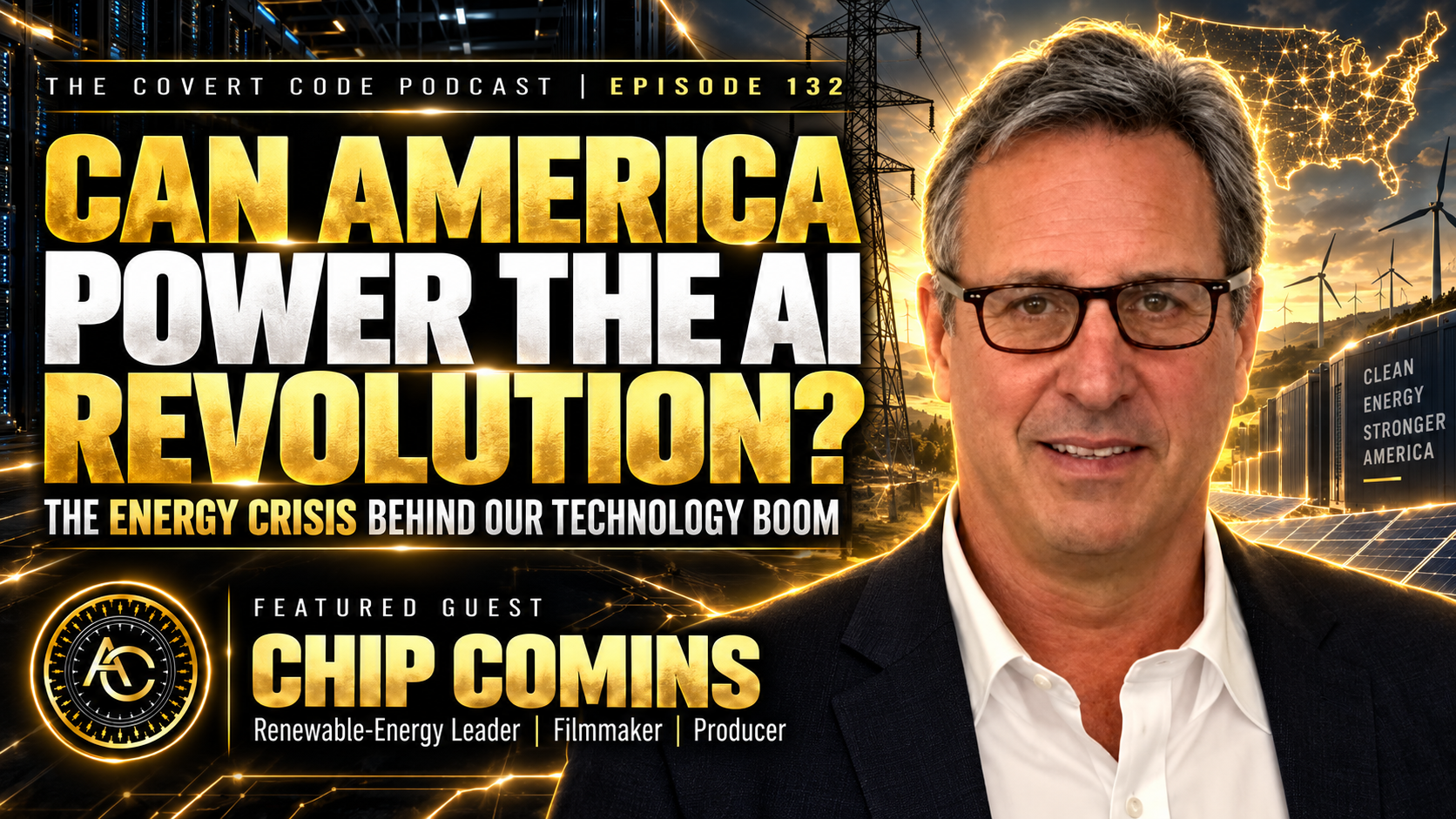
Can America Power the AI Revolution? The Energy Crisis Behind Our Technology Boom
Artificial intelligence may feel digital, but the infrastructure powering it is decidedly physical.
Every AI query, model, and data center ultimately depends on electricity. And as artificial intelligence expands alongside electric vehicles, battery storage, and the broader electrification of the economy, one question is becoming increasingly difficult to ignore:
Can America’s electrical infrastructure actually keep up?
On this episode of The Covert Code Podcast, Anna Covert sits down with renewable energy leader Chip Comins to explore the energy challenge behind the technology boom.
Comins is the founder, chairman, and CEO of the American Renewable Energy Institute (AREI), the founder of AREDAY, and Chairman of the American Energy Initiative‘s HVDC SuperGrid effort.
AI Has a Physical Infrastructure Problem
The AI revolution isn’t happening somewhere in an invisible cloud.
It is happening inside enormous physical data centers filled with computing equipment that requires electricity, cooling, and supporting infrastructure.
At the same time, America’s demand for electricity is being influenced by much more than AI. Electric vehicles, battery systems, connected devices, industrial electrification, and other technologies are changing how electricity is generated, transmitted, and consumed.
For Comins, that makes the energy conversation inseparable from the technology conversation.
If the United States wants to remain competitive in artificial intelligence and advanced technology, it must also consider whether the infrastructure underneath those industries is prepared for dramatically different patterns of electricity demand.
What Is an HVDC SuperGrid?
At the center of the conversation is a technology known as High Voltage Direct Current, or HVDC.
America’s traditional transmission infrastructure primarily relies on high-voltage alternating current. Comins argues that HVDC offers an important advantage when electricity needs to move efficiently across very long distances.
His vision is ambitious: create an underground, coast-to-coast, and border-to-border HVDC mesh network across the continental United States.
You can explore the HVDC SuperGrid initiative here.
The key word is overlay.
Comins isn’t proposing that America rip out its entire existing electrical system and begin again. Instead, the HVDC network could operate alongside existing infrastructure, connecting into regional systems through upgraded substations and other points in the grid.
Moving Energy From Where It Is Generated to Where It Is Needed
One of the biggest challenges with renewable energy isn’t simply producing electricity. It’s getting that electricity where it is needed, when it is needed.
A region may have enormous solar resources while demand is hundreds or thousands of miles away. Another region may produce significant wind power but lack sufficient transmission infrastructure to move that electricity to another market.
A more interconnected transmission network could help address that mismatch.
During the episode, Comins illustrates the concept by imagining renewable electricity moving between distant regions of the United States rather than remaining constrained by today’s transmission boundaries.
America Doesn’t Really Have One Grid
Another important part of the discussion is the structure of America’s existing electrical system.
Comins explains that the continental United States is broadly divided among the Eastern Interconnection, Western Interconnection, and the Texas grid.
These systems do not operate as one seamless national electricity network.
That becomes increasingly important when electricity demand is growing in one location while abundant generation may exist somewhere else.
The proposed SuperGrid is intended to create another layer of connectivity capable of moving electricity across greater distances.
Why Put the SuperGrid Underground?
Transmission isn’t only an engineering challenge. It is also a land-use, permitting, and public-acceptance challenge.
Large overhead transmission projects can face significant opposition from communities that don’t want major power lines crossing their property or changing landscapes.
Comins argues that burying an HVDC system could help address some of those concerns while potentially improving resilience.
The conversation explores using existing transportation corridors—including interstate highways and railroad rights-of-way—to create energy corridors rather than requiring entirely new routes across the country.
Underground infrastructure also introduces a broader discussion around resilience, extreme weather, and security.
The Data Center Challenge Isn’t Just Electricity
AI data centers create another infrastructure challenge: cooling.
Large computing facilities can require substantial cooling resources, making water availability part of the conversation in some regions.
That’s especially significant in parts of the western United States already facing water constraints.
Where data centers are built, how they are powered, and how they are cooled may therefore become increasingly interconnected decisions.
Could Existing Infrastructure Become the Foundation?
One of the most interesting ideas in Comins’ proposal is using infrastructure corridors America already has.
The interstate highway system stretches across the country. Rail corridors connect major regions and commercial centers.
Rather than creating every right-of-way from scratch, Comins believes those corridors could potentially play a role in a national transmission buildout.
That doesn’t make the regulatory process simple. Federal agencies, states, utilities, transportation departments, infrastructure companies, and private landowners could all become part of the equation.
But it reframes the challenge.
The question becomes less about whether America has corridors connecting the country and more about how those corridors might be used differently in the future.
A $2 Trillion Infrastructure Vision
Comins estimates that building the nationwide system he envisions could cost approximately $2 trillion.
He describes the concept as a public-private undertaking in which existing utilities and infrastructure operators would continue playing significant roles rather than creating an entirely separate electricity ecosystem.
The broader American Energy Initiative presents the SuperGrid as part of a modernization strategy designed to support a national electricity market and growing energy demand.
Renewable Energy Is Also an Economics Conversation
For Comins, renewable energy isn’t simply an environmental issue.
It is an economic and competitiveness issue.
If AI, manufacturing, and other advanced industries increasingly depend on massive quantities of electricity, then the availability, reliability, and cost of that electricity could influence where those industries grow.
That makes energy infrastructure part of America’s broader technology strategy.
The future of AI may therefore depend as much on transmission lines, substations, and generation capacity as it does on chips, algorithms, and software.
What Hawaii Can Teach the Rest of the Country
The conversation becomes particularly relevant from Anna’s home in Hawaii.
Hawaii has established a goal of reaching 100% renewable electricity by 2045 and has become an important testing ground for solar, batteries, and distributed energy.
Anna shares her own experience participating in a battery program in which stored residential energy can support the broader grid during periods of demand.
It demonstrates a larger shift in how we think about electricity.
A home with solar panels and batteries isn’t necessarily only a consumer anymore. Distributed energy resources can potentially become part of a larger, coordinated electricity system.
From Virtual Power Plants to a National SuperGrid
Virtual power plants offer an interesting parallel to the national concept discussed in the episode.
Thousands of individual batteries, solar systems, or other distributed resources can be coordinated to behave more like a larger power resource.
Comins’ SuperGrid concept tackles a different scale of the same fundamental challenge:
How do we connect energy resources to demand more intelligently?
One happens at the distributed level. The other happens through massive transmission infrastructure.
Both demonstrate why the future grid may look very different from the centralized, one-directional electricity system of the past.
Energy, AI, and America’s Next Infrastructure Era
The scale of the proposal is enormous.
So are the forces driving the conversation.
AI is growing. Data centers are expanding. Transportation is becoming increasingly electrified. Homes and businesses are adding batteries. Renewable generation continues to develop. Electricity is becoming more deeply embedded in nearly every part of modern life.
That means the infrastructure underneath all of it matters.
America spent previous generations constructing railroads, highways, telecommunications networks, and the electrical grid.
The question now is whether another major infrastructure transformation is beginning.
Technology Alone Isn’t Enough
Comins has spent decades not only working in renewable energy but also using storytelling to communicate environmental and energy issues.
His film work includes serving as an associate producer of Racing Extinction, and he has produced and directed documentary content for educational and broadcast audiences.
That experience shapes another important theme of the episode: infrastructure transformation requires public understanding.
Technology may provide possible solutions, but people still need to understand why change is necessary and what those solutions could mean for their lives.
Optimism—and Execution
Despite the scale of the challenges, Comins remains optimistic.
The technologies already exist.
Renewable generation exists.
HVDC transmission exists.
Battery technology exists.
What remains is the far more complicated challenge of bringing technology, capital, infrastructure, policy, and public support together at sufficient scale.
And as artificial intelligence accelerates electricity demand, the timeline for answering those questions may be getting shorter.
Connect With Chip Comins
American Energy Initiative:
https://americanenergyinitiative.net/
American Renewable Energy Institute / AREDAY:
https://areday.net/
HVDC SuperGrid:
https://areday.net/hvdc-supergrid/
LinkedIn:
https://www.linkedin.com/in/chipcomins
American Spirit Productions:
https://americanspiritproductions.com/
Watch The Full Episode
Watch the complete conversation with Chip Comins on The Covert Code Podcast and subscribe for more conversations exploring technology, business, innovation and the forces shaping our future.
Can America Power the AI Revolution? The Energy Crisis Behind Our Technology Boom
The Covert Code Podcast | Episode 132
Host: Anna Covert
Guest: Chip Comins
This transcript has been edited for readability, with obvious transcription errors in names and technical terminology corrected. Statements and estimates are those of the speakers.
Episode Transcript
Anna Covert [00:00:16]:
Aloha. My name is Anna Covert, and I'm coming to you from my battleship here on the beautiful island of Oahu. This week on The Covert Code, the topic is: Can America power the AI revolution? The energy crisis behind the technology boom.
My very special guest is Chip Comins, a renewable energy leader, filmmaker and producer. Chip is the founder, chairman and CEO of the American Renewable Energy Institute, founder of AREDAY, and chairman of the American Energy Initiative's HVDC SuperGrid effort.
For decades, Chip has worked to bring leaders together from energy, science, business, technology and media to advance practical solutions for our changing world. His work connects renewable energy innovation, public engagement and storytelling.
Today, we'll be discussing how AI is reshaping America's energy needs and what a SuperGrid of the future might look like. Thanks so much for being here today, Chip.
Chip Comins [00:01:26]:
Thanks for having me on.
Anna Covert [00:01:28]:
So, to begin, we'd love to start off with a CliffsNotes version of the Chip story. What do you think are the most important facts we should know about your journey to where you are today?
Chip Comins [00:01:40]:
Great. Well, thank you very much. I would like to start with the year that I moved to Aspen, Colorado, to pursue my skiing dreams. That was in 1982.
That journey has taken me, in the beautiful town of Aspen, through many twists and turns to the founding of the AREDAY Summit, American Renewable Energy Day, in 2004, and the subsequent founding of the American Renewable Energy Institute in 2011.
But before that, I became a filmmaker. It was in my work making films that I learned the importance and significance of renewable energy and why that's important for our world.
One thing leads to the next. We had a beautiful summit that went from 2004 through 2019, 16 consecutive summits that attracted the likes of Ted Turner five times, but also T. Boone Pickens five times.
The last time Ted came, he brought Jimmy Carter and Rosalynn Carter. I was able to host President Carter in 2014.
We have a cross-sector dialogue and a cross-section of attendees, including James Cameron, when he had produced the movie Avatar, and other notables from Hollywood like Val Kilmer and Daryl Hannah.
We also had many governors, senators, congresspeople, experts in their fields, CEOs and captains of industry representing solar, wind, biofuels and energy efficiency.
It expanded from there to talking about Earth systems, atmospheric systems, ocean systems, food, shared watersheds, regenerative agriculture—pretty much the entire gamut when we talk about sustaining our world and creating a place where we can all live and breathe.
What Is an HVDC SuperGrid?
Anna Covert [00:03:56]:
That's amazing. What an incredible roster.
Before we dive into some of the really nerdy things that we all love, can you share with people who are listening and don't know what the SuperGrid is? Tell us what HVDC stands for and what it means to the regular consumer.
Chip Comins [00:04:14]:
Of course. The SuperGrid is based on high-voltage direct current, not alternating current.
The reason I have the map of the Earth behind me—you see those lights? Those are cities that are lit up at night by the grid.
The global grid is largely an aboveground high-voltage alternating current grid that has provided electricity for our homes and businesses for 100 years.
But now that the human population is exceeding eight billion, and with the invention of AI and the data centers, our needs for electricity have grown enormously.
We need to go to a much more efficient and effective way of moving our electricity. High-voltage direct current is able to go long distances with great efficiency.
With the AC system, you can only get up to about 400 miles. What we're promoting in the United States is a coast-to-coast, border-to-border, underground HVDC mesh grid in the continental United States.
It's very important to understand that it's a mesh grid.
If we were to build that along the interstate highway systems, rail corridors, river bottoms and coastlines, we could send electricity in both directions—not at the same time, but in both directions.
We could take wind from Maine and move it to San Diego. Or we could take solar from Arizona and move it to Minnesota, and we could do it at the speed of light in real time.
The last thing I want to say is that we have to solve the issue of NIMBYism, which has been a great obstacle to the expansion of the U.S. grid system.
NIMBY stands for "not in my backyard." Nobody wants to see these high-tension power lines, and they don't want them going over their homes because of perceived health effects. We also don't like the fact that we can see them. They're an eyesore.
If we bury the grid and solve that problem, that opens up the opportunity.
I also like to remind your listeners that the grid in the United States comes in three sections. There's the Eastern grid, the Western grid and the Texas grid, also known as ERCOT.
These grids don't necessarily communicate with one another very well. Some have a very high percentage of renewable energy, like Texas. About 30% of its energy comes from wind, along with a smaller amount of solar and battery storage.
I'll stop there. I think that's a pretty decent overview.
Anna Covert [00:07:16]:
It is. I think one thing people really need to understand is how much power is lost when we transmit electricity today.
You said it can go 500 miles. Well, by the time it gets to the end of that wire, to its destination, we lose 60% of the power.
It's not just an eyesore, fire hazards and the environment. It's also very inefficient, which I think is one of the biggest problems we're experiencing today.
We're looking at a model. Is this the same thing that they did in Korea?
Chip Comins [00:07:51]:
They're using high-voltage direct current in other countries. China is the leader by far, but they're not burying it. They're moving it from Inner Mongolia down to Beijing.
They have large runs of a thousand miles, and they know the benefits of changing from an AC to a DC system.
At the end of the day, whoever has the cheapest energy is going to rule the roost. It will be the leader on planet Earth.
Right now, we are playing second fiddle, third or fourth down the line.
The SuperGrid concept and the HVDC concept are very well known throughout Europe. But remember, it's very complicated in Europe. There are more than 30 countries, and they don't all have the same system.
Think of what it would be like if all 50 of our states had their own separate systems and weren't connected, instead of just three: Eastern, Western and Texas. It would be much more difficult.
Still, the difficulties are enormous, and we can solve them with this system that we're promoting, based on my colleague Sandy MacDonald's work that he created at NOAA.
We can get into that a little bit later.
Who Would Own and Finance the SuperGrid?
Anna Covert [00:09:07]:
One of the things I think is also very interesting is that people don't really understand that, in a lot of places like here in Hawaii, the utility company is really the only monopoly.
You can decide where you want cable, but you cannot decide where your power comes from. In places like Texas, you can.
That's because of the upfront investment in the technology that we're now kind of grandfathered into.
When we look at places like Texas, where it's more open and you could throw a shoe and hit a utility company, what would be the ownership structure of this SuperGrid?
Who would own it? And what would happen to independent power companies?
Chip Comins [00:09:53]:
The ownership structure we're promoting is a national grid that is paid for by the consumer. We don't want the taxpayer to pay for it.
We want the grid to be managed by those who already manage the grid system. We don't need to reinvent the wheel here. We just need to make smarter use of our technology.
How would we go about funding it? Obviously, this is a true public-private partnership.
Most of the railroad corridors are owned by private railroad interests. The interstate highway system goes through the 48 lower states here in the continental United States, and each state Department of Transportation would have to be part of that.
It's expensive to do the entire nation as we're envisioning it. It would be somewhere in the neighborhood of $2 trillion, with a T.
But that's not a lot of money when you look at our national debt and our annual GDP, which is $40 trillion. We have the ability, as the world's largest economy, to do this, and it would pay for itself within the first couple of years.
Anna Covert [00:11:22]:
I would imagine the first thing would be kind of like straight across. You're creating the grid, and then you're going to rely on local substations and other infrastructure to carry it into homes, correct?
Hopefully, they're now going through the process of updating their equipment and burying wires and things like that.
They would become the power center, and we would still use the same infrastructure we have now to disseminate electricity.
Chip Comins [00:11:49]:
We're promoting an overlay. We're not talking about replacing the preexisting grid. We're talking about working with it and then integrating through reconfiguring the upgrades at the substations and so forth.
It does get into some great engineering complications, but suffice it to say that we have the technology. We know how to do this.
The computer models have indicated that, were we to do this on the planet, we would actually decrease our carbon throughput by 40%.
That's a whole other conversation. But the reality is that how we produce energy—coal, oil, gas, nuclear, hydro, solar, wind and geothermal—is creating the problem we're experiencing with these massive floods, droughts and wildfires sweeping across the planet.
We need to connect the dots and tell the truth about why it's happening and how we can stop it and, in fact, reverse it.
Virtual Power Plants and Renewable Energy
Anna Covert [00:12:54]:
Absolutely. I think this is a concept that's becoming more common.
We're already seeing markets like New Jersey and California starting to talk about virtual power plants, where someone who has solar and a battery can opt in.
I have that here in Hawaii to help offset the state's reliance on coal.
A few years ago, we shut down the coal facility, and I was part of a battery rebate program where the state paid me to get my Powerwall.
Now, every night, I allow them to draw from my Powerwalls to help offset the grid.
Community solar, virtual power plants and using distributed resources are becoming more common.
This is a bigger example of that—someone in Arizona could help someone in New York.
Chip Comins [00:13:47]:
Absolutely. The fact of the matter is that we're energy agnostic. This grid will take energy from any source.
But we feel that Wall Street needs to lead this change forward, and that goes to the lowest cost of power.
The reality is that solar and wind are the lowest-cost sources of energy.
The numbers are approximately two cents per kilowatt-hour for solar and wind, four cents for natural gas, eight cents for coal and fifteen cents for nuclear.
With those numbers, it doesn't take a financial genius to figure out the way to go here.
What's going to lift everybody's ship will be the buildout of utility-scale renewable energy, primarily solar.
AI, Data Centers and Growing Electricity Demand
Anna Covert [00:14:55]:
One thing I think we have to discuss is demand charges.
If you use more power or you use power during peak times, you get a charge.
Let's talk about these data centers in your new model. A data center is going to use a lot more power than a homeowner would.
How is it going to work so that everyone can get a fair share of power? Is there a plan for that in place?
Chip Comins [00:15:26]:
Quite frankly, right now, as you know, it's the Wild West. There aren't any plans in place.
They're putting up thousands of data centers as quickly as they can get communities to let them.
There's quite a bit of resistance because of what you're saying. There's no way to get the power or the water.
Don't forget, these CPUs have to be cooled with fresh water, and water is in very short supply, especially here in the West and the Colorado River drainage.
We just had to cut 20% in Arizona, Nevada and California because it did not snow adequately in the Colorado Rockies last winter.
We're really experiencing massive effects of this 20-year drought that we're in right now.