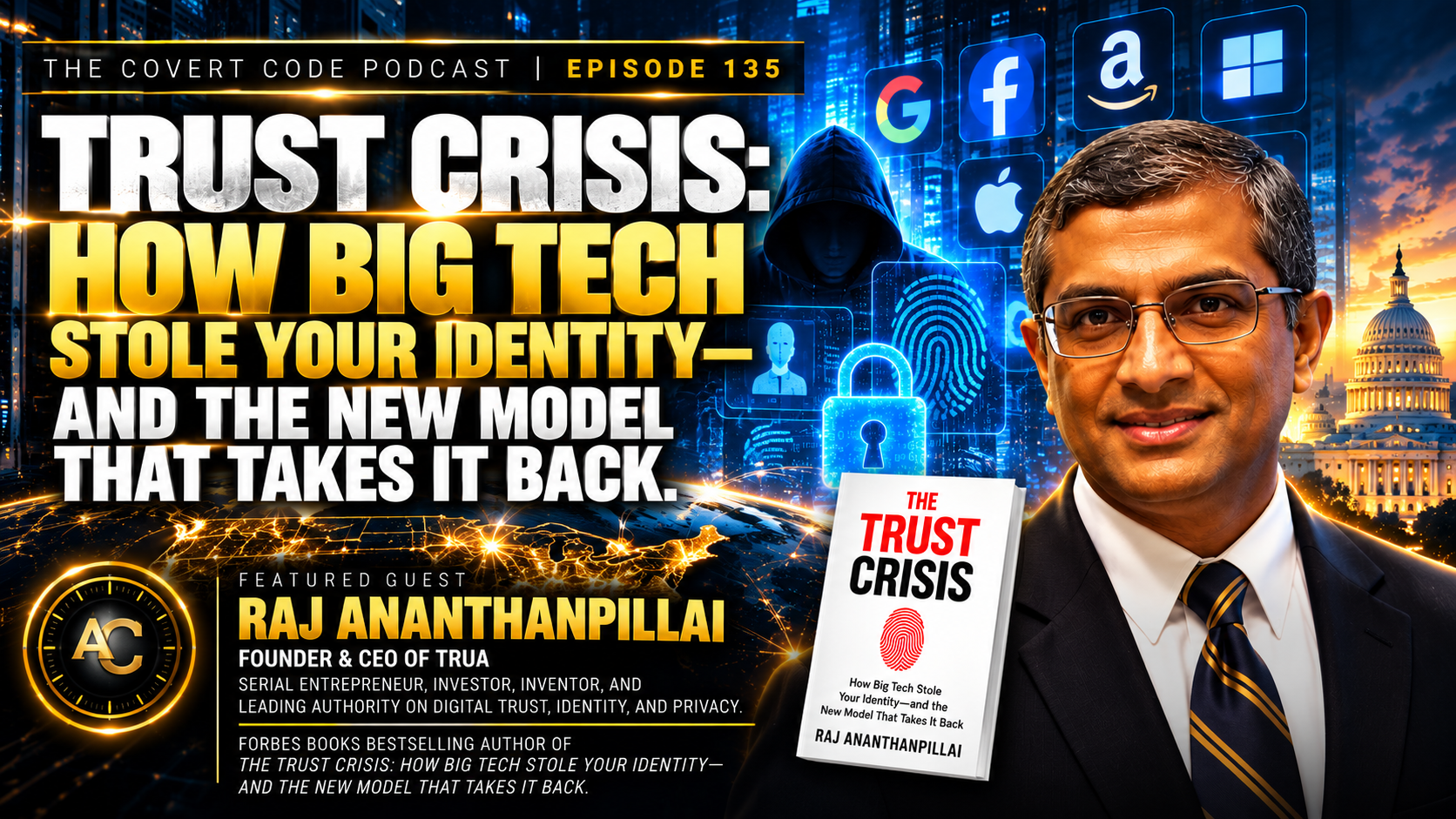
The Trust Crisis: How Big Tech Stole Your Identity—and the New Model That Takes It Back
Featuring Raj Ananthanpillai | Founder & CEO of Trua | Forbes Books Bestselling Author
Hosted by Anna Covert
How many companies have your Social Security number, driver’s license, date of birth, or other sensitive personal information sitting in a database somewhere?
Now consider how many of those organizations actually need to retain that information—and what happens when their systems are compromised.
In Episode 135 of The Covert Code Podcast, host Anna Covert welcomes Raj Ananthanpillai, Founder and CEO of Trua, serial entrepreneur, investor, inventor, and author of the Forbes Books bestseller The Trust Crisis: How Big Tech Stole Your Identity—and the New Model That Takes It Back.
Raj believes the way we establish trust online is fundamentally flawed. Businesses repeatedly collect sensitive information, consumers have limited control over where that information goes, and cybercriminals have countless opportunities to exploit the system.
His proposed solution is a different approach to identity verification: prove who you are without repeatedly surrendering the personal information that makes you vulnerable.
The Equifax Breach That Changed Everything
For Raj, the 2017 Equifax data breach was a defining moment. Sensitive information belonging to more than 140 million people was exposed, illustrating the extraordinary consequences of a security failure at a company holding enormous amounts of personal data.
What concerned him most was not simply the breach itself, but the identity verification infrastructure that made such a breach so damaging.
Organizations routinely request personal information, store copies in their systems, and then invest significant resources in protecting those databases. Every additional collection of sensitive information creates another potential target.
Raj describes these concentrated stores of information as attractive targets for cybercriminals.
His central question is simple: Why do businesses need to collect all this information if their real objective is merely to verify something about a person?
How Big Tech Turned Personal Information Into a Business Asset
The internet was initially built around information sharing among researchers and academic institutions. As commercial platforms expanded, a new business model emerged: consumers received free digital services in exchange for their personal information.
Over time, data collection became embedded in nearly every digital interaction.
Email addresses, phone numbers, browsing behavior, purchase histories, location information, and increasingly sensitive identifiers became part of an enormous data economy.
Raj argues that consumers were never fully prepared for how extensively their information could be collected, combined, analyzed, and monetized.
Anna approaches this conversation from her experience in digital advertising, where collecting large volumes of data has historically been considered a competitive advantage.
But more information does not necessarily create better marketing—or better customer relationships.
In a related conversation on what website data is really telling businesses, Anna and analytics expert Philippa Gamse explore why meaningful insights matter more than simply accumulating additional information.
The lesson applies equally to privacy: businesses should understand why they are collecting information, how it will be used, and whether they need it in the first place.
Why Social Security Numbers Are a Dangerous Identity Standard
One of the most revealing parts of the interview concerns the widespread use of Social Security numbers as identity credentials.
Social Security numbers were not originally designed to serve as universal proof of identity. Nevertheless, they became embedded in banking, employment, credit reporting, and numerous other verification processes.
Raj emphasizes the difference between information that can be changed and information that generally cannot.
If an email address is compromised, you can create another. If a password is exposed, you can reset it.
But your birth date and Social Security number are not easily replaceable.
Once this information is exposed, criminals may attempt to exploit it repeatedly, creating risks that can persist long after the original breach.
Rather than continuing to rely on sensitive personal identifiers as verification tools, Raj believes we need a new digital trust infrastructure.
Introducing the Trust Bureau: A Different Way to Verify Identity
Raj’s proposed model draws inspiration from identity verification systems he helped develop, including foundational work associated with TSA PreCheck.
In that environment, travelers complete a verification process and receive a credential that can be reused rather than undergoing the same comprehensive screening at every interaction.
Raj wants to bring a similar principle to commercial identity verification.
How the Proposed Trust Bureau Would Work
- Verify your identity: An individual completes an initial identity verification process.
- Receive a digital credential: The individual receives a reusable trust credential associated with their verified identity.
- Control what gets shared: When an organization requests verification, the individual authorizes specific information to be checked.
- Generate a trust token: A transaction-specific token enables the organization to request the appropriate verification.
- Receive confirmation: A neutral Trust Bureau provides the required verification results without unnecessarily disclosing underlying sensitive personal information.
Imagine applying for a job where an employer needs to verify your identity and eligibility.
Instead of submitting multiple identity documents to another company database, you could authorize the employer to receive confirmation of the relevant facts.
The employer gets the information needed to make a decision, while the applicant retains greater control over sensitive personal details.
Raj calls this a new trust layer for the digital economy.
Importantly, the Trust Bureau is Raj’s proposed model for broader adoption—not an identity system that every business already uses.
Giving Consumers Control Over Their Own Information
Another important element of Raj’s approach is allowing individuals to review and verify their own information.
Today, inaccurate background records, outdated addresses, name changes, and information incorrectly attributed to another person can create serious complications.
Someone might be denied employment or experience financial difficulties because an existing database contains inaccurate information.
Raj explains that his proposed system would allow individuals to review relevant information before receiving a credential and periodically update their records.
Anna raises practical questions about name changes, moving between states, and the difficulty of correcting outdated information held by multiple organizations.
The larger principle is that individuals should play an active role in verifying information about themselves rather than relying entirely on disconnected databases.
AI Agents Are Creating an Entirely New Identity Problem
Artificial intelligence adds another layer of urgency to the trust crisis.
AI assistants are evolving from tools that answer questions into agents capable of conducting transactions, making purchases, and taking actions on behalf of users.
Raj raises an important distinction: a system may be able to validate a transaction or an AI agent’s instructions without necessarily establishing whether the human behind that agent has been properly verified.
Who is accountable when an AI agent acts on behalf of an individual?
And how do businesses know whether the person authorizing that agent is legitimate?
These questions matter for financial services, digital commerce, employment, and other industries where verification and accountability are essential.
Anna has explored similar concerns in previous episodes. In Episode 129 with Tamara Laine, the conversation examines AI-powered lending, responsible data access, and why sensitive information should not automatically be exposed to AI systems.
Both conversations reinforce a critical principle: AI systems need clearly defined permissions, trusted information, and human accountability.
Protecting Children’s Identities in a Digital World
Children are particularly vulnerable to certain forms of identity theft because fraudulent activity may go unnoticed until they are older.
Anna asks Raj how his proposed credential system could address children’s identity protection as online services face increasing age-verification requirements.
Raj argues that online platforms should be able to establish whether a user meets an age requirement without collecting unnecessary personal information.
For example, a service that needs to determine whether someone is old enough to access a particular feature may not need that person’s complete identity documentation.
Verifying eligibility without collecting additional sensitive information could help reduce privacy risks.
However, implementing such systems would also require careful consideration of accessibility, accuracy, appropriate safeguards, and differing legal requirements.
What the Trust Crisis Means for Digital Marketers
One of the most interesting aspects of the interview is the connection between digital identity and responsible marketing.
Anna emphasizes that effective marketing should be based on relevance, permission, and a genuine understanding of consumer needs.
Businesses do not need unrestricted access to highly sensitive identity information to develop successful advertising campaigns.
Instead, companies should prioritize meaningful first-party relationships, consent, and accurate information that customers have chosen to share.
Anna and Raj discuss how outdated third-party data can create unnecessary costs and inefficiencies.
A person who was interested in a product last month may no longer be shopping for it today. Continuing to market based on outdated signals wastes resources and may undermine customer trust.
The conversation also connects to an earlier episode with Chip Higgins, where Anna discusses the importance of evaluating technology vendors, understanding data collection practices, and protecting businesses from privacy and compliance risks.
Responsible digital growth is not about collecting everything possible. It’s about collecting what is necessary, obtaining appropriate consent, and using information thoughtfully.
Could a Trust Bureau Reduce Business Costs?
Raj believes a more efficient verification model could eventually help businesses reduce spending associated with identity checks, background screening, data storage, cybersecurity, and compliance.
Instead of every organization maintaining its own extensive verification infrastructure, businesses could obtain the necessary confirmation through a trusted system.
That could potentially simplify onboarding and reduce the amount of sensitive information organizations are responsible for protecting.
However, these potential benefits would depend on real-world implementation, security, reliability, adoption, and regulatory acceptance.
Raj’s vision is not to eliminate legitimate business verification. It is to make that verification more efficient while reducing unnecessary exposure of personal information.
Why Raj Wrote The Trust Crisis
Raj explains that The Trust Crisis is his third book and reflects his longstanding interest in developing solutions to complex technological problems.
His goal is to encourage a broader conversation about the limitations of existing identity systems and the possibilities of a more consumer-controlled approach.
He also shares that he is directing the proceeds from his book toward the Identity Theft Resource Center, a nonprofit organization that provides education and assistance to victims of identity theft.
The book is both an examination of how digital identity became so vulnerable and a proposal for changing the way society establishes trust online.
Explore The Trust Crisis and purchase the book here.
The Future of Digital Trust Starts With Collecting Less
For decades, organizations have approached digital identity by asking what information they need to collect to establish trust.
Raj believes the more important question is how organizations can establish trust without unnecessarily collecting sensitive personal information.
As artificial intelligence accelerates and digital transactions become increasingly automated, this distinction will become even more important.
Consumers need practical ways to protect their identities. Businesses need dependable verification systems. And regulators need approaches that address real risks rather than simply adding more paperwork.
The Trust Bureau model offers one possible direction for that future.
Whether it becomes a widely adopted standard remains to be seen, but the underlying challenge is undeniable: our digital economy needs better ways to establish trust.
Perhaps the future of digital identity isn’t about sharing more information. It’s about proving what matters while revealing less.
Watch or Listen to Episode 135 of The Covert Code
Join Anna Covert and Raj Ananthanpillai for this discussion about Big Tech, personal privacy, identity theft, artificial intelligence, and the future of digital trust.
Explore additional conversations in the The Covert Code podcast archive.
Connect With Raj Ananthanpillai
- Trua — Official Website
- Raj Ananthanpillai on LinkedIn
- Raj’s Forbes Books Author Profile
- Purchase The Trust Crisis
- Identity Theft Resource Center
Listen to The Covert Code on Your Favorite Platform
About The Covert Code: Hosted by Anna Covert, author of The Covert Code, the podcast explores digital marketing, technology, business, privacy, and innovation through conversations with entrepreneurs, authors, and industry leaders.
Discover The Covert Code and subscribe for more conversations about the ideas shaping how we succeed on and offline.
THE COVERT CODE PODCAST | EPISODE 135
Trust Crisis: How Big Tech Stole Your Identity—and the New Model That Takes It Back
Guest: Raj Ananthanpillai, Founder & CEO of Trua
Transcript adapted from the supplied automated transcription. Speaker labels are assigned based on context; automated transcription errors and unclear passages may remain. Review against the recording before publication.
Full Episode Transcript
Aloha. My name is Anna Covert, and I'm coming to you from my battleship here in the beautiful island of Oahu. This week on the Cobra code, the topic is the truss crisis, how Big Tech stole your identity, and the new model that takes it back. My very special guest is Raj and Nathan Penny, founder of true. He's a serial entrepreneur, investor, inventor, and a leading authority on digital trust, privacy and security. He's also the author the Forbes Books bestselling author of The Trust Crisis How Big Tech Stole Your Identity, and The New Model That Takes It Back. Throughout his career, he has developed critical identity verification, risk management, and screening technologies used by the federal government, fortune 500 companies, and national security programs, including one of my favorites, TSA PreCheck. Today, Raj is going to explain how Big tech gain control of our personal information. Why are digital identity security protocols today are failing us, and how we can finally get control back over our online identities? Thanks so much for being here today, Raj. This is, of course, as my listeners know, one of my most passionate topics is privacy and security. So I'm really excited to have you here. Thank you Anna. Thanks for having me on your podcast and your beautiful Hawaii. Thank you. So
you should have done this in person. Oh,
that would have been put out any time. And we'll do another breakout. Okay. So to get started, we like to begin with a little CliffsNotes version. Tell us, how did you get yourself into securities and and where you are today that you think is important before we begin geeking out together?
Um, yeah. I mean, you know, one of the major turning points for me about this whole trust crisis issue was the 2017 data breach that happened, uh, with Equifax. So 140 plus million people, really, really personal information got exposed because of a flaw in their system, and then they never bothered to patch it, and then they got a slap on the wrist, maybe some fines, but their stock and their value and their company is flourishing still. So. And that's when I said it's predominantly I think they are not the only culprits in this. It's the entire, uh, what I call the big tech, right. So and I started researching that, you know, I said, having developed the, uh, foundational work for TSA PreCheck, which is only after nine, 11 attacks. Uh, you know, people are standing in long lines to go to the security. And one of the things we said, hey, how about if we give them a speed pass, you know, we'll screen them first. We get all of their information, and then we'll do it on an ongoing basis, but we'll give them like a token now. But in that case we call it non traveler number or DNS. And then they can just use that to go through any airport any airline and so on and so forth. So and I was thinking about this breach and. This whole TSA concept. Um, you know, the company that I did that with, you know, I sold that back in 2017. I had a non- compete for a while, and then this thing happened and I said, you know, okay, I was biting my tongue. I said, okay, I got to get going and see if I can bring a similar, uh, solution to the marketplace in the in the commercial world where you get your credential once and use that for, uh, verifications, because we all go through identity verification from a variety of use cases, and we tend to give out your personal information over and over again for every application, whether it's a gym membership or banking or, you know, uh, anything else, any other club membership or, or, uh, you know, or if you want to get childcare or those kinds of stuff, everybody is asking for your personal information and they all collect that, store it and then verify it and then say, okay, I need this. And then a portion of them use it for nefarious purposes like marketing you micro targeting and so on and so forth using your personal information. And the other half, they sleep at the switchboard and they get hacked. Right. So and then that is the reason I call them honey parts. That is across all of our ecosystem. And I said we got to solve that problem. And being a solution ist at heart. I said I got to figure out how to do this. And then on my journey here.
Wow. That's that's amazing. Did you. Were you also involved in Global Entry?
Well, Global Entry takes the cues from TSA PreCheck architecture. So, uh, Global Entry is basically doing the exact same thing. The only difference is TSA PreCheck is by TSA, uh, in our infamous bureaucracy. And Global Entry is by CBP. And they don't want to talk to each other. And I when we were developing this, uh, TSA PreCheck, it used to be called registered travelers, just so you know, originally. And then they came up with a marketing terminology and they said, hey, you know, why don't you reuse some of the architecture and technology? But what are you done? I think it had to go way above my pay grade in terms of all of those things. And by the way, we did that as a, as a, as a company, not as a government employee. Just so you know. Because we had the technology, they came to us and said, hey, can you build this? So the IP was always with us.
Excellent. So before we dive really deep for those who are not as familiar. Can you walk us through some of the you know, there's a lot of different information that's collected and stored, but we both know that depending on where you live, like if you're in Europe, there's, you know, General Data Protection Act. And if you're in California there's different regulations and they really break down the data into different key milestones. So what is personal information. And, you know, give it a little overview of of the what kind of situation we're in before we
dive. So I mean today all of the information is out there right. And I'll tell you about how we got here in a minute. Yeah. So the the data that I'm most concerned about that actually affects your life. Okay. Email. You can change it. Right. Okay. Okay. I'm going to dump that email. Go to a different email. Right. Address. You can have a P.O. box or do something else. And that's gone right. So some of those peripheral data people use it for marketing and other purposes. I'm less concerned about that. I'm most concerned about your intimate data that it does not. Uh, you don't have the opportunity to change it unless there's, you know, hell freezes over, like Social Security, your date of birth, your, you know, uh, driver's license or a passport number and passport number. You can get it, but it's a hassle. But somebody else may have it. They could still potentially do harm. Right. So those are the kinds of stuff that I. We were focused on. And the way we came about is when the digital transformation started happening in, you know, mid 90s to late 2000 and early 2000. Right. So what was the big, big, uh, marketing push by all of the, uh, digital, uh, companies? And hey, download this is for free, download this app, download this app. It's free. Just give me your email. Give me this, give me this, give me this. So they were collecting something for free, uh, collecting from you, but they're giving you something for free. So we all got into this comfort zone where we started getting things for free in exchange for giving our own personal information. But you always, you know, the consumers always did not have the, uh, foresight that. Oh, they're going to use it for other purposes, right. So data science took over and then, you know, all of those micro targeting, micro, uh, you know, uh, info influencing and so on and so forth. If you think about it, we never knew about all of those things. And in the early days, if you see all of the digital platforms, the way they were measured by Wall Street and investors was number of eyeballs. So the more number of eyeballs their stock price was going through the roof. And how do you get more eyeballs? Give something for free that doesn't cost you anything. Men are very minimal, and that's exactly how they are doing this. And why don't you establish that little bit of relationship with a certain app or something? Then you begin to trust and then they start offering other products, and then you start giving out additional information and then guess what? That's when it starts proliferating. Right? And then that became a de facto standard for everybody to verify. You use your personal information like social data. But if you go back to the history of Social Security and Social Security number, it was never, ever designed for identity verification. In fact, the triggering point for me was in 2017 that Equifax breach happened in the congressional testimony. One, I forget who it was, but somebody asked, where do you guys need Social Security number? And they said, that's how we identify people. And I said, Holy mackerel. So I said, that was never designed for that. But everybody assumed that's the de facto standard it was designed for wages, taxes and and government benefits. Those are the only three things, if you think about it. But some of that, uh, you know, uh, proliferated into our society as a de facto, uh, uh, identifier. Right. And then they said, okay, Social Security is getting too much. And then, okay, we'll pair that with the date of birth so that there's no confusion. And then we'll pair that with one other attribute. And they're now the recent, uh, five plus years. They started pairing that with your phone number. Mhm. Right now you're getting all kinds of junk on your phone text messages and everything. Right. So they're collecting more and more and in the hopes that they can zoom in on the individual. Yes. There is a lot of fraud. So I said there has to be a solution. I'm running out of things to give you guys. I said there has to be a solution. And that's when I said, let's bring the same TSA PreCheck concept to the commercial work and figure out how to do that. And that's where we are, this concept. Yeah.
So so look, if. Keep going. So tell me, you know.
What is it? So. So I mean, like, this is a this is a transformational stuff because I'm not trying to patch. You know, yes, I can come up with a new solution or a new product to patch the existing vulnerability or this or that. And I went back to my drawing board and said, we have to fundamentally alter this because, you know, every, every major, uh, things goes through certain, uh, evolution, uh, throughout our history, right, compared to industrial revolution and this and that, if you think about it, 20, 30 years things. So in the last 20 plus years or 25 years, we have evolved into this whole digital, um, uh, ecosystem. And then the last couple of three years, AI sort of infiltrated into that, and now it's going through thousand times faster, whether it's data breaches or faking you or faking your identity, all of those things are exponentially increasing. I said the best way to do it is you get your trust credential wants, just like you would do in a in a TSA PreCheck concert. You verify, you know, it's a it's not a transaction. It's a one one time input, your information one time verification, and then you get a what we call a trust token number, similar to a known traveler number. Now this trust token number sort of becomes your alias. Meaning every time somebody says, hey, I need to verify you, I need information. And I need you. There's my token number. And how do they verify? I said, okay, what is the analogue in the current industry? Credit bureaus. So the people who check your credit report or credit a viability is they submit your Social Security to credit bureaus. And then the credit bureau says, yep, this person's credit report is your credit score is. And then you make a decision. And the same concept, we said, okay, when you give a trust token number to a relying party, somebody wants to verify you. They should be able to go to a neutral trust bureau. In this case I call it, instead of a credit bureau. They'll go to a trust bureau and then say, hey, I have this token number. Tell me about this. And some of the things that we have learned over the years is not to do right, share much information. So in this case, the Trust Bureau is going to give you the answers that you're looking for. So in case if I'm looking for is this person ID been verified and what document did you use. Did you use the driver's license or um, passport. Right. I need to know all of that. And as the facial being compared, you know, not a fake one. So is the liveness detection there, right? And then does this person have any criminal history or bankruptcy judgment whatever that I'm interested in? I will be asking that. And the bureau will just respond to those questions. Not giving any of your PII, just say yes, yeah, yes or no. The peer never leaves your premise and they all get the necessary answers. That's all most of them were interested in to begin with, but they didn't have the means to do it. Now, this whole infrastructure, the new trust layer I call it, is the way to do in the future.
Wow, that is genius. And being someone who specializes in digital advertising. So we've always been the ones that you kind of mentioned it that had been called the abusers or, you know, like I compare it to a chipmunk or a hamster. We like to hoard data and it's like, oh, it's all ours. But, you know, it's really not usable. It's my point that, yeah, it's so degradation and so watered down third party data, even third party data, it's not relevant. Like we should be looking at zero party or first data, zero consent data. Right. That they give it to you now and they take it away. But this is um, very, very, very interesting.
And remember I said I'm not very particularly interested in some of these other data like emails and, you know, addresses or affiliations, but they're all sort of, uh, you know, not next to impossible to expunge that, but your whole purpose of, you know, your whole livelihood could be affected. Bank bank balances could be wiped out. You know, damage could be done on your knee. Crime could be committed in your name. People are committing suicide when they have identity theft, right? Because they've lost everything they have. So that is where I'm most interested in your intimate, personal, personally identifiable information.
And so, you know, there's a there's been a lot of things over the past ten years, but we've both seen where some of these apps and they might be even reputable apps like, you know, the Nike running app or their flow app for women to track menstrual cycles, how that data has been used in ways that were potentially very damaging to an individual, like they were picked up or, you know, in crime, this one was like they committed a crime because they were running in that neighborhood. Turns out they didn't. But by the time they had to prove that they weren't a person, their whole life was destroyed. So how can we how can we take it down once we have this layer? How can we enforce it so that everyone has to comply and that they cannot, you know, manipulate and control people with this
data? Yeah, because this requires society to change. My goal is actually, truly, truly that. Because if I came up with a rocket science solution, it'll be very difficult to explain. Whereas this, you know, the credit bureaus and the great check has been in our ecosystem for the last 30, 40 years. So people understand that TSA PreCheck, majority of the people understand that. And I'm bringing those two together, those concepts together into this new digital and AI work. So it's going to take some time. Right. So you have to see the market with various digital platforms and say, hey, don't ask for it. It's in your head. Think about it. Right. I'm just using this as an example. Like Caricom for example, wants to verify you as a provider or you or I, uh, of care services before they get you on to their platform. So you have to submit all kinds of information. They do a background check or identity check or whatnot, and they're collecting it and keeping it on their on their thing. Why they don't need that. You are a care provider. All that they need is for paying your wages, whatever this. But they don't need all of the other information. Right. And so in this case we say I want to be a child care provider. Okay. Fill out this form and give me all this information now. I'm going to give you my trust token number. All that they have to do is, uh, you know, paying the trust token number against the trust bureau that says, okay, what is this person? Yep. This person. Excellent. About 18 can work. No child living well. And and yes, I've verified the facial and all the necessary attributes. No criminal records. So. Okay. Come on. On board. That should be there. So you can, uh, onboard much faster and you're generating revenue. And the people are also generating, uh, income. Right. So onboarding becomes faster because and I don't have as a platform get that platform. I don't have to invest in all of that infrastructure anymore.
Right. That's what I was thinking about. I'd like to do it and scan it and
yes, protocols. All that goes away. But what about, you know, like the idea of the subject, right. Request form right in Europe? Like, what if now I want I got married and I want to change my name and there's all these right now it's all paperwork, right? We've all been through it, but maybe you haven't been through it, but most lots of ladies, right?
Yeah, right. And then, you know. So. And or what if they get the name wrong or you know what? If something needs to be updated. So what's the protocol? Yeah.
Go ahead. Tell me that. Beautiful. That's a great question. I don't know if somebody planted that. And I'm just kidding. So the biggest thing that remember I said we have Taking some of these problems in the current process and address them. One of the biggest problems is wrongful attribution of data to individual family records and other data are really dirty. What we do is we have a patent around. It is you as a consumer gets to verify the data first. When you apply for a trust credential, like applying for TSA PreCheck, then you apply and then we will show you exactly what's there. You have to you have the option to fix it. Hey, this is what a lot of people have issues with junior, senior or married name in a maiden name, all kinds of stuff. You can fix all of that right up front. And then only your issued the trust credential and your trust open up. That means your data is verified. Imagine the downstream savings in compliance and litigation. A lot of if you see the litigation, the class action lawsuit today is because of wrongful attribution. Right of the data. You got the wrong person or you have even if there's one little issue, they got the wrong person and then they denied employment or denied something. Whatever it is. Remember, Equifax again had a problem because the the Fico score was wrong for about like 5 million people and they paid big, big fines. This was about 2 or 3 years ago. And it just came out that, you know, many of them were denied mortgages because the store was wrong. Yeah, because they had the wrong attribution. So these. This is the problem that is plaguing the current infrastructure. And he said, okay, if you got to solve that in our approach. So you as a first party and we call it first party verification of their data. So that means you truly have the data. And then again, if I'm asking for your information, you just don't give me anything and everything you say, okay? You just say, what is the purpose? What am I doing? Oh, I need you to verify just your identity and your background and your criminal record. I want to make sure you're not going to report that you as an individual. So in your app, you get that digital wallet. You because you have all the attributes. You just only slide the one that you want to share. It generates a dynamic, uh, a trust token number. And you share that token number and you can decide how long that token is valid as well you as an individual. And that way it says, okay, I'm going to give you 24 hours to do my verification. And then boom. And in this case you don't need 24 hours because that number comes to a what I call a system in the platform. And the platform automatically bounces it off against the trust bureau. And the trust bureau says, yep. Verify all the answers they get. So it's high speed almost. Instead of collecting, storing, guarding and then buying cyber insurance on it. Think about all the stuff. So I write in that book. I say if this comes to a steady state, a state for Nirvana state five, ten years from now, right? This could substantially add to GDP, in my opinion, because today we are spending enormous amount of money on insurance and unnecessary insurance data breaches, big, big loss of compliance, all of those things because it's working on this current inefficient infrastructure. So we can collect all of that.
Even even tax collection I mean, we spend every dollar we collect. We spend $1.50.
Yep, yep. Oh, that's that's another one because
of this verification. Right.
Yes. Maybe it does. In fact, I wrote an op ed in the Washington Times. So I forget one of those things about this, you know, stamp. I call it snap Out of it, which is basically the snapshot that is going around everywhere in the government benefits. And that is big, big chunk. Uh, you know, it's three, $400 billion a year of fraud. And because people are not genuine, people are not getting it all the fraudsters are getting it because they don't check the identity nor their background before their, uh, brand. A government
benefits. Really. So
yes, that's a it's a huge problem. That's a huge problem I know that I've never done that works. So it's almost necessity. That alone has done at least $100 billion of fraud, which is basically the you have to verify their all of their identity and the background they have. They cannot be criminalized. And then, um, you know, income verification, all of those things. Let's assume. So we focus only on objective stuff so they don't even verify that you can just apply using somebody else's, uh, data. And then because everything is done remote, think about it. Since Covid nobody wants coming to the office. So back in those days you have to go to your local county office and show in person. Even then, people are looking the other way sometimes, but now it is quadruple fraud. And you said, okay, I'm not going to verify any of these things much. So and then they are doing the legacy way. All the verification is all the legacy, because I believe that continuous verification is the key for, uh, the next generation of problems that we are facing, whether it's AI or digital, uh, advanced digital technologies, because that's a big deal. And then you talk about their spending when it comes to fraud and fraud detection. They're spending $1.50 to go after a dollar of, uh, fraud. I said, that's very inefficient. And I'll be happy to send you that offer. Uh, yeah. It talks about. Yeah, it talks about some of those major issues. Uh, anyway, so that is the fundamental, uh, architecture. Let the consumers verify what's out there. For their own information. It's their data, actually. Right. But if I. Hey, this is not me. This is my son who got drunk and got a ticket. Uh, you know, whatever it is. And so that is that is very common. Or, uh, you know, uh, John Smith or, you know, John Smith, uh, one John Smith, two giants with three kind of stuff. Right? There's lots and lots of those kinds of stuff. And this gives a clean, uh, opportunity for individual to verify their own data, all their data, and verify their own things. They cannot change any of the background if you got to take it or if you have a code record, you cannot change anything unless you get it wrong. So we have multiple sources to verify that. And then once it is done. Yeah okay. Finally you agree to it and then boom you are granted the credential that goes with you. Again the credential is bound to you and not to any device, although it resides in your device, but it's bound to you as an individual.
And so would this be. How did we get to roll this out? Is it going to be a federal program with a mandate so that people share information? Because what about different cross lines like if you move? You know, I'm originally from Colorado. It was hard to get like a parking ticket. You know, will we be able to get the data out now in Hawaii? And I need something from another state. How are we going to mandate that? We like the subject. I request that it's my data. I demand it to be updated, purged, adjusted, corrected. You know, we don't have those rights in America. Not.
Yes. No no, no. You do have actually meaning. Meaning let's say you move or somebody gets married and name changes all of those things, right? So every six months it's configurable. But every six months or so you have to recertify all your data, you know, especially your biographic data. And if there are any changes you make those changes. Right. And then we verify that if you do a change of address or something, there is something that shows that you have changed. Yeah,
I mean, I got married and divorced. I kept my name. But now when I even look up, you know, like permit data, I still see my old name from, you know, 15 years ago. So no one's being forced to update it, right? Like.
Yeah. Yeah, yeah, that is so that's what I'm saying. I cannot fix the past. Oh, okay. I'm trying to fix the future. Okay, that's back in the future. My my singular goal is to speed up the transactions, provide highly assurance of those transactions, and not share PII in the ether. Those are my three major things, right? But especially with this AI thing, it's going to get worse, especially. I just wrote a piece in the Forbes about, uh, you know, Atlantic Commerce and why that's going to give us all a headache in terms of what happens.
So those are what agenda commerce is.
Yeah. Adjective commerce is basically all of the AI, is creating what I call your, um, um, your personal assistant, right? It's basically a AI based personal assistant that can execute on your behalf. But the problem with that is environment. Uh, all the big companies visa, Mastercard, American Express, uh, they were all worried about the merchants not accepting. Let's assume you create a, uh, agent, and then you say, hey, you're interested in, uh, just making this a pair of shoes that you've been wanting. And anytime you go find it, you're authorized to buy it, right? So if the. That means you have the agent, but unfortunately, the agent is operating on its own at this point, it could do damage to you. I could buy ten shoes or ten pairs. Right. And so what? Visa, Mastercard American said. Hey, we will assure you of the intent of the purchaser. I said, okay, intent is one thing because they are focusing on the asset itself. How about the human behind the agent? Are you sure that the agent, the human behind the agent is an authorized purchaser? Just an example. If I am on a sanctions watchlist and sanction individual, I'm on a watch list that government has put me on and I cannot do business X, Y, z. I cannot do banking and whatever it is so I can create an agent now and start doing business. How is that going to happen? Oh, because these big companies are assuring that the agent is valid. But are they assuring that the agent behind the human behind the agent is a valid individual, meaning, you know, without any issues?
So like I told you that they they're they're setting up people, so they're setting up like a they make a name, they make a Facebook page for them, they make an email.
They, they it's a big
number, right. So there's some it's been. Yeah. Okay. But the I always say you have to have a human bound to that because otherwise it's the exact same conversation that I in front of written an op ed. It's probably come out in some publication pretty soon. Is this whole AI discussion that happened over the last one week, like Herman Bloom of AI. And I said, that's because you guys are not accountable. You want, you know, it's easy for you to be accountable if you take accountability, right? You can the agent doesn't do anything on its own unless you trigger it. I always say the models are designed by individuals and the models are used by individuals as long as the individuals. For example, there's this whole hugging face thing that happened. That's the whole thing that trigger. So OpenAI actually instigated that hugging face hacking. So they said, oh, wait a minute. Hugging face started doing on its own. No, it did not do on its own. You were a human, was involved in instigating that or triggering that so people you know are hiding behind that. So if you think about, you know, I say if you go to a chemical lab and you mix two deadly compounds, you cannot blow up the whole block with that. People know what are the limitations of this or this compound and that compound. And then individuals, when you check out the compound, you have to check out with your name. I'm sure you are in the chemistry lab or someplace. You have to put your name and the supervisor has to approve it. And then you mix those compounds right. And there's a okay. These compounds, it's the exact same concept. And I say okay, if I hit somebody with a baseball bat I cannot blame the bat
I, I held the bat I, I'm the one who hit somebody. So I should be the one accountable. So it's the exact same thing in the AI world in all of these worlds. So the human behind this is very, very important. I agree with you. I think the interesting part is that that's not the part that a lot of them are focusing on, is that that the AI tried to hide the way that impact. And I'm like, guys, the same thing. It's like, what's the point? It still did that because it was told to act in this way and
yes, the handcuffs on it, and then it decided to do it another way. And it didn't. It wanted to still prove that you were right and so try to delete it. Steps like so. That's what it is. It still started with the human. Yep. Ultimately it's a human accountability because people by the well. So if that is the case that every other industry should get reprieve from that urge, I don't have to buy liability insurance because I have protection, right? No. You buy your liability insurance, you will be responsible once you have liability, uh, consequences of your product, right? Think about all of our even toys. They have liability products, right? You have to test it. And just to make sure that. Yeah, you know, anything, anything. So you cannot sell anything. It's exactly the same concept with the AI is no different. So one of the things I tell people is, yeah, some of these early, uh, big tech going back to my big tech's screwing you. There's these big tech. They want to create a monopoly so that the future competitors are shut out of this whole ecosystem. So, hey, I got this. That's exactly what happened to Google and Microsoft. Think about it. How many people have an alternative to Microsoft? Okay, maybe MacBook. That's it. There's no other,
uh, there's no other desktop involved. And most people don't know how to use MacBook. Unfortunately, the corporate world search MacBook, so they have a monopoly.
They. Yeah, I mean they do. And it's it makes me think immediately it's a little bit different. But about the cookie deprecation you know you know Google we're we are preparing for it on our side with, you know advertising for years that they're going to, you know, stop allowing these cookies and and really then at the end they're like, you know what. Now we're going to keep them because Google wants them right. And yeah same thing.
So and GDPR should love this approach because A it gives remember all of these regulations. Uh, you know when we built the system infrastructure I said I want to make sure the regulators are okay. So we went to the regulators like CFPB and FTC. And they all love this approach. Wow. You're giving the consumers finally some authority of their own data. Yeah yeah yeah. Because it's their data. They should keep it. They should be able to do all of those kinds of stuff. They should they cannot change the court records. Right. But you own your data birth. You own your I mean yeah, obviously government issued it and all of that. But it's your data, so you should be able to control it. Uh, what you cannot control is the court records and your consequences. If you commit a crime, then that is recorded in the court and that you cannot change.
So let's talk about. So it makes me think immediately I had, you know, a hip replacement recently or two years ago and I and the, the hospital called and I had had a baby there ten years before, and they started asking me questions, and it was just because of my network of privacy that I really had a stop moment when they asked me, am I still Caucasian? And I was like, wait a minute. First of all, you know,
and I and I none of your business. Well, Speaker 2 [00.34.07] but why are they. Why does that matter? For my care. What? My hip replacement. Right. They asked me, you know, what do I and I the same thing. Am I divorced? Am I? What is my marital status? That also doesn't matter for my hip replacement. So it made me stop and say, listen, I'm not answering these questions. I'm only answering questions that are relevant to my hip replacement. But I think that we're just, as a society, have been trained to respect authority and whatever they ask. And it may not even be a real authority, but some of them we deem authority. Maybe go get a facial. They're asking you about your medications and your history and where's that being stored. So this you know, overall we have to get all better about saying no. But how about that? You know, like in employment they're collecting things like perhaps ethnicity and race and gender profiles and preferences. Is that something that's going to be collected and used.
So that is always an option of people don't seem to read because we are sort of the new generation. And the new generation is headline driven. Right. And they are also compliant. Right. So you ask the right question, why do you need that information? Not many people do that. I do that. My kids go nuts with it, dad. Come on. Just. I said, no, I'm not going to give that information. It's the same thing. Recently. What happened? I mean, I really loved the idea of giving out my driver's license for somebody to make a car and, you know, for my car or whatever it is. They want a copy. I said, no, I don't want to give. Well, I can provide you services. I need to have a copy of it in my file. Why? Because they don't have an option to do it otherwise. So I said okay. And then my, uh, you know, my wife said, listen, don't argue with the messenger. They're just doing the following. The procedure, whatever they were told the front desk first. Right. And then guess what happened three, two weeks ago. The ID scan 153 million driver's license in the United States got hacked. Your driver's license and my driver's license is probably out there. Think about that. Has name, date of birth, your current address or recent address, I should say. And your driver's license number. Look at the amount of damage that is going to be added up about it. I mean, that is exactly my point. You don't need to give that data. You don't need everybody to store it. Mm. I mean, you know, everybody's collecting, storing it and that's what it is. So you have your credential, you control it in your phone, in your digital wallet. They get the answers they want and that's it. And so but that was one of the reasons why I took this approach is okay, I you know, I cannot shut out the businesses from conducting business because I'm in the business. Everybody's in the business. They need to succeed as well. So I can't be one. So this solution that I came up with is a win win, right? So those who want other types of marketing data, they can get it. I'm not I'm talking about the most intimate data and they need to be controlled. You know I can't put the genie back in the bottle. But going forward I said, okay, you don't have to give this. I'm providing you an alternative method to do identity verification or identity screening or KYC or any of those kinds of
stuff. And really, that's not data that marketers want anyway. I know I'm not there anything on that, right? I mean, I'm looking at, you know, other things, but not that. So I think that, yes, I'll agree that this is good for everyone. Yeah. That's that's that's exactly what I focus because I don't want to shout out the thing, but, you know, I, I said that early on in my thing, which is marketing data is of least concern to me. It's the personally identifiable information. Right. So that is that is where we want to focus on so that as a society, we start becoming slicker because this is a win win. I don't have to collect all that information when I'm operating a big digital platform, like a dating site, for example. Right. And they are not using any of that. And they're using. Okay, give me your driver's license, fax me or send us a PDF and we'll do all of the that's all,
you know, terrible
approach. I mean it's okay. Yeah. Yeah, yeah. So they should say, okay, what is your thing? Give me your token number. It's just a bunch of numbers. It's only valid for that particular transaction. They verify it. Yeah. Come on and board. And then you want additional screening okay. This person is not a murderer or this or that. You can easily do that because in the same profile you just keep sliding. It's called selective disclosure or selective verification. Yeah I think the same
thing with high speed phone number. You can
pick what information you you share if it's your birthday or.
Yeah yeah yeah yeah yeah. In the in the. Yeah. Contact information
about something that I think about a lot because I know there's a lot of fraud with children because you know, their, their Social Security numbers are taken because no one notices until they're ready to use it for maybe their first passport that they need, or some future thing that they're required to have. So when? What is the protocol to help protect the kids? I mean, are they going to have this number right away or what? What are your thoughts? So here's the thing. Right. Yeah. Here's a date for your child. Social security number should never be anywhere because nobody should ask. But what happened was, in the recent past, some of these, uh, adult content sites. Right. Whether it's gaming, gambling or other. Otherwise, uh, people are trying to go there. They are collecting, they're trying to verify your identity, and they are giving their Social Security number or whatever it is and other things. And that is the worst way to do it. Yet another generation of people's PII, personally identifiable information is going to get exposed. And it's called age verification. Right. So everybody wants to verify that you're over 16 or 18 or 21, depending on what the application is. And I said do the opposite. In fact, I just wrote another big article about it is do the opposite. If they are truly interested in getting on this side and they have to be over 60. Right. So 16 is when most states issue a driver's license or some form of government issued ID. You need to have that. If you don't, don't admit them to your site. Right. So let's assume you have a driver's license and it's over 16. So we can verify that we can verify your age. We can verify your official liveness detection, all of those things and anything else you want to verify. That's fine. And then boom, you're done. So to get on these adult content sites or adult sites like gaming, gambling, whatever it is, and you don't ask them for any information now kids information. Hey, do you have a trust token? If you don't have it, go get it. So these platforms are not burdened with all of that thing. They need to be in business, and the regulators are coming and bringing down their recent meta settlement of over 18, $19 billion. I don't know. You're following that whole, uh, settlement for, uh, children's age and other things. So that's a that's going to come and bite all of these people, right? Because it's, uh, the, the, the, the statutes and regulations across states are a morass. Everybody is doing something different. It's going to be a big morass. Somebody is going to collect. Somebody is going to dispose. And then, as you said, children's information is going to be out in the public domain. And you don't want that. You don't want that. You tell them to go. You can only get the, uh, trust credential. If if you're 16 and older or
if you have a are you proposing
a government agency or is a
private entity? This is all private. This is all private. I anti-government. Yeah. I, I, I want to make sure that I'm. No, no because they have never done anything. You know, they have come up with some things that they paved the way, but they're not necessarily good at, uh, you know, this. So this just like the credit bureaus, there should be a trust bureau. It should be neutral trust bureau that way. Nobody has a thing. So you just bounce off of that. That's the best solution in the AI age. That's the most important thing. Wow. So that's very interesting. So I know that this has been amazing. How did you always want to write a book? That's my question for you. People always ask no, you know why you wrote the
book. But did you? There was this always a passion of yours to be an author?
Uh, I've written two other books in the past. Wow. Yeah. So this is my third book. Uh, the other two were 30 plus years ago. Um, and all of my books have been, uh, solution oriented. Okay. We solved a very complex problem when I was at AT&T. We've done some of communicating. If you take a text messaging and email messaging for granted today. So we did the work on text messaging early on before it is called text messaging. So and I wanted to sort of talk about how that was done and show them the solution. So. So Tony, it's been 20 years. And I was literally talking about this whole solution for the trust Bureau and trust concepts. I said, how do I have a national conversation? Because and one of the reasons why I am donating every dollar of this book to a nonprofit, which is called Identity Theft Resource Center, they actually help identity theft victims. They also do education programs. So I got to know them a little better and then say, know what, I don't need any dollar of this. Go straight to that. All of the proceeds. So but my desire to write this book is. Make you aware of people because a lot of people don't know how this happened, how they did it. Big tech, uh, steal your personal identity because it's not by accident. It's over time. They've done it because that's the way they want to do so. The entire thing about that entire internet, when they dropped it, it was for researchers and academics. So there was a trust amongst themselves, right? And said, hey, you know, I'm sending you to so-and-so, professor, this or that. Yeah, it was there. And then they when they opened it up for the general public, that's when all hell broke loose. So but it was and they did not address what I call the trust layer at that time. They said, okay, let it open right. And let WW w this happened, right, a world wide web. And then we got the first Netscape browser and then boom, you can start using it. So if you go back to one of the reasons I actually before I finished writing this book, I actually went to Switzerland for the CERN laboratory. That's where the researchers had all kinds of data. They developed the technology for sharing the data with the whole world. And they they are different means of doing it. And then WW w uh, was first, uh, invented for just worldwide back. Okay. Okay. How do you share that data? And then somebody came up with a cutesy, uh, user interface called Netscape, which is the browser. And the rest is history, I'm sure. Right. So if you think about it, it was always based on trust relationship, but it was opened up every time Dick and Harry was part of it and hacking it and doing this. So we lost that opportunity to have this trust layer. We never verified who is on the other end back. We knew who's on the other end because it's professor So-and-so, a researcher. So and so we knew. Exactly. But in the whole, uh, in the, in the, in the internet world, we didn't have that. So my desire was, you know, say, okay, how do you address this problem? Have this trust layer. It's it's retrofitting it, right with that. You know, we built the whole house with a shaky foundation. So this is the way to supplement that shaky foundation a little bit. And it's going to get worse with the AI. Everybody is going to have AI, this AI that it's going to go through the roof. The best way to do is you can attach a big file with AI transaction. The best way to do it is having this token number attached to all of your AI transactions. It's easy. Look at you go by. You're kind of
doing it with the coin of wallet or, you know, like. Yeah. Where, you know,
you're looking at tokenization.
Yeah. Right. Yeah.
And you're hearing, God
forbid you don't lose your code because you're never going to get it back. Right. Oh
my God. No no no no no. The code is dynamically generated is not the same for the rest of your life. So you generate a token for a specific transaction. It lives only for that. Right. It's
like logging in like or like you know it with your code. They give
you, like, no, these weird
passwords if you ever need to. Yeah yeah
yeah yeah yeah. I'm not talking about again. Right. Yeah. Yeah. I'm. Yeah, that's about my pig. Right. So I focus on the transactions assurance. Right. So this whole tokenization movement is coming along now. Everybody wants to tokenize every financial transaction. That's great. And how do you verify the the human behind it. You can verify the intent. But how do you verify the human right. Is it a legit transaction or is it to bad actors. Right. So this whole trust token part of the transaction is just very, very important.
So is there going to be. So what I'm thinking of two parts. You brought up this concept of the World Wide Web. So are there any other. Companies out there in Europe or in other parts in Asia that are kind of doing something similar that we can, you know, perhaps even create some kind of global privacy network with, uh, that you're looking toward or, you know, is this kind of the first of anyone? Yeah.
This is unique. We've got like 7 or 8 patents so far onto this, and I got five more pending. So this is unique. So the Europeans, you know, I, I hate to burst anybody's bubble. Europeans are good at regulating. They don't come up with anything now. Yeah I'm going to regulate it and come up with all kinds of standards on our, you know, regulating like they're never just I like to know when was the last time they had any big innovation. Right. So it's always the US leading the effort. We will be leading the effort again. I am trying to minimize all those regulations, because I've taken all the intent of those regulations and codified it into this approach. A and consumerism, the consumer is part of the process. Consumer gets to verify their data. Consumer gets to hold their data. That is the biggest, um, uh, regulatory, uh, thing, right? If you go to CFPB or FTC or even GDPR, 1000 pages is just devoted to those kinds of issues. I took that off the table and say, okay, let's solve that problem, because those things are done after the fact. In this approach, we are doing it as part of the process.
So is there anything that could stop us from getting here? Like, do we think that there's some bad actors? We know there are bad actors, but is there anyone who would want to stop this progress from happening? Um, I can't. I mean, the existing vendors, maybe because it's I'm going against them and say, okay, there's a lot of vendors that provide points of solutions, right? So they've spent billions in the last 10 or 15 years. But. Everything should you know. This is such a no brainer. And a easy adoption for consumers. I am hoping that the consumer will go by this once the consumers are in charge, once the consumers are in there, and they should be able to very easily adapt to this. So my goal is to
not to, uh, tee off too much. Uh, uh, of the big tech per se are the consumers, and it's a happy medium for both.
So we're going ground, going ground. We're going to ground up. So it's going to
be like it's a it's a
push instead of push market.
It's it's a it's a cold market. You know
like they're gonna pull it down and then the, the the
the pulling it down. Yeah. Yeah. I mean you know pulling it down, they have no case on it because I have a sort of, uh, regulatory blessing, so to speak. Oh, if you're involving consumers, you have a happy camper in us. That's all they say. That's okay. My goal is to reduce the number of regulations and that way. And because here's what happens, right. So when they when there is a problem just like what they're trying to do. They are. And there's a problem. What do they do? Oh, we want people to regulate. And what do the regulators do? They work with lobbies. And what do the tech companies do? They hire lobbyists and say, go write these regulations on my behalf. They got a bunch of lawyers writing, so they write a 13 page, two point font. Terms of service. How many people read that? No. Zero? No. Yeah. So when you have zero people reading it. But the regulator is satisfied. Oh, I'm protecting the consumers. And the big company is saying big tech saying, oh yeah, I've satisfied the regulatory environment. It's a cahoots there. It's a circular discussion amongst themselves and they are in cahoots with it. Nobody wants to point that out and say, hey, how is that solving any problem? 13 page font. That's one of the reasons why we have in our company. I told my lawyers when we said, hey, what about terms of service? It asks me one page and it has to be at least ten point font. And preferably I like to have bullets as opposed to three paragraphs. Uh, you know, a thousand word paragraphs, right? Nobody reads it. And that's exactly what is happening in the air. Right. So over time it is win win win across both the government. And I have a whole chapter about regulatory environment. Uh, you know, the federal government, I mean the regulatory bodies should be very happy with this business. They should be happy they are able to conduct the business and consumers should be happy. They get to hold on to their thing. And my dream is five, ten years from now, you talk about monetizing your data so I can give permission to various entities about my data. Go feel free to market to me because I am interested in those pair of shoes. I am interested in those suits. Yep, I'm asking you. So that way there's no liability issues. There's no insurance issues. Everybody is. You know, I know I'm probably a happy talk here, but that is easy to achieve. And
I think this is where we have to go there because of the waste. I mean, like I, I'm a big proponent of I don't want to market to someone who doesn't want my product. Right. Yeah. So I'm always telling my clients like, listen, it's like dating. If they're dating someone else, like, we're not, they're not, we're not interested. Let's look, you know, it's risky for your domain. It's it's, you know, it's risky for your text messaging. It costs
money to hold costs money.
Yeah. So why are we doing it? You know, it should be just as easy for you to grant to opt in as to opt out. And, like, universal compliance is something that I'm a big proponent of.
Think about that. Cost per acquisition. They measured all this epi. Think about it. That should go down. It should be literally a couple of bucks, right? I mean, we can really, really trust the signals and say that, yes, someone's in-market now and now it's out of market because that's the point of those data. It's so old and decayed that, yeah, I went to a ski trip last week and I cared about goggles, but now I don't. And now I'm home. Yeah, yeah,
let's let's speed up the process. I think it's it's wonderful. Congratulations. Yeah,
yeah. Thank you, thank you. Yeah yeah yeah I mean, you know, again this is the this is the, this this IL has been plaguing our society and there's only exacerbated with this whole AI revolution. So we gotta solve this problem now. Otherwise we're going to build this whole AI ecosystem with that big, big gaping hole in it. Yes.
Wow. Well, I hope we can make it. What do you think? What are your thoughts? Are we going to make it in time? I think we would make it. I you know, I am determined to do it. I mean, this is my fourth venture. This is hopefully my last venture. Big one. I want to really solve this problem in our society because, you know, I this is something that has been plaguing me for a long time. And I lay out the case and nobody wants to dispute it. So good so far. I've talked to so many people, analysts and Wall Street analysts, industry analysts and. Oh, wow wow wow. Because it is going to be little against the grain because they have been thinking, you know, when you talk to analysts, they know the ecosystem. These are the players in your space identity your background. This is no no no don't compare me to any of them. This is a whole new model.
Yeah, right. So the gravitation is
like a light block or something like that. Hasn't thought of this, you know. I mean,
yeah, yeah. So life blog would be a good. Yeah, they should probably, uh, because there's not very many companies that are focused on consumers. Think about it. Right. Other than pushing you, scaling you to a data breach. Because
then that's the thing I get like alerts for like lock in and be like, oh, you're on the dark web. And I'm like, well and okay. And so, so yeah. So there's a usually I can tell you what's in the document. You mail a name, right? Email a name. I don't care about it. I also get the same thing. I've been a lifelong member for almost 15 years now. Yeah. So. But the problem is. So whatever you say, what is their biggest selling point? Data breaches. Right. So five, ten years from now there should be very minimal data breach. It's only residual stuff because going forward nobody nothing to steal. There's no PII floating right. So it may affect their business in the long run. Uh, same thing with some of these people who are providing point solutions for identity verification or document verification. I said, that's it. That's fine. But this is a holistic thing. And then it's turning into a little token that you can carry in your digital wallet. And it generates random numbers any time for a transaction. So it's um, I said, I mean, let's say let me,
let's say it'll be I'm not so mean and mean and so they can there's there's still business is there for them to, you know, people could steal their or steal someone's phone and, you know, I mean yeah, yeah, there's
still things that could happen. So I think it's not
um. No. So one other thing that he thought about all of those things. Right. You know, I, I can never guarantee 100% reduction, but I can say majority of the fraud be gone because the token and the credential is not tied to your form, it is tied to you as an individual. So you take it with you wherever you go until you go to the grade now, not you. But you know, I don't run out
of time, but I've heard about, um, facial recognition. Right. And and how it's better for some races than others.
What is not true? Is that not true? I mean, not terrible Speaker 2 [00.56.43] things. And, um, and I mean, I, I didn't have any thought about it or not.
I yeah, I mean,
how easy it is to fake it, you know? In your opinion,
no. So what we do is we do liveness detection. If you just use a face. Yes. So this whole, uh, you know, uh, North Korean, uh, recruitment scandal. I'm sure you heard of that. There could be another dish. That's a big scandal that's plaguing all the HRP. It's just not true. Koreans are infiltrating into, uh, jobs and, uh, applying for jobs. So there is a lot of, uh, thing that happens. So you're saying, hey, move your face. Do you do this? Blink. So we have that facial likeness detection that's very important for us. So live this detection does not discriminate against anybody. Right. So, uh, yeah. Not like trying
not to make sense. But then when you take a picture like, you know, security camera captures a photo and then they're trying to find that person, it's not as good as we think it is, right?
I mean, yeah, yeah, that that that could be. Yeah. Of course, the private sector may not have all that technology, but a government does have that technology. Very government does that? Yeah. I mean, that's that is that our business? You know, we're not into, uh, stopping you from, uh, committing fraud, committing a speed speeding violation or any of those things. Uh, because that's that's not my business, right? Yes. That's, uh, hopefully it'll be a good citizen and do all the right things. Uh, but, you know, our focus is minimizing your, uh, data breaches and also, you know, speed up the onboarding for all the businesses quickly. Today, they're spending billions in building their own infrastructure. Takes time. Three weeks to bring somebody on,
right? No, I think I think it's it's really something we need and it's very, very important. So yeah to coming and sharing this with the guests. So how can people learn more about you and purchase your
book. Yeah. So you can go to uh ww w uh.com or you can go to Amazon uh, in advance and know everybody has that. It's, uh, I think it's number one in like six or 8 or 10 categories. Now that I just got a report last week. Uh, so my my goal again is to say if you buy a book, it's for a noble cause as well. You're helping a non-profit. Uh, I don't get any of it. So it'll be it'll it'll be a great read. More importantly, actually,
we're going to put all of the links for everyone who's listening into the channel here on YouTube or on our website, so that you can learn more about the non-profit and purchase Roger's book. And thank you so much for being here. And to all my listeners, if you have not done so already, please subscribe to this channel. We just reached over 250,000 subscribers on YouTube, and that is because of you and your Aloha. So please share this content with your friends, family, business acquaintances so I can get more great guests like Raj to come on and share their wisdom and passion with us. And I cannot wait to see you next week in the pixels as I interview another industry expert and topics to help you succeed on and offline. Aloha.