Biochar, AI & the Future of America’s Forests: Can Technology Help Prevent Wildfires?
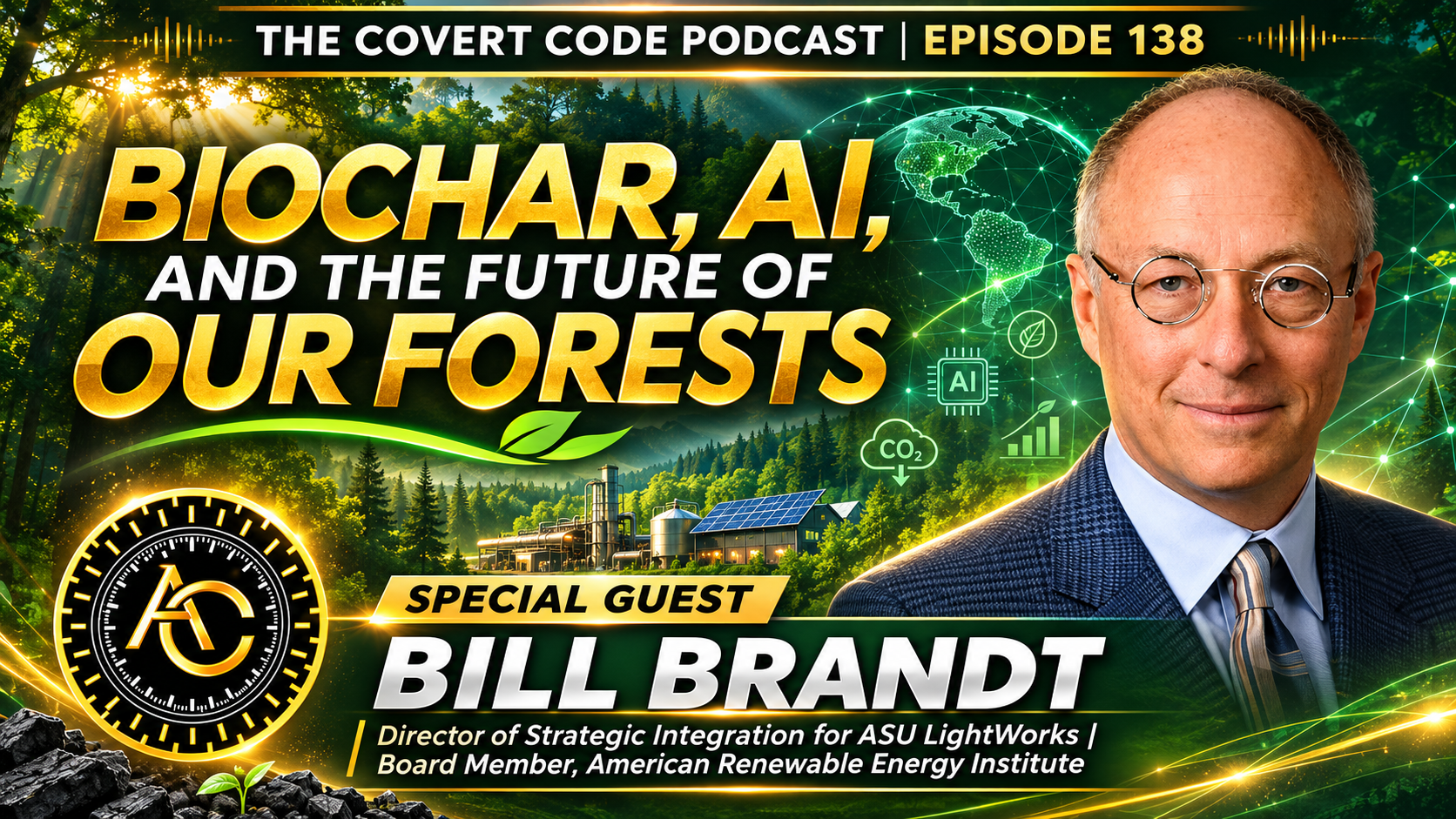
By Anna Covert | The Covert Code Podcast | Episode 138
What if the solution to healthier forests, reduced wildfire risk, and new economic opportunities was already growing all around us?
America’s forests face a complicated challenge. Excess vegetation and accumulated biomass can contribute to dangerous wildfire conditions, but removing that material is expensive. Transportation, processing, storage, and the lack of dependable markets can make large-scale forest restoration difficult to sustain.
In Episode 138 of The Covert Code, I sat down with Bill Brandt, Director of Strategic Integration at Arizona State University and board member of the American Renewable Energy Institute, to explore how artificial intelligence, biochar, and organized biomass supply chains could help change that equation.
Bill brings more than 30 years of experience in the global energy industry, including his career at BP, where he retired as Director of Mergers and Acquisitions. Today, he works at the intersection of innovation, energy, technology, and commercial development.
What Is Biochar, and Why Does It Matter?
Biochar is a carbon-rich material produced by heating organic material through a controlled process. While it begins with a concept similar to charcoal production, engineered biochar can be developed for a variety of applications.
Bill explains that biochar can provide a habitat for beneficial soil microorganisms, support soil water retention, and contribute to improved agricultural conditions. Higher-quality carbon products can also have applications in contaminant capture and advanced materials.
Rather than treating all forest biomass as waste, the opportunity is to identify how different materials can be processed into products that have real markets.
Can Artificial Intelligence Help Restore America’s Forests?
One of the most interesting parts of our conversation was how artificial intelligence and satellite imagery could change forest management.
Traditional forest thinning requires people to evaluate conditions on the ground, identify vegetation that should be removed, and coordinate the equipment and crews needed to complete the work.
Bill describes how machine learning, satellite data, and modeling can make this process more efficient. He discusses an example involving The Nature Conservancy in northern Arizona, where satellite imagery was used to identify individual trees and transfer instructions to equipment through an iPad-based system.
The important distinction is that AI is a tool to improve human decision-making. Forest managers and other stakeholders still need to establish priorities, evaluate recommendations, and oversee how the work is performed.
The opportunity is to use better information to coordinate forest restoration at a scale that would otherwise be difficult to achieve.
The Hidden Problem: What Happens to the Biomass?
Removing excess vegetation is only part of the challenge. Once trees, branches, and other material are removed, someone has to transport and process them.
Bill points out that wood is bulky, heavy, and often contains significant moisture. Moving it can be complicated and expensive, particularly when trucks have to travel long distances or make inefficient trips.
He uses a simple comparison: if you cannot remove the grass clippings, you cannot keep cutting the grass. The same principle applies to forest thinning. If there is nowhere economical to take the leftover biomass, the amount of forest that can be treated becomes limited.
This is where AI-powered logistics and better supply-chain coordination could make a difference.
Turning Forest Waste Into a Business Opportunity
Bill’s vision goes beyond individual forest-thinning projects. He describes a more organized biomass supply chain that would connect forest managers, contractors, transportation providers, processing facilities, and end users.
Instead of each business trying to solve its own supply problem, a coordinated system could make biomass available in predictable quantities, qualities, and locations.
That consistency matters. A company operating a biochar facility, sawmill, or biomass energy plant needs to know that material will arrive reliably. Without dependable feedstock, investment becomes much more difficult.
Creating this infrastructure could also open opportunities for small and medium-sized businesses, particularly in rural communities.
Why Forest Thinning Can Matter for Wildfire Risk
Bill explains that forest management involves understanding the fuel load within different ecosystems. Removing selected vegetation and excess underbrush can be part of a broader strategy to reduce wildfire intensity and improve conditions in forested areas.
However, every forest is different. Ponderosa pine forests, southeastern forests, and northwestern forests have different ecological characteristics and require different management approaches.
Effective restoration must therefore be informed by local conditions, experienced forest managers, and appropriate environmental practices.
Wildfire impacts also extend well beyond the immediate burn area. Bill points to the Canadian wildfires and other fires across the western United States, explaining that smoke can affect air quality hundreds of miles away.
The 18-Month Arizona Pilot Project
One of the most exciting developments discussed in this episode is a proposed pilot project in Arizona.
Bill explains that the team has developed a concept paper and is working toward securing funding to test its ideas under real operating conditions.
Over an anticipated 18-month period, the project would evaluate transportation logistics, material handling, costs, and the feasibility of a more organized biomass system.
The goal is to collect actual operating data, test assumptions, and establish whether a coordinated biomass system could support larger-scale forest restoration and commercial investment.
This is an important distinction: the pilot is intended to test the business model and operational assumptions rather than assume that the concept is already proven at scale.
Biochar, Agriculture, and the Circular Economy
We also discussed how biochar could support agriculture and local economic development.
Bill explains that biochar may improve water retention and microbial activity in agricultural soils, although its application needs to be evaluated for each specific ecosystem.
Local universities, community colleges, technical schools, and businesses could all play a role in understanding how these products should be used in different regions.
This creates an opportunity for a circular economy: material removed from forests can be processed into useful products, supporting businesses and potentially returning value to agriculture and other industries.
What Does This Mean for America’s Energy Future?
We also touched on the American SuperGrid and the importance of efficient electricity transmission.
Bill explains that the SuperGrid is about moving electricity efficiently from places where it is available to places where it is needed. Biomass and biochar contribute to a different part of the broader resource equation, but the underlying objective is similar: creating systems that make better use of available resources.
When infrastructure, technology, and commercial opportunities work together, the potential benefits extend beyond a single project.
The Bigger Picture: Innovation Must Work for Communities
What stood out to me throughout this conversation was Bill’s focus on practical implementation.
We hear a lot about artificial intelligence, sustainability, and innovation. But technology only creates meaningful impact when it can solve real problems, operate economically, and benefit the people and communities involved.
Better forest management could create opportunities for regional businesses, support local employment, and help address the economic barriers that currently limit restoration work.
It will take collaboration, investment, policy support, and local expertise to make these ideas work. But the opportunity to rethink how we manage and use our natural resources is worth exploring.
Connect With Bill Brandt
- LinkedIn – Bill Brandt
- X – @wrbrandt
- Arizona State University Profile
- ASU LightWorks
- OpenCarbon
- Educated Change
Follow Anna Covert and The Covert Code
- The Covert Code Website
- Anna Covert’s Website
- Anna Covert on LinkedIn
- The Covert Code on LinkedIn
Listen to The Covert Code
Enjoy the full conversation with Bill Brandt on your favorite podcast platform:
Watch Episode 138 and join the conversation.
Because the future isn’t just about the technology we invent. It’s about what we choose to do with it.
Note: The Arizona pilot discussed in this interview is a proposed project intended to test operational and economic assumptions. Potential environmental, commercial, and wildfire-management benefits depend on implementation, local conditions, and further evaluation.
Full Episode Transcript: Biochar, AI & the Future of America's Forests
Podcast: The Covert Code
Episode: 138
Host: Anna Covert
Guest: Bill Brandt
Introduction
[00:02:07] Anna Covert: Aloha! My name is Anna Covert, and I'm coming to you from the Warwick Hotel in Dallas, Texas. Today on The Covert Code, the topic is Biochar, AI, and the Future of Our Forests. My very special guest is Bill Brandt, Director of Strategic Integration for Arizona State University, as well as a fellow board member of the American Renewable Energy Institute.
Bill has more than 30 years of experience in the energy industry, retiring from BP as Director of Mergers and Acquisitions before joining Arizona State University to help advance renewable energy technologies. His experience spans global energy business development, with a specific focus on helping launch integrated products into the market.
Today, we'll be discussing how AI and biochar could help restore American forests, improve soil health, reduce the chance of wildfires, and create more jobs. Thanks for being here, Bill.
[00:03:11] Bill Brandt: Hey, welcome, Anna. Thank you for the opportunity. Appreciate it.
From BP to Renewable Energy Innovation
[00:03:14] Anna Covert: So to begin, we like to give our viewers a little CliffsNotes version. How did you get into the energy industry?
[00:03:22] Bill Brandt: I fell into the energy industry right out of graduate school, and that's where I got started. The wonderful thing about the energy industry is that it's a global business. It also involves geopolitics. I had an amazing career trying to understand how oil and politics, industrial collaboration, cooperation, and competition actually drive the system.
[00:03:45] Anna Covert: Well, so you went from making deals with BP to working with Arizona State and renewable energies, right? What are most people missing in the equation here?
[00:03:57] Bill Brandt: The wonderful thing about working at a university is that it's kind of a neutral place where people like to think. Thinking includes innovation, technologies, and things like that, but also critiques about the current system.
Universities tend to look at things through the eyes of: How might we make it better? What would happen if we actually changed the system? Can we model it and do something completely different?
I remember when I first joined Arizona State University in 2010, the price of solar was twice as high as the price of electricity generated from gas. Now it's super, super cheap. Of course, with solar, you have to have batteries to make it available at night. But that just shows you the amount of change happening in the energy and electrical industry.
What Is Biochar?
[00:04:46] Anna Covert: Wow. So for people who don't know, what is biochar and why should they care?
[00:04:53] Bill Brandt: Biochar is essentially a finished carbon product. You start with charcoal, and then you get better and better. The process is similar, except that you have more of an engineered approach to making the finished product.
Biochar can come in several different sizes. It can come as something that you can put on the soil. We'll just say it's the equivalent of condominiums for microbes. The microbes get into the biochar, and the biochar then starts to become a lot more interesting. Plants get the benefit of that.
Biochar can also, at a higher quality level, be used to capture contaminants around places like Superfund sites. The material is captured in the carbon, and then the carbon has to be reprocessed. At a very high level, it can become super-high-quality graphene, which can be used in batteries. So there are lots of different products that can be made.
Turning Forest Biomass Into a Valuable Resource
[00:05:59] Anna Covert: Tell us about your concept using AI. How is it going to help the forests?
[00:06:05] Bill Brandt: The thing about forests is that you have to understand that when somebody takes out a tree, half of its timber goes into lumber or a pallet, and the other half is rubbish or biomass.
What we're focusing on is: What do we do with the biomass that's left over?
That leftover material can be treated professionally in a supply chain. We need to think about how to maximize the opportunity to sell that material, grade it properly, and get it to customers.
The process we're looking at is asking what would happen if we treated the whole business of taking material that nobody wants and turning it into a professional supply chain.
[00:06:50] Anna Covert: And really, people do want it, right? I mean, wood chips and other things are used in all different types of products.
[00:06:55] Bill Brandt: Yes. People go to the store and buy wood chips to put in their gardens. That's fine, but there aren't enough gardens out there to take the amount of biomass we have.
So how do you turn that into something that's a useful, reliable product?
Many people use wood chips to make electricity. When you make electricity, you fire up a boiler that creates steam, which turns a turbine. Then you've got waste heat left over.
If you can use the heat for something and make electricity, you're producing power at a slightly higher average cost than the average cost of power. But if you can't use the waste heat, it's very expensive power.
For that reason, you don't see little power plants popping up everywhere because the economics are driven around the heat.
What's happened over the last 15 years is that people have become more sophisticated about biochar, and biochar is creating markets.
There is a possibility that you could install a biochar facility and sell into markets that are available for it. That creates another opportunity for small and medium-sized enterprises.
People are also looking at sustainable aviation fuel. That's a slightly different process. There are companies on the edge of making it commercial, and we believe that in time biomass could go into methanol, ethanol, or sustainable aviation fuel.
[00:08:31] Anna Covert: And so what other examples are there out there? People who are using this biomass already?
[00:08:37] Bill Brandt: Most of the biomass is going into power, and you'll find that in many places.
Classic examples are sawmills, which produce a lot of waste. As they're cutting boards, there's material left over from the process. That has to go into fuel, and that makes electricity. The sawmills can actually use the waste heat to dry the wood.
You can see there's a compatible ecosystem there.
What we're trying to do is make the material available 24/7 to anybody who needs it or wants it in an industrial system. That's a huge benefit to the system.
We're focusing on system savings as opposed to individual projects or company savings.
Forest Management and the Growing Wildfire Challenge
[00:09:26] Anna Covert: So tell me, historically, forests didn't really have all these wildfires. Things are changing quickly. What's different about where we find ourselves today compared to where we were in the past? Why is this so important now?
[00:09:40] Bill Brandt: Right.
[00:09:44] Anna Covert: The way we manage forests has changed over time. That has had to do with how we think about fires, proximity to where people live, and things like that.
We've noticed that as the climate has changed, wildfires have become more frequent and more intense.
The way to manage wildfires is basically to manage the fuel load in a forest, which means you want to get in there and take some of that material out.
Every forest has its own ecosystem. Ponderosa, for example, is similar but different from other forests you would find in the Southeast or Northwest.
The U.S. Forest Service is focused on how to trim the forest, clear out the underbrush that's not needed, and get rid of it.
We're focused on how to industrialize the removal of that biomass so that you can put it into a system that will process it.
Wood is not the easiest thing to move. Think about putting it in your pickup truck. You're shoveling it in. There's a lot of air. There's water in wood because wood is green. It's a living thing.
All of that makes the transportation of wood complicated, difficult, and expensive.
We're trying to reduce the cost of transporting that wood to the lowest possible level. That then allows the forest to be cleared.
Maybe I should put it in a slightly different way. If you're cutting grass and you have to remove the grass clippings, the amount of grass you can cut is limited by how far you can move the clippings.
If you can't get rid of the clippings, you can't cut more grass. This is the problem our Forest Service is facing in doing some of the work now.
In the United States, there are federal forests, state forests, local forests, and private land. The amount of federal forest is a little over half of the entire forest area.
You can see that it is a policy issue that we, the people, have to weigh in on. How do we want to manage those forests?
Private forests can be managed differently, but they still face the same issues: how do you trim the forest, keep it healthy, and get rid of the material you don't need?
Wildfire Smoke and Its Impact Beyond the Fire Zone
[00:12:10] Bill Brandt: Fire is the big hazard we've looked at.
Many of you can remember the Canadian wildfires this past summer. There were wildfires across the western part of the United States in the last three or four years that made some areas pretty unlivable for people.
It's not just your next-door neighbor or the town next door to you. What happens 500 miles away can have an impact on air quality. Air quality affects all of us.
[00:12:40] Anna Covert: It does. It does. So what would AI do? What kind of problem could it solve for what we're doing today?
How AI Can Help With Forest Management
[00:12:48] Bill Brandt: Think of AI as just a faster way to get models to work.
Models allow us to understand the impact of looking at an entire system. We've been doing that industrially for a long time.
But it's one thing when you're a mining company and you own all the assets. You can basically say, "I'm going to do this, this, and this." You don't have to ask permission.
It's another thing when other people have to get involved and give permission.
What we're doing is saying we can use AI with modeling techniques to improve the ability to see in real time what's actually happening.
We can go to the different stakeholders and make suggestions based on what the models are telling us.
That's what we think is going to be a game changer for making the system work.
Whenever you change systems, you have to create a governance system for how it works. People have to follow the rules and not be disruptive if you've decided you're going to run this as a system.
The advantage of a system is that you can manage it for the lowest cost. From a public-benefit point of view, driving the cost to the lowest level means we can get our grass cut for the lowest possible price and our forests treated for the lowest possible price.
That's the objective.
[00:14:07] Anna Covert: So for people who are not understanding, what exactly is AI going to be doing?
[00:14:12] Bill Brandt: If you've ever used AI, you'll know that you can do a search that's more thorough and effective, and you can do it more quickly.
If you want to build a budget or a project, you can do it more quickly and effectively.
Think of AI as an accelerator and a way to build models that tell us more about what to do.
We can look at the whole thing as a system rather than a series of small silos.
[00:14:38] Anna Covert: So instead of the old way, where we used to have people on the ground going through the forest and picking which trees they were going to clear, now we're going to give a map to AI. It's going to use its knowledge to figure out what we're going to clear and how we're going to clear it, so that then we can deploy people.
[00:14:56] Bill Brandt: Yes. AI is going to help us at lots of different levels.
When we talk about AI, we have to make sure that we say it's machine learning. How do we improve a machine's ability to do work, and how do humans actually direct it?
Then, when you get into artificial intelligence, you get to the point of agency, where the model can actually make certain decisions, and those decisions can help improve effectiveness.
What's an example of machine learning and early AI?
The Nature Conservancy did some work in the Four Forest area in northern Arizona, where they basically said, let's try something different when it comes to forest thinning.
Instead of people going out and marking trees that were going to stay while the rest of the forest was cleared, they did it on an iPad using satellite data.
The satellite data is good enough that you can see each tree independently.
Once the trees were marked on the iPad, the iPad was sent out on a tractor that had chainsaws. The chainsaws then cut down the wood using the iPad. A few people go around and finish the job.
What it does is make the whole job simpler because you can do it more quickly on your iPad. The Forest Service can track it more easily, too, because they can compare what the iPad said with what actually happened.
[00:16:21] Anna Covert: That's amazing that the tractors can just go in on their own. How big are these tractors?
[00:16:26] Bill Brandt: Some tractors are like everything else. They come in different sizes.
[00:16:29] Anna Covert: They can fit in all this forest?
[00:16:34] Bill Brandt: Think about it as a robot that doesn't do everything, but it does most things. Then somebody else comes along with a chainsaw and finishes the job.
Reducing Transportation Costs and Improving Forest Thinning
[00:16:44] Anna Covert: Are they using leaf blowers to...?
[00:16:46] Bill Brandt: No. These are the machines that are like logs. Then what happens is the logs are attached to something called a skidder.
The skidder moves this material to a road in the forest. A truck comes up and picks up the logs, and then it drives off.
The whole system is set up around how you reduce the cost of moving heavy, big, bulky pieces of material so that you can minimize the amount of truck time.
Trucking is expensive, and we all know that fuel costs have a lot to do with trucking. The higher the fuel price, the more expensive it gets.
Everything we're doing is using the power of AI with systems and optimization models to reduce costs.
When you reduce costs, you can improve the effectiveness of thinning forests. It's the thinning of the forest that reduces fire intensity and improves outcomes for people who live in forested areas.
[00:17:49] Anna Covert: And then, of course, we need to reduce the cost. We all know what a truck roll costs in any kind of business in order to make it effective, to get funding or make this a private business opportunity.
You've been doing business opportunities and reviewing innovation. What would make this something you would invest in personally?
Building a Biomass Supply Chain
[00:18:03] Bill Brandt: That's a really good question. Let's talk about investments.
There are investments for the common good, and then there are investments to actually run a process.
If I had a technology that I liked and could set it up in a particular area, I'd go out and buy a five-acre site to put my industrial facility on.
If I could have the material delivered to me every day, so that I had, let's say, ten days of inventory, that's what I would want.
That gives me the ability to focus on the system itself that I'm operating and make it as profitable as possible. I don't have to worry about what's happening on the trees on the hill or whether it's snowing or raining. Somebody just delivers me the material.
That's kind of what we're doing. We're saying we can build a system that allows everybody access to a low-cost inventory supply depot that makes material available.
Whether you're running a sawmill, a combined heat and power plant, a biochar plant, or something more sophisticated, that system operator can make the material available to you.
[00:19:22] Bill Brandt: What you're doing is reducing system risk for everybody by having an organized system.
We've seen people do this in the past. Rural electrification was one of the primary successes of the 20th century.
Congress stepped in and made policy decisions to create low-cost capital. People went out and organized cooperatives. That's another way of saying we're putting together a group of people who need electricity.
How many people are in this area? How do we size the equipment? What's the lowest-cost way of addressing this group's needs?
These things have been very effective. We don't see this as any different. What we do see is that technology, modeling, and AI can help us be more effective.
The Arizona Pilot Project
[00:20:11] Anna Covert: So in terms of where your concept is, is this just a concept? Is it in prototype, or is it ready to scale?
[00:20:18] Bill Brandt: The Forest Service said they liked our ideas. We said okay, and they said let's do a concept paper, which we've done for them.
Now we're at the point where they're basically working within the administration to secure some funds for us to run a pilot.
The reason we're running a pilot is that we have ideas about what can be achieved and what the costs are of dropping material off, shipping it on-site, reloading it on another van, and then letting that van run somewhere else.
But we really haven't tested those models against actual physical conditions.
That's what we're going to do over the next 18 months: put it into physical operation, measure the operations, look at the costs, and test some of our hypotheses.
Once we do that, we're very happy to find a way of getting the public and investors to invest in this cooperative so it can operate on a much larger scale.
Remember what I said before: the amount of forest you can work on is totally dependent on how you get rid of the biomass on the other side. They come together.
How Often Do Forests Need to Be Thinned?
[00:21:38] Anna Covert: There are different types of trees and biomass in every forest. Once we clear it, how often do we need to clear it? Is this a short-term industry, or is it something sustainable?
[00:21:56] Bill Brandt: That's a really good question.
In the case of the Ponderosa, where there are 2.4 million acres of federal forests and four different forest properties, the turnaround time is over a hundred years.
There's so much of it that needs to be done that they'll essentially be able to double the amount of forest being treated.
The Forest Service, working with local counties and cities, will make priorities about certain areas closer to cities or towns where there is fire hazard.
Eventually, that work will reach out to the entire forest so it can be properly looked after, just like a garden, over the next hundred years.
Some areas of forest typically turn over once every 20 years, so that's a very different process. Some of the techniques we're using are equally applicable, although the wood type and solutions may be different.
[00:22:59] Anna Covert: Living in Hawaii, there are all different types of fruits and vegetables and all kinds of trees. There's a lot of opportunity here for local universities to be involved and start seeing what their unique environmental attributes could be and how they could be used.
[00:23:17] Bill Brandt: Exactly. The whole idea is basically to create a body of knowledge that people can use.
Like Lego blocks, you can say, this is what's right for Hawaii, this is what's right for the Pacific Northwest, and the Southeast is very different.
Moving biomass is not any different no matter where you are because it's basically wood, water, and a lot of air.
Biochar, Soil Health, and Carbon Retention
[00:23:47] Anna Covert: Let's talk about soil health itself. There's been a big movement started with Kiss the Ground, and now they have Groundswell, which won a bunch of awards.
I'm a big fan of Sadhguru. It was really inspiring for me to see what regenerative agriculture could do conceptually for carbon sequestration.
Tell us about the benefit here. We talked a little bit about biochar, but what is the benefit, and how much can we sequester by doing this for forests?
[00:24:22] Bill Brandt: I'll start by saying I am not a soil expert. I'm somebody who has had a lot of experience in industry.
Every ecosystem is going to have a different kind of requirement. It's entirely possible that some biochar in an ecosystem may lead to better-quality soil or better carbon retention.
There's a high degree of probability that for agriculture this is a good first step because biochar can substitute for fertilizer. What it does is improve water retention in the soil and improve microbial activity.
But each ecosystem requires a different approach.
This is what's going to create jobs for people in local areas, working with local universities, community colleges, or technical schools to understand how we can substitute this product into different applications.
It's a real opportunity because we can practice a circular economy.
[00:25:46] Anna Covert: So let me make sure people understand the process. First, we're going to use AI technology to determine what needs to be removed. There will be humans involved, but we're going to try to rely on innovation so we don't have to be out there doing these dangerous jobs.
Then they're going to clear this material, and it's got to go somewhere to a plant to transform it. Then they're going to go back to the forest and spread it on the ground, along with other plants and other things to help it. Is that kind of how it's going to work?
[00:25:57] Bill Brandt: Kind of. But it will depend on what the people responsible for managing the forest deem to be the most appropriate treatment.
A little bit of biochar in a pine forest may be different from biochar in a deciduous forest. It may also be different for agriculture.
All of these things need to be worked on. That's the really cool thing about it when you think about it, because we have opportunities for different ways of deployment.
I'm excited about it because it creates opportunities for people to have good local jobs inside an ecosystem where we're recycling and reusing what's already there.
Funding, Investment, and Policy
[00:27:00] Anna Covert: What do you think is the biggest obstacle to getting this funding?
[00:27:00] Bill Brandt: Like I said, we're working with the Forest Service. They're providing us with some funding now.
The next question will be: once we produce the data, what are the opportunity sets? The data will help inform that.
I think the real issue is going to be thinking about how we change or nudge policymakers to think about doing things differently.
There are a host of different policies that have already been written in Washington. People on different committees and their staffers are looking at how those could be put into a set of bills.
We'll have to wait for politicians to clear the air and figure out whether they can work jointly together to make some of these things happen.
We're just a little cog in this wheel, saying that if you do the following five things, this could improve the outcome for everybody or for lots of people.
More specifically, there's nothing wrong with investment tax credits. There's nothing wrong with incentivizing people to risk capital to make these things happen.
We should also make sure that the base material gets to them at the lowest possible cost because that's the way the system will run most efficiently.
What Does Success Look Like?
[00:28:01] Anna Covert: What is success going to look like? How many years until we have enough data? In your mind, is this a five-year plan, or is it shorter?
[00:28:10] Bill Brandt: Ideally, we're going to run this for 18 months in Arizona, and we should have some ideas there.
We're going to try to put this independent biomass system operator up and running so it can work on behalf of the industry. We'll have to raise some money to do that.
Once I get the project up and running and we're busy collecting data, our next step will be to say: if the data holds good, who's going to make investments in this biomass system operator?
That will allow the business development people in the counties and cities in northern Arizona to bring in developers who will actually develop projects.
What we're going to do is make sure the material is always there. That's really important for people trying to manage risks in their individual systems or businesses.
[00:29:07] Anna Covert: And in terms of the cost of this, do we have any idea?
[00:29:15] Bill Brandt: The answer is that each area is going to have its own way of deciding what to pay for.
The price of electricity is different in New Mexico, Arizona, Texas, and Hawaii. In Hawaii, you're paying something close to probably 45 cents a kilowatt-hour, or higher.
All of these things make it important to determine where you can produce power economically or produce biochar economically so that it displaces industrial fertilizer applications.
As you know, in Hawaii, the price of power is really high. Making power out of biomass may be a really good idea there.
There's a little bit of biochar that comes out of the back end of these power plants anyway. If you make it right, you can probably put it back on your field.
[00:30:07] Anna Covert: In Hawaii, we recently stopped burning coal. I was part of one of the first waves of people to go solar with net metering.
I got credits from the state to get my two Powerwalls. I'm part of this battery rebate program where I allow them to discharge between 6 p.m. and 8 p.m. Eighty percent of the power goes to my Powerwalls, and they gave me $850 per kilowatt.
It's been really great. I still get some checks every once in a while.
Let's shift a little bit and talk about how you're also a board member of the American Renewable Energy Institute. Let's talk about the SuperGrid. I've had Sandy and Chip and some others on to talk about it. How could biochar contribute to that concept?
Biochar and the American SuperGrid
[00:31:00] Bill Brandt: If you're making electricity, you're just like one person feeding into the system. If you're making biochar, you're not making electricity, so it doesn't matter in the same way.
You can think of the SuperGrid as a way of moving surplus power to places where people need it, and as a way of efficiently transporting electricity.
HVDC is an efficient way of transporting electricity.
Everywhere we look in our modern industrial ecosystem, we have to be mindful about trying to find a way to get the lowest-cost system to deliver things to everybody. Then that can be passed on to the consumer or the business, and businesses make jobs in local economies.
[00:31:45] Anna Covert: Right. So it's a great way to incentivize private industry to take this up instead of having to rely on government funding. They could then decide to work in their own forests, not necessarily federal land, but their own private forests.
[00:32:00] Bill Brandt: Yes. And we have to remember that with electricity, we have public policy that's been established since the end of the 19th century and certainly in the early 20th century.
That was basically designed to manage how monopolies, which are considered to be the most efficient way of ensuring that a group of people can get access to electricity, do their job.
There are a lot of patches we've put into the system just to try to make it work, and we'll continue to do that.
Remember, our regulatory system is something we created. If people created it, maybe we make a few changes if that's what's needed.
With change, many people are okay with it and some people don't want to do it. We're just going to have to recognize that not everybody is going to be completely happy.
But if we do it properly, we set the basis for the future of our communities, our state, and our country.
Jobs, Communities, and Economic Opportunity
[00:33:05] Anna Covert: When you think about the benefits compared to the risks, nobody wants forest fires. People are scared. People want jobs. We want there to be a future for our grandchildren and children.
It seems like a win-win-win. While this might not be an industry as large as oil in terms of revenue opportunities, it's still comparable to lots of industries that are fluctuating rapidly and could fill a need.
[00:33:35] Bill Brandt: What we're trying to do is make it possible for people to put capital to work and create small and medium-sized enterprises that employ people.
They create a regional economy that actually works and improve opportunities for everybody.
Not everybody is going to be sitting on the newest large language model company or the next Google. But there are lots of opportunities to do things effectively and efficiently and make some money.
That's good for communities and it's good for the country.
[00:34:26] Anna Covert: Europe does a lot of things with biomass, and we might be able to take some lessons from Europe on how this gets done.
It's a circular economy that allows material to be recycled. In Europe, there's more work on using waste heat, which usually comes through district heating.
You need a certain density to make that work. In rural America, people live too far apart. In small towns and communities, it might work. It could create improvements in universities or healthcare complexes where you can use that heat through hot-water tubes.
They do that in Sweden.
[00:35:17] Bill Brandt: They do that in Sweden because they're using...
[00:35:19] Anna Covert: They're using algae, and it could also be biochar from algae.
[00:35:26] Bill Brandt: There are people who've been working with algae to mix it with biomass to see whether it creates a more stable product. That certainly could create some improvements.
We just don't know.
Right now, the algae program is a bit paused with the current administration, but we're starting to see money flow back into it again.
I was just at the Algae Biomass Summit, which was held at Arizona State University a couple of weeks ago. A couple of people were talking about what might be happening there.
It's like everything. Science is one of those things where you make a hypothesis and ask, could it be better? Then you try it and see whether it worked or didn't work, or whether it worked but could be better if we did something differently.
We keep working on those things.
The Future of Innovation and Environmental Responsibility
[00:36:15] Anna Covert: So what are you most excited about? I know we're here for EarthX. What are you here for, and what do you think is the biggest idea you want people to come away with?
[00:36:25] Bill Brandt: I'm here at EarthX with you, and we're celebrating that. It's a good thing.
But I think the thing that's most important is for people to say: we need to make sure we use the tools available to us to study what can be done to make things more efficient.
We need to think about how the common good is represented in our system and remember that forests are part of our ecosystem.
It's not just what's on my block. If I live in a city, there is a forest around me.
What we need to do is a better job of improving the circular economy around where we live.
If we can do that, we will create jobs that require people to do that, and I think that's inherently a good thing.
I'm excited about what AI modeling and other tools can do to help us improve the system.
Now we have to figure out as a community how we need to change in order to take advantage of these opportunities. If we don't change, we won't be able to take advantage of them.
[00:37:31] Anna Covert: That's always the number one struggle, right? Everything's changing. What's your opinion?
[00:37:40] Bill Brandt: Some change is good, particularly if we can think about it through the lens of how we improve the ecosystems we all share.
Ultimately, we have one planet. We have to look after it, and ultimately we have to garden effectively.
[00:37:58] Anna Covert: These really aren't new concepts. They're old concepts we forgot about.
Native Americans were doing controlled burning and other things to manage land in different ways. We just kind of stopped doing it, and then that's where we find ourselves.
[00:38:13] Bill Brandt: We find ourselves innovating into different places. But it's always good when you've innovated into a different place that you don't carry the baggage of the past.
Step back and say, if we were to start all over again, what would we do?
Sometimes there are some really interesting nuggets in that question.
We just have to work forward by asking how we use science and human imagination to create new opportunities for ourselves. That's how effective or good change happens.
Universities, Research, and the Next Generation of Innovation
[00:38:48] Anna Covert: The last thing I want to ask you about: since you're at a university, and recently there have been a lot of changes with funding toward universities, how do you think that policy shift is really going to have a long-term impact on universities? Are you already seeing problems on the ground?
[00:39:08] Bill Brandt: I'll just say this as an observation.
It's right to challenge the system that we have.
The system we have right now is largely a creation of what followed World War II, when it was recognized that innovation and the things that come with it could be effectively served in the university system.
The system was designed essentially to allow many seeds to grow, and then we can pick the seeds out of it.
It's entirely appropriate at times to ask whether we're really getting the best value.
But at the end of the day, political agendas don't drive innovation. They drive a directed point of innovation, but they may miss a lot of opportunities.
As we rethink how we're allocating money into the sciences, it would be wise to do it with the idea that you can't pick winners.
You may think you can, but opportunities arise as part of the normal evolution of science and studies.
Look at what's happened over the last 30 years. The internet was created. There were lots of people involved in that, and lots of enterprises came out of it.
Now we've got large language models that have made AI available to everybody, not just a few specialists. That's going to create new opportunities, too.
We need to let creative people get in there and find things. Once they do, maybe that's the time to make those investments.
[00:40:47] Anna Covert: And like we always say, don't put all your eggs in one basket.
It's all about differentiation and integration.
[00:40:54] Bill Brandt: That's right. That's right. The applications of old wisdom to new ideas.
What's Next for Bill Brandt?
[00:40:59] Anna Covert: Wow. So what's next for you? Are you planning? Are you writing any kind of book or anything like that?
[00:41:04] Bill Brandt: It's too early to write a book because we're just at the beginning of the process. But that's a really good idea, and I'll start thinking about who the characters in this book are.
[00:41:15] Anna Covert: I can see you being an author coming up here.
[00:41:18] Bill Brandt: Well, it's like everything. Thank you for planting that seed, because I'm going to let it grow and see where it takes me. I really appreciate it.
Connect With Bill Brandt
[00:41:28] Anna Covert: Well, thanks so much for being here. How can people learn more about what you're doing and connect with you?
[00:41:32] Bill Brandt: You can write to me. I'm Bill Brandt at ASU. I would love to hear from you.
If you've got any comments or know people who are actually working on this, where you can say these people know what they're doing and you should meet them, I'm more than happy to do that.
It's important for all of us to recognize that wisdom is not inherently in any one group of people or any group of people at a university.
Drop me a line and tell me what's up.
Episode Closing
[00:42:04] Anna Covert: We'll be putting all of these links, of course, into this channel. Thank you so much for joining me.
We just reached over 270,000 subscribers, and that is because of you and your Aloha.
Please continue to share this content with your friends, family, and business associates so I can get more great guests like Bill to share their wisdom and passion with us to help us succeed on and offline.
I can't wait to see you next week in the pixels. Aloha!