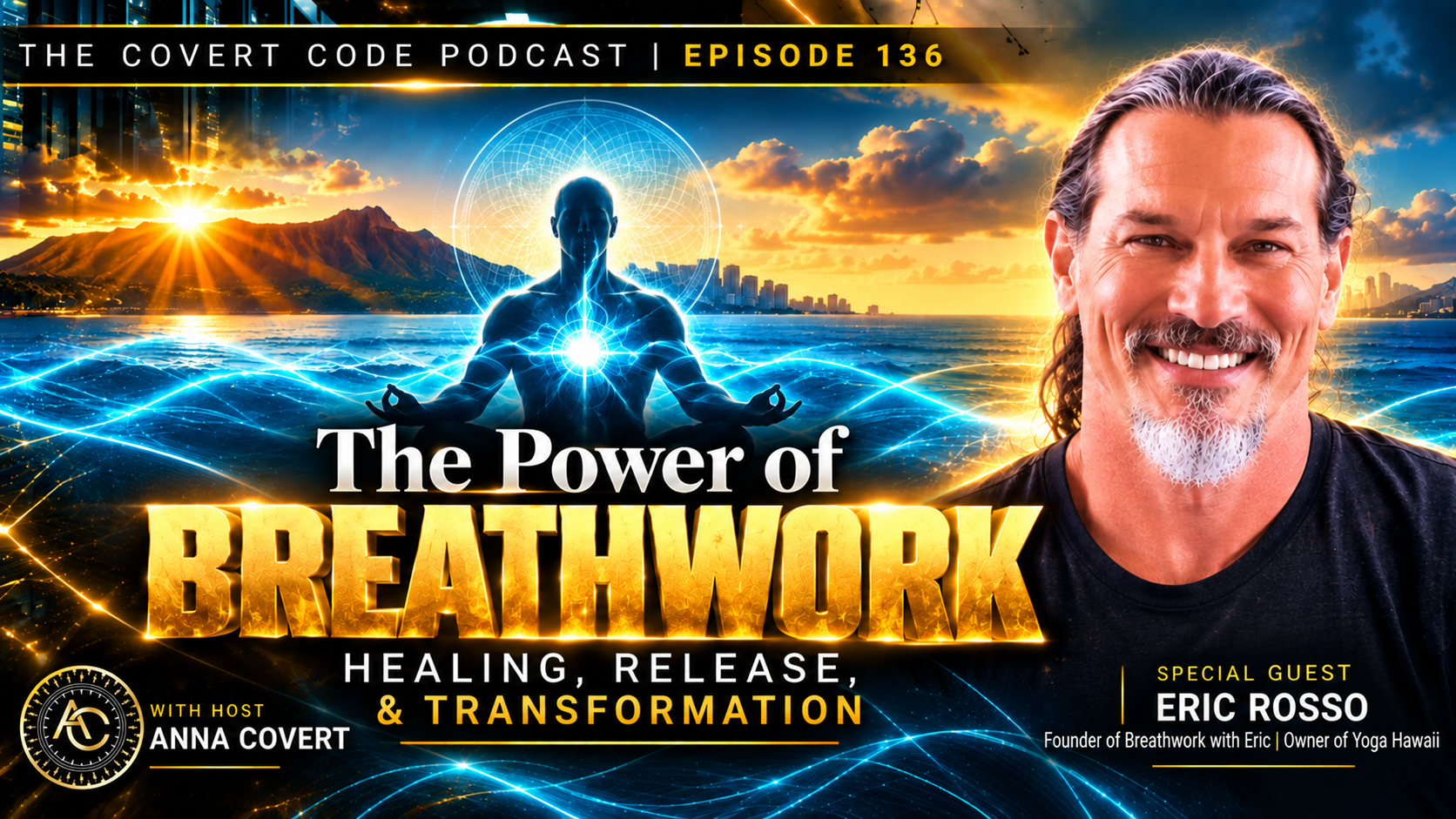
The Power of Breathwork: Healing, Release & Transformation with Eric Rosso
The Covert Code Podcast | Episode 136 | Hosted by Anna Covert
What if one of the most accessible ways to slow down, reflect, and reconnect with yourself was something you already do thousands of times every day? In this episode of The Covert Code Podcast, Anna Covert speaks with Eric Rosso, founder of Breathwork with Eric and co-owner of Yoga Room Hawaii, about the possibilities and personal experiences associated with conscious breathing.
For Anna, this conversation is personal. After attending Eric’s class with friends, she began practicing a guided 20-minute session on her own. Each experience felt different. Some brought up unexpected childhood memories; others left her feeling energized, emotional, or reflective. The episode explores why Eric is passionate about the practice and what listeners can learn from slowing down.
From Brown University to Breathwork in Hawaii
Eric’s journey did not begin in the wellness industry. A Brown University graduate and former football player, he remained active through cycling and eventually yoga. When a fitness assessment revealed that flexibility was his weak spot, he tried hot yoga and fell in love with it. He began teaching in 2012 and became one of the owners of Yoga Room Hawaii in 2020.
A retreat in Costa Rica in 2021 introduced him to intensive guided breathwork. Eric describes that experience as a turning point. He returned to Hawaii, pursued certification, and began facilitating classes. During the interview, he says he has guided more than 5,000 participants since 2021. His work has expanded from Oahu to other islands and international sessions.
What Is Conscious Breathwork?
Breathwork is a broad term for intentionally changing or observing breathing patterns. Eric distinguishes between slower, calming practices and more activating guided sessions that involve different breathing rhythms, music, and inward attention. His classes may incorporate headphones, eye coverings, guided prompts, and time for reflection.
One of the episode’s practical discussions is breathing mechanics. Eric encourages listeners to notice the movement of the abdomen and chest and explains why he often emphasizes a relaxed, slower breath during yoga. Different breathing techniques can produce different sensations, and there is no single practice that is appropriate for everyone.
Breathing, Stress, and the Nervous System
Eric and Anna discuss the familiar feeling of being stuck in fight-or-flight mode: the racing thoughts, tense body, and difficulty slowing down. Eric describes his interest in the autonomic nervous system, the difference between activating and calming practices, and the idea of moving toward a more restful state.
He also discusses brain-wave states and the default mode network as part of his explanation of breathwork. These are his interpretations during the conversation; the episode does not establish that a particular breathwork technique reliably turns off a specific brain network or treats a medical condition.
What emerges is a simpler lesson: taking a moment to notice and regulate breathing may help people interrupt an automatic stress response and respond more deliberately. That idea fits with the broader conversations on The Covert Code about navigating a fast-moving world with greater intention.
Anna Covert’s Personal Experience: When Memories Surface
One of the most compelling moments comes when Anna describes what happened during her own breathwork sessions. As Eric guided participants to notice whatever arose, Anna found herself thinking about experiences from childhood: struggling with dyslexia, being teased, and feeling different from other children. She also recalls physical challenges and the messages she absorbed about her own body while growing up.
She explains that the experiences were meaningful because they prompted her to reconsider memories she had not thought about in years. Eric frames this as an opportunity to approach old experiences with curiosity and courage.
These experiences are personal accounts, not proof that breathwork retrieves accurate buried memories or independently resolves trauma. For anyone with a trauma history, an appropriately qualified mental health professional can help determine what approaches are suitable.
Letting Go, Surrender, and Emotional Regulation
As the conversation unfolds, Anna and Eric move beyond technique and into the way people handle difficult emotions. They talk about trying to control outcomes, carrying old patterns into adulthood, and learning to pause before reacting.
Eric shares an idea that resonates throughout the interview: be the slowest person in the room. He describes moving with intention, noticing physical sensations, and allowing a little more space between an event and a reaction. Anna connects that lesson to her own efforts to surrender what she cannot control.
In other episodes of the podcast, Anna has explored how habits, beliefs, and technology shape everyday decisions. Here, the focus shifts inward: what happens when we give ourselves permission to stop pushing for a moment?
Health, Happiness, and Love: Three Wishes That Matter
Eric describes a reflection exercise from his breathwork workbook. Imagine you are granted three wishes, but you cannot ask for money, superpowers, or additional wishes. What would you choose?
He shares a story suggesting that answers often revolve around three themes: health, happiness, and love. The conversation becomes a reminder that people may pursue very different careers, ambitions, and lifestyles while hoping to experience many of the same fundamental things.
For listeners, it is a useful journaling prompt: What are your three wishes, and does the way you spend your time reflect them?
Three Grounding Breaths: A Practice from the Episode
Near the end of the interview, Eric guides Anna through three intentional breaths. Seated safely, he invites her to exhale comfortably, breathe in through the nose, pause briefly, and release the breath through the mouth. They repeat the sequence three times. Anna notices a sense of relaxation afterward.
This is one example of a gentle grounding exercise discussed in the episode. Avoid forcing breaths, prolonged breath holds, or intensive breathing. Stop if you feel lightheaded or uncomfortable, and never practice techniques that may alter awareness while driving, swimming, or operating equipment.
Finding Balance in an Always-On Digital World
Anna and Eric also consider how phones, scrolling, and digital media affect attention. Both recognize that technology can be useful, even essential, but the constant stream of information can leave little room for stillness.
Their conversation is not about abandoning the internet. It is about choosing how to engage with it. The ability to step away, notice the body, and reconnect with the present moment may be especially valuable when work and personal life feel nonstop.
Explore Breathwork with Eric Rosso
Eric offers classes and private sessions in Hawaii and has facilitated events elsewhere. To learn more about his approach and current offerings, visit Breathwork with Eric. You can also follow @breathworkwitheric on Instagram or explore Yoga Room Hawaii.
Listen to Episode 136 and explore more interviews in The Covert Code podcast archive.
Listen on Your Favorite Platform
Editorial note: This interview discusses personal wellness experiences and interpretations of scientific research. It is not medical advice, and breathwork is not a substitute for professional mental health or medical care.
The Covert Code Podcast | Episode 136
The Power of Breathwork: Healing, Release & Transformation
Host: Anna Covert | Guest: Eric Rosso, Breathwork with Eric
Edited-format automated transcript. Speaker identification and transcription accuracy should be checked against the recording before publishing. This text reflects speakers’ experiences and claims, not independently established medical findings.
[00:00:03] Anna Covert: Aloha. My name is Anna Covert, and I'm coming to you for my battleship here on the beautiful island of Oahu. This week on the Covert Code. The topic is the power of Breathwork. Healing, release and transformation. My very special guest is Eric Rosso, founder of breathwork with Eric, owner of Yoga Room Hawaii and a Brown University graduate.
[00:00:26] Anna Covert: Since 2021, Eric has helped thousands explore the power of breathwork and what it means for release renewal and to find a deeper connection within. Clearly to be talking about what makes breathwork so powerful and what actually happens in your brain and body during a session, as well as how becoming more conscious of breathing can help us in our daily lives. Thank you for being here, Eric. Thanks for having
[00:00:51] Anna Covert: me. So give us a little CliffsNotes version of the Eric story and how you how you got into breathwork. And I know you, you know, your yoga studio is incredible. And you have so many classes every day. Tell us a little bit about
[00:01:03] Eric Rosso: that. Well, I got it. And let me start off with Brown University. I was always an athlete. I played football, and then I stayed active, and I was a spin cycle instructor at the Honolulu club. Oh, yes. And then yoga came in. I mean, I remember. Honolulu club did this thing where they did three things. They they wanted to check your your cardiovascular, your strength and your flexibility. And they came back and said, Eric, your cardiovascular is good, your strength is good, but your flexibility sucks. So you start doing some stretching. So obviously yoga and I did the hot yoga and I just fell in love with it. And then I started teaching in 2012. In 2020, um, myself and four other partners, we bought the yoga room. Uh, it's doing extremely well. It's a wonderful, beautiful community of yeah, it's really good. And then in 2021, I went down to Costa Rica and I went to a place called arrhythmia, and I did an ayahuasca ceremony. Wow. It was a one week. Have you done that? No,
[00:02:13] Anna Covert: I haven't. I've done other hallucinogens, I'm sure. Um, it was four nights of, uh, ayahuasca. Three nights of breathwork. Wow. And the breathwork just knocked me out of the park. It's just. What's going on? I've never experienced anything like this. And I said, well, I own a yoga studio back in Hawaii. So I came back to Hawaii, I got certified, and then I started facilitating breathwork classes in 2021. I've done, uh, you know, helped over 5000, you know, participants and, uh, since 2021. And it's just doing well. I mean, it's amazing how much people don't know about it. Um, I started a yoga magazine called Hawaii Yoga magazine back in 20 1615, and I was the publisher.
[00:03:06] Eric Rosso: I would come up with all of the articles and, you know, from anything that had to do with yoga and Hawaii and just pranayama breathing to how to stretch before you get on a plane, how to stretch before you go surf, things like that. Um, nothing came across my table, uh, my desk about breathwork or activation breathwork? Yeah. And it's just taken off.
[00:03:33] Anna Covert: Wow. That's amazing. You know, I had never heard about breathwork either, and it was it was very fortuitous because I had another guest on the podcast and, uh, he's a business coach, and he mentioned breathwork and sent me a link. And that same day I went to a new doctor's appointment for I needed some blood work, and my PCP had retired. And one of those and I sat down in the waiting room and I picked up a Pacific Edge magazine, and I started flipping through. And the first thing I see is your ad for breathwork. And I'm like, oh my gosh, I this is this. Now the second time, the one day that I've heard
[00:04:05] Eric Rosso: breathwork synchronicity, I need
[00:04:07] Anna Covert: exactly synchronicity. I need to look into it. So we went to your class, September, uh, me and a group of people, and I found it to be profound, I really did, and since then, I've done your 20 minute YouTube by myself, and every single time I've done it has been different. I mean, amazing, all of them. But just the it's so incredible how much you can get and how different each one can be. So tell us what's going on in the body when this is all happening.
[00:04:34] Eric Rosso: Yeah. And explain it every single time I do a breathwork class, I try to explain the science behind it. I'm a science guy. I was a chemistry major at Brown, and I just love the whole science behind it. So in a nutshell, um, there's a scientific phrase called the default mode network, and it's in the prefrontal cortex to the anterior cortex. It's this mohawk. And when we do breathwork. This goes to sleep. Now, this is on every waking hour of your day. So that's prefrontal cortex. Uh, is the conductor of the orchestra. It is designed to protect you. It is your ego. It is things that make you bring logic. So when we do breathwork, this goes to sleep. But there's other parts of your brain, and your other parts of your brain end up talking to each other. And this is when you're going into the subconscious. So some people have said that the breathwork is tapping into the DMT of your body. You know that we all have DMT. Yes. And the active ingredient in ayahuasca and is is DMT. And it's you know, and I remember going to James Nestor's retreat and he was saying it's not the DMT, it's this going to sleep. So that that I know is confirmed. And I've been saying this for five years and I'm like, thank you for confirming that this is what it was, because there are some things on the internet that says DMT, breathwork and all that kind of stuff. And it's it's not.
[00:05:59] Anna Covert: Yeah. I mean, and that wouldn't be me when I went to Joe Dispenza, we talk about DMT and the pineal gland and the cerebrospinal fluid and squeezing it up and then shooting, shooting it through the back of the ventricle. And then it it creates it hits those little, little hairs and that creates the EMT. And and I did I hallucinated. So I know that that's true. I didn't feel any of that when I did the breathwork. I felt it more like in my full body. I had a hard time with the just getting a full belly breath. Okay. I feel like so, you know, I'm like, oh, is it even working? I mean, because it was like, we, we, we demonstrate for us. So just regular breathing. Yeah. And I think just what's the proper biomechanics of just breathing. And this is what I got at James Nestor. We started this out. And because most people are paradoxical breathers are not breathing correctly. So as you breathe in through your nose, you should be breathing through your nose all the time, except for when we do breathwork or when we're working out. You know, you're breathing through your mouth, but your belly expands on the inhale.
[00:07:02] Eric Rosso: And contracts on the exhale. That's just the proper biomechanics. And Nestor talks about how many people are mouth breathers. And if you walk down the street and you look at people, you can see who the mouth breathers,
[00:07:15] Anna Covert: chest breathing, maybe like, well, is that the same thing?
[00:07:17] Eric Rosso: Sure. I mean, well, the belly breath, that's what's that's the proper biomechanics. So when things start to go up, you see a lot of people, especially when they're under anxiety and stress their chest right. In a panic attack. It's here.
[00:07:35] Anna Covert: When you when you have a panic attack, you can't get the inhale thin. You can't breathe in, but you can get all the air out. Okay. And that's all right up here. So what we're trying to do is to try to slow the breath down and breathe through the belly.
[00:07:52] Eric Rosso: We breathe about 14 breaths to 15 breaths per minute, unconsciously since the day that you were born. Okay. So when we go, when we're in this stress mode, it can jump to 20 to 25 breaths
[00:08:05] Anna Covert: that feel like hyperventilate. It's not really hyperventilate. It's just like you're stressed out, you're breathing faster. Mhm. When you're angry, it jumps to 40 breaths per minute. Wow. Right.
[00:08:15] Eric Rosso: So. When we can consciously breathe, we can bring that breath slower than 14 breaths per minute. Sure. Okay. And if you ever taken my Yin class, my yin class is very breath oriented, but it's a deactivation breathwork. It's to slow the breath down. We go to what I call been calling for years. The heart cohesion. Breath of six breaths per minute. And that's five seconds on your inhale, five seconds on your exhale. And this slow breath. And when I went to Nestor, he was talking about how the, the Taoist, the Buddhists. And when they do. Even in religion, when you do prayer, everything goes down to this six breaths per minute. And it's happened in so many different secs.
[00:09:01] Anna Covert: I mean, even out of body exercises and whatnot. I mean, they bring you even lower, right? You know, I mean, there's there's evidence that we can even breathe less. I mean, some people can.
[00:09:13] Eric Rosso: Christopher Barataria yeah, the father of modern yoga used to go down to the, you know, flea market. And that's how he used to get students. He would able to slow his breath down to the point you can't even feel his pulse. So you have the ability to do that. Like you can act like, okay, I can't feel his pulse. He must be dead. But we have the power in our breath to be able to do all of that, which is crazy. It
[00:09:36] Anna Covert: is. Yeah, it is. So this heart cohesion breath is just a great way to get into what we call the parasympathetic. And that's when I, when we went to Joe Dispenza because you been right I have, I have it was wonderful. He talks about the beta mind you know, the the beta brain. If I put electrodes in an EEG machine, there's low beta media medium beta and high beta. So high beta is fight or flight. And we live in a time where we're always in. So many of us are in a fight or flight. And when we're in that fight or flight mode in beta.
[00:10:11] Eric Rosso: What happens is the corticosteroid comes. The cortisol comes into our system. Adrenaline comes into our system. And that's what creates this fight or flight, this run, fight or flight mode. So when we have this, we're in this run, hide or fight. The body is saying to do run, hide or fight not to eat. That's why so many people have gut problems because the body is saying run, hide or fight. This is not a time to eat. It's why people have a hard time sleeping at night because there's so
[00:10:39] Anna Covert: many people. That's like the number one thing. I'm very lucky that I have no problem sleeping at all. It's great. I go to bed like 730. I can't wait to go to bed. Right? But yeah, I know that's a pretty common
[00:10:50] Eric Rosso: one, but it's because. And I'm not saying this is the reason, but it's one of the reasons why people can't sleep at night. The mind is is going too fast and you're in this stress mode. You're in this high beta brain activity. And so the body is saying, run, hide or fight. This is not a time to sleep, right? Okay. And it's also a time when, you know, a lot of people have a hard time when you're in their run. How to fight. You want to control things, so you try to grip tighter. And what you want to try to do is how do you get out of beta. And there's. There's multiple different levels, but there's alpha and theta and delta. Delta is sleep. So every night when you go to bed you go from beta. Alpha theta delta. When you wake up in the morning you go from delta, theta, alpha beta. But this alpha and theta state is just a wonderful place to be. And that's the parasympathetic that is the rest and digest. And that's what you wanted. That's what you're going to get through meditation, through yoga, walks in the park, dancing. You get into this nice little in- breath work, of course, into the alpha and theta. And that's the creative state. And that is a wonderful place to be. So if you can get into Alpha and Theta, you're not in fight or flight anymore. Get out of beta. And that's what all Doctor Joe is all about. Once you do that, what happens? You slow down the breath. You're in a relaxed state and it's a beautiful place to be. That's the time to have those nice conversations with your partner. That's the time to be creative, about thinking about what you can do to change your life. It's almost like
[00:12:27] Anna Covert: that flow state, right? It's the flow state. And that part where the manifestation of those big hot words now is how to manifest your dreams. And really, you can't if you're not the radio receiver with that pure signal. And so that was part of some of the breathwork we did together.
[00:12:42] Eric Rosso: That's right. So tell me about how did you I never asked you because you never spoke after. I was
[00:12:47] Anna Covert: so amazed with what had happened. But I think, you know, I've actually been in the when we did it during your one hour. It was incredible. But I think, um, there was so much going on around that I've had more powerful experiences along. You know, and, uh, and even the last time I just did it, I'm completely by myself in the house. Like there wasn't anyone else here. My daughter wasn't here, and no one else was here. And I think that was probably the best. Just because no distractions of. Are you, you know, who's around you. And if you if you're, you know how loud you're going to be and and and whatnot. But I have I mean each one was powerful. And what I've found is just the feeling in my body afterward is there's no, no way to match that high. There just really isn't. Yeah, there's there's no nothing you can take to, I mean, in the energy flowing through the body. So what I've been doing is my Doctor Joe meditation, which is I do an hour and a half every morning. And then I did it beautiful. And so it was incredible. But the first, the first or second time, I think both times I kind of went back to my childhood. And I when you're asking us to go toward that, when you take that deep breath in and then you're going toward whatever pops into your mind. I was seeing things in my childhood and, you know, I had a really I feel like a great life, but I was dyslexic or I'm still dyslexic. So when I was raised, I was the one who couldn't read out loud in school. And I was the overweight kid. So I was teased a lot and I cried a lot when I was a kid. But now that I'm the way that I am, I think I buried a lot of that, you know, and didn't didn't think that it really maybe had left as much of an imprint as it did or, you know, so that was that was a big one when I, we did it at the class
[00:14:27] Eric Rosso: kind of it was. And what's good about that is all of us have trauma. You can come from the most, you know, affluent household and still have trauma because your parents worked all the time and you were abandoned. You know, there's traumas in so many different areas of of how you grow up. And the question is, is that we a lot of the times we put it in a backpack and we take it into our adult life. Yeah. And we don't realize how much that affects us. Right. So the first thing in, in, you know, all these guys like Joe, you know, Bessel van Niekerk and you know, you know, Chase Hughes, they all talk about the same things, but they, they lay it out in a different way. So you can, you can, you can digest it better. But a lot of that stuff that you're dealing with when you are seven years old and younger goes into your adult life. And a lot of people don't realize that. Yeah. And until you look at it, sit with it. You know, this guy named doctor K says, if I have a glass of water and I peed in it. And I have a glass of water with me in it. No amount of sweetener will be able to take that po. Mm. You know. And how do you got to get rid of it? Or maybe live above it and be able to work around it? And you know, Doctor Joe, you know, all of these, you know, great. You know, podcasts that you hear on online, including yours. Uh, can help you, you know, uh, try to dissolve that. And there's no magic wand that someone can put over your head and say and get rid of it. And you have to find something that works for you. Yeah. And breathwork is just one modality to do. It was so easy to do. And then and then the next time I did it, I went back and saw like, a thing with my father. You know, he was a great guy, but he was a hypochondriac. And and we didn't have that great relationship when I was younger. I got better when I was older. And then the last time I did it, just two days ago, I went back to, you know, I have a fake hip I got when I was a hip replacement. Hip replacement? Yeah, I'm bionic right now for one hip. Beautiful. But when I was 16, I was running and had the top of my hip hop off. And before that, even going back further, I had fallen off a bridge when I was younger and all these different health things I started, I they popped up because when I was young I had they put these casts on my feet for like six weeks because they didn't know why I had this pain in my feet. Wow. Finally I went down to a to Denver to pathology pathologist. Except for the doctor, but
[00:16:48] Anna Covert: podiatry podiatrist. Thank you. And what they learned is that I actually had extra bones in my feet. So I had two extra bones, and they were rubbing. Whenever I would grow, it would rub against my Achilles heel. Wow. So that's what the pain was. And but they didn't know. So they made me wear these casts and and I saw that. And it made me think that my entire life I had been told that I was, you know, you know, I had minor scoliosis and I had these problems and, and that I, that the solution was outside of myself. And that's what I realized, that there is no solution outside. It's not. But that's why I had to go through it so that now I could find that I am the solution.
[00:17:22] Eric Rosso: Like this. But here's the thing. What breathwork did is made you remember. Yeah. And it was kind of blocked. Yeah. Right. And you know. Bessel van Kirk says, you know, the opposite of trauma is not just remembering, but being able to remember this stuff in a safe environment. And I think that is once you start to go on. Aha. These are one of these aha moments. These golden nuggets come up and you go, oh I didn't realize that. Like I've had so many people come up and said, well, I thought I was safe, you know, because one of the questions that I asked in my class, like, who made you feel safe when you were seven years old and younger and at first people going, oh, I had a lot of people. And then they realized that, you know what? My mother wasn't didn't make me feel safe. I thought it was my mother or my this. Nobody made me feel safe. Wow. And that that obviously is the seed that starts this journey. And it takes courage to be able to look at those things.
[00:18:16] Anna Covert: Absolutely. I mean, and talk about I think something that's really profound for me is this concept of the animal shaking off trauma. Tell us about
[00:18:22] Eric Rosso: that. So this is you can actually find this on on a YouTube channel where they're they're chasing a polar bear. And what animals do is when they have trauma, they will about after the trauma has hit the especially dogs. And a lot of people say it does Eric. It doesn't happen after 15 minutes. It happens right away. But when you traumatize a dog or an animal, it'll shake. It'll do a yeah, it'll shake. You've probably seen it. Or even if
[00:18:52] Anna Covert: you just wash the dog, it'll shake. It's like, ah, I don't get it. Just. And it gets rid of all the trauma. Yeah. We as human beings, we don't do that. What do we do? We hold it in our whole body and our energy and our body and our spirit, and we walk around with that. We don't realize that. And I always say that on a bigger scale, when we have trauma, the first thing that we have when we have a trauma, we don't want to look at it. We want to we want to disassociate from that. And I call it a brick. And we put a brick right here. And we said, no, it doesn't. You know, we don't want to look at it. It's not here. And then other traumas hit. And throughout our lifetime, we end up building a wall around us that we think is protecting us. And really, it's really stopping us from going to our higher self because these things are going to come out and they're going to come out in stressful times. They're going to come out in our relationships. It's going to come out in a way. We do our business. It's going to come out. Is that how you talk to yourself? You know? I mean, I always say in my yoga class, if someone came up to you and started talking the way you talk to yourself, would you hit him or would you hug him?
[00:19:55] Eric Rosso: You know, so these things are going to come out and some I know I and they repeat. I mean and so I practice Kabbalah. So like you know it's going to keep coming up until you transform it. Mhm. Right. Just a reminder. And you don't even realize why. And people are always asking oh why do these things always happen to me. Well that's it's a reflection. Right. And this is the easiest way to see inside. Exactly.
[00:20:16] Anna Covert: Yeah. Exactly. I mean, and it feels so good. They, you know, it's it's it's it's it's liberating, you know, to be able to free yourself from that. You know, they said one of the, one of the biggest, uh, things that people say on their deathbed is that I wish I was able to live this life of that I really wanted. I've always been too confined by what's the exterior world expects of me. And I have this one guy that came to my class a couple of times. He would get so angry. Wow. And, um, he and I, you know, I pulled him aside, took him, took him out, took a cup of coffee and said, why? Why are you so angry? He says, I was always told not to be gay,
[00:20:59] Eric Rosso: and I've. I never got married. I never found love. I haven't found love. And he's in. You know, he's in his late 70s. And. Wow. Yeah. And he says, I'm never gonna find it. I go never, it's never too late. You know, there's always time. You can find it. But it's good that you recognize and you're angry about this. And now you can actually be free. Yes. And to me, that's liberating once you know. But, you know, he never found love. And that's what he says. I want to find love. And of course, we all want to find love.
[00:21:29] Anna Covert: Yeah. I mean, and then. Absolutely. I mean, that's one of the number one things, right? You had that little journal and your workbook and tell us about your workbook and how you came up the column. Oh,
[00:21:39] Eric Rosso: no, it's you know, it's just one of those things where, um, I put little different things in there. And you need you need something. Write down your your journey in your breathwork journey. I think it's very important. It's the same thing is when you leave a notebook beside your bed so you can remember your dreams. So you write that thing that
[00:21:58] Anna Covert: only works if you can read your handwriting. Exactly. I have an app that I.
[00:22:01] Eric Rosso: That's what I'm saying. That's great.
[00:22:03] Anna Covert: I tried reading and I'm like, what is this? This is hieroglyphics, you
[00:22:06] Eric Rosso: know? Yeah, exactly, exactly. It's good to have it if you can just talk it out. But sometimes you're in a daze, too. You don't really know what's going on. Um, but in that, I just have a couple of things in there. And one of the things I got from, um, this lady by the name of Angela Kumar, and it was a Ted talk. So I did not burn this at all. But I thought it was so interesting is that this shaman from South America was saying, when you come down to see me, I'll grant you three wishes. And if you have a friend that can come down and see me, have your friend give you the three wishes, and you come down, the three come down and tell me those three wishes, and I'll make it come true for you. And this, uh, Angelou was an attorney for Google, and it went viral. And she brought down thousands upon thousands of three wishes to the shaman. Wow. So whether it came true or not, now, these three wishes, there's a caveat to it. You can't ask for money. You can't ask to be a superhero. You can't be flying around the world and all that kind of stuff. You can't say, I want to be able to fly and you can't ask for more wishes. So what are the three wishes? And and whatever they are, think about it right now. What are the three wishes that you would ask for? If you can't ask for money, you can't be a superhero and you can't ask for more wishes. And she said it was amazing. She laid them out all these thousands upon thousands of three wishes about a year later, and she noticed that there was a pattern that they were not only the same, but in this exact same order. Wow. And the first one was.
[00:23:41] Anna Covert: Health.
[00:23:42] Eric Rosso: You can't do anything without good health, right? And that is so true. So true. You know, I mean, think about the last time you got a cold.
[00:23:50] Anna Covert: When or when I couldn't. When I couldn't walk because, like, you know, even even a couple blocks or even up my stairs without being in tears. And then you realize how grateful
[00:23:59] Eric Rosso: you are. Grateful? Yes. But the first thing you do when you get a cold is you call in for work. You don't go to work. You start eating right. You start sleeping. You start doing things that are going to help you get better. Yes, you do that one thing, which is great. Um, so health and health for the people, health for the people that you love around you. The second one was happiness, but nobody really just said happy. They were saying things like, want to travel more? I want to spend time with my kids. I want to do more work. I have a new project.
[00:24:29] Anna Covert: My purpose is
[00:24:30] Eric Rosso: exactly, you know, the you know what? What's your passion? Mhm. And the third one was love but not love for your mother or your love for your pet. It's romantic love. Yeah. And it's so true. We're all wired in the same way as human beings health, happiness and love. But we all move in different directions to try to achieve that.
[00:24:54] Anna Covert: It's true. Yeah. It's true. I mean, and that's kind of what we're moving toward right now anyway. This age of love. Right. Love is one of the unique things about being a human.
[00:25:05] Eric Rosso: It's powerful. Yeah. Yeah, I love it. It
[00:25:07] Anna Covert: is. So what else inspires you?
[00:25:10] Eric Rosso: Uh, about the breathwork? Yeah. It doesn't. No. It's great. Oh, and just in general. Well, breathwork has been, you know, I had an advertising agency for 30 years. I retired that in late 2023 and just been concentrating on yoga and breathwork and just really enjoying this time. And I just love every single time I do the breathwork and you hear what people say, because every experience is different. As you can see, you just said, I've done it so many different times and so many different things come up. And I always say, the reason why that is, is because you're going to go to your strongest hold, so there's something in your life, and there may be something different in your life that's coming up subconsciously. A week from now, three weeks from now. And that's what you're going to. That's what these are, the things that are going to be bubbling out. Yeah. And I shared one story about I did a private breath for a class and, and this person came in and said, oh, something's happened at work. You know, she was an attorney. I need to do a breathwork session on, on on something that's happening where I need to get clarity. And she ended up sobbing and crying. And afterwards she says, I can only think about my parents. My parents are going through this, this, this and this and this. But that's what really was the strongest hold and that came up. So you want whatever is going to be coming up to come up. And then of course, what ends up happening is something happens when this ego goes away. You get clarity, you get aha moments, you get something that is just these nuggets that just come.
[00:26:44] Anna Covert: I mean, I was like the other day, I was like, I was shaking for like a 30 minutes after. I was like, I couldn't even hold a coffee cup.
[00:26:50] Eric Rosso: Is that amazing?
[00:26:52] Anna Covert: My daughter was like, oh, I touched her because I'm gonna get her in the field of energy of mine. And she's like, oh, I don't like it.
[00:26:58] Eric Rosso: It's funny. Yeah, yeah. No it's great. Yeah. I mean, breathwork is great. I mean, I wish and still it's still brand new to so many different people. Nobody realized that the power of the breath that we can consciously breathe, like we're doing right now. But once we put attention to that breath, then we're consciously breathing and we can control it. It's part of the autonomic nervous system. Whereas like when you eat, your body is going to digest it no matter what you don't you don't have to tell it to digest. But the breath is different. You can control it. Yes. You know, it's we're breathing. And then all of a sudden when we. Not. When we can control that breath. We can slow it down. We can speed it up. We can do a lot of different things. It is very interesting. I mean, especially with like the pineal gland breathing and the, you know, just all the different types of breathing. And then it is really a vehicle of consciousness. Is it. It's amazing.
[00:27:53] Anna Covert: It is amazing. It is the dawn.
[00:27:55] Eric Rosso: It is. Yeah it is. And I do believe that there's so much more that we're going to find out about what's happening. And, and, you know, I don't tell anybody to do psychedelics. I mean, I did the ayahuasca, but the ayahuasca is a plant that's in South America. Do you know anything about it? I mean, I know about it. I I've
[00:28:13] Anna Covert: never I've always been a little afraid of it, you know, just it's purging the. Yeah, it sounds intense. Like, I mean, I'm like, mushrooms are one of my ones that I've, I've tried, you know, tried it and love because it's, you know, from the earth and, and you know, nothing has I mean, they came and kill a rat with them. They took like, £5 of mushrooms to kill a rat. And it's always been profound for me. And the connection that I felt to the earth and the pattern. No. It's awesome.
[00:28:37] Eric Rosso: Yeah. And and I and I say, you know, it takes courage to try all these different modalities. And I just said, you know, the thing about breathwork is that you don't have to ingest anything. It's just your breath so you can come out of it any
[00:28:51] Anna Covert: time. I mean, it's true, even with Doctor Joe, I mean, I didn't we didn't drink or anything for I think 40 days before I wanted to be like completely pure. And I had never been hired my entire life. I was I couldn't even believe when I was laying there and I was doing this, you know, electric body meditation. And I kept like having these micro blackouts. And it was incredible. Right. But I was if I had been intoxicated, I would have been afraid. Yeah. Because it was that intense. You know, I'm like, who knew that you didn't even need to take anything to feel this? Our body. Whatever
[00:29:23] Eric Rosso: you don't, you don't realize that the power of the breath. And it really is. And the thing is, is that when I went down to see James Nestor, this has been going on. The tumor breathing. The tumor breathing is very similar to Wim Hof. Wim Hof took a little bit. I mean, Wim Hof is different, but it's kind of the same thing. It's it's the it's this burning of the fire inside.
[00:29:46] Anna Covert: So there was a so, you know, the one that you do is just the one, one breath in and then out. And then there's another one that I, one of my friends was, I had heard was like the two breaths. So what is the what is the difference there? Why did you pick the one you pick? There's there's so many different ways of activation breathwork. You know, you can breathe through your nose and out through your nose and still have a very strong, you know, sense of, of clarity and all that kind of stuff after the breathwork, you know. Mine is designed to oxygenate your body quickly and get you into that, that zone. And that's why I do it with my mouth open. With your mouth open. Yeah, but there's so many different ways. And there's no one right way or wrong way. You just got to find one that works for you. It's that simple. But yeah, there is the double breath, like so. Basically you just swallowed a balloon and as you breathe in, the belly expands. Okay. It goes up the chest and then it just there's nothing to the exhales. There's nothing to the exhale. So Stan Lovecraft is the guy that created this hollow tropic breathwork. That was it was called
[00:30:52] Eric Rosso: Hollow Tropic. Hollow Tropic. Okay. And he would be having his students do it for 2 to 3 hours. Wow. Yeah,
[00:31:00] Anna Covert: I did go really fast. I mean, like your we said the one was going to be one hour or whatever, and it was, oh, we're
[00:31:05] Eric Rosso: gonna we're gonna do it for 40 minutes. 40 minutes. It felt like. But it goes it went like super fast. But I started adding in all of these different, uh, modalities that I've learned throughout the ages of when I went to do more breathwork and started to really immerse myself into it. I do the headsets. Yeah, and the headsets get you to go deeper. You have your eye blind's on. Also designed to turn the lens back inward. I have mouthpieces to help you breathe if you want to use them. I had worked
[00:31:34] Anna Covert: out with the mouthpiece myself, but but I did. I did like the. That's one thing when I was doing by myself that I noticed. So I had the speaker and it was too far away the first few times I did it, and I was breathing so hard that I couldn't hear the hear
[00:31:46] Eric Rosso: your my voice, your
[00:31:48] Anna Covert: voice. And this time I stuck the speaker, like right behind my head. And that was good because I liked to listen to the guided,
[00:31:54] Eric Rosso: the guided, the guided, the guided meditation breathwork. Yeah. No. It's good. Very powerful, you know, and and like, sometimes people turn off what I say. Sometimes people really tune in to what I say. Uh, every time is different, you know? And like, I've done a breath for a class on letting go. I've done a breath for a class on abundance. I mean, there's so many different, you know, things that you can say when you're in that state to help you. Get better at what you want to do. Like abundance. You know, think about when you're a child. What's the first? What's the first time in your life that you that you knew about money? You know, a lot of people said, oh, when I did a lemonade stand. Mhm. Some people say, I used to hear my parents yell all the time about money and the fact that they didn't have it. So that can actually turn into something in the future. The feeling of lack, the feeling of of having everything that you wanted. I mean, there's a lot of things that can go on in terms of abundance and also about letting go, you know, how many people do you know have a hard time loosening that grip of just sometimes when you just loosen the grip, things just fall into place. Sometimes
[00:33:03] Anna Covert: surrender isn't that that's kind of the when the new keywords of the day, right? When we watch podcasts and whatnot. Just to surrender. And I found that that's been the case for me too. I was someone who was trying to control things, right? You know, and and when you realize that you really can't control anything. I mean, you can control your your what you feel, but that's the only thing that you can control.
[00:33:24] Eric Rosso: You control yourself and how you handle it, and the emotional regulation that comes along with that. And always being able to say, okay, how do I handle the situation? You know, I love this guy named Chase Hughes. You'll find them online and he talks about, um, be the slowest person in the room. I love that. You know, and and I'm really adapted to it, you know, for, you know, to try to do it because something happens when you move intentionally. Pick up the glass. What are you doing? How are you doing? What are you feeling when you feel the coldness of the glass in your in your fingertips? It changes your whole system and also from the outside if people see you moving slowly. A lot of times people see a lot of anxiety when people move fast, right? So they also see a difference in you as well.
[00:34:16] Anna Covert: It's also the same thing with the public speaking. I remember I had someone tell me once I think about politicians, they want you to hang on every word they say. I was like.
[00:34:30] Eric Rosso: Yeah. Yeah, totally. Yeah. And
[00:34:33] Anna Covert: then you're you're really captivated. Mhm. Yeah. That's like Sadhguru too is like say less. It's
[00:34:40] Eric Rosso: you know he's great I love him. Yeah I love him. Yeah.
[00:34:42] Anna Covert: Have you done a silent retreat.
[00:34:45] Eric Rosso: Oh that's a good one. That is on my bucket list. Yeah me too. And I'm so scared. Yeah, I'll do one to not. Well, first of all, uh, the silent retreat is a ten day. No talking. That's
[00:35:01] Anna Covert: ten days. Is pretty long. I thought there was Arthur.
[00:35:03] Eric Rosso: Well, you know, the organizations that put these on, you have to do the ten days first, and then you can do the three day weekend thing, but they want you to do the ten day first. Wow. And it's free. Really? Yeah.
[00:35:16] Anna Covert: That that is a big commitment though.
[00:35:18] Eric Rosso: It's it's a big one. And it's it's something that it's not not the fact that I'm scared of of what's going to come up. It's more of the fact that I just love being around people. Yeah. You know, I'm an extrovert. I like, I like, I mean, terribly, you know, entertaining. But but I think it'll be good for me if I ever did one. I've
[00:35:38] Anna Covert: been also thinking. So. Yeah, I didn't realize that you had to do it quite that long. I was more interested in like a, you know, five day or a three
[00:35:44] Eric Rosso: day. Three days. No, exactly. But then I looked into it and they said, you got to do the ten first. Oh,
[00:35:49] Anna Covert: wow. And how about the complete dark retreat?
[00:35:52] Eric Rosso: The vipassana is the sound. It's called. That's what vipassana is. The silent retreat. The dark retreat? Yeah. I haven't thought about that one, but I heard
[00:36:01] Anna Covert: previously. Like. Incredible.
[00:36:04] Eric Rosso: Going into a cave and just being in down there. I
[00:36:06] Anna Covert: don't even know how you how that actually happens. I mean, how what how do you find food? And
[00:36:11] Eric Rosso: in this it's just the circadian rhythm of being able to know what day is and what night. I have no idea.
[00:36:16] Anna Covert: But people are like seeing angels and all kinds of things that are, you know, just come from me in the complete darkness. I'm
[00:36:22] Eric Rosso: not I'm not ready to do that one yet, but I definitely want to do the
[00:36:25] Anna Covert: you don't need to do that. You can just do meditation and you can see plenty of things. You know, that's what I've been realizing. Yeah.
[00:36:30] Eric Rosso: Is it's fine to find something that, you know, again, it all comes back to courage and courage to be able to say, I just, you know, sometimes I keep on seeing the same patterns, things saying, I keep coming up, I keep on, you know, something, something. And there's there's trauma, there's negativity, there's something that's just not right. And having the courage to find out. And there's a lot of different vehicles out there. And again, breathwork is just one of them and
[00:36:58] Anna Covert: so easy and affordable.
[00:37:01] Eric Rosso: Right. It is it is. You don't have to do
[00:37:02] Anna Covert: much. And I'm going to be posting a 20 minute YouTube video, the one that I've been doing, uh, now once a week. I've done it since our great or since our class. And, um, it's it's really powerful. So try it out and let us know what you're thinking about. And so for you, you do this once a month, this breathwork class, you're going to increase it or try different ones.
[00:37:23] Eric Rosso: I have you know, being retired is nice isn't it? Oh yeah. So you get to do what you want to do. I have a lot of other different little projects coming up. It's something that's going to be happening pretty soon, but I will do some stuff at the park. I really like being on the earth. On the aina, feeling the aina when you're doing the breathwork. So, you know, I've been I haven't done one this this year yet, but I will. Exciting. But I go to all the other neighbor islands. I just got back from Germany. I've been to Guam. I've been to a lot of different places doing breathwork. So it's taking me abroad, which is wonderful. That's
[00:38:01] Anna Covert: amazing. Amazing. So what else can you tell people who are listening right now about, you know, just their their in their car or what are some tips on how to kind of regulate their breath, work at work and do out the day. So I think the basic thing is people are feeling stressed. We live in a in a world where we're going really fast and I wouldn't recommend it doing it in the car. It's not right. But, um, Andrew Huberman said this in his podcast. The quickest way to the parasympathetic is these three breaths. And I do these three breaths. I've been doing it way before. Andrew I heard it on Andrew Human's class. The quickest way to ground down. And I do this before every one of my yoga classes. Okay. I get them to sit up and I want to do it with me. Yeah, sure. Okay, so it's three breaths. All right. Okay. So. Doctor Joe Dispenza. Where you place your attention is where you place your energy. So place your attention. Read it, your root chakra and we're going to ground down. So exhale all the air out of your lungs. Breathe in through your nose.
[00:39:10] Eric Rosso: Expand your lungs. Now fill up all the air in your lungs. Hold it at the top and pause. Take another sip of air. Whole. Exhale through the mouth. Let it all go. All the air comes out of your lungs. Let's do that again. Breathe in through your nose.
[00:39:29] Anna Covert: Hold it at the top. All the air. Take another sip of air and hold. Exhale. Let it all go.
[00:39:38] Eric Rosso: Last one. Biggest breath of the day. Breathe in through your nose.
[00:39:43] Anna Covert: Hold it at the top and pause. Take another sip of air. Inhale. Exhale. Let it all go.
[00:39:58] Eric Rosso: Open up your eyes. It's the quickest way.
[00:40:03] Anna Covert: Yeah, I can feel this. The tension, like, kind of going down through my
[00:40:06] Eric Rosso: hands. You know, I mean, just slowing the breath down. You think about people that smoke cigarettes. A lot of people smoke cigarettes because, you know, especially, like, oh, I need a cigarette because they're stressed out. But think about the breathing. It's breathwork. Oh, wow. Oh, yeah. How many times do people have saying, oh, you're chanting like, take. Take deep breaths. Take deep breaths. It's always been there, right?
[00:40:32] Anna Covert: It has always been there. And even some of the you know, you know, when I used to have trouble sleeping a couple of years ago and there's a heavy sink. I don't know if you've done any binaural beats. Mhm. And that is really very, very very powerful as well. And Monroe Robert Monroe, he's got one where it's deep relaxation and it starts off with breathing. And it's like you breathe in and you open your eyes and you hold. And then you breathe out and you, you close your eyes and then you breathe normally and you do it and it's very relaxing. Yeah.
[00:41:03] Eric Rosso: Yeah. I mean, you think about the, the, the military, you know, the, the Navy Seal is doing the box breathing. You know, the four, four, four, four. There's the the four eight, you know, you know, the 4 to 8 and then two to in. There's so many different types of ways to just. The whole purpose is to get into the parasympathetic. To get into that rest and digest. To get into that calm, relaxed state. Because when you are in a calm, relaxed state, you can think better, you can make better decisions. Uh, you're ready to move. You're ready. It's just so many great things to do that. But we just live in this time where we're just constantly scrolling, we're under the stress, and we need to find the opposite. Yeah. So I always say that, you know, my yoga studio is going to be around for a long time. Um, when the pendulum, you know how the pendulum works. So if you bring the pendulum way up this way, we're in a, we're in a society that we're under a lot of stress. When you let that pendulum go, it'll go just as far as the other side. Yes. You know, things like what you're doing right now. Paramedic. Very appealing. So just giving people information is something that's going to take that pendulum to the other side. And it's something that is needed if we're stuck constantly doing with this technology, we need to come back to being human.
[00:42:22] Anna Covert: Yes, I think that we're seeing a huge movement toward not being on social media. I mean, I, I used to scroll a couple times during the day, and now I just post because I want to be able to see my own posts later, but it can become very, very addictive. And what is it that little adrenaline kind of or dopamine? Dopamine addiction. But it's stressful almost when you don't do it and you start to look at and you're like, oh my God. Like, you know, like, this is a lot of content, you
[00:42:52] Eric Rosso: know? You know, it's funny when you go back to when in the 1920s when radio came out, I remember hearing the parents because their kids were running to the radio and just listening to the stories of The Lone Ranger or something like that. Parents were saying, this is going to ruin our kids, and then TV comes in there. This is going to ruin our kids. Then the internet comes in. It's going to I mean, these are things that we have to learn to live with. Yes. They're not going to go away. No. So. How can you make it a positive experience? Because there's some stuff on the internet. All my all my algorithms are really about
[00:43:25] Anna Covert: helping a digital marketing expert. So I mean, without the internet, I wouldn't have a
[00:43:29] Eric Rosso: job. Exactly. And same with the same with my online. You know, with the Instagram, it's like it's if there are some good things to it. Yes. You know, and so once you're able to learn how to use it correctly, it can be beneficial and not try to be on it as long as you
[00:43:43] Anna Covert: get in a good way. A lot of people are stressed out about what content they're receiving, but that's because of what you've looked at in the past a great way. And I tell my clients to do this as well is just delete your app from your phone, and then when you redownload it, all your content is still there, but then it resets the cookies. So then you have a new chance and then know that whatever you hover like, comment or scroll or watch, that then becomes what you're going to see more of. So a lot of people see the news all the time. I see things like this great content about aliens and whatever it is, right? You know, and and so I it's enjoyable.
[00:44:20] Eric Rosso: Very good. Yeah.
[00:44:22] Anna Covert: So what's next for you? Are you you have a book in mind or anything else? I have
[00:44:25] Eric Rosso: a, I have a project that I'm working on that's going to be unveiled soon. I'm not ready to unveil it just yet, but it's coming. It's around the corner. And, uh, just other stuff. I love to travel. I just like I said, I just got back from, uh, Germany to Hamburg. I did a breathwork there, and then I vacationed in London. I never been to London before. It was wonderful. Yeah. So my girlfriend and I, we we did that and we did Paris, and we had a great time. Wonderful. I want to go and do it again.
[00:44:53] Anna Covert: Great. Well, thanks so much for joining us. So how can people learn more about you?
[00:44:57] Eric Rosso: Um, breathwork with Eric. Com is my website, and, uh, I do a monthly breathwork session at the yoga room. I have other stuff that I pop up. I go to the neighbor islands. Um, and I can. I've gone other places if you want me to come and do a breath for a class. Uh, in a session in the town that you're from. You know, we can set that up, and we can coordinate that, and we can fill the room.
[00:45:24] Anna Covert: Great. Yeah, well, we're going to put all those links into the content here. And if you're listening and not watching this on YouTube, uh, you can go to Onex or the code. Com and find this episode, and there will be all the links there available for you when you're not driving. And to all my listeners, thank you so much for being here today. If you have not yet subscribed to the channel, please do so. We've just reached over 270,000 subscribers on YouTube, and that's extending to almost 300,000 with all the channels. And that's because of you and your Aloha. So like this content. Subscribe and share it with your friends and family so that I can get more great guests like Eric to share their wisdom and passion with us to help you succeed on and offline. I can't wait to see you next week in the pixels. Aloha.
[00:46:11] Eric Rosso: Mahalo,
[00:46:12] Anna Covert: Mahalo.