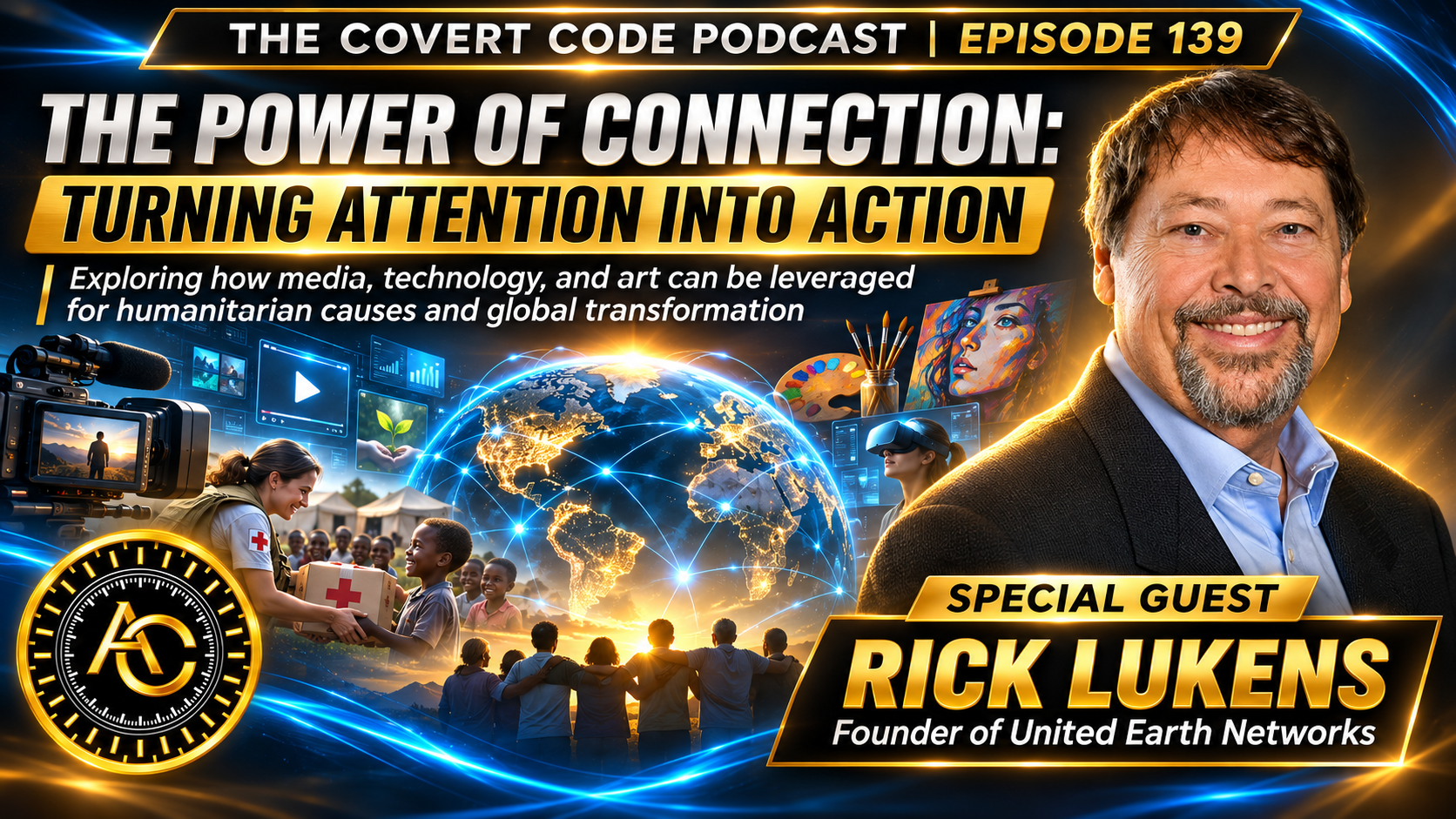
The Power of Connection: Turning Attention Into Action with Rick Lukens
The Covert Code Podcast | Episode 139 | Hosted by Anna Covert
What does it take to transform a moment of attention into lasting action? A concert can draw millions of eyes. A television broadcast can connect people separated by borders and politics. A single community event can inspire someone to help a neighbor. But the moment matters most when people have a way to keep participating after the lights go down.
In this episode of The Covert Code, I talk with Rick Lukens, founder of United Earth Networks, about decades of pioneering global events, historic media connections, and the next generation of tools that could help citizens, artists, nonprofits, and young people turn shared experiences into collective action.
Where Rick Lukens’ Journey Began
Rick started organizing events in high school, then brought people and new ideas together through community gatherings during the late 1970s. He describes himself as someone who has always enjoyed the complex work of creating connections: making introductions, coordinating logistics, and helping people discover what they can achieve together.
Those early gatherings led to an extraordinary opportunity involving Apple co-founder Steve Wozniak and an event designed to demonstrate how technology could bring the world closer. Rick wondered whether television could connect audiences in the United States and Soviet Union in real time. He traveled to Moscow in 1982, and what followed became the first of several exchanges he helped produce.
Building a Space Bridge Across the Cold War
In the interview, Rick recalls the astonishing experience of linking American and Soviet audiences during a period when contact between ordinary citizens was limited. He and his collaborators called these two-way satellite events space bridges. The novelty wasn’t simply the technology; it was allowing people who rarely saw each other as individuals to interact.
Rick explains how he returned to organize or advise on further exchanges, including a later project connecting San Diego and Vladivostok. He also recounts being in Vladivostok as the Soviet Union broke apart in 1991. These are Rick’s personal memories of events he participated in; the interview does not independently establish every historical characterization or claimed impact.
His central lesson remains relevant today: direct communication makes distant people more human to one another.
Live Aid and the Difference Between Attention and Action
Another turning point came when Rick joined Live Aid in 1985. He describes working as an international director to extend the event beyond the major stadium concerts, bringing additional countries and broadcasters into a global humanitarian moment.
Live Aid demonstrated the potential of shared cultural experiences to inspire giving. But Rick also asks a more difficult question: what happens afterward? A major fundraiser may capture attention for a few hours, yet the underlying challenges continue long after the broadcast.
That distinction shapes the title of this episode. Attention is the beginning. Action requires a structure that people can return to. A successful campaign gives its audience opportunities to volunteer, contribute, learn, partner, and carry the effort forward.
Why Music, Art and Culture Can Bring People Together
Rick has spent much of his life using music and the arts as a bridge between communities. We discuss the way a shared experience can bring down barriers more quickly than a formal presentation or policy discussion. Songs, performances, and stories invite people to feel something in common before they agree on every detail.
We also talk about the role of technology. The expensive satellite connections of the 1980s have evolved into devices almost everyone carries in a pocket. The technical barrier to sharing stories across borders is dramatically lower. The challenge now is how to use that access with purpose, care, and credibility.
United Earth Networks: Connecting a Network of Networks
Rick’s current work through United Earth Networks (UEN) builds on those decades of relationships. His vision is not to replace nonprofits or local community organizations, but to help connect them with people, production capacity, and media channels that can amplify what they already do.
He describes relationships with Hubcast Media, whose distributed production network supports cross-border programs, and the PEAC Institute, which works in education, art, culture, and civil-society engagement. UEN’s own website explains how the organizations are collaborating on a global media network intended to support civil society and storytelling.
The larger goal is to build the infrastructure behind a movement: partnerships, shared resources, creative teams, community involvement, and opportunities to act.
Turning a One-Time Event Into an Ongoing Movement
During our conversation, Rick recalls asking a simple question after fundraising events: So what? That may sound provocative, but it’s an important challenge for organizers. What can participants do the next day, the next month, and the next year?
Rick points to civic campaigns that offer clear next steps rather than assuming that awareness automatically becomes change. For organizations, this might mean making it easy to volunteer, join a local group, support a specific project, or share information responsibly. For individuals, it may start with everyday kindness and community participation.
Fort Worden and a Home for Collaboration
Rick describes using the historic Fort Worden campus in Port Townsend, Washington, as a physical gathering place for production, learning, and collaborative events. He talks about bringing people together in person while linking remote groups through interactive media.
He also describes opportunities for young people to develop storytelling and citizen-journalism skills, and for Indigenous communities to document and share cultural knowledge and languages on their own terms. These efforts underscore a broader theme: technology should increase participation, not concentrate the right to speak in a few institutions.
How to Organize a Community Event That Matters
Rick’s advice is practical. Start with something you care about. Ask friends and neighbors to participate. Build an event around a realistic goal, whether that means a local meal, a concert, a fundraiser, or an educational gathering. You don’t need the resources of a global television production to get started.
He also emphasizes the importance of remaining calm while details change and taking time to thank volunteers. Many people contribute because they care about the cause, not because of compensation. Acknowledging that generosity helps the next event—and the next stage of the movement—be possible.
Human Connection in an Age of AI
Anna and Rick discuss emerging technologies, including AI, media distribution, and tools that help communities tell their own stories. We also touch on personal beliefs about consciousness and collective action. Those exchanges are reflections and anecdotes from the speakers, not scientific demonstrations of medical or societal outcomes.
What remains persuasive is the human premise: the most powerful technologies are the ones that help people understand one another, collaborate, and translate shared interest into useful work.
Connect With Rick Lukens
- United Earth Networks — official website
- Rick Lukens — biography
- United Earth Networks on LinkedIn
- UEN, PEAC Institute and Hubcast partnership
- Hubcast Media
- PEAC Institute
Follow Anna Covert and The Covert Code
- The Covert Code
- Anna Covert
- The Covert Code on Instagram
- The Covert Code on Facebook
- The Covert Code on LinkedIn
- Anna Covert on LinkedIn
Listen to The Covert Code: Spotify | Apple Podcasts | Amazon Music | iHeartRadio | YouTube Music
One takeaway: The next movement doesn’t begin when everyone sees the same screen. It begins when people know what they can do together.
Full Transcript — The Power of Connection: Turning Attention Into Action | Rick Lukens | Episode 139
Host: Anna Covert Guest: Rick Lukens, Founder of United Earth Networks
[00:00:12] Anna Covert: Aloha. My name is Anna Covert. And this week on the covert code, the topic is the power of connection. Turning attention into action. My very special guest is Rick Lukens, founder of United Earth Networks. From Live Aid to pioneering live satellite connection between the United States and the Soviet Union, to his work with the white House Conference on Global Climate Change and the United Nations. Events Rick has spent decades connecting people across borders through shared experiences. Today, we're going to be exploring how music, media, and technology build trust, inspire participation, and how to turn a powerful moment into a global event. Thanks for being here today, Rick.
[00:00:55] Rick Lukens: My pleasure. Anna. Thanks.
[00:00:57] Anna Covert: So how did you get into the business of saving the world?
[00:01:01] Rick Lukens: Well, it's not saved yet, but a lot of our friends are, you know, trying to move the ball that direction. Um, I got involved really early. I started producing events in high school and have always wanted to bring people together. And back in the late 70s, I started doing large scale alternative conferences. And in my community we called them Community Consciousness Carnivals, and we brought a lot of the new ideas and silos together, you know, to learn about our own communities and and see what we're doing together and how to better organize. And that led to the next event, which, um, turned out to be quite a large event for Steve Wozniak from Apple Computer. And, um. Wozniak's idea was to see how technology could be used to bring the world closer together. I was producing the satellite. Well, it wasn't the satellite uplink. At the time, I was actually finished with my part of the event, which was more about the tech fair and exposing new tech to young people. And I had some extra time I had ten days before the event. And, um, to be honest with you, the idea came out of out of the ceiling into my head that I could link the Soviet Union and the United States by two way interactive TV, and that had never happened. It was during the Brezhnev regime in 1982. And within that ten day period, um, honestly, you know, a lot of grace and a lot of magic lined things up. And we pulled that off, um, in 72 hours from the time I landed in Moscow, until we broadcast live back to 350,000 people in California. So those were really early breakthroughs in people to people communication between our countries. And we're credited with being a big part of the. Shift from the Soviet Union to what is now Russia.
[00:03:15] Anna Covert: Wow. What was it like when you landed in Russia? In the Soviet Union?
[00:03:19] Rick Lukens: Well, it was, um, it was really interesting. There were no modern buildings, nothing like today. Um, people were were bent over when they would walk in the street. There was a heaviness almost a lid on top of everything that I could see. And, and people actually called me out on the street because I was walking like a free man, I would say, just because I stood up straight. So it was kind of heavy. And, um, you know, the way that event happened is that we were greenlit at the very highest level. Brezhnev, I learned later, you know, said, do this. And so at that point, there was nothing I could say that they wouldn't do. And so we just pushed on and, and, uh, brought a Russian band out of the literal illegal underground. They sought asylum in the American embassy in Moscow. Um, until they learned that this was legit. And they they joined us. And we did that in 1982. And then we did a bigger version of that link in 1983 with the full talk show format. And it was really the first time that average citizens could speak somewhat freely. You know, there was no censorship. It was live. Um, the Soviets had never had any live television. The rock n roll was seriously illegal. Nobody had ever worked. Over time, there were half a dozen things that they'd never really done before. So it pushed the envelope. And, um. The Soviet citizens got to see themselves being portrayed back to Americans. And that's, I think, one of the biggest, biggest things that I've always really enjoyed is just the. When you do these events, people in other parts of the world are just so moved that you care enough to even knock on the door and, you know, set something like this up because we just Americans thought Russians had hooves and horns. And, you know, we just did not have a chance to even see or speak to each other back then. So it was it was quite a time.
[00:05:39] Anna Covert: That's really incredible. And and how long after that was it that the Soviet Union changed to Russia?
[00:05:48] Rick Lukens: Well, that was 1989 or 82 and 83. For those first links, in 91, the Soviet Union collapsed. I was literally in Vladivostok, Russia, the day the Soviet Union collapsed. I was I was doing another one of these, what we call space bridges, and it was between San Diego and Vladivostok, which were sister cities, and both our naval ports. And Vladivostok was in off limits. Even Russians and Soviet citizens couldn't travel there without a special permit. And when I was there, the Soviet Union literally collapsed overnight. I was officer in the government building and the Soviet side of that government building, the central government. Those people didn't come back or enter their offices. Their offices were sealed that day and that was it. And so my friends actually stormed the went to and stormed it. But they went to the the meeting hall for the Central Communist Party meetings. And they brought me the flags, the beautiful velvet and gold embroidered flags. So I helped open the door, and I was there to capture the flag on the way out on the Soviet Union.
[00:07:09] Anna Covert: Wow. I got chills just
[00:07:10] Rick Lukens: thinking about that. It was kind of interesting. That is incredible. In 1991. So those were kind of my bookends of working in the Soviet Union and haven't been back since.
[00:07:19] Anna Covert: And why did you how did you come up with the name The Space Bridge?
[00:07:23] Rick Lukens: Well, I had a colleague that we met when I went over who was very unusual. He was, um, he was pioneering what they called hidden human reserves in the Soviet Union, which was the beginnings of our kind of consciousness and psychic movement. So we were doing different programs that involved telepathy and remote viewing, and all of those things were happening at the time. And this gentleman, while he was way on the fringe, he he had protection. He had cured a Politburo member of a stuttering issue on a disco boat on the Volga River, that he created a special event that somehow popped this guy through his stuttering. And so every time he would get rounded up and, you know, set off to a psychiatric hospital, perhaps he'd have a Politburo member bail him out. And his name was Joseph Goldin, and he and I were just sitting in a room in Moscow, made up the word space bridge. Together we. And it just kind of came out of nowhere. We just made it up and the name pretty well stuck for many years. And so I just was really fortunate to, you know, take a chance and not take no for an answer. That's a big part of doing these events. You you learn that if you agree with no, then you're not going anywhere. So, um, how many
[00:09:06] Anna Covert: of these events did you do in Russia?
[00:09:09] Rick Lukens: Oh, I did probably close to ten over those that decade and advised on a lot of the early ones that started after we did the first two. And, um, but then I typically don't stick around and do things more than once or twice, and I kind of move on and seem to pioneer something else. And so, um, a lot of people and a lot of my friends have carried that ball, and I've just blessed to have been part of the beginning of that. Indeed.
[00:09:41] Anna Covert: So tell us about Live Aid and how did that came to fruition? Well, Live Aid, you know, that decade, I think, um. The events that I was doing were, um, I've got to say, full of a lot of I lead with love. And I think people feel that and they respond to that, and they want to be a part of that energy. And, um, like an event like Live Aid you would think would be so complex and so detailed. But it happened so fast. It was six weeks that I was involved, and probably nine weeks from when everybody started until I got on board. And but, um, I just have to say, those are events whose time has come. You know, it's a moment in time that everybody can resonate with. You're not out trying to cajole or convince or bargain or negotiate. You just everybody goes. They're professional. They know what they're doing. They don't need to be super supervised. And so everybody went and did their part, pulled it back together. And my my role as the international director was to take it from two large stadium concerts and help in the globalization of it. So I worked on my travel, went to the Soviet Union again and engaged them. I went to India, um, put. India together in less than two hours of arriving. Wow. I arrived in New Delhi. I didn't know one person, didn't know what I was going to do, and within an hour I was an hour and a half. Probably. I was with the Prime Minister of India. You know. Oh my gosh. Yeah. It wasn't my I mean, it was just the right timing, the right phone call, the right moment. And, um, actually, I was sitting in my hotel and I decided I. What am I going to do? I just left London. I'd met with Bob Geldof and the BBC was our lead broadcaster from London, and I called the BBC. I just called called and the guy didn't say two words. He just said, I'll call you back in two minutes after I gave him a short pitch. And do you remember your pitch?
[00:12:07] Rick Lukens: Well, I just, you know, we're doing this with the BBC. I had just come from London. I explained what Live Aid was about for people who
[00:12:14] Anna Covert: don't know what Live Aid is. Tell
[00:12:16] Rick Lukens: us. Well, it was a. In 1985, and it was an African famine that people on television. It was one of the first times that you could see starving children and the situation beamed into your TV sets in your home. And it was, you know, not a good time for Ethiopia. And Bob Geldof and his partners had this concept or, you know, got it going. I got a phone call and was asked to join the team, and, um, Live Aid raised, um, just under $200 million and 16 hours of live television streamed to 2 billion people, not streamed. It was satellite broadcast. There were no wasn't streaming. Right. And so, um, you know, that we reached as many people as Princess Di's wedding that was on the PA that close to 2 billion and everybody. I worked with the AT&T call center. They thought that maybe they could. They processed 15% of the incoming phone traffic because I had to pick up a phone. Have a pencil, write down a credit card number. Nothing was computerized. Right. And and they told me you need to
[00:13:41] Anna Covert: lie. People that was in any any AI to take those calls
[00:13:44] Rick Lukens: either. No, no. And if they only got 15% of the calls processed and we raised $200 million, you can see what. You know, everybody contributing a small amount can add up to. So it really set the standard for global charitable events for humanitarian causes. And I've gotten on a path of really just wanting to be involved in humanitarian work early in life. Really early. Um, and I realized early that, you know, you can't always plan everything that you have to. Like in sports, you have to get into the flow. And so a lot of these events just unfolded. You know, you couldn't have said you're going to go to India and meet the Prime minister in two hours, you know. But there you go. So that secured all of India for 16 hours of TV and radio, which reached more people than television in India. And Prime Minister Rajiv Gandhi, you know, agreed to everything I asked in the first 30s. He was just thrilled. So he did a world leader message. And, you know, it just was one of those, again, moments in time. People have called me ever since Live Aid and they want to do the next Live Aid or something, you know, to help humanity. But you can't push that. You can't just say, oh, I'm, I'm going to get a billion people to join my event. You know, it's it really is a bit of a collective moment that humanity has to just get it and want it. An idea whose time has come. Really? Yeah.
[00:15:26] Anna Covert: And that's kind of how technology is involved as well. Like this was something really new at the time. Yeah. Right. But now that everyone has a phone and we're streaming, you know, basically on Facebook and everywhere else, all types of atrocities from all over, it's might be more challenging to think of what is the next thing. Mhm.
[00:15:47] Rick Lukens: Well we're, we're involved in so many international projects now. Um we've formed our some new partnerships and we have new technology that is available to us. I've always pushed technology with, you know, art and culture and music and cross-cultural understanding. So you know I've, I never know what I'm going to do next. I'll put it that way. I'm not on a trajectory where I've got the plan. You know, the amount of brain matter between my ears I didn't ever think could figure out what I'm going to do. So I've just kind of let it unfold and been very blessed to have done a lot of things, kind of for the first time. And, uh. You know, it's on my timeline. I'm a big believer
[00:16:38] Anna Covert: in surrendering to the universe and letting it unfold. You can't can't perceive when your hands
[00:16:44] Rick Lukens: in a fist. Yeah, yeah, yeah. So that's kind of been my guiding experience throughout all this.
[00:16:53] Anna Covert: So humanitarian work, of course. I'm also very passionate about that. I know we're both board members for the American Renewable Energy Institute. Tell me about your part in our the white House global climate movement.
[00:17:08] Rick Lukens: Sure. Um, again, another just happened. I didn't seek it out, but I had been coming and going from the Soviet Union and the People's Republic of China at that point and all around the world. You know, for many years. And people keep eyes on you during that. And I think right after Live Aid, I was approached by our government. Like, what are you doing? And so my dossier was filling out, I suppose. And. Again, right place at the right time, and I was asked to contribute to the first global conference on climate change that first President George W Bush wanted to do. Margaret Thatcher had told him he should keep his eye on this climate change thing, and he did. And he wanted to do a white House conference. And we brought 16 countries, ministers of science and economy, together with their entourages in Washington, D. C., and it inspired George Bush to go push out the United Nations to start the cop events. And, you know, these things have a way of really. It's amazing what what 1 or 2 people can, can do in the world and how it just, you know, it's a trim tab. It it can really move, um, move people and move history. I mean, I have heard years later that that was the only climate event that was worth a piece of salt, you know, from other climate leaders. Yeah, they remembered that. And they said, well, that was a good one, but it really got, um, got the cop going. And I walked out of the front of the hotel during the event, and there were thousands of protesters. And I realized, oh, you know, maybe they're people are paying attention. And, um. You know, because our government wasn't, you know, doing much for climate change, but it was an attempt to talk about it at least, and gather some people. But honestly, it was it was also I learned that, um, you know, there are people that want to divide people and keep people separated. And one day the door came off of my office. Literally. Some people came and took the door off. And outside in the hall there were two desks set up, and there were two guys who were there to listen to me in my office and to, uh, they were making a matrix of everybody's position on issues specifically so they could separate them so that there wouldn't be two people with a good idea, perhaps that might do something positive. So, you know, there's powers for good and powers to divide and whatever. And that's when I had the idea of United Earth Networks being a intelligence agency for a real planetary intelligence. They could not divide, not division and separation. But, you know, we could. We could have a, you know, a network of people that love the planet, love the earth, love humanity. And I'll tell you, there's millions and millions of people out there now that are rallying around different projects for different causes, the environment or the you know, I think everybody if we do this event again in a large scale, like a Live Aid for the planet, um, I think it needs to empower the individual in their own mission, not just save the rhinos or save something, but empower the individual to with tools and technology and new ideas and networks so they can be supported and lifted up. And so that's what I hope to do in the future. And we're we've got an incredible opportunities. Now. When you think back in the 80s was interesting. Um. Things that are that are coming at us now, I think are, you know, they're global in scale and exciting as heck. So, you know, everybody is a little pinched for resources in this current time. And, um, you know, struggling. But, you know, it doesn't take that much. I mean, I went to the Soviet Union in 82 with a blank cheque from Steve Wozniak, and I filled it out for $3,000, you know. And, um, you know, a few people can make a real difference in the world, and everybody's heard that. But in my experience, it's really true. It really is.
[00:22:02] Anna Covert: What surprised people that about putting on a big event?
[00:22:07] Rick Lukens: Well, the you know, my when I started doing larger festivals, um, I had some interesting experiences. The, you know. I think what surprises people is. Just how much other people care and and will step up if there's a little bit of leadership and, uh, you know, the opportunity to engage. So a lot of the events back in the day, we I used to always say, you know, we had to so what factor? You know, we'd do a big event. We'd raised $2 million or something for the UN Food and Agriculture in one case. But it's very difficult to follow up and get an ongoing campaign going. And, and, um, you know, give people a way to keep it moving. So it's, um, I've always said it's a you you raised $200 million and, you know, so what?
[00:23:10] Anna Covert: It's true. It's like, how do we get people to go from caring
[00:23:13] Rick Lukens: to acting? Yeah. And that's that's happening a lot more now, you know, Global Citizen and different organizations that have. Are doing this type of work for humanity here. You know, they've got action plans. And so that's just part of building a campaign and not just doing a one off event and walking away. And so
[00:23:33] Anna Covert: what? Yeah, I think part of just what can people do at the individual level. I mean, I always, you know, like to say turn the lights off when you leave the house. You know, you can watch how much water you use. You can turn the lights off. You can think about recycling. These are things that you have the power to do. And, you know, buy only what you need and take if you're if there's a buffet, eat what you need to take and things like that. We can all become aware of and that can collect up to a lot of
[00:23:59] Rick Lukens: change. It really can. And you know the simplest of things, there's a project I've come across recently, a billion acts of kindness. And students around the world are, you know, young students and grade schools. They're just doing an act of kindness. They're just being friendly. And, you know, some it doesn't have to be a big thing. You don't have to raise $1 billion, you know, just do an act of kindness. It's just, you know, from my perspective, I think it's about human awareness and consciousness. And if we can see and love each other as ourselves. And I think that goes a long way.
[00:24:43] Anna Covert: And I'm with you. And I think that technology is one of those. I know a lot of people are afraid of AI, and I want to hear your opinions on AI, but I think that this is a perfect example of what you've been through to show that technology can become this bridge. And the more that we see each other and communicate and understand that we are all. Breathing for all humans here in Hawaii. We're sitting here in Hawaii, and the idea of ha being the breath of life, and that really unites us. That's the one thing that every human, no matter your color or where you're born, your first thing you do is take your first ha or breath. And when you die, your last and everyone in between is an opportunity to connect to the people and the culture and the community. And it's one of the beautiful things about, I think, Hawaii in particular.
[00:25:29] Rick Lukens: Yeah. Well, I read something just the other day, um, a woman, Lynn McTaggart, has a new book, and her book is about everything. The universe is music. The universe is is, you know, frequency and vibration and that's music. And I think that's one reason that music resonates within us, you know, and through us and, and, um,
[00:25:57] Anna Covert: have you ever heard plant music?
[00:25:59] Rick Lukens: I have a little bit. Yeah, it's pretty
[00:26:01] Anna Covert: cool. Yeah, it's really beautiful,
[00:26:03] Rick Lukens: actually. Yeah. There's. Everything's talking to each other. Yeah. It's it's all we're all just kind of a mixed mash of, you know, energy and vibration and it, uh, it's exciting to learn more about the cosmos and, you know, what's coming with new tech. And it's, it's quite a time that we're living in and, uh, you know, we need to support our younger generations and have them have experiences they can remember for their lifetime. So, uh, bridging to five generations that are generally alive at once on the earth. We need to take care of our young people and learn from them. Because they're inheriting what? What we've created. It's true. It makes me think. You know, when you said that there was picketing, which I. And I know still today. But really, I think that we need as a community to and as a people who are into renewable energy, we need there to be a campaign that changes this idea, that oil, that we're against oil because we're not. Right. I mean, I'm not. And what I think is that this is a precious, precious resource, just as important as gold or diamonds. And why are we burning it when we have alternative options? Alternative energy options. Right. And if someone is invested in oil, why would they want this volatility of per barrel. When if we do rebranding and say hey listen we can replace energy in our houses, in our cars. But what we can't replace is what oil does in clothing and other materials that we have no replacement for. So this
[00:27:43] Anna Covert: is worth a lot more than it's being said. It's worth today and we don't want to. Gosh. I mean, I don't want to run out. I don't know about you until we find a replacement, but I think then people can really say, hey, it's not that we're against it. No, we we want to elevate it. To what it where it's placed in a precious resource. It should be. Yeah. Well, people are, you know, um, motivated by greed and money, and it's a it's a powerful world. And everybody's doing their part, though, and, um. I think. I think we have a very positive future with technology and new ideas and the things that we're going to learn in the next five years with AI, um, solutions. We're about solutions. Absolutely.
[00:28:34] Rick Lukens: And our friends are. And all the people we work with are. And so we need we need the solutions are there. They are. It really isn't like we don't know what we're doing. It's just how to do it and move it forward. So I'm later, hopefully
[00:28:49] Anna Covert: very excited about the future. I know people are really scared, but I'm very optimistic. I, I, you know, I have a 12 year old daughter and she's one of the reasons why I'm so passionate about renewables. And I want to make sure that she gets the chances to grow up to be whatever she wants to be. Yeah, right. And and I do think that, you know, especially with AI and these abilities to and consciousness in particular and our ability to hey, let's, let's use AI to not have to do the boring things and no one wants to do. And humans can be more creative, which is something that the aliens and the technology can never take away from us. Right. And use that to help heal the world which we are a part of.
[00:29:27] Rick Lukens: Yeah. Yeah.
[00:29:30] Anna Covert: Yeah. So tell me, what is what are you most excited about that you're working on right now?
[00:29:35] Rick Lukens: Well, I think, um, our networks have evolved now over 50 years, and there are so many people at the top of their field that want to contribute to a better world. They have mastered their space, their, you know, made money from their clients, but they want to give back and they want to work with our network. Um, not to make money, but to leave some impact. And so, um, what's exciting to me is the caliber of the people that are stepping forward now that want to be a part of the United Earth networks and the work we're doing, and so many others are doing. It's not just us, but, um, the other exciting part is a new partnership I formed in the last year with two groups. One is called Hub Cast Media Out of Canada, and they have a proprietary technology for linking studios around the world interactively so that our director could be in one studio in Africa and or, you know, guy calling the shots could be in Australia. And it's all decentralized, connected, small scale networks. And we're rolling that out. Um, I already have, I think 7 or 8 studios around the world. Um, two in Africa, 2 or 3 in Canada. I've opened a new one at my center. And this is something that's been around for ten years, but it basically is, um. You know, I've, I've wanted to have a global media channel and hubcaps dropped it in my lap. I didn't have to build it. I didn't have to take ten years to do it. But I'm partnering with an established platform where we can reach so many more people through storytelling and, um, to youth. And our third partner in this program is a group in New York called the Peak Institute stands for Peace education, Art and communications. And um, this is headed by a young woman, Rebecca Irby. She's a Nobel Peace Prize winning person. She won the Nobel Prize for her work on nuclear nonproliferation in 2017. Her organization was part of the ICAN movement, and large movement won the prize. But she got one. And she's part of the United Nations co NGO organization. And so the three of us have partnered, and we've just opened a new media, what we call a civil society media desk in New York, a block from the UN, um, approved and greenlit by the secretary general at one of Rebecca's meetings with, with his team. And, um, so this network is really growing legs and it's going to be distributed and we're going to be able to work with youth and, um, NGOs around the world. The Congo was founded by the UN to be the it was the first NGO created to help. Guide civil society. Other NGOs in their relationship with the UN and the UN is going through tremendous change and restructuring and reorganizing. And so we seem to be at the table for what's next and how civil society, you know, regular organizations that are states, member states can affect and consult and advise as the UN goes through a new transformation and a new time. So the three of us joining forces gives us a global media platform. It gives us the ability to do global events. We've done two around the world global events in the last month, you know, 24 hour or 10 hour events that that went to 100 countries recently. Wow. And had feeds from 100 countries. So the the tech is available. The. It's just exciting what's coming together. I mean, it's it's a time, though, where we all have to scale this work. You know, um, people do this work to the best of their ability. Some organizations are huge and super funded, and others are grassroots. But we need to we see ourselves at at the Peak Institute and United Earth Networks and hub cast as creating a like a mycelial network under the forest to support the trees and all the leaves on the trees. So there might be a tree for the environment or for human rights or other verticals, and then all the organizations that are in those verticals, and we're trying to create a toolkit and a, you know, a platform so that we can support getting these NGOs messages out.
[00:34:49] Anna Covert: So 17 sustainability goals from the UN as
[00:34:51] Rick Lukens: well. Our channel is is based on those goals, the sustainability goals. And from what I understand there are some I wouldn't call them spiritual, but they're more, you know, internal goals that we can't get to the 17 unless we kind of
[00:35:07] Anna Covert: like the Maslow's hierarchy of needs.
[00:35:09] Rick Lukens: Let's be sure we're, you know, taking care of our own internal space. And to me, that's exciting because I, I honestly believe that the shift is going to be a shift in consciousness. It's not like somebody raise more money to do something, but all of the. I think the people that are doing this kind of work have had a shift in their consciousness or, you know, they want to give back and and that that's what makes me happy. That's what I want to do. But I don't know that I've got an answer. It's not my plan. I'm just along for the, you know, ride of the quantum universe, you know? So and that's what makes it fun, because I don't know what I'm going to do next. I, I now have, you know, some real partners and we're going to make a big effort, you know, to build this network and do these global events and keep all this going. But how and with who? It changes every day. Every day there's a new opportunity and a new group that reaches out to us literally every day. So we need to scale it, you know, because you can only hold so much with a small team and then you.
[00:36:23] Anna Covert: Yeah. And how to get the awareness out to from a micro to a macro so that people out there know that there's this. Has been created. These events are being housed, this technology is available and communities can use it. Right, like a grassroots television station kind of
[00:36:40] Rick Lukens: situation. Well, that's we just keep going and doing the next one and people are seeing it and you know it. It's organic. I won't say, you know, we're not here to get rich and, you know, take over the media and we're just here to support humanity and give people new tools and opportunities. So it, um, it's a little different. You know, we're not I'm not particularly motivated by, you know, making $1 million, but I can afford to give back. And I have all my life since I was quite young. So lucky me. Lucky.
[00:37:20] Anna Covert: Yeah. So how can people get involved in what you're doing?
[00:37:27] Rick Lukens: Well, check us out online. My website is United Earth Net for United Earth Networks. Hub. Cast. Medium.com and the Peak Institute. Peak Institute. And those, you know are just some of the members of United Earth Networks. I have a team of people that all have their own businesses there. They're all wonderful people. They bring so many resources and connections and opportunities. But I don't you know, they've got their own companies. And I don't wake up worrying too much about a gigantic payroll. But, you know, we're in the relationships business. Honestly, it's, uh, people have come to me because they want to know who I know and how to get things to happen, and they have a dream, and they think I can help them. And they come, and I help a lot of people with their dreams, and we'll see what's next. I'm excited.
[00:38:28] Anna Covert: So for people who are out there who are looking to start their own event in their own local community, what advice do you have for
[00:38:34] Rick Lukens: them? It really isn't that hard. You know. Just find a subject that you're passionate about and you've got some energy to. You know, it might be a career path that you think you're going to be on. It might be just service. I started doing soup kitchens and, um, you know, organizing grocery store waste and government cheese and, you know, feeding people and loving everyone. That was my first big event was with a spiritual teacher, Ram Dass. It was called Feed the People and Love Everyone. And I'm just kind of still on that track. So, um, I really do think it's about caring for each other and the events there. It's not that hard. You know, you can do a car wash, you could do a concert, you could do almost anything. And and it's not hard to learn. I started doing sock hops in high school, and I got the gene for organizing complex events through my family. But they were engineering construction projects. They weren't humanitarian space bridges, but they were real bridges. And so I just did get that gene. I like to organize a lot of details. But one thing I learned early on is when you're doing an event of any kind, you you want to be in the eye of the hurricane when the hurricane lands because things go get going so fast. In my experience, I actually felt almost like a, a time shift, like things went into slow motion when they got busy. When I was being approached by so many people for so many answers all at once, things kind of went into this weird slow motion mode. And so you want to just stay calm. You know, this too shall pass. You know, the event always seems to happen. You know, don't don't get too over amped about oh my God. The details are overwhelming because events have a way of just flowing and happening. And then you do a wrap up and you want to be sure you thank everybody that touched it. Because, you know, these kind of events people aren't always doing for money. They're doing it, you know, for so they can give something back. They're volunteers. And if you don't thank people and you don't appreciate the time and energy, yeah, that's a turnoff. Yeah. So, um, we're always sure that we. A really grateful for everybody and that's that's
[00:41:10] Anna Covert: a reward. I mean, that's part of the compensation comes in
[00:41:13] Rick Lukens: many forms. Exactly. Yeah, it's not always monetary. And I think people are looking for ways that they can contribute in that way. And they sign up for events all around the world. We work with Rotary International on some of our peace events. I'm involved with the Jimmy and Rosalynn Carter Peace School at George Mason University on a global event for world peace. But then there's five other events for world peace that have tapping into me. So, um, there are just so many different angles and, you know, find your bliss and find what gets you excited and get with your friends and cook up a party or whatever, or be a small part in these global events because they're decentralized now. Um, I was working with Steve Wozniak in the early 80s, doing these satellite bridges to the Soviet Union, and my friends at Apple Computer, who were running their high speed prototype laboratory, literally brought that technology that cost us thousands of dollars in rentals of satellites. And my friends literally brought that down into the pocket right now, into our devices. Because now we just pull something out of our pocket. We can interact with anybody on the planet. And so, jeez, just think of what we can do now compared to the when, you know, technology was a little further back. It's true. Yeah. So
[00:42:49] Anna Covert: yeah. So when social media first started going and then there was the, you know, Arab Spring.
[00:42:53] Rick Lukens: Yeah. Right. I mean, it's
[00:42:55] Anna Covert: the way that we can get information out there is instantaneous now. And it's a very exciting time.
[00:43:02] Rick Lukens: Well, and people, the people, you know, our governments are doing their government thing. And I'm not saying that's wrong or bad, but people can do things and they don't need governments to talk to each other. Yeah. And, um, you know, and I think it's,
[00:43:17] Anna Covert: you know, you talked about the six degrees of separation. I think it's a lot faster now. I think it's one degree of
[00:43:22] Rick Lukens: separation. Degree. Yeah. The way it's going in my world, it's incredible. It's really taken off this. I'm very excited about the next five years. So, um, we're there at the United Nations. We have an opportunity to. Reach civil society through media and amplify the voices of people doing the work and support that. I think that's a huge opportunity. I mean, really, um, you know, the the world is in a bit of a tough spot and, um, I can't even tell you how many wars there are going on. And so peace and human rights and all of those issues are more important than ever. And it's people that are going to solve it. I don't think the governments are getting us much closer. So no, you know, doing their best, I suppose. But the
[00:44:13] Anna Covert: only way to stop war is to make it
[00:44:14] Rick Lukens: unprofitable. Exactly. And we have a lot of work going in that direction and people thinking about that. But, um, that's a big leap from where we are today. But I think it's possible.
[00:44:29] Anna Covert: I know it's possible, too. Yeah. Especially when we think about collective consciousness and even some of those little tests that they've done in some cities where they've got super meditators. Have you heard about these? And they got them together in. Places of extreme violence and just 1% of the population in that area. I can't remember how the distance, but it was pretty large and they got these super meditators there, and they were they could actually track that. The crime went down, the hospitalizations went down just from them meditating together there that the collective responded,
[00:45:03] Rick Lukens: well, we actually hubcaps just did last month on one of these around the world 24 hour events for a group that had created has created a wearable device that measures that kind of coherence. Oh, really? And it was a proof of concept that exactly what you're saying is measurable and works using their wearable device. And so the data came in from the event. We did 24 hours around the world linking events. People were wearing the device, the unified moments, like you said, where you're focusing on something together. It was it's measurable. It's. Not new science. No. And so this was a proof of concept which helped this particular company land a huge new round of funding because there was the data and they weren't just saying it. It's true. You know, I was I was at Doctor Joe Dispenza, one of his events this year in Dallas and they were doing we do group healings. Yeah. And those were incredible. I mean, the, the you could feel the energy around and people were being cured of all kinds of diseases right there. And so group prayer works. We are so powerful. Yeah. And I think that's one of the things that it's time when we realize that, that we can fix all these problems with our minds and our hearts.
[00:46:27] Anna Covert: Yeah. And this, you know, age of love that we're
[00:46:30] Rick Lukens: moving toward. I hope so. Um, yeah, it's it's right in front of us. I think we just reach out and work together. That's. Collaboration is always the key.
[00:46:45] Anna Covert: And I think a lot of people right now, it's so dark. But, you know, I'm a big believer in the Hermetic laws. And, you know, when there's a lot of darkness, that means that there's an equal amount of light. And so it feels dark. But that's because there's so much light, like the work that you're doing. And these all these people from all over the world who are coming together and and being lifted up with their new knowledge and all this ability to share information quickly that we didn't have before. And I think it's just a matter of time before it. It crashes through. Yeah. Yeah. Well, you asked me about what's exciting, and my relationships with some new partners are quite exciting, and and my network is growing. And but one thing I didn't mention is that I've located to a, um, an interesting headquarters, I guess we'll call it. And it's a a Washington state park in on the Olympic Peninsula of Washington state. And this is a decommissioned military base that is like the Presidio in San Francisco, if people know about that. So it's from 1910. It was protecting the entrance to the Puget Sound from an enemy that never came. So it never had to shoot anything perfect other than just target practice and have a good time. But, um, this is a large facility in campus that was created for arts and lifelong learning 50 years ago, and I'm the newest partner there, and that's my headquarters with my studios. And I can do residential conferences for up to 5 to 700 people. Oh it's big. I just did a 500 person, five day conference for Global Earth Repair that gathered leaders from around the world that are fixing the planet. You know, their hands in there, in the dirt. Regeneration.
[00:48:37] Rick Lukens: Regeneration and,
[00:48:39] Anna Covert: yeah, groundswell and all that.
[00:48:40] Rick Lukens: Yeah, but it's, uh, people really actively on the ground, and it's so inspiring
[00:48:46] Anna Covert: to see that we can actually do change solutions.
[00:48:49] Rick Lukens: Yes. You know, that was one of the points of our gathering, was to just compile solutions and, and network with the friends that are doing this worldwide. But this center gives me a real place. I, I say I'm building a center for personal and planetary transformation at Fort Warden. And so if anybody makes it to my website, they'll see a link to Fort
[00:49:14] Anna Covert: Worth. We're going to include all of the links in the channel here so you can check out
[00:49:18] Rick Lukens: everything. Yeah. So that's exciting to me that I actually have a facility that I can gather people. I have a trunk of fiber that comes in 24 strands of glass, comes into my my office building and distributes out to the fort. So we have a pretty much unlimited bandwidth for all the interactive work. We had, um, 500 people in person. We had 12. Um. Tribes represented indigenous tribes. And then we linked interactively to groups of 400 in Africa, 400 in Brazil, 50 or 60 in Nepal. So we were bringing in keen odours from around the world. We were making had large groups that were interacting with us. It was, uh, you know, it's a hybrid. And, and I like to push the edge of the technology with, um, you know, music, art, culture, make the world a better place stuff. And so this was my first large event at this facility, and it is set the stage now for many that were organizing, um, in Washington state. And we're linking that the, the efforts at the UN with the Congo, we call it um, we're starting a new educational youth institute, and I'm hoping to base a lot of the class studies out of Fort Worden in New York at our offices to start. But this will be an international organization for young people to we're starting with citizen journalism as a theme, as we teach young people how to use technology in their device to create real news and real content and provide them with the channels to get it out there. So, um, it's one of the things back in the, uh, human rights, um, projects that I worked on in the early 90s, in late 80s, putting the tools that capture what's happening on the ground in the hands of people. Peter Gabriel did that. After the Human Rights Now tour. He put handheld, the first handheld video cameras, into human rights activist hands so they could record.
[00:51:33] Anna Covert: So important. Otherwise, we had the parachute journalism, which didn't really tell people
[00:51:36] Rick Lukens: much. I didn't hear about parachute that, you
[00:51:40] Anna Covert: know, they call it parachute journalism, where we just send a journalist and yeah, what they bring back is this is a long time ago, but, you know, was not necessarily the truth. Right. Because they weren't told the truth. Because they were foreigners. Okay. You know, but when you're on the ground, right, then you you you really are seeing the truth.
[00:51:58] Rick Lukens: Yeah, yeah. Obviously, every device is in almost everybody's pocket everywhere in the world. So we're all connected on so many levels. And now we can just say hello and
[00:52:09] Anna Covert: are people. I mean, is there is there fear? I mean, are you hearing that people are afraid even in these other countries, or is it kind of that's why you have some of these channels because of being persecuted or.
[00:52:19] Rick Lukens: Well, that's a thing. That's for sure. We're doing this project with the Carter School for peace, and we're building a global network of peace leaders and activists and programs and providing support and resources. The funding and. Things and it'll have a private section. You know, there are certain countries and places where, you know, it's not looked upon too well that you're trying to make the world a better place. Right. You know so well. So
[00:52:47] Anna Covert: corruption or. Yeah.
[00:52:49] Rick Lukens: Yeah, it's it's not a
[00:52:51] Anna Covert: totally but ways to be anonymous maybe that they could you can help them hide their IP or whatever it might be.
[00:52:56] Rick Lukens: Yeah. Yeah. I mean we're working with indigenous nations about their language and you know, things will be on the blockchain and they'll be private. And, you know, there'll be ways to keep things a little more.
[00:53:08] Anna Covert: I think that's actually really interesting to me. You melt up indigenous cultures and how many almost like apple seeds and how many apples are used to be. And then we've lost all the seeds. But there's so many different unique languages and dialects that are out there that are being
[00:53:21] Rick Lukens: lost. Well, that's true. And that's a conversation I had yesterday with a group out of Australia who has a tech that will allow any person in the world, really to see an object and speak it in their. Indigenous language, and it's a way to catalogue and to teach younger generations and preserve the languages, because they just they're disappearing every day. Yes. You know, there's a language that it's banished that is incredible. That chills us now. Yeah. That's another. It's an example of the everyday, something new.
[00:53:56] Anna Covert: And then the AI. I mean, then we can use the AI to even maybe decode. I've heard that they're able to. Now we're close to being able to decode
[00:54:07] Rick Lukens: whale. Well, they're more than close. I think they've managed to, you know, actually have some. But then I
[00:54:13] Anna Covert: want to know, how are we going to actually, you know, we're going to make a fake whale and we're going to put them down there. And I mean, how are we going to deploy this technology to speak to the
[00:54:22] Rick Lukens: whale? You know, I think they're already doing it. Really. They've got that is amazing. They've got some
[00:54:27] Anna Covert: relationship. And then what's next? You know, pigeons or what are we going to pick? I know somebody said the other day, have you ever seen a baby pigeon? And I'm like, hmm. No,
[00:54:40] Rick Lukens: I don't think I have. I think that was the weirdest comment.
[00:54:43] Anna Covert: You know, what's really this is a little odd for this thing, but especially for in here in Hawaii. What I find to be fascinating, one of the mysteries of the universe is that whenever you see a cockroach that's dead, it's on its back.
[00:54:56] Rick Lukens: So it's like the last act of life that it knows. I mean, unless it gets smushed and, you know, then obviously it's whatever way you were smooshed, it smushed. But if you find them that they've died on their own, they're always on their back. Interesting. Yeah. Now you'll start noticing. And then I've you're like, wow. And the other day I saw one struggling, but I was like, no, this is it's final. I mean, who am I to get in the way of its relationship with God? I mean, this might. This is definitely some kind of act of surrender here. Wow. And a deep, profound moment for
[00:55:23] Anna Covert: this creature. So I just let it be.
[00:55:25] Rick Lukens: You know, you got to share. Good
[00:55:27] Anna Covert: luck with that.
[00:55:29] Rick Lukens: You do you. Yeah. Yeah.
[00:55:33] Anna Covert: Well, we're
[00:55:33] Rick Lukens: all. We're all doing ourselves.
[00:55:34] Anna Covert: We're all doing things. Well, it's been a very exciting time. And thank you so much for taking the opportunity to share this wisdom and your stories with my audience.
[00:55:43] Rick Lukens: I'm very happy that I agreed to do your podcast. This is my first podcast. So there you go.
[00:55:51] Anna Covert: So honored. Well and to so we're going to include everything that all these links about Rick and how to find United earth networks and hub cast and everyone in the channel here. Of course. Thank you so much to my listeners. If you have not yet subscribed, please do so. We've just reached 300,000 subscribers and that is because of you and your Aloha. So please continue to share this content with your friends and family and colleague so I can get more great guests like Rick to come and share their wisdom and passion with us to help us succeed both on and offline. I can't wait to see you next week in the pixels.
[00:56:24] Rick Lukens: Aloha!