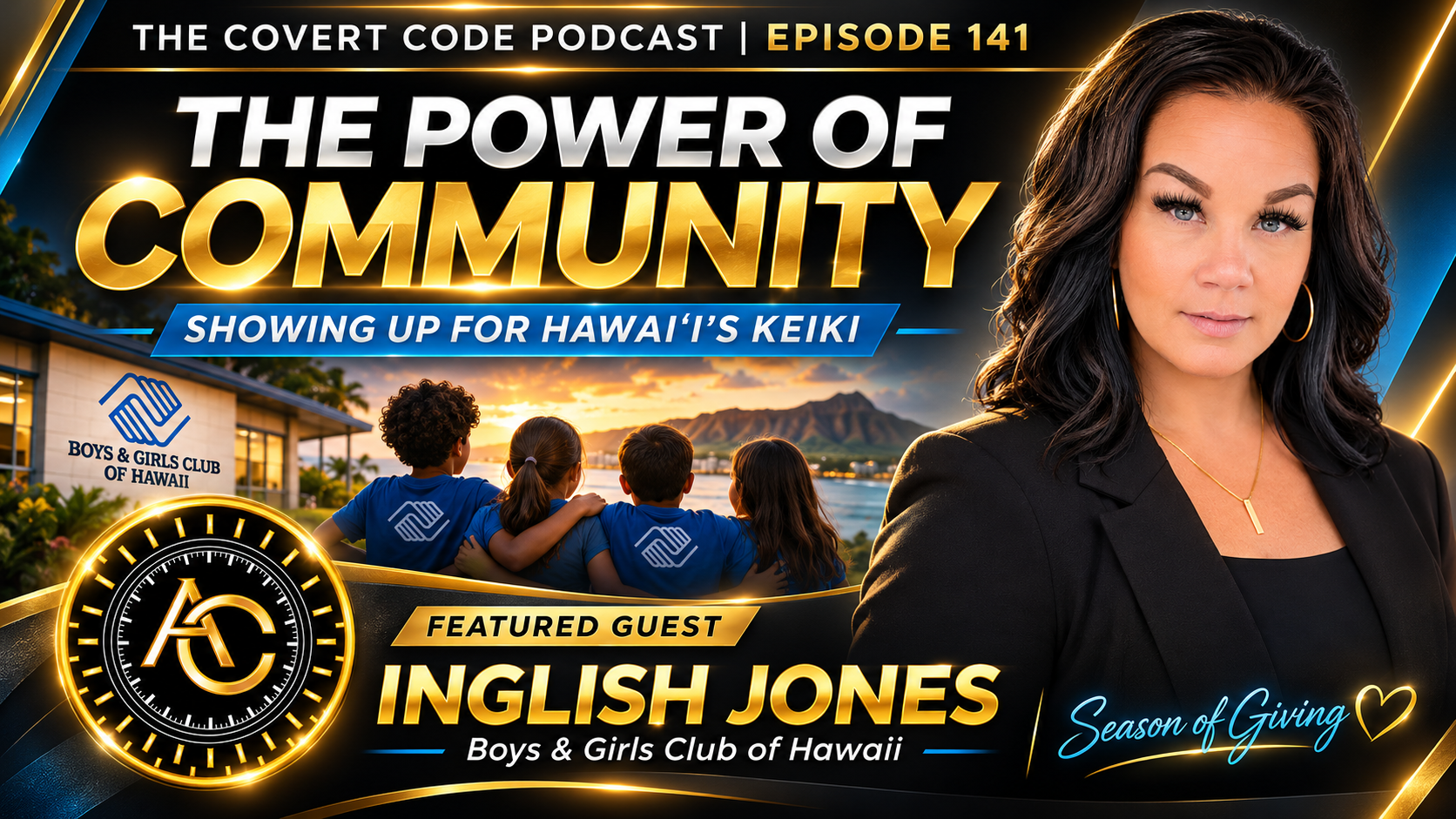
The Power of Community: Showing Up for Hawaiʻi’s Keiki with Inglish Jones
The Covert Code Podcast | Episode 141 | Hosted by Anna Covert
What happens when a community chooses to show up for its children? For some young people, the answer is a safe place to go after school. For others, it is a mentor who sees a future they cannot yet see for themselves. And for families across Hawaiʻi, it can mean the reassurance that their children are safe, supported and encouraged.
On this episode of The Covert Code, Anna Covert speaks with Inglish Jones, Director of Development – Oʻahu at Boys & Girls Club of Hawaiʻi, about the power of belonging, the resources that keep Clubhouses running, and the many ways people and businesses can help. This conversation also marks a special milestone: Covert Communication donated a redesigned website to the organization through its new Season of Giving program, which is now accepting applications for future organization recipients.
From Club Kid to Community Advocate
Inglish understands the mission personally. She grew up attending Boys & Girls Club, later spent 14 years volunteering and serving on the Waiʻanae Clubhouse Branch Board, and has watched her own four children grow through Club programs. Today, she helps raise the resources to make those experiences available to other families.
When Anna asks Inglish about a favorite childhood memory, Inglish does not name one activity. She remembers how the Club made her feel: safe enough to forget the difficulties outside its doors, laugh, make friends and simply be a child. That sense of belonging, she explains, remains central to the organization’s work.
More Than an After-School Program
The Club is not simply a place for children to wait for pickup. Its staff and mentors create programs aimed at helping young people build confidence, learn new skills and imagine what comes next. Inglish describes opportunities in arts and culture, music, media, mentoring and career exploration.
One example is the What’s Next program, which helps teenagers plan their paths after high school through exposure to education, careers, mentors, internships and college visits. Inglish shares stories of young people pursuing ambitious goals they might not previously have considered possible.
Inglish says Boys & Girls Club of Hawaiʻi serves more than 15,000 young people through its Clubhouses and outreach services. The nonprofit serves children and teens on Oʻahu and Kauaʻi, with programs rooted in the needs of local communities.
Why Affordable Programs Still Need Donations
During the interview, Inglish explains that annual membership costs are deliberately low—approximately $25 for younger members and $10 for teenagers—while the organization’s cost of providing programs and safe spaces is much higher. She cites an estimated $2,600 per child to support its services, as well as scholarship assistance for families who cannot afford fees.
That gap helps explain why fundraising, partnerships and volunteers matter so much. Small membership fees make access possible for families, while donations and community support help sustain the program behind each Clubhouse door.
The Realities of Food Insecurity
One of the most moving parts of the episode concerns children who cannot count on having enough food at home. Inglish explains why snacks and meals are more than an extra benefit: children need adequate nutrition to focus, learn and feel secure.
She discusses partnerships, food support and the organization’s goal of expanding access to meals and snacks. These are immediate needs, not abstract talking points, and they are among the reasons donations can have such a direct impact.
Fifty Years of Helping Hawaiʻi’s Keiki
Boys & Girls Club of Hawaiʻi is celebrating its 50th anniversary in 2026. Inglish reflects on how the organization has adapted over decades while keeping the same foundation: safe spaces, caring adults, useful programs and opportunities for young people to succeed.
The conversation highlights young people finding direction through mentorship and creative outlets. A standout example is a Waiʻanae Clubhouse teen Inglish discusses who was recognized as Hawaiʻi State Youth of the Year in 2026 and hopes to pursue electrical engineering.
A New Website, Donated Through Covert Communication’s Season of Giving
Anna has supported Boys & Girls Club of Hawaiʻi for years. This year, her agency, Covert Communication, contributed a newly redesigned website to help families discover Clubhouses, learn about programs and connect with opportunities to donate, volunteer and partner.
Explore the new website at BGCH.com. Visitors can learn more about ways to get involved and go directly to the donation page.
The donation is part of Season of Giving, a new Covert Communication initiative to support organizations with professional website services. And the program is ready for its next chapter: applications are now open for future recipients.
Know an organization that could benefit from a new website? Share the Season of Giving application page and encourage the organization to apply. Refer to the application page for current eligibility, selection criteria and timing.
GivingTuesday: December 1 and the Season of Giving
GivingTuesday is December 1, 2026, and Inglish hopes the community will remember that a meaningful contribution does not have to be a large check. Individuals can donate any amount, volunteer their time, share specialized skills or introduce the Club to potential partners.
For business owners, the message is especially clear: expertise can be a gift. A company might help with technology, facilities, mentoring, creative programs, services, supplies or connections. The important part is starting a conversation about what the organization actually needs.
How to Help Boys & Girls Club of Hawaiʻi
- Give: Donate to Boys & Girls Club of Hawaiʻi.
- Volunteer or partner: Explore ways to get involved.
- Learn: Visit the newly redesigned BGCH website.
- Nominate or apply: Season of Giving website applications.
Meet Inglish Jones
Inglish Jones is Director of Development – Oʻahu for Boys & Girls Club of Hawaiʻi. A former Club kid and longtime volunteer, she brings firsthand experience as a parent, advocate and fundraiser to her work. Learn about the organization’s leadership on its team page and connect with Inglish Jones on LinkedIn.
Listen to Episode 141 of The Covert Code
Catch the full conversation with Anna Covert and Inglish Jones for more on belonging, mentorship, the cost of keeping Clubhouses open and why a community’s investment in children changes its future. Explore more interviews at The Covert Code Podcast.
Follow The Covert Code on Instagram, Facebook and LinkedIn; learn more about Anna Covert and the work of Covert Communication.
Listen: Spotify | Apple Podcasts | Amazon Music | iHeartRadio | YouTube Music.
The interview includes figures and program descriptions provided by the guest. Visit BGCH.com for current details and eligibility.
Full Transcript — Episode 141: The Power of Community
Anna Covert and Inglish Jones, Boys & Girls Club of Hawaiʻi
Unverified automated transcript. Speaker labels and timestamps were not included in the source recording transcript.
Aloha. My name is Anna Coburn, and I'm coming to you from my bottle. Shapiro on the beautiful island of Iowa. This week on the Cobra code, the topic is the Power of Community. And I hope everyone had a wonderful Thanksgiving yesterday. As we enter our season of giving, I want to ask a question what would happen if everyone in the community stood up and supported its children? My very special guest is English Jones, director of development for Boys and Girls Club of Hawaii. I think it's safe to say that no one knows their organization better than English. Her journey started as a club kid herself. Then she spent 14 years volunteering and serving on the Waianae clubhouse ranch board. She's also a mom of four club kids herself. Today, she helps raise funds that help keep programs available to families. With Giving Tuesday coming up on December 1st. I want to see what we can all do to support local organizations near us. We're going to talk about specifically what Boys and Girls Club means to families on Oahu and Kauai, what it really takes to make a program that makes it safe for kids after school, and what we can all do to lend a helping hand. Thanks so much for being here with me. English. Hi. Nice to be here. Thank you. Anna. So tell us. You know, I think with this jump right hand, I want to hear a story of your favorite memory as a club kid yourself. Um, you know, um, Anna, when I think about my childhood at a club, it's not necessarily, um, one particular activity or one big event that really makes me smile. It's just remembering how I felt when I was there, you know? Growing up wasn't always easy for me. Like a lot of kids, I had, um, things happening in my life that weren't always great. But when I walked through the doors of the clubhouse, um, I could leave all of that behind so I could just be a kid, of course. And laugh and have fun and make friends and just be myself without worrying about everything else. Wow, that's really beautiful. I remember, you know, so just for the viewers, I've been working with the Boys and Girls Club personally for a long time. I donated, I think that first website was it almost ten years ago. And, uh, you know, and, and I remember just hearing a story and just feeling so touched. And it was about a young child who, you know, started coming to the club and, you know, for the first couple weeks was just sleeping. Right. He would come and he would just sleep in the back. And everyone had left him alone. And finally he started to kind of open up. And it turned out that that was the only place he could sleep where he felt safe. And I remember just like crying, like it was just I was bawling because it was so touching and so meaningful and and so tell us, I mean, how many children do you help currently right now in Hawaii? Uh, well, the Boise Girls Club Hawaii serves over 15,000 kids through our club sites and through outreach services. And how many times more for people who aren't. Don't know about you. What exactly is your. You know what? What do you do? Well, the Boys and Girls Club of Hawaii. I mean, if I could explain it from. Let's explain it from a club kid. So every day the doors are open, as soon as the, uh, the bell rings at school. Uh, kids come in. They wind down. Um, and, you know, meet with their friends, and then they're off to programs. And, you know, those programs are geared at inspiring them to reach for a future that they really want to have. And I think that sometimes there's a misconception of the Boys and Girls Club that we're just in after school, um, daycare. We are not. Every single program is really a roadmap of success for our kids, just getting them ready for what comes next. What are some of the programs that you have right now that are most popular? Oh my goodness. Okay, so one of my favorite programs is the What's Next program. Um, that is, uh, geared up toward our teens. And what's next program is really what comes next for them after high school. So it's a cohort based program where it takes kids from eighth grade all the way through graduation and then beyond. And what our goal is, is to find out really what is inspiring them for their future and then give them the resources to get there. So if that's, um, internships, if that's, uh, having people come in and talk to them, uh, traveling to the mainland to visit the college of their choice. Those are all the steps we're taking to make sure that they get exactly what they want to do after high school.
Wow. When did you start that program? Oh my goodness. I was right in the thick of the pandemic on, uh, it was um, in 2020, I believe is when, you know, we kept asking, you know, it's interesting because you asked the kids, so you graduated, what's next? And then we thought, okay, that's that's it. We've got to figure out how we're going to help these kids after they graduate high school. And that's how the program came about. So you probably already had some kids who've now graduated. Absolutely. We we we did I think we just graduated our first and second cohort. Off the top of my head and oh my gosh on it. It's incredible. All of these kids are off to college. Um, some of them are, um, studying to be, uh, uh, doctors. Some of them are studying to be, um, pharmacist. It's just remarkable to see that. And they wouldn't have been able to do it without the services, because these kids are going to the schools that we took them to tour. Um, it was their their schools of choice, and we took them to tours and inspired their trainings. Wow. So how do kids become, you know, how do you qualify to be a member of the boys or a club kid? Oh my gosh. Anybody could be a club kid as long as you're seven years old to 17 or whenever you graduate. We do not turn anybody and get away. So yeah, I mean, it's just everybody's welcome. Wow. And so there's a fee, right, to be a member. Absolutely. So we charge $25 a year for our younger kids, and we charged $10 a year for our teenagers to participate in programs. That's like nothing like it is absolutely nothing we have. Yes. And we have to keep affordable on it because the kids we serve, 96% of them are coming from low, the low to low, the low income level family. So it has to be affordable to make sure these kids have an opportunity to come inside the sites. And then I know that there's even for those who can't even afford that, there's that's what this fundraising is all about. Absolutely. So we charge, like I said, the low fees, but it costs the organization $2,600 per child to keep them safe in our facilities, and programs are running for them every single day. Um, and yes, there are kids that cannot afford it, but, uh, we do have opportunities, uh, there are scholarships to get kids in those doors and things like that. But that cost that is costing us is is definitely why we have to fundraise. We've got to be able to bridge that gap. And so since Covid, you know, well, what have you been seeing in terms of support? You know, I know that we talked offline a little bit about how, you know, the things have been tumultuous with donations across the board. I know it's not not just Boys and Girls Club. It's all kinds of nonprofit. What have you been seeing? What do you think that's the result of? Oh, sure. So I mean, most recently we've definitely seen a decrease in support. And I do believe that is just because of the way of the world right now. Folks are really concerned about where we're headed as a nation. Um, and I do believe that folks are just really more concerned about their own personal situations right now, and that's understandable. I mean, we I'm sure you are on I know my family and we are as well. Um, so it's definitely changed, I would say, since pandemic. I mean, during the pandemic, we received a ton of support. When you think support wouldn't come in right during a time where folks were losing their jobs and, and, um, you know, there wasn't a lot of support to go around, but support was through the roof during that time. But yes, I'm definitely seeing a decline. Um, not just us. Like you said, uh, nonprofits across the board. What is something that we think we can do to turn it around? You know, is there any kind of new type of fundraising or what are your thoughts on on getting more support? Well, I think for us on it, it's just a matter of just keep doing our work every single day and keep reminding people why we're here. Um, keep advocating for our kids. And I do believe when things come around we will pick up, the support, will pick up again, and we just have to keep moving. That's all we can do. Yeah. What do you think? If there's one thing you wish more people knew about what the pro Hawaii keiki and families need right now? Um, for me, I think that, um, I wish more people understood that not every child starts life with the same opportunities. Um, and that doesn't mean one child is more deserving than another. It just means that some children need a little support, a little more support. Can you get the same starting point? Um, we have families who are doing everything they can to provide for their children.
They're working. They're raising their families. They're trying to keep, um, you know, navigating the cost of living here in Hawaii. And sometimes, despite everything that they're doing, they still need help. And I think we also need to understand that kids need more, um, than somewhere to spend their time after school. Uh, they need relationships. They need encouragement. They need opportunities to discover what they're good at, and they need a place to make mistakes and know that it's okay. So that's where they can learn and grow. And, um, they need it all to may see something in them that they don't see in themselves, and that inspires them to do what they want to do when they grow up. Right and talk. Do you think a lot of. I think there's a lot of misconceptions about the difference between you and Big Brothers. Big sisters talk. Talk us through that. Yeah. For sure. Big Brothers Big Sisters are an amazing organization. We absolutely love what they do with kids of the community. Um, the difference, I think, between the two organizations is it was Boys and Girls Club of Hawaii's brick and mortar buildings, where we're welcoming kids in the facility every single day after school, whereas Big Brothers Big Sisters is taking kids out, right? They don't have that brick and mortar. They're leaving kids elsewhere. Mhm mhm. Right. What are some of the other programs that you're really excited about. Um, you know for me I think um, you know, my kids were club kids and I think uh, one of the most inspiring, um, programs that my kids went through were the media programs, um, and arts and culture. Um, and, and why I think those are important is because it's, it's allowing our kids to, uh, express themselves, which is important. Right. I think oftentimes kids believe they can't be who they are, um, at school or at home, um, because they're afraid of being. And unfortunately, they're just afraid of being left out, right? Because they're not who they're expected to be. But these programs like media and arts and culture and things like that, allows them to really express themselves and be who they truly are. I think that's even so important, especially that the public schools don't really have these outlets for creativity. They used to, you know, they used to be more our programs and music and other different activities. I guess, what are they? You know. And now they don't really have those. So if they're not doing it at club and they don't have parents who are paying for crayons and things like that, then where can they really create this, this outlet for creativity? Exactly. And that's why the clubs are so important. Because, you know, oftentimes you see funding come in at schools and, um, you know, in some communities there's not an arts program or there's not a band program or there's not, um, you know, all of these things that we used to have when we were kids, right? It was just a part of school. Um, so that's why, um, you know, after school programs, specifically the Boys and Girls Club were critical because they could get exposure to those things that they may not have otherwise. And how do you get T? Who teaches these programs? Are they all? Boys and girls club. Are they volunteers? You know how how who was involved in the different clubs and and how does it work? Absolutely. So at an average clubhouse, you have, uh, trained mentor staff professionals, right. Um, these are trained folks in program areas of, uh, you know, wherever their program area is. And, uh, we also have volunteers that come in, you know, we have a lot of people that want to lend their expertise, and they'll come in and teach our kids, um, certain things that we may not be able to offer. For example, Hawaii Symphony, uh, we have a partnership with them, and they come in to teach, um, a couple of our sites, our kids, they get to access, uh, violins, and they learn from their teachers there. So it takes a lot of hands, right, to, to make these things happen, whether it's our trained staff or professionals or outside resources like Hawaii Symphony, for example. Wow. So if someone's listening right now and, and they're a business owner in Hawaii or they're, you know, someone with a skill, how how can they reach out to see if you could use them? How do they get Morse? Yeah. Of course. So, um, you know, I always tell people to just reach out to me anytime. Um, I'm always here to answer any kind of questions that, um, folks may, may have. I'm seriously always here. I think sometimes businesses assume that supporting a nonprofit means writing a big check.
### Transcript continuation Continue copying directly after the previous paragraph, inside the same `And and of course, financial support is incredibly important to non-profits like us. Um, it's certainly not the only way to make a difference. So, you know, maybe maybe your business provides a service that one of our clubhouses need. Um, maybe their employees want to volunteer. Maybe they have an expertise that could help prepare our teams for their future. Or maybe they can introduce us to someone that might be interested in helping the organization. Um, but there are so many ways to get involved. And honestly, I would tell a business owner that you don't have to have everything figured out when you give me a call. Let's just have a conversation, learn about each other and figure out how we can make a difference together. It's beautiful. So what is something that you learned from being a club mom that would surprise you from, you know, being in the club yourself or volunteering, like a totally different perspective. Um. Or was there anything, I guess. I think, um, this one actually is a big one for me. Um, as a child, I never thought what it took to make a club possible. I just knew I had somewhere to go and people who cared about me. Like I belonged. Um, but as a mother of four kids who all attended the one I clubhouse, I. I have began to appreciate something completely different in that peace of mind. Um, as a parent, there's something incredibly comforting about knowing your children are somewhere safe and surrounded by people who really do care about them. And having four children, I think, taught me something. Um, something else is that every child is different, right? And they have different personalities, interests, challenges and strengths. And what I love about the club is that it gives each child that space to be exactly who they are. And and I believe for me personally, that the club, um, helped keep my children on the right path when they give them opportunities for relationships that help shape who they are today, just like it did for me. What's really amazing? What's one story of a club kid who you, you know, that you always think about? That really was transformed by their experience, of course. And he's always at the top of my mind. Um, one young person who really always is there for me is Messiah. Uh, he is a whiny clubhouse teenager. Um, he's been there for, uh, gosh, his entire life. Really? Um, when his mom started working there when he was a baby. Um, he was just actually recognized as our 2026 Hawaii State Youth of the year. And what's really special about Messiah's story is how he, um, his experiences at the club, um, helped him see new possibilities for his future and recognized that he was worth it as a human being. Um, you know, through mentorship opportunities for Messiah, he began exploring his goals, um, that he wanted to be an electrical engineer. And I think that's super powerful. And through, you know, mentorship and scholarship opportunities and things like that, he's actually going off to college to do that very thing. And, you know, I also think about how many other kids are sitting in our clubhouses right now who have that same potential but have discovered it yet. And I just know that, you know, if they keep continuing to grow and we keep mentoring them in the right direction, they'll be on the same path with somebody like Messiah. Since you see so many different types of kids, you know, now with the rapid change of technology, you know, everyone's talking about AI or, you know, do you have rules about being on your phone? You know, are you like, what are you seeing in terms of the evolution of communication and kids playing together? Absolutely. So, um, our websites, um, really try to keep kids off their phones as much as possible. And of course, they're, you know, they're allowed to be on their phones. Of course, you got to call your mom, and mom's got to be able to get Ahold of you. And we understand that. But our kids are so heavily involved in program that there's really no time to be on the phone. Right. And and if there is it, you know, we absolutely make sure that it is a safe, um, experience that they're going through right at that time. So we are constantly checking our kids that are utilizing their devices. Yeah. And are you seeing that? How are kids more isolated now because of technology, or do you think that they're just it's it's we're just worried about it for nothing. And then there are still kids, you know, they still when they get together, they still play. No, they're certainly isolated. Hotter. Personally, I see that. I see that with my own kids, you know, and of course at the clubs they're playing because they're involved in programs.
Um, but, you know, when they're not with us, they are consumed. And that's a, that's a huge problem. Right? And that's something that we'll have to work toward and keep working for. It is a problem we're ever going to be able to solve. No it's not. But as an organization, all we can do is make sure that when they're in our facilities, they are engaging in positive activities, um, not social media and things that they shouldn't be looking at on their phones. Right. So for the I know one thing that we had talked about. Gosh, I'm sure it's still a concern now, but something that I'm passionate about is feeding children. Right. Can you tell us a little bit more about here in Hawaii, how many kids don't have access to even one meal a day? Exactly. So like I said before, you know, 96% of our kids are coming from those low to very low income levels. And a lot of these kids are, you know, getting their last meal at school, at lunch, and they're getting their next meal at school at breakfast. It is a real problem. And, um, it's something I don't like really talking about, but because I get super emotional about it, because there's nothing more hurtful than a child, um, not getting the property, not nutrition. Right. And we know that as an organization that kids can't think properly and they can't, um, uh, focus in school when they are not fed. Right. And it's something that we strive for an organization. Um, you know, the Boys and Girls Club of Hawaii. This is a huge goal of ours to to offer meals to every single child, every single day. And we're getting there, right? Some of our sites have official stacks. Some of them are having afterschool shops where they have super inexpensive snacks for kids to get Ahold of. And then we have partnerships with like Hawaii Food Bank and things like that, who bring in meals once a week. For seasons, we have a partnership with them and they bring in meals occasionally for our kids, so it's definitely something at top of mind. The last thing we want is for these kids to go home with an icky stomach, because we don't know if they're going to be getting fed. Yeah. And are the is it free at the high school or the regular public schools? Do they provide the food for free? Still, I know they were doing during Covid, but is that still a are they still providing that meal? Absolutely. So every child of Hawaii qualifies for a free for free or reduced lunches in Hawaii? Well that's good. It's good. Absolutely. What are you guys doing for Season of Giving? What's happening for Boys and Girls Club. What's our what's our goal for this season of giving. Oh my gosh. Well Season of Giving is my favorite time of the year. I love this time of the year of course, because it's the season of awesomeness. You know, it's the holidays. But you know, Giving Tuesday is coming up and that is a big one for our organization. Um, that's on December 1st. And, you know. If someone wants to help support the organization, of course they can always visit BGC. Com. You know, we're doing a huge campaign, um, just to raise awareness for our organization. You know, we're putting things out in media and sending things out to the public. Um, but what's really important for people to understand on it is that, um, no gift is too small to to our organization, to the Boys and Girls Club. Why? I think some people hesitate because they feel like they can't, um, what they can afford is not going to make a difference, but it does. Every single dollar makes a huge difference. So, um, you know, when people give to the Boys and Girls Clubs, they're helping us provide a lot of things that people take for granted and that safe places to be. Um, meals or snacks, after school homework help and opportunities to explore, you know, sports, arts, culture, uh, future career. But, um, I think beyond those things, uh, there are people who support our organization. Is there something that we absolutely cannot price tag on? And that's making sure that every single child that walks our doors has a place to be, and they get that sense of belonging that they really need as a young child. And you guys have been helping people for a long time in Hawaii. When did you. It was over 50 years. Yes. We actually just made 50 years this year, and that is a big deal, I know. It's very, very exciting. You know, we've been celebrating all year and the outpouring of support from our community is just amazing. I mean, not many nonprofits, um, can say they've been around for 50 years, and I am so happy that I get to be a part of this moment. And you know what? They just haven't changed much on it in 50 years.
We have the same programs and the same ways of doing things. And of course, we evolve, you know, to keep up with the times. But our programs and the way we're raising up our kids in clubs, they, they work. Um, and we will continue to keep doing this for generations, hopefully generations and generations to come. I know you will. I know you will. What else is there that we haven't covered that people need to know about? Boys and Girls Club of Hawaii? Um, I think that for us, I think it's just, um. Okay. Sorry. I'm gonna stay here. I'm doing great. This is a really good one. I'm so sorry. Um. What? Let me just think about this. When I think about it, it covers something we've already said. Um. Okay. Having some event events you have coming up, or is there any, like, special? Yes, there's or anything. Is there anything like that? Is there any kind of fun. Is there any like walks or anything coming up? No there's not. We just talked about Giving Tuesday, but I say I think I can come up with something that's more kind of like this. English. What is there? Is there anything else that people need to know about Boys and Girls Club of Hawaii that we haven't yet covered? Um, absolutely. I think the most important thing about our organization, of course, is the kids that we're serving. Um, I think people really need to understand that we're giving kids that safe space to be who they truly need to be, but what we're also doing is we're setting them up for success, for our future. Um, I think it's important that people bring that attention to the organization and really understand what these programs are doing because our kids, uh, they truly are the future of Hawaii. They're the future of everything that's going to happen next for us. And in order for us to have a successful future, um, a fruitful future. Uh, it's. I don't even say the word fruitful. Why would I think that I was engaged? I like it. Okay. Oh my God. Oh, I'm so sorry. Hey. English. I don't think I'm in the first section. Uh, hell. Okay. One more time. Okay, let me think. One more time is the direction I'm going. Okay. Yeah. No, I think it's great. Okay. Um, might not be anything. I go back. Can I talk about. Can I go back into doing whatever it takes? That was one of your questions. You said to me. Yeah. Okay, perfect. I'll. I'll do that because I, um. And then maybe even, like, you know, volunteered. You talked about businesses, what they can do. And I'm going to talk a little bit about, um, I'm going to say that like, we like the businesses are really expect people to step up here because like, we're donating websites and, you know, we're going to do one a year. You're the first one we're going to do. We're launching our giving season. But people should be able to step up and do lots more. Okay. Yeah I'm going to do like a little spot at the end. Um, okay. About how I think people should really step up here and like, let's, you know. But what about individuals? Like, can people volunteer? Yes. You know, and and that's maybe that's a bit like, hey, like, you know, anyone can participate with any, any donation. I like that a lot, like even a doll. And then what can they do if they want to volunteer? Here we are. Okay, so here we go. Got it. So beyond what we already discussed, what else do people need to know about Boys and Girls Club of Hawaii? I think it's important to know it's actually critical to know that Boys and Girls Club Hawaii is a non-profit organization, and we heavily depend on the support of our community and sponsorships and fundraising and all the things that it takes to keep our organization running. And I think it's really important for folks to understand that we do need that support every single day, and there's multiple ways to do that. Right. Like I said before, um, visit Boys and Girls Club. Com. Com. You can donate there. You can wait for Giving Tuesday which is coming up on December 1st. That's the best day, um, in the year to give in my opinion. Um, but we also take in volunteers, right? Like I said, um, volunteers come in and they help us do things that maybe our budget doesn't allow us to do, and whether that's yard work or painting walls, building bookshelves, there's something somebody can do for us, whether it's monetary or our volunteer work. And you've got to think about that. What is some expertise that you have, right? That you can support an organization like ours. It may not be money, but you may be able to come in and build something with our kids. That's right, that's right. It's a it's like, well, what we decided to do, you know, for like we I like to donate websites. Right.
And that's what I was really excited about is the new look that we were able to give Boys and Girls Club, uh, this year, and hopefully everyone is listening, is going to contribute in whatever way they can because this is critical. The children are our future and without that the support, things are looking a lot different out there in our communities. And if you're not here in Hawaii now, look at your local communities around you. There's probably boys and girls organizations there where you live. Um, or, you know, we're happy to have you support us here locally. And I'm going to provide all the links in the, in the, our video down here as usual, so that you can support volunteer. If you're a business, what can you do to make a difference? Now's the time to step up and give. So, um, what do you hope for? The holiday? What am I doing for the holiday? Um, things I usually do for a holiday. Cook dinner for my family. Um. Um. Stay home. You know, my family is here. Uh, you know, hopefully I'll get my Christmas decorations up soon. I should have had them out the day after Halloween, but I didn't get that far yet. So, um, hopefully in the next week, I'll be set and ready to go. What is a local? So what do you like? What do you how do you celebrate Thanksgiving? What's your what's your M.O.? Uh, well, we cook a, you know, Thanksgiving recipes passed down from my mom. Generations and generations of, you know, just whatever. And but we stay here, we cook and eat, and everybody sleeps while mom cleans up the mess. But last year, you know. So I grew up in Colorado. And there's obviously a big difference when I moved to Hawaii. But now I've been here for longer than they were. Also, my whole life I've been here for 22 years, so law and now I'm a real, real Camino, right? For a while it was like, if it wasn't, it wasn't snowing. It was hard for me to really become feel the holiday spirit. Now I just love it. But last year I had a goose for the very first time. Oh my gosh, it was delicious. So you're not a beast. No, no absolutely not. But it was, you know, it's kind of like the dark meat of the turkey isn't the whole thing. Yeah. Wow. Interesting. But I thought, you know, it's always interesting you're in Hawaii because there's just so many different ethnicities of what are people, how are they celebrating? Is it. Were they having like, let me let me salmon or you know, what other kind of interesting local wares there are? And are you doing anything for the kids or is it closed on Thanksgiving? Yes, we are closed on Thanksgiving. We have partnered with a few organizations. So I know Colleen is going to be bringing in Thanksgiving to our Waianae clubhouse. Um, for their families, it'll be kind of like a Thanksgiving drive by pickup. Um, our Spalding clubhouse is doing a, uh, tomorrow. They're doing a community Thanksgiving, but it's local style. It's definitely not a turkey. It will be plate lunches and some poopers, but they are bringing the families in. Um, it's one of the things which our clubhouse director at Spaulding wanted to do. Right. It's it's a huge challenge, uh, food insecurity at her site. Um, so she wants to bring the families together for some food, and that's what we're doing. So, uh, some of our sites do have those partnerships. Um, but we are close. But luckily, we get to sit on the way there, so. That's wonderful. Yeah. Well, thank you so much for being here. Again, we're going to include all of the links you can find English on LinkedIn. Uh, that's really one of the best places to connect with you directly. And for all my listeners, if you have not done so yet, please subscribe to this channel. We're approaching 300,000 subscribers and that's because of you and your aloha. So share this content with your friends and family so I can get more great guests like English to come on and share their passion and purpose with us. And I cannot wait to see you next week. And the pixels. Aloha!