Why Qualified Isn’t Enough: How to Stand Out and Land Executive Opportunities
The job market has changed.
Being qualified still matters, but it is no longer enough to guarantee opportunity.
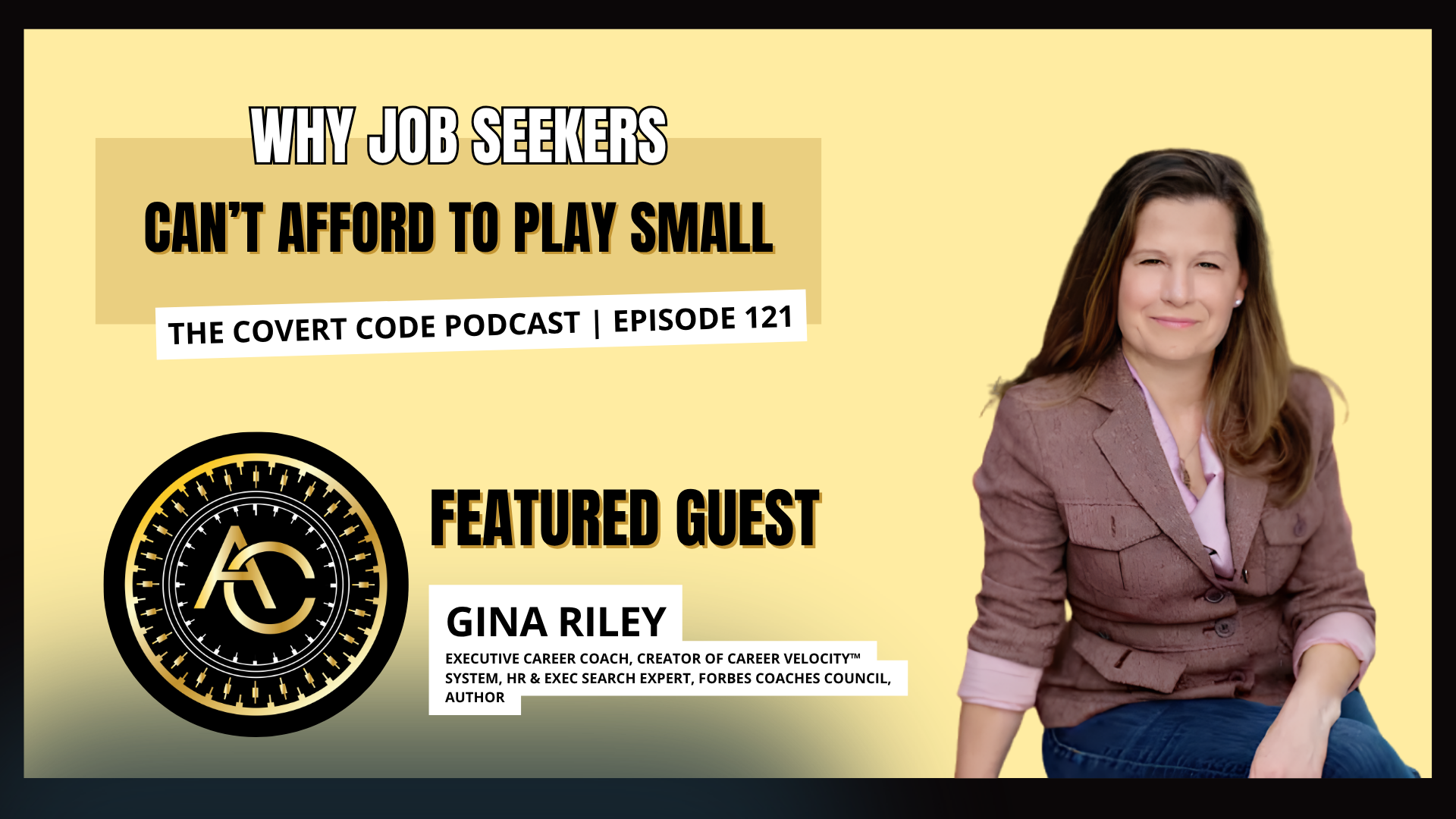
On this episode of The Covert Code Podcast, I sat down with executive career strategist Gina Riley for her second appearance on the show. Gina is the founder of Gina Riley Consulting, a LinkedIn Top Voice, and author of the Amazon bestselling book Qualified Isn’t Enough.
In our conversation, Gina shared why job seekers, especially executives and senior leaders, can no longer afford to play small. Between longer hiring cycles, more competition, AI-driven applications, and shifting recruiter behavior, professionals need more than a polished resume. They need visibility, credibility, and a clear point of view.
The Job Market Is More Competitive Than Ever
Gina explained that leadership roles are becoming increasingly competitive. There are fewer roles at the top, more candidates competing for them, and hiring cycles that can stretch for months.
For senior leaders, a four-month hiring process can actually be considered fast. In many cases, opportunities may take six, twelve, or even eighteen months to fully develop.
That is why relying only on online applications is no longer an effective strategy, especially for executives.
Gina recommends that senior leaders spend the majority of their effort building relationships, networking, and gaining referrals rather than simply applying online and hoping to be noticed.
Qualifications Get You Considered. Visibility Creates Opportunity.
One of the strongest takeaways from this episode was Gina’s reminder that qualifications are only the starting point.
Your experience proves capability.
Your qualifications get you considered.
But your visibility creates opportunity.
This is especially true in a noisy marketplace where resumes, LinkedIn profiles, and job applications are beginning to sound increasingly similar because of AI-generated content.
As we often discuss on AnnaCovert.com, personal branding is not about ego. It is about clarity, trust, and making it easier for the right people to understand the value you bring.
Why Professionals Cannot Afford to Play Small
Playing small can show up in many ways.
It can look like waiting to be noticed.
It can look like avoiding visibility because you do not want to appear self-promotional.
It can look like only posting on LinkedIn when you need a job.
It can also look like allowing imposter syndrome to keep you from sharing your expertise.
Gina made an important distinction: strategic visibility is not the same as self-promotion.
Strategic visibility is about sharing helpful insights, mentoring others, contributing to your professional community, and demonstrating the value you create.
LinkedIn Is Not Just an Online Resume
One of the biggest mistakes Gina sees professionals make is treating LinkedIn like a static resume.
LinkedIn is much more than that.
It is a professional marketing platform.
Your profile should clearly communicate who you are, what you do, what problems you solve, and what kind of impact you create.
That means having a strong headline, a clear about section, an updated profile photo, and a banner that supports your professional positioning.
But beyond the profile itself, Gina emphasized the importance of using LinkedIn as a place to share thought leadership. Short posts, videos, lessons learned, professional insights, and helpful commentary can all help build credibility over time.
AI Can Help, But It Can Also Make You Sound Generic
AI is changing the job search process on both sides.
Job seekers are using AI to write resumes, cover letters, LinkedIn profiles, and application materials. Employers and recruiters are also using technology to filter, organize, and evaluate candidates.
Gina’s warning is clear: if you let AI write your brand without your own authentic input, you risk sounding like everyone else.
AI can be incredibly useful for brainstorming, organizing ideas, preparing for interviews, and helping job seekers think through their stories. But it should not replace the deeper work of understanding your value proposition.
That deeper work includes knowing your strengths, your leadership style, your career themes, your results, and the specific impact you have created.
Impact Matters More Than Responsibilities
Another important theme from our conversation was the difference between responsibilities and impact.
Many professionals describe what they were responsible for.
But recruiters and hiring teams want to know what changed because you were there.
Did you increase revenue?
Did you improve efficiency?
Did you reduce costs?
Did you lead a team through change?
Did you build something new?
Gina recommends framing career stories around results, action, and situation. This helps candidates lead with measurable outcomes instead of simply listing duties.
Executive Presence Still Matters
In a world shaped by digital tools and AI, human presence still matters deeply.
Gina discussed how eye contact, communication style, confidence, emotional intelligence, and the ability to read a room all contribute to executive presence.
These are the qualities that cannot be fully captured on a resume.
They show up in conversations, interviews, networking meetings, presentations, and leadership moments.
For executives, technical qualifications may open the door, but presence and trust often determine whether the opportunity moves forward.
Build Your Network Before You Need It
One of Gina’s strongest pieces of advice was to build relationships before you are actively job searching.
When professionals wait until they are in transition to start networking, the process can feel awkward or transactional.
But when you consistently contribute, support others, share ideas, and stay visible within your industry, your network becomes a long-term career asset.
As Gina explained, the best opportunities often come through relationships, referrals, and professional reputation.
The Future Belongs to Visible Leaders
This episode was a powerful reminder that the job market rewards more than credentials.
It rewards clarity.
It rewards confidence.
It rewards relationships.
It rewards visibility.
For executives and professionals who want to grow their careers, the message is clear: stop waiting to be discovered.
Start showing people what you know, how you think, and the value you bring.
Listen to the Full Episode
To hear the full conversation with Gina Riley, visit The Covert Code Podcast.
You can learn more about Gina at Gina Riley Consulting, connect with her on LinkedIn, or explore her book Qualified Isn’t Enough on Amazon.
🎧 LISTEN ON ALL PLATFORMS:
Spotify: https://open.spotify.com/show/0UcnL4g4J2DckqMpZg4DdB?si=NKAFJcRMSdOJlP5iebBxoA&nd=1&dlsi=50d6d5c5753a499b
Apple Podcasts: https://podcasts.apple.com/us/podcast/the-covert-code/id1733326615
Amazon Music: https://music.amazon.com/podcasts/d15bb709-a4df-43bb-9284-9e479c8574a7/the-covert-code
iHeart Radio: https://www.iheart.com/podcast/269-the-covert-code-269144900/
YouTube Music: https://music.youtube.com/channel/UCSU2Anqu1_yzb_D6IFd7i_Q
🌐 FOLLOW THE COVERT CODE:
Website: https://thecovertcode.com/
Instagram: https://www.instagram.com/covertcodeofficial
Facebook: https://www.facebook.com/thecovertcode
LinkedIn: https://www.linkedin.com/company/covert-code-official/
📚 ABOUT HOST ANNA COVERT:
Anna Covert is the host of The Covert Code Podcast and the author of The Covert Code – Mastering the Art of Digital Marketing and The Solar Coaster. With over two decades of experience in digital marketing and business strategy, Anna has worked with top-tier companies like Microsoft, Apple, and IBM and leads Covert Communication, Hawaii’s largest digital agency.
ANNA’S WEBSITES:
The Covert Code: https://thecovertcode.com/
Anna Covert: https://annacovert.com/
Covert Communication: https://covertcommunication.com/
Reactium: https://reactium.io/
⚠️ Affiliate Disclosure: Some links included may be affiliate links, which means we may earn a commission if you choose to make a purchase through them at no additional cost to you.
Transcript: Why Qualified Isn't Enough — How to Stand Out and Land Executive Opportunities
Episode: The Covert Code Podcast
Host: Anna Covert
Guest: Gina Riley
Anna Covert [00:00:05]: Aloha. My name is Anna Covert, and I'm coming to you from my battleship here on the beautiful island of Oahu.
Anna Covert [00:00:12]: This week on The Covert Code Podcast, the topic is why job seekers can't afford to play small. My special guest is returning for her second Covert Code appearance, the amazing Gina Riley.
Anna Covert [00:00:25]: Gina is an executive career coach at Gina Riley Consulting. She is also known as a LinkedIn Top Voice and author of the Amazon bestseller Qualified Isn't Enough.
Anna Covert [00:00:40]: The last time Gina was on the show, we talked about why qualified isn't enough. I invited her back because people loved that episode so much, and with everything happening in the job market, I thought it was important for her to return and talk about why professionals can't afford to play small.
Anna Covert [00:00:58]: Welcome back to the show.
Gina Riley [00:01:00]: Thank you.
The Current Job Market
Anna Covert: Since your first appearance on The Covert Code, what have you seen in the job market that concerns you?
Gina Riley: The thing that concerns me most is that there is more competition now for fewer roles, especially fewer leadership roles. I work primarily with leaders, and when you look at the tip of the triangle, there are fewer jobs to begin with.
Gina Riley: With layoffs and company acquisitions, sometimes entire leadership teams are let go from acquired companies. There is a lot of competition and very long hiring cycles.
Gina Riley: When I start working with someone and they say they have an interview opportunity, I tell them they will be lucky to have an actual offer in four months if they are the top candidate. Four months is good. It can be six months, twelve months, or eighteen months as you go up the hierarchy.
Gina Riley: It is much more important now to demonstrate your impact and not just rely on a stale resume. AI is also making it easier to apply, which increases competition, but it can also reduce differentiation.
AI and Online Applications
Anna Covert: With all these applicants and AI tools, people can have a professional look, but then everyone starts to sound the same. Are we still seeing AI reading applications?
Gina Riley: If a person is a true executive or senior leader aiming for higher-level jobs, they should spend only a tiny fraction of their time applying online.
Gina Riley: That means they are not worrying as much about whether AI is reading their resume. They should be doubling down. Ninety-five percent of their effort should be on relationship building, networking, and gaining referrals.
Gina Riley: Applying online is valid, but for senior leaders, even a five percent response rate is better than average. Often, people are not being seen in those systems, and it is not only AI's fault.
Gina Riley: It can be how the system is configured, how recruiters use the system, how AI reads and sorts content, or even how job seekers answer prequalifying questions.
Gina Riley: If a question asks whether you are willing to work for $150,000 and you say no because you want $250,000, you may be filtered out before the recruiter ever sees your application.
Qualifications, Experience, and Visibility
Anna Covert: What matters more today: qualifications, experience, or visibility?
Gina Riley: Qualifications get you considered. They are the minimum bar to entry. Experience proves your capability. But visibility is what creates your opportunity.
Gina Riley: If you are not being seen, you are not getting heard. You have to get seen to get heard.
Gina Riley: But if you are sharing visibility without creating value through your thought leadership and helpfulness, then you are just making noise. You want to be visible while adding value.
Why Leaders Can't Play Small
Anna Covert: Let's talk about the idea of playing small. For a long time, leadership was hidden behind the company. Now that seems to be changing.
Gina Riley: Leaders have to step up, and they needed to do it yesterday. There is a fear of appearing self-promotional, but when you focus on the value you offer and the impact you make, you can have a positive impact without being self-promotional.
Gina Riley: The danger of playing small is waiting to get noticed. I call that getting plucked from obscurity. No one is coming to rescue you. You own your own career.
Gina Riley: Senior leaders can also suffer from imposter syndrome, which may hold them back from stepping out with thought leadership. It can cause people to retreat instead of expanding the relationships they need.
Imposter Syndrome and Unique Value
Anna Covert: A lot of this makes me think about limiting beliefs and whether people believe they deserve to be at the forefront. Is imposter syndrome common?
Gina Riley: I do not address imposter syndrome as a specific topic with my clients, but I do help alleviate it.
Gina Riley: In the first phase of my book, the first five chapters lay the groundwork. They help a person develop their unique value proposition brick by brick.
Gina Riley: How do we avoid imposter syndrome? By tapping into what makes us uniquely us: our natural talents, our approach to leadership, our unique career story, and the themes and patterns that show how good we are at what we do.
Gina Riley: We also build an impact and results repository that helps explain what you can do for an employer. You overcome imposter syndrome by getting grounded in why you are excellent at what you do.
Strategic Visibility
Anna Covert: Visibility does not just mean sitting in front of your computer and posting on LinkedIn. What are some ways people can become more visible without being salesy?
Gina Riley: I do love LinkedIn, and I am on it every day, but there are many ways to stay visible. You can share posts and insights about lessons you have learned. You can speak, mentor, volunteer, lead, and stay active in professional communities.
Gina Riley: I worked with a chief technology officer who thought he had nothing special to share. But he was leading 200 engineers, had been through M&A, and had consulting experience. He had content for days.
Gina Riley: Sometimes your first audience is your own employees and the people who already follow you and want to know you are credible and trustworthy.
Common Mistakes
Anna Covert: What are people doing that causes them to stay small or miss the mark?
Gina Riley: A major problem is overusing AI and diluting the actual brand. The materials may sound smart, but when people go to market, their own network cannot refer them because the messaging is confusing.
Gina Riley: Another mistake is relying too much on the resume. The resume is the leave-behind. The referral and the conversation are the lead.
Gina Riley: People also use generic profiles, fail to show a clear point of view, and only post on LinkedIn when they are job searching. That can feel awkward and transactional.
Breaking Through the Noise
Anna Covert: In marketing, sometimes you need breakout visibility techniques. For business owners, I have used FedEx campaigns because owners usually open those packages. Could job seekers do something similarly creative?
Gina Riley: I have not heard of many people doing that, but that is brilliant. I am taking notes in my mind.
Anna Covert: It feels like people need to take control back and not just be victims of the system.
Gina Riley: There is a defeatist mindset out there, but that does not serve the person who has it. My recommendation is to build a support team during that time.
Gina Riley: Do not allow your partner or spouse to be your only support. You may need a job seeker support group, a coach, accountability partners, or a small team of people who help you maintain hope and momentum.
Using AI for Career Growth
Anna Covert: What can people do to build new skills right now?
Gina Riley: AI is one of the biggest topics. People are taking classes and dabbling with AI, which is great. But do not just add a class to the bottom of your resume.
Gina Riley: You need to show how you are applying the knowledge and how you would use it to have impact. Think in dollar signs, percentages, numbers, increases, or decreases.
Gina Riley: Did you increase production? Did you decrease throughput time? What did you do with the AI? You need to demonstrate how you can use AI to accelerate the business.
LinkedIn as a Marketing Platform
Anna Covert: What are the biggest mistakes people make on LinkedIn when trying to position themselves for future opportunities?
Gina Riley: The first mistake is thinking of LinkedIn as your online resume. I think of it as your marketing storefront window.
Gina Riley: You need an updated profile, a banner with your value proposition, a good headshot, a headline that tells people what you do, and an about section that clearly explains what you do.
Gina Riley: I come from a recruiter perspective. I do not want the about section to begin with a long childhood story. I want to see what kind of leader you are immediately.
Gina Riley: Most importantly, treat LinkedIn as a broadcasting system where you share thought leadership, posts, and short-form video content.
Showing Impact
Gina Riley: Another mistake job seekers make, especially executives, is talking about responsibilities instead of impact.
Gina Riley: Do not just say you were responsible for something. Explain what you led, developed, created, increased, or improved.
Gina Riley: In my book, I talk about how to show impact using a framework called RAS: result, action, situation. Lead with the result, then explain the action and situation.
Making AI More Human
Anna Covert: One thing I am noticing with AI is the importance of thinking about how you want people to feel when they read something. Do you want them to feel that you are creative, innovative, reliable, or a team player?
Anna Covert: If you ask AI to consider the feeling you want the reader to have, the results change.
Gina Riley: That is so cool.
Rebuilding Professional Presence
Anna Covert: For someone who feels invisible within their organization or industry, what is the first step to rebuilding professional presence?
Gina Riley: First, get over the idea that you are being self-promotional.
Gina Riley: Shift your mindset from self-promotion to strategic visibility. Ask how you create value, how you help people, how you lead, and how you mentor.
Gina Riley: Can you teach me something rather than bragging about something? Can you share insights instead of only accomplishments?
Gina Riley: Visibility strategy is about how you can help other people.
Executive Presence and Interviewing
Anna Covert: AI can also be used for interview practice. You can ask it to interview you and ask more questions.
Gina Riley: Most of the work I do is in person because clients need to build their own stories. Ultimately, if you are an executive or leader, you will be in the room with human beings. You need authentic confidence to deliver those stories.
Gina Riley: Eye contact is also incredibly important. It is part of executive presence. I spoke with a very accomplished leader who did not look me in the eye for the first five minutes of our Zoom call. It makes the other person feel uncomfortable.
What Recruiters Are Looking For
Anna Covert: What should candidates be signaling to recruiters to stand out?
Gina Riley: You need to showcase adaptability, but you cannot just say you are adaptable. You need to show how you lead through change and help teams adapt.
Gina Riley: Emotional intelligence also matters. Organizations do not want to hire people who disrupt culture.
Gina Riley: You should also be able to influence across functions, even without positional power. Executive presence, change leadership, learning agility, and AI literacy are all important.
Gina Riley: For Gen X and younger boomers, the fear is relevance. You have to build a relevant story for yourself. No one is going to do that for you.
Global Trends and Career Risk
Anna Covert: Are global trends impacting the job market?
Gina Riley: I do not have one solid answer, but I do think many things affect leadership here in the U.S.
Gina Riley: One example is acquisitions. I have spoken with two CHROs this year whose companies were purchased by companies outside the country, and their entire leadership teams were let go.
Gina Riley: That is why people need to pay attention to their corporate environment, keep their LinkedIn profiles strong, have resumes ready, develop their stories, and continue networking.
What's Next for Gina
Anna Covert: What is next for you?
Gina Riley: My focus is on my private one-on-one coaching clients, delivering content for communities I am part of, and serving on the board of directors for the Intel Alumni Network.
Gina Riley: We have recorded sessions on YouTube where I guide conversations with experts or lead sessions myself. I am also building my private learning management system and converting my book chapters into an online course.
How to Connect with Gina
Anna Covert: How can people get ahold of you?
Gina Riley: GinaRileyConsulting.com. My email is Gina@GinaRileyConsulting.com, and I am on LinkedIn every day unless I am on vacation. I also write a newsletter and am about to start a Substack.
Closing
Anna Covert: Thank you so much for coming back. To all of my listeners, thank you for joining me again. If you have not subscribed yet, please do so. We are approaching 200,000 subscribers, and that is because of you and your aloha.
Anna Covert: Continue to share this content with your friends and family so I can bring more great guests like Gina back to share their wisdom with us. I cannot wait to see you next week in the pixels. Aloha.