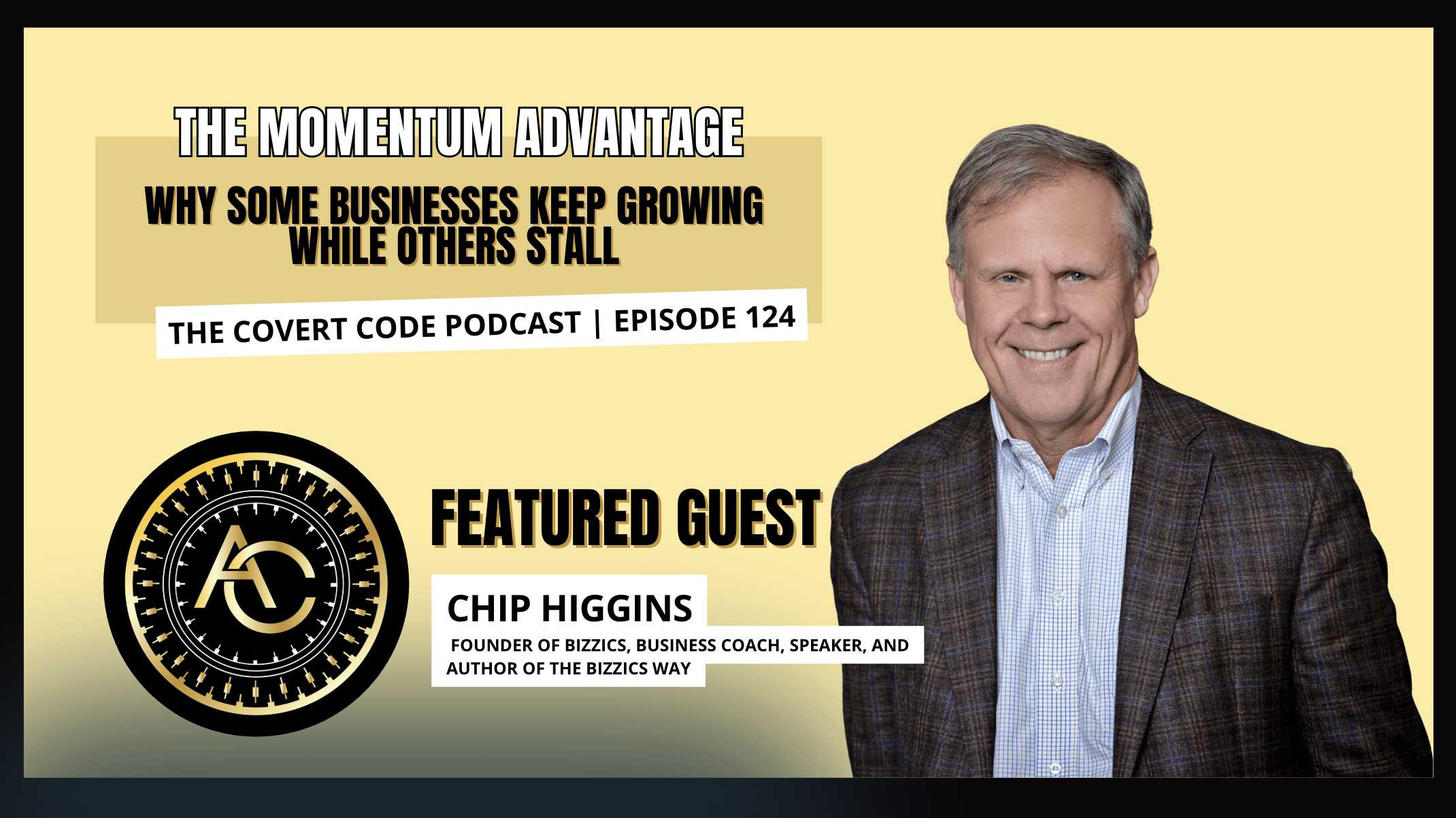
The Momentum Advantage: Why Some Businesses Keep Growing While Others Stall
Featuring Chip Higgins, founder of Bizzics and author of The Bizzics Way
Growth rarely stops all at once.
A business may continue generating revenue, serving customers, and paying its expenses while quietly losing the energy that once drove it forward. Sales flatten. Margins begin to narrow. Leaders become increasingly cautious, and the company starts protecting what it has instead of building what comes next.
That is the danger of a business plateau.
In Episode 124 of The Covert Code Podcast, Anna Covert welcomes Chip Higgins back to discuss The Momentum Advantage: Why Some Businesses Keep Growing While Others Stall.
Chip is the founder of Bizzics, a business coach, speaker, and author of The Bizzics Way: Powering Your Small Business to Maximum Momentum.
The conversation explores how entrepreneurs can regain momentum, use artificial intelligence responsibly, reconnect with customers, strengthen employees, protect margins, and make better decisions in a constantly changing environment.
Business Momentum Requires More Than Movement
A company can remain busy without moving forward.
Employees may be working long hours. Marketing campaigns may still be running. Customers may continue placing orders. Yet none of those activities automatically indicate that the business is gaining momentum.
Momentum requires both movement and direction.
Chip uses principles from physics to help business owners understand this distinction. A company needs energy, velocity, direction, and enough force to overcome the friction working against it.
The same idea forms the foundation of The Bizzics Way, which translates principles such as force, energy, friction, and momentum into practical guidance for small-business owners.
A company moving rapidly in the wrong direction is not succeeding. A company with a clear destination but no energy is not progressing either.
Sustainable growth requires alignment between where the company is going, how quickly it is moving, and whether its people and resources are working toward the same outcome.
Making Business Coaching More Accessible
One of Chip’s central concerns when creating Bizzics was the accessibility of experienced business guidance.
Traditional coaching can be expensive for smaller businesses. It can also be difficult for entrepreneurs to fit recurring coaching sessions into unpredictable schedules.
To address that challenge, Chip introduced Bizzics on Demand, an AI-supported business companion built around his book, writing, tools, and coaching philosophy.
The platform allows an entrepreneur to begin with a specific problem and work through questions such as:
- What are you trying to accomplish?
- Why is this outcome important?
- What have you already attempted?
- What options are you considering?
- What is the first realistic action you can take?
Instead of attempting to solve every problem at once, the process helps the business owner establish a foothold and begin moving forward.
The objective is not to replace experienced human coaches. It is to make informed guidance more accessible when the entrepreneur needs it.
AI Is Changing How Entrepreneurs Ask for Help
AI gives people the freedom to ask the same question repeatedly, rephrase it, request clarification, and explore different options without feeling embarrassed.
That can be especially valuable for small-business owners who may not have a board, a large leadership team, or a group of experienced advisors readily available.
However, Chip emphasizes that the quality of the response depends heavily on the quality of the question.
“What should I do to grow?” is too broad to produce a meaningful strategy.
A more useful question might be:
- Why has revenue from my highest-margin service declined?
- Which expenses have increased faster than revenue?
- Why are qualified employees leaving after six months?
- Which customer segment is most profitable?
- Which service creates the greatest operational strain?
Learning to ask better questions forces business owners to define what they are actually trying to solve.
AI can then provide rapid analysis, ideas, and structure. But the entrepreneur still needs the context, judgment, and experience required to evaluate the response.
AI Should Strengthen People, Not Replace Them
One of the most important themes in the conversation is that artificial intelligence should support human talent rather than automatically replace it.
AI can process information rapidly. It can analyze numbers, generate possibilities, organize research, and identify patterns that might otherwise take hours to uncover.
What it cannot fully understand is the daily context surrounding a company.
It does not automatically know the history of a customer relationship, the strengths of an employee, the emotional consequences of a decision, or the values the business is attempting to protect.
The stronger model combines human knowledge with artificial intelligence.
An employee who understands the customer, recognizes the problem, and knows which questions to ask can use AI to become more capable and efficient.
This is similar to the arrival of online banking. Digital banking did not completely eliminate the desire for human assistance. Customers wanted the convenience of technology and access to experienced people when the situation required it.
Hiring and Managing People Remain Major Growth Challenges
Chip initially expected users of Bizzics on Demand to focus primarily on strategy and competition.
Instead, many questions have focused on people:
- How do I find strong employees?
- How do I attract the right people?
- How do I lead them effectively?
- How do I create an environment where they want to stay?
Technical skill alone does not determine whether someone will strengthen a company.
Business owners are increasingly concerned about values, attitude, energy, adaptability, and whether a new employee will positively influence the existing team.
Chip strongly disagrees with the belief that employees should be treated as interchangeable or expendable.
Processes and systems are important, but a business should not be structured around hiring the lowest-cost person capable of following a manual.
Leaders rarely know the full potential of the people they hire.
When an employee is aligned with the company’s values, interested in its mission, and motivated to improve, the leader should invest in that person.
Training, encouragement, patience, and responsibility can help employees grow into capabilities that were not immediately visible when they were hired.
Agility Is the Foundation of Continued Momentum
Businesses once spoke frequently about making a dramatic pivot.
During the pandemic, restaurants added pickup services, retailers expanded e-commerce, and companies changed their operating models almost overnight.
Today, the more common requirement is not one major pivot. It is continuous adjustment.
Technology, customer behavior, regulations, competitors, and communication platforms are changing too quickly for a static business plan to remain reliable indefinitely.
Chip explains that entrepreneurs need a process for gently steering toward emerging opportunities.
Even rockets are continually making small course corrections. Being temporarily off course does not mean the mission has failed. It means the guidance system must remain active.
The same principle applies to business.
A leader should know the destination but remain willing to adjust the route.
The Risk of Becoming Too Comfortable
Entrepreneurs take enormous risks when starting a company.
They invest savings, time, energy, reputation, and sometimes home equity into creating something that may not succeed.
Once the company becomes stable, their appetite for risk often declines.
The business owner who was once willing to experiment may begin protecting the existing operation at all costs.
That caution is understandable, but it can become dangerous when the world is changing rapidly around the company.
Maintaining momentum does not require risking the entire business again.
It requires making controlled investments, testing ideas at a manageable scale, learning from the results, and adjusting accordingly.
A failed experiment does not necessarily represent wasted effort. It may reveal that the opportunity was only a few degrees away from the initial approach.
Use Your Values as a Decision-Making Compass
When entrepreneurs reach a fork in the road, they often compare opportunities primarily by cost and expected return.
Chip recommends beginning with a broader evaluation.
First, determine whether you have an objective understanding of the environment. Social media feeds, headlines, friends, and family can all create a distorted view of the market.
Look for credible industry data, examine what competitors are doing, and study what happened to businesses that made similar choices.
Next, determine whether the opportunity aligns with your values and intentions.
Ask:
- Does this reflect who we are?
- Does it support the purpose of the company?
- Does it serve the people we originally wanted to help?
- Do we understand the partner or vendor involved?
- Does this opportunity feel meaningful, or is it merely a shiny object?
The financial analysis still matters, but it should occur after the opportunity has passed the alignment test.
Vet Every Vendor and Technology Partner
The growing availability of AI, data tools, lead-generation services, and marketing platforms creates enormous opportunity. It also creates risk.
A company may promise to identify website visitors, collect contact information, automate outbound calls, or deliver large numbers of leads.
Before adopting those tools, business owners must understand how the data is collected, whether consent has been obtained, and whether the technology complies with applicable privacy and communication laws.
Anna explains that companies can face serious consequences when marketing pixels, cookies, voice agents, or lead-generation tools are deployed without proper review.
The larger business lesson is simple: A vendor’s promise does not transfer the risk away from the business purchasing the service.
Business owners must thoroughly vet the people and platforms they allow into their operations.
A Plateau Can Be an Early Warning of Decline
From Chip’s experience in banking, several years of flat revenue were rarely interpreted as a sign of stability.
They were often viewed as an early prediction of decline.
A company on a plateau may be working intensely to preserve its top-line revenue. To retain customers, it begins cutting prices, granting concessions, and accepting lower-margin business.
Revenue appears stable, but profitability begins deteriorating underneath it.
The company eventually responds with reactionary expense reductions.
It cuts employees, marketing, training, innovation, and customer programs. Those cuts remove the very capabilities required to create future growth.
The plateau then becomes a downward spiral.
Return to Your Vision, Values, and Mission
When a company loses momentum, Chip recommends returning to the foundation.
Revisit the original vision, values, and mission.
Ask why the company was started and what problem it was created to solve.
Then examine what has changed:
- Has the competitive environment changed?
- Have customer expectations changed?
- Have new products or technologies emerged?
- Are former strengths still relevant?
- Are current services aligned with the core mission?
- Has the company added offerings it is not equipped to deliver profitably?
A traditional SWOT analysis and competitor review can help reveal where the company has drifted and where a new opportunity may exist.
Your Customers May Know Where Your Growth Is Hiding
Chip recommends conducting meaningful conversations with key customers rather than relying exclusively on ratings and short surveys.
A five-star review confirms satisfaction, but it does not necessarily reveal what the customer needs next.
Invite a small group of strong customers to lunch or conduct individual conversations. Explain that the business is evaluating its future and ask for direct feedback.
Questions might include:
- What could we do differently?
- What are you purchasing elsewhere that we could provide?
- What is becoming more difficult in your business?
- What would make working with us easier?
- What is one problem you wish someone would solve?
Customers who already trust the company are often honored to be asked.
They may identify an unmet need, service opportunity, operational weakness, or emerging competitor that the company cannot see from inside its own walls.
Analyze the Business Behind the Revenue
AI can also help owners examine financial information more deeply.
Accounting software records what happened. AI-supported analysis may help the owner ask why it happened.
Business owners can examine:
- Which services generate the strongest margins
- Which products require disproportionate support
- Which customer segments are most profitable
- Which expenses are growing faster than revenue
- Which offerings have drifted away from the company’s core expertise
- Where discounts and concessions are reducing profitability
Growth does not always require adding more.
Sometimes momentum is restored by simplifying the business, removing unprofitable offerings, and concentrating resources on the areas where the company delivers the greatest value.
Storytelling Can Restore Energy
Chip’s most immediate recommendation for a business owner seeking momentum is to begin telling the company’s story again.
Revisit what the business has accomplished, the people it has helped, the problems it has solved, and the reason it exists.
That story can energize the owner, employees, customers, and community.
It can also create unexpected conversations. Someone may hear the story and suggest a partnership, service, customer group, or opportunity the owner had not considered.
This is not about inventing an exaggerated narrative.
It is about taking pride in the real work the company has done and communicating that work with clarity and enthusiasm.
The Momentum Advantage
Businesses that continue growing are not always the companies with the largest budgets, newest technology, or most aggressive expansion plans.
They are often the companies that remain alert.
They listen to customers, invest in people, protect margins, test ideas, review their assumptions, and adjust course before a plateau becomes a decline.
AI can help businesses analyze information and move faster, but technology alone does not create momentum.
Momentum is created when people use better information to make decisions that align with the company’s purpose.
That requires energy, direction, agility, and a willingness to keep moving.
Watch the Full Conversation
Watch Episode 124 of The Covert Code Podcast to hear Anna Covert and Chip Higgins discuss AI-supported coaching, employee development, business plateaus, customer relationships, financial analysis, strategic agility, and the practical steps entrepreneurs can take to regain momentum.
Learn more about Chip at ChipHiggins.com.
Explore business coaching and resources at Bizzics.
Learn about the AI-powered coaching companion discussed in the episode at Bizzics on Demand.
Discover more interviews and business insights from The Covert Code Podcast.
🎧 LISTEN ON ALL PLATFORMS:
Spotify: https://open.spotify.com/show/0UcnL4g4J2DckqMpZg4DdB?si=NKAFJcRMSdOJlP5iebBxoA&nd=1&dlsi=50d6d5c5753a499b
Apple Podcasts: https://podcasts.apple.com/us/podcast/the-covert-code/id1733326615
Amazon Music: https://music.amazon.com/podcasts/d15bb709-a4df-43bb-9284-9e479c8574a7/the-covert-code
iHeart Radio: https://www.iheart.com/podcast/269-the-covert-code-269144900/
YouTube Music: https://music.youtube.com/channel/UCSU2Anqu1_yzb_D6IFd7i_Q
🌐 FOLLOW THE COVERT CODE:
Website: https://thecovertcode.com/
Instagram: https://www.instagram.com/covertcodeofficial
Facebook: https://www.facebook.com/thecovertcode
LinkedIn: https://www.linkedin.com/company/covert-code-official/
📚 ABOUT HOST ANNA COVERT:
Anna Covert is the host of The Covert Code Podcast and the author of The Covert Code – Mastering the Art of Digital Marketing and The Solar Coaster. With over two decades of experience in digital marketing and business strategy, Anna has worked with top-tier companies like Microsoft, Apple, and IBM and leads Covert Communication, Hawaii’s largest digital agency.
ANNA’S WEBSITES:
The Covert Code: https://thecovertcode.com/
Anna Covert: https://annacovert.com/
Covert Communication: https://covertcommunication.com/
Reactium: https://reactium.io/
⚠️ Affiliate Disclosure: Some links included may be affiliate links, which means we may earn a commission if you choose to make a purchase through them at no additional cost to you.
The Momentum Advantage: Why Some Businesses Keep Growing While Others Stall
The Covert Code Podcast, Episode 124
Host: Anna Covert
Guest: Chip Higgins, Founder of Bizzics and Author of The Bizzics Way
Anna Covert [00:00:04]:
Aloha. My name is Anna Covert, and I am coming to you from my battleship here on the beautiful island of Oahu.
This week on The Covert Code, the topic is The Momentum Advantage: Why Some Businesses Keep Growing While Others Simply Stall.
My very special guest, who I am glad to welcome back for round two, is Chip Higgins, founder of Bizzics. He is a business coach, speaker, and author of The Bizzics Way.
Since his last appearance, he launched Bizzics on Demand, an AI-powered companion that gives entrepreneurs 24/7 access to the principles and strategies in his book.
Today, we are going to talk about practical ways to keep momentum rolling, how to overcome plateaus, and how to keep a business moving forward.
Chip, let us get the ball rolling. Pun intended.
Tell me about the vision behind the AI, how it is going, and what kind of feedback you are receiving.
Chip Higgins [00:01:06]:
First of all, thank you for having me on. I loved being on the show the first time. We had the best conversation, and I am thrilled to be here again.
Part of my value proposition, and one of the things I worried about when starting Bizzics, was the accessibility of coaching.
I wanted small-business owners to be able to find good resources and, more importantly, engage with intelligence and experience that could help them move forward.
I have done several things to make that more accessible. Writing the book was part of it.
It can still be a steep financial hill for many small-business owners to afford a coach. It can also be awkward to schedule coaching because of the time demands on a small-business owner.
They may wonder when they will talk to the coach, what they will discuss, and how frequently they should meet.
I have been in business for a long time, and I have followed AI closely. I kept hearing about people using AI for data and financially driven models.
I came across a company in Austin, Texas, that had developed a small language model for authors.
I began exploring it and thought it was a unique opportunity to make my book available for people to interact with at any time, 24/7, with unlimited use.
It creates a conversation people can have at any time of day.
It is based on my book, everything I have written, and the mindset I use when coaching.
The mindset I tried to train into the agent is focused on questions such as:
- What are you working on?
- Why is it important to you?
- How will it make a difference?
- What have you already tried?
- What are you considering?
- Do you need ideas?
- Where do you want to begin?
The goal is to help people gain a foothold and start moving forward without feeling like they have to change the entire world overnight.
There are also resources that come after that, including tools, templates, guidance for leading meetings, running a company book club, developing SMART goals, and other practical support.
It is compact. People know where to find it and how to interact with it.
The conversation feels very human, and I think that is because it is based on my book and my voice.
It genuinely feels like talking to me.
I think people are reading less and less, and this gives them a way to experience the book wherever they want to begin.
There are many principles in the book, but someone does not necessarily need to read the entire book before having a useful session with the agent.
Anna Covert [00:04:41]:
That is really interesting.
We already know from websites that people are skimming more than ever.
If there is too much copy or something looks too complicated, people may not engage at all.
You want to captivate them, stop the scroll, and then they may read more.
I know there are analytics involved with these agents. Are you seeing any trends that surprised you?
What are business owners asking your AI that may be different from what they asked you in person?
Chip Higgins [00:04:59]:
The one thing that stands out is hiring and managing people.
I thought the questions would be more focused on strategy and where companies fit in the competitive landscape.
There has been some of that, but most of the discussion has focused on questions such as:
- How do I find good people?
- How do I attract them to the company?
- How do I lead them effectively?
- How do I create an environment where they want to stay?
Maybe that is a function of the advice already available.
Many people who work with business owners are fractional CFOs or financial professionals. They bring useful experience.
However, fewer people are easily identifiable as having experience in HR, workplace quality, and the work environment.
Hiring and managing people has been a very hot topic.
Anna Covert [00:06:03]:
That is interesting.
I have had other guests discuss the same thing, and I think there is a lot of fear right now.
Five or six years ago, people were often hired and fired as part of a regular cycle.
Now, with layoffs and increased uncertainty, people in positions of authority are more concerned about bringing the wrong energy into their companies.
It is no longer only about technical skill. It is about whether the person is truly right for the company.
Chip Higgins [00:06:38]:
That is absolutely showing up.
Anna Covert [00:06:40]:
Have you seen other major changes since the last time we spoke?
Things are happening so quickly.
One thing I appreciate about your book is that many of the principles are timeless because they are grounded in science.
My book focuses on digital advertising. The core principles remain the same, but many of the exact examples change as new platforms and choices emerge.
Have you noticed anything different in business in general since our last conversation?
Chip Higgins [00:07:27]:
I think the door has opened much more widely for AI applications in general.
When I launched the agent about a year ago, it was difficult to get people to engage with it.
There are aspects of AI that can be dangerous or harmful if they are left unmanaged, and those concerns should be acknowledged.
Overall, though, I see AI as a huge benefit.
I was surprised by how reluctant people were at first.
My wife reminded me that we were among the last people in our neighborhood to get cell phones, so I understand being cautious about an adoption curve.
Now, I see much more intentional use of AI tools to support businesses.
Bizzics on Demand is one version of that. It is a conversational strategy resource and a C-level voice that a business owner may need.
I have also seen people use AI to gain financial insights into their businesses.
QuickBooks gives you numbers, but it is not necessarily a reasoning source. It does not automatically match up the numbers and tell you the story of what is happening in your business.
I have seen more business owners use AI to help uncover that story.
I have also seen more use of AI in marketing.
People are becoming more trusting of using a platform to help them develop a message for their target audience when they do not know what to say.
That may sound threatening to marketers, but in another sense, it is opening conversations that many businesses ignored before.
People are becoming more confident about using AI for specific purposes.
Not everything in AI is simply ChatGPT. People are harnessing intelligence for specialized reasons.
Businesses need to understand where AI can create greater effectiveness or efficiency while adding to the human equation.
I do not want to replace humanity with AI.
Even though I have the agent, I still hold office hours every week because I do not want to lose touch with people.
I am grateful that AI gives people a level of accessibility I could never have provided without it.
Anna Covert [00:10:11]:
I think it is a tool that creates more opportunity.
It also helps people feel less afraid.
I can ask AI the same question in several ways, several times, without feeling embarrassed.
If I were talking directly to a person, I might feel uncomfortable if I did not understand something immediately.
That creates an opportunity.
Chip Higgins [00:10:45]:
Something you said made me think about the importance of questions.
People are learning that asking questions is an art, and it is a very powerful art form.
Some early users of Bizzics on Demand asked questions such as, “What do I need to do to grow?”
That is too broad.
Prompting intelligence requires a person to understand what they are looking for and what they are trying to solve.
That takes some energy.
However, the rapid response and completeness of the answer can make it worthwhile to spend ten minutes defining the real problem.
A business owner may know they want to grow, but they should ask what part of growth needs an answer right now.
Is it hiring? Finding the market? Improving operations? Increasing margins?
I think AI will ultimately cause people to develop a deeper understanding of what they need to know about their businesses.
They may have been operating on autopilot for a long time.
We should be able to stop and ask hard questions of ourselves.
Used in the right context, especially for small-business owners, the availability of this resource is incredible.
Anna Covert [00:12:35]:
I do not think this is bad for marketers.
I think it creates more parity.
People will not be able to compare businesses only by budget because one company could afford something another company could not.
The actual product and service will need to shine.
That does not mean there will not be agencies.
Businesses still need help creating a clear brand.
If they ask different AI tools to solve every problem and every result sounds different, they may lose a clear vision of who they are.
AI is an equalizer, but businesses still need consistency and strategy.
Chip Higgins [00:13:18]:
I agree.
The position you are taking is one of the most evolved applications I have seen.
A single-person business may eventually have access to an informed C-suite made up of specialized tools with tremendous intelligence.
Imagine having a seasoned board as a solopreneur.
That is essentially where we are heading.
Anna Covert [00:13:58]:
I have been experimenting with several tools.
I use Claude on my desktop, and I train it almost like an employee.
I explain why I created a document a certain way, who the audience is, and what the strategy is.
I keep it open all day.
Sometimes I screen share with clients while using it, and we solve a problem together in real time.
People are mesmerized by what we can do with AI.
I have also been experimenting with image-to-video tools.
You can take a still image and animate it in ways that look remarkably close to the original.
Chip Higgins [00:14:49]:
I would love to see that.
It has been a great learning frontier for me, and I have enjoyed it.
Anna Covert [00:14:57]:
What are some of the biggest mistakes entrepreneurs are making today that quietly slow their growth?
Chip Higgins [00:15:07]:
We have been discussing this indirectly.
Momentum requires a certain level of agility.
If you think about velocity in the momentum equation, you have direction, distance, and speed.
Those are the elements required for a vector.
Even rockets are off course much of the time.
They know where they are going, and they know how quickly they want to get there, but they constantly make small corrections.
Entrepreneurs need to be more agile and aware than ever.
AI should help increase awareness of what is happening.
We became accustomed to the idea of a major pivot during COVID. Businesses pivoted to pickup service, online sales, or other major changes.
What may be holding people back today is not the failure to make one dramatic pivot.
It is the failure to make gentle, continuous adjustments toward emerging opportunities.
These technologies are not completely predictable, but if a business remains on the sidelines and does not use them at all, it will be left behind.
Other companies may have several intelligent, well-trained agents supporting their work.
Entrepreneurs often take a huge initial risk when starting a company. Once they figure things out and become successful, their desire to take additional risks can diminish.
They begin to say, “I am not sure I want to take that risk. I will wait and see.”
We need to refresh the entrepreneurial spirit.
Businesses should try things at a level that will not destroy the company but will reveal whether a certain direction is worth pursuing.
The belief that a business plan worked once and can simply be executed forever will eventually cost someone the business.
That is not the world we live in.
Everything is fluid.
Business owners must remain flexible, agile, educated, and willing to use resources that help them improve.
The hidden danger is that a company may feel like it is doing fine while the world is changing quickly around it.
Every business needs a mechanism for rising to those changes and navigating toward the right destination.
Anna Covert [00:17:47]:
That is true.
We are part of a global economy, and AI is one more accelerating force.
When one AI gains access to an idea, that information spreads quickly.
Growth is also painful.
When children grow, they experience growing pains. Their knees hurt, their bones hurt, and suddenly their clothes do not fit.
We forget that growth continues to be uncomfortable as adults and business owners.
We are never truly finished.
AI can expose the areas where it is time to grow again.
Chip Higgins [00:18:34]:
It is important to consider the relative size of the risk.
When people first start a business, they make a huge leap.
They become emotionally invested. They may use savings, home equity, or other resources.
The risks required to maintain momentum are rarely of the same magnitude as the original startup risk.
You cannot compare every new experiment to starting over.
There will be some pain. You will make some bets that turn out to be wrong.
You learn from them.
Perhaps you were not exactly right, but a few degrees to the left would have worked.
Keep moving.
Entrepreneurs need to recapture that risk profile as a day-to-day discipline in a dynamic world.
Anna Covert [00:19:42]:
How do you personally navigate that?
Suppose I reach a fork in the road and see several possible opportunities.
Two of them may appear financially equal.
How do you choose the right direction?
Chip Higgins [00:20:04]:
I do not know anyone who has been right one hundred percent of the time.
If someone claims to be, that should probably make you cautious.
The first step is making sure you have a broad perspective at the fork in the road.
We all receive different information through social media, news feeds, and other sources.
You must ask whether you have objectively evaluated the environment in which you are making the decision.
Have you been influenced only by family members who tell you that you are doing great?
Have you tested yourself in the market and confronted the hard truths about where you stand?
You can become blinded without a broad perspective.
One thing I do with clients is provide a full, current industry report.
It may be thirty-five or forty pages long and include links to strong industry resources.
It is data-driven and not sales-oriented.
Get the broad perspective first.
The next step is determining how the choices align with your value system and intentions.
There are many shiny objects, and it can appear that everyone is doing something.
You are not everyone.
You must ask:
- Is this right for me?
- Does this align with the person I am?
- Does this align with the values of my company?
- Does it support the person or group I originally wanted to help?
You should work through those questions before you reach the economics of cost and expected return.
If someone tells you that spending five hundred dollars per month will produce a certain number of leads, do not evaluate only the price and promise.
Ask whether they understand your values, your market, and the people you are trying to reach.
There must be integrity in those partnerships.
You will not be right all the time, but you will be wrong more often than necessary if you are not truthful about who you are and what you want your company to become.
We often think we understand what is happening in the world when we are only seeing headlines and information designed to capture attention.
Step back and study the situation.
Understand the fork in the road, study what others have done, and look at what happened to the people who tried similar approaches.
You do not always need to be the first person on the bleeding edge.
Anna Covert [00:23:29]:
For me, I have learned to ask which opportunity I feel most passionate about.
When two choices appear equal, which one creates more energy?
That usually aligns with values and mission.
If an opportunity feels exciting and meaningful, you may have the energy required to keep pushing forward.
If it does not feel right, you may not be able to move it very far.
Chip Higgins [00:24:03]:
Checking in with yourself is important.
Sometimes we do not want to ask ourselves what we are actually doing. We want someone else to tell us what to do.
With so many choices available, people may believe they do not have the skill to determine what they want.
However, if you have built a business to that point, you should know your values and what you are trying to accomplish in the world.
Anna Covert [00:24:26]:
Another issue happening now involves privacy and compliance.
Several of our clients have received legal letters related to privacy laws.
One client in New York received an allegation involving the California Consumer Privacy Act because a pixel was allegedly firing before consent was recorded.
There was a misclassification, and we corrected it.
Business owners need to slow down and understand who they are working with.
A company may promise to place a pixel on a website and identify every visitor’s phone number and email address.
That may sound appealing until the business faces a significant per-violation penalty.
There are people actively looking for those violations.
Businesses need to be extremely careful when a promise sounds too good to be true.
Chip Higgins [00:25:37]:
I had a similar experience with someone who wanted to help Bizzics with content marketing.
We discussed creating courses and other materials.
After three conversations, the person disappeared.
I kept waiting for the proposal and received no response.
Eventually, I realized the entire thing may have been made up and the person may not have known what they were doing.
We live in a world with a great deal of fraud.
You have to vet every person thoroughly.
Anna Covert [00:26:24]:
If someone feels like their business has hit a plateau, what step can they take today to begin moving again?
Chip Higgins [00:26:33]:
In banking, we used to say that flat revenue over two or three years was essentially predicting decline.
It was often the first indicator that someone had lost their way.
Sometimes a plateau involves pride in what someone has built and resistance to changing it.
Sometimes it involves the energy required to get back onto a growth trajectory.
What I tell people is to return to the beginning.
Dust off the vision, values, and mission.
Ask why you started the business in the first place and what you were trying to accomplish.
Then examine what is different today.
- What has changed in the competitive environment?
- What has changed in product availability?
- What has changed in specifications and capabilities?
- What has changed in customer expectations?
Conduct a SWOT analysis and a competitor analysis.
Then identify a space where the company can create lift.
You may already have a critical mass of customers who like you, but perhaps you have not made small investments to explore the next frontier.
If you are on a plateau and have not conducted meaningful 360-degree conversations with key customers, that is one of the best places to begin.
There should be a constant cycle of contacting customers and asking what they think.
Ask where they are buying other things, what would be valuable, and what you could change that would help them today.
Many customers are honored to be asked.
I am a major supporter of customer panels.
Invite six to ten customers into your office, give them an excellent lunch, and tell them the truth.
Explain that the business feels flat and that you remain passionate about serving them.
Ask what you could do differently.
You may be surprised by what you learn.
Customers may be buying things elsewhere that you do not even realize they need.
There is very little downside.
They already like you and want to do business with you.
Technology may not always serve us well because we rely too much on star ratings and short surveys.
Five stars confirm that a customer is satisfied, but they do not necessarily tell you anything useful.
It is worth the cost of a great lunch to hear ten trusted customers explain what you are missing.
We cannot see everything from inside the company.
Anna Covert [00:29:52]:
That also connects to another tip.
Business owners can take their QuickBooks data and financial statements and ask AI some difficult questions.
There may be things they are not seeing.
Restaurants often simplify menus after financial challenges because a smaller menu can be more efficient.
California Pizza Kitchen, for example, had a much larger menu before restructuring and later reduced it.
I have also added products and services and later realized they were not aligned with why we started the business.
Customers may want something, but that does not mean we are the best company to provide it.
It may require another team member or additional support.
Business owners should examine whether each offering is truly good for the company and understand what it costs to deliver.
Chip Higgins [00:30:41]:
Yes. Please understand those costs.
If you are on a plateau, there is a strong chance your margins are being damaged.
You may be trying so hard to preserve top-line revenue that you begin cutting prices and making concessions.
You are trying to hold on.
Instead, you should be asking what value-added component could restore margin.
What could you offer that competitors do not provide?
What is complementary to what you already deliver?
What would be easier for the customer to purchase from you than to buy somewhere else?
Top-line revenue and margin are connected when a business is on a plateau.
Once margins begin shrinking, everything is at risk.
If revenue is also flat, the business eventually becomes forced into reactionary expense reductions.
It begins cutting employees and programs that keep the company close to customers.
That is where the downward spiral begins.
Businesses must stay fresh with customers.
My book focuses on momentum, including angular momentum.
A tornado has linear momentum because it moves across the land, but it also has tremendous energy spinning inside the system.
Businesses need that kind of constant movement with customers and reinvestment in the company.
Online reviews are useful, but five stars only tell you that someone is satisfied.
What information are you actually learning from the people buying your product?
Spend the time and money to stay close to them and understand their experience.
Anna Covert [00:33:34]:
That is more important than ever because people are becoming disconnected.
There is no replacement for spending time with people, whether in groups or one-on-one.
I used to have more local clients and more in-person meetings.
Now, Zoom makes remote work easier, but there is still no replacement for taking a client to lunch or having a drink together.
Chip Higgins [00:34:03]:
Absolutely.
Anna Covert [00:34:04]:
The more people like you, the more they want to do business with you.
That is simple math.
Chip Higgins [00:34:13]:
The wisdom is flowing out of you.
Anna Covert [00:34:16]:
What is one piece of widely accepted business advice that you completely disagree with?
Chip Higgins [00:34:48]:
I strongly disagree with the idea that people are expendable.
One of the best-selling small-business books of all time is The E-Myth Revisited by Michael Gerber.
The intention of the book was to help people think about making their businesses franchise-ready.
That means creating systems and processes that allow the business to operate without the owner.
However, there is also an idea embedded in that philosophy of hiring to the lowest common denominator and creating a manual that allows almost anyone to perform the work.
I do not view employment that way.
The capacity and talent of people are unknown to us.
We do not know what someone may be able to accomplish.
If leaders are patient, show people the way, inspire them, and motivate them within the context of the business, they may be amazed by what those people grow into.
Much of the conventional wisdom says that people do not want to work, that companies should cut quickly, and that an employee should be replaced as soon as a problem appears.
I disagree.
Leaders must be diligent about values alignment when hiring.
If someone is motivated by life, aligned with the company’s values, and interested in the change the business is trying to create, the company should invest in that person.
That is part of the mass in the momentum equation: making people stronger.
A business leader should value the opportunity to pour into people and help them improve.
Anna Covert [00:37:10]:
That is not where I expected you to go.
I thought you might discuss AI because some businesses believe AI will be cheaper than employees.
However, business owners should be prepared for the cost of AI to change.
When social media first became popular, it appeared to be free.
Today, organic posts often receive very little visibility unless a business pays to distribute them.
AI companies are also investing heavily and may eventually charge for individual tasks, lines of code, and higher levels of usage.
A company should be careful about changing its entire workforce strategy based on today’s pricing model.
Chip Higgins [00:38:01]:
These may be the golden days of AI pricing.
I also want to comment on AI replacing people.
AI offers rapid computing power and incredible intelligence.
However, it cannot fully understand the context of what happens in a business every day.
The beauty of people is that they have knowledge and the capacity to ask the right questions.
AI can then become a powerful tool in the background.
In banking during the late 1990s, many people believed online banking would eliminate the need for branches.
The reality was that customers wanted both.
That is likely what will happen with AI.
Businesses need people who are committed to the cause, understand the problem, stay close to customers, and are trying to innovate.
Connect those people with AI tools and allow them to bring stronger solutions forward.
If a company believes AI will become its entire workforce, I do not think that will work.
AI cannot fully understand the necessary context.
Anna Covert [00:39:16]:
There are also new risks involving AI voice agents.
Businesses may not be allowed to conduct AI-powered outbound calls without explicit customer consent, and there can be significant penalties.
Some call centers are reducing staff because they believe AI can take over, but they need to understand the legal and compliance risks.
Businesses should proceed carefully.
I use AI for many purposes, especially research.
It can be faster than searching through Google when I need to find specific information.
It is also useful for organizing data and completing structured work from an existing template.
It should be treated like another tool, similar to a calculator.
Chip Higgins [00:40:26]:
I am old enough to remember slide rules.
Anna Covert [00:40:42]:
What is one easy thing someone can do today to create more momentum in their business?
Chip Higgins [00:40:58]:
I am Irish by heritage, so I am a strong believer in storytelling.
When you revisit the vision, mission, and values of the company and feel that spark of energy, begin telling your story again.
It can be energizing to remember what you have accomplished and how many people you have helped.
Reconnect with the intention behind the change you are trying to create in the world.
Storytelling is a skill we will need even more in the future.
People need to be able to tell stories from their own experiences, infused with their own spirit.
Tell the story to employees, customers, and the larger community that may have lost track of what the business does.
Be proud of it.
You never know who may hear the story and say, “That is great. Have you tried this?”
New ideas may emerge simply because you told the story.
Have fun celebrating what you have already accomplished.
Tell the story to as many people as possible, and then take it directly to your customers.
Anna Covert [00:42:30]:
In the spirit of the Irish, you can go to the bar and tell your story.
Chip Higgins [00:42:33]:
That is where I practiced.
Stick to the facts, though. Do not start embellishing.
Anna Covert [00:42:46]:
What is next for you? What are you most excited about for 2026?
Chip Higgins [00:42:50]:
I am very excited about a partnership I am building with a regional bank.
It has required a great deal of work over a long period of time.
We are on the verge of a large bank including my book as part of an experience for its small-business clients.
The idea of small-business owners across eight or nine states gaining access to the book and its resources is an unreal opportunity.
I am extremely excited about it.
Anna Covert [00:43:27]:
I have chills thinking about that.
Chip Higgins [00:43:30]:
I think it is a good book, personally. I am proud of it.
Anna Covert [00:43:36]:
That is exciting, and we will be rooting for you.
How can people connect with you?
Chip Higgins [00:43:42]:
I am on LinkedIn, and people will see the book cover there.
My business website is Bizzics.com.
I also have a personal website at ChipHiggins.com.
The book is available through both places.
I love speaking about the book.
If someone is looking for a speaker for small-business owners, they can visit ChipHiggins.com and send me a message.
Those are the three best ways to connect: Bizzics.com, ChipHiggins.com, and LinkedIn.
I would love to engage with as many small-business owners as possible.
Anna Covert [00:44:17]:
Chip is also a Forbes Books author, so you can purchase his book through Barnes & Noble and many of the same places where you can find my book.
We will include all of the links.
If you have not watched our first episode together, please do.
Thank you so much for coming back on the show.
Chip Higgins [00:44:34]:
Thank you again.
I think this conversation was even better than the first one, which I loved.
Thank you for having me back. I really enjoyed it.
Anna Covert [00:44:41]:
Me too.
To all of my listeners, we recently celebrated 200,000 subscribers, and I am overwhelmed with gratitude.
It is because of you and your aloha.
Thank you for sharing this content.
If you have not yet subscribed, please do so, so I can continue bringing more great guests like Chip onto the show.
To celebrate this milestone, we will be inviting more of my favorite guests back for additional conversations.
I hope you enjoyed this episode and the future conversations to come.
I cannot wait to see you in the pixels next week. Aloha.