Why Writing the Right Book Builds Real Authority
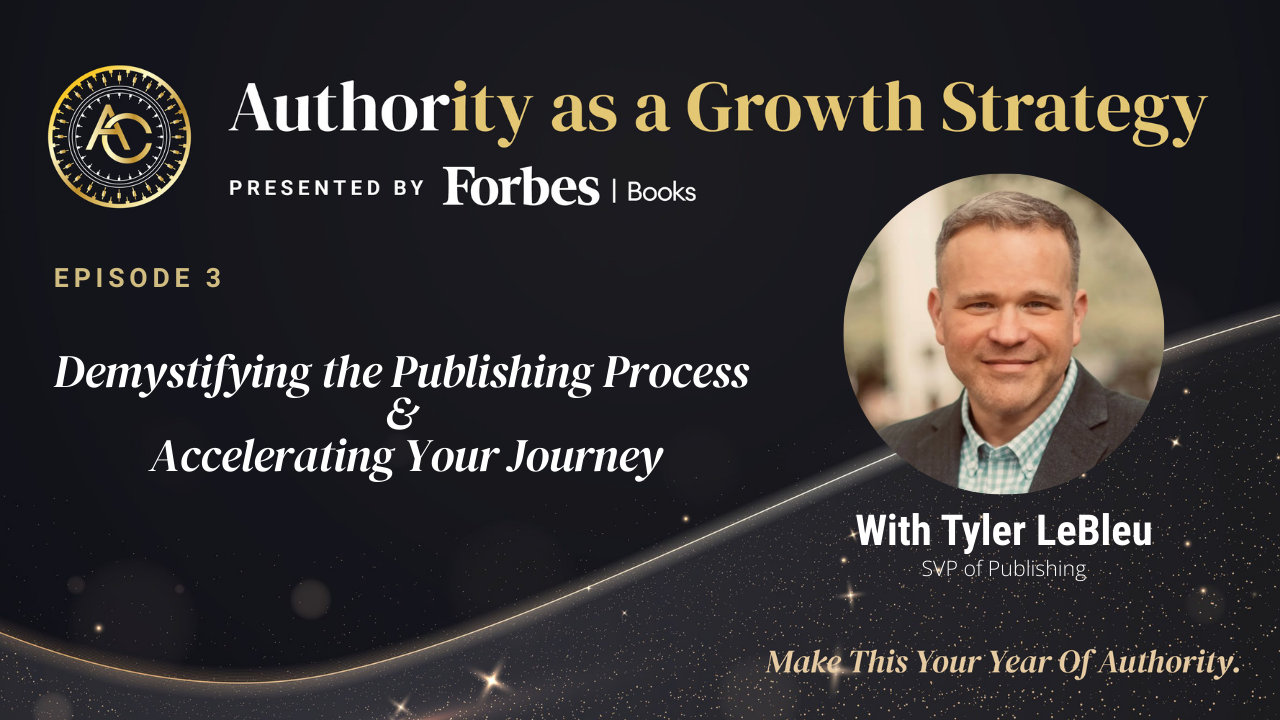
In Episode 3 of Authority as a Growth Strategy, our Forbes Books partnership series presented by The Covert Code, I sat down with Tyler LeBleu of Forbes Books to talk about one of the most powerful authority accelerators available to leaders today: writing the right book.
Not just publishing a book. Not checking a bucket list box. But strategically creating a book that builds trust, opens doors, and becomes a long-term business asset. Because in 2026, authority is not just about being seen—it is about being believed. And authorship remains one of the strongest signals of credibility available.
Your Book Is Not the Product
One of the biggest mindset shifts in this conversation was understanding that your book is not the product—your authority is.
Too many people approach authorship thinking only about book sales, royalties, or bestseller lists. But the real value of a business book often comes after publication. A strong book creates speaking opportunities, media credibility, investor confidence, client trust, strategic partnerships, and thought leadership positioning.
People may not read every page, but the fact that the book exists changes how they see you. That matters.
Choosing the Right Publishing Path
Tyler broke down the three major publishing paths leaders consider: traditional publishing, self-publishing, and hybrid publishing.
Traditional publishing is often the first route people imagine because of the prestige attached to it, but it usually comes with long timelines, limited control, lower royalties, and difficulty getting accepted. For many executives, it simply does not align with the speed of business today.
Self-publishing offers the most control, but it also comes with the most responsibility. Leaders are suddenly managing editing, design, distribution, marketing, retail placement, and quality control on their own. Most people underestimate how much work this actually requires. Writing the book is only the beginning.
Hybrid publishing is often the strongest strategic fit for business leaders because it offers professional support, higher quality production, faster execution, stronger distribution opportunities, and ownership that protects long-term leverage. It creates the authority benefits without sacrificing speed or quality.
The key is choosing the right publishing partner.
Clarity Matters More Than Speed
One of my favorite takeaways from Tyler was simple: publishing fast is not the goal—publishing well is.
Before writing begins, leaders need clarity around who the book is for, what problem it solves, what authority it creates, how it supports business growth, and what opportunities it should unlock.
Without that clarity, writing becomes expensive confusion. With it, authorship becomes strategy.
The book should serve the mission, not the ego.
The Truth About Ghostwriters
We also talked about ghostwriters, which still carries unnecessary stigma for many people.
Tyler shared that the majority of high-level business authors use collaborative writing support. That is not cheating—it is smart.
Busy founders and executives often have deep expertise, valuable frameworks, and powerful stories, but they may not have the time or process to turn that into a manuscript alone.
A good ghostwriter does not replace your voice—they help reveal it.
That distinction matters.
AI Is a Tool, Not the Author
Of course, we also discussed AI and where it fits into the publishing process.
Can AI help write a book? Yes.
Should AI be the author? No.
AI can support structure, organization, idea expansion, and efficiency, but authority cannot be automated.
Your lived experience is the asset. Your perspective is the value. Your credibility comes from what you have actually done—not what software can generate.
In a world full of AI content, authenticity becomes even more valuable.
Why Distribution Still Matters
Tyler also shared something important about visibility: where your book appears matters.
Airport bookstores, retail placement, and major distribution channels are not just vanity wins. They create perception. They signal legitimacy. They reinforce trust.
A book that feels real performs differently than a book that feels self-promotional, and that perception shapes opportunity.
Where your book lives influences how your authority is perceived.
Protecting Long-Term Ownership
Another often-overlooked part of publishing strategy is ownership.
Who controls your intellectual property, your distribution rights, future editions, licensing opportunities, and long-term monetization matters more than most people realize.
Authority is a long game, and your publishing decisions should support future opportunities—not limit them.
Publishing decisions made today can shape authority opportunities for years to come.
Your Book Is the Beginning
The best books do not end with publication—they begin there.
A book should lead to better conversations, better introductions, better visibility, stronger positioning, and bigger opportunities.
It becomes the bridge between where you are and where your authority can take you.
That is the real strategy.
Ready to Build Authority Through Authorship?
If you know there is a book in you, the question is not whether you should write it.
The question is whether you are ready to write the right one.
Explore our Forbes Books partnership and start your authority blueprint here:
👉 thecovertcode.com/forbesbooks
Because your book is not just a project. It is positioning. It is leverage. It is authority.
And in 2026, authority is the growth strategy.
Ready to elevate your authority? Click the URL for a free digital copy of The Authority Advantage, available now for Covert Code listeners:
https://books.forbes.com/free-resources/the-authority-advantage/?rpaname=annacovert
🎧 LISTEN ON ALL PLATFORMS
Spotify: https://open.spotify.com/show/0UcnL4g…
Apple Podcasts: https://podcasts.apple.com/us/podcast…
Amazon Music: https://music.amazon.com/podcasts/d15…
iHeart Radio: https://www.iheart.com/podcast/269-th…
YouTube Music: https://www.youtube.com/@thecovertcodepodcast
🌐 FOLLOW THE COVERT CODE
Website: https://thecovertcode.com/
Instagram: https://www.instagram.com/covertcodeofficial
Facebook: https://www.facebook.com/thecovertcode
LinkedIn: https://www.linkedin.com/company/covert-code-official
📚 ABOUT HOST ANNA COVERT
Anna Covert is the host of The Covert Code Podcast and author of The Covert Code – Mastering the Art of Digital Marketing and The Solar Coaster. With over two decades of experience in digital marketing and business strategy, Anna has worked with top-tier companies like Microsoft, Apple, and IBM, and leads Covert Communication, Hawaii’s largest digital agency. Through The Covert Code Podcast, Anna brings together industry leaders, innovators, and entrepreneurs to share insights on business growth, leadership, and the strategies that drive success in today’s evolving marketplace.
ANNA’S WEBSITES
The Covert Code: https://thecovertcode.com/
Anna Covert: https://annacovert.com/
Covert Communication: https://covertcommunication.com/
Reactium: https://reactium.io/
⚠️ Affiliate Disclaimer: Some of the links above may be affiliate links, which means we may earn a small commission if you choose to make a purchase through them at no additional cost to you. We only recommend resources we genuinely believe in and personally support.
Transcript: Demystifying the Publishing Process & Accelerating Your Authority Journey
Episode: Authority as a Growth Strategy – A Forbes Books Series Presented by The Covert Code
Host: Anna Covert
Guest: Tyler LeBleu
Anna Covert [00:00:00]: This Covert Code podcast is in partnership with Forbes Books. Aloha! My name is Anna Covert, and on this episode of Authority as a Growth Strategy, a Forbes Books series presented by The Covert Code, the topic is demystifying the publishing process and accelerating your authority journey.
My very special guest is Tyler LeBleu, a senior leader at Advantage Authority Publishing. Tyler has over 25 years of extensive experience in publishing, spanning traditional publishing, independent press, and online retail book publishing. He handles everything from editorial to production, design, and distribution.
Today, we’re uncovering what it really takes to write a book, especially now with AI and all the changes happening around speed, publishing models, and authority building. Thanks for being here today, Tyler.
Tyler LeBleu [00:01:16]: Absolutely. Thanks for having me on.
Anna Covert [00:01:18]: To start us off, we like to begin with a little CliffsNotes version of the Tyler story. You have a very impressive background. How did you get into publishing, and how did you get to where you are right now?
Tyler LeBleu [00:01:30]: It really started when I was growing up. My mother was a librarian, so books have always been a big part of my life from the very beginning. When I finished college, I moved to New York. I had a degree in education, but I knew I did not want to become a teacher.
My mom suggested publishing because I was in the Mecca of publishing. I started looking at publishing companies and got a job at Simon & Schuster. That really started my publishing career. I worked my way up from sales into marketing.
After about ten years at Simon & Schuster, I moved into online retail with Audible. That gave me a chance to understand how to communicate to customers and how the industry worked from a retail perspective. Then I moved to Austin, Texas, joined an independent publisher, and learned the production process: editorial, design, printing, and distribution. Eventually, I ended up at Forbes Books and Advantage in a leadership role managing the team.
Anna Covert [00:03:54]: Can you walk us through the different types of publishing that exist today and what makes each one different?
Tyler LeBleu [00:04:06]: The one everyone knows is traditional publishing. That’s what people think of when they think of Simon & Schuster, Random House, or Penguin. There is an acquisitions editor who buys the rights from the author, and the publishing company does the work from editorial through design and distribution. The author has some say, but ultimately it is the publisher’s book.
The next option is self-publishing. That is a complete do-it-yourself model. Platforms like KDP and IngramSpark assist at a minimal level, but the author is responsible for editorial, design, production, and distribution setup.
The happy medium is hybrid publishing or independent publishing. With that model, you get established industry professionals working on your book: editors, designers, production teams, salespeople, and distribution support. It gives authors professional support while allowing them to move with more control and often more speed.
Anna Covert [00:06:59]: That’s a really good overview. One thing I learned is that traditional publishing is often more associated with fiction, memoir, or big-name authors. For business books, many leaders are choosing between hybrid publishing and self-publishing.
I started my journey with Forbes Books for my first book, and then later self-published a niche industry book, The Solar Coaster. It was a whole new world. You don’t realize how many details there are until you’re responsible for everything.
Tyler LeBleu [00:08:05]: Absolutely. Until you start doing it on your own, you don’t realize how much effort it takes and how much time goes into each step. If you’ve worked with a traditional or hybrid publisher before, a lot of those details were handled for you. In self-publishing, you are responsible for every single piece.
Anna Covert [00:08:36]: A lot of successful leaders say they’ve always wanted to write a book someday. How do people move from that fantasy to something legitimate? What is the non-negotiable next step?
Tyler LeBleu [00:09:23]: The fantasy is seeing yourself holding the finished book. The reality is figuring out the steps to get there.
The first thing you need to focus on is your message. What are you trying to solve? Who is your audience? What is their pain point, and how are you going to help them solve it?
It comes down to clarity and commitment. Clarity means defining your audience, their pain point, and your solution. Commitment means treating writing as part of your job, not a hobby. If you’re working with a ghostwriter, schedule those sessions upfront. If you’re writing it yourself, schedule writing blocks and treat them like board meetings. Those appointments need to be non-negotiable.
Anna Covert [00:11:33]: I can attest to that. I wrote my own book, and one thing I recommend is to just write something. The first 15 minutes of anything you write may feel like garbage, but you have to get over yourself and keep going. Don’t stop, don’t get distracted, and don’t worry too much about editing while you’re drafting.
Tyler LeBleu [00:12:28]: I completely agree. I would also suggest starting with some kind of blueprint. Start with the one-pager, then take it to the next level with a detailed book plan. Map out what you want to say, how you want to say it, and where case studies or personal stories fit. That plan helps drive both clarity and commitment.
Anna Covert [00:13:37]: When I first met with Forbes, I was still writing and had around 57,000 words. The team basically told me, “You’re done.” There’s a recommended length for business books. Tell me about that.
Tyler LeBleu [00:14:09]: For the average business book, 45,000 to 50,000 words is the sweet spot. That’s enough to cover your topic in an effective way without overwhelming the reader or adding too much material that doesn’t serve the message.
You don’t want to put everything you’ve ever learned into one book. You want to stay focused. That’s why a book plan is so important.
Anna Covert [00:15:05]: That makes sense. Especially for business leaders, you want readers to feel like they achieved something and consumed enough to move forward. If you write extra content, it can still become articles, blogs, podcasts, or other material later.
Tyler LeBleu [00:15:52]: Exactly. Get it on the page because you never know what idea may not make it into the book but could become a series of articles, blogs, podcasts, or other content.
Anna Covert [00:16:11]: Everyone is talking about AI right now. How is AI changing the author experience?
Tyler LeBleu [00:16:29]: We’re seeing more leaders submit completely AI-written manuscripts because they don’t think they have time to write a full book. But as publishing professionals, it is easy to detect when something was fully written by AI. It usually lacks personal stories, lived experience, and real situations. It can feel very vanilla.
AI should be viewed as a tool, not a replacement. It is not a ghostwriter. It can help with research, outlines, and planning, but the author still needs to bring the human edge: your story, your experience, your knowledge. That is what the audience wants.
Anna Covert [00:18:31]: Absolutely. If the book doesn’t sound like you when you talk, there is a mismatch. People are becoming more sensitive to AI-generated content, and they can feel when something is not authentic.
Tyler LeBleu [00:19:18]: The reading audience has experienced enough AI already that people are becoming savvy. They can tell the difference between someone sharing experience, pitfalls, and accomplishments versus AI-generated content based only on what has been fed to it.
Anna Covert [00:20:00]: I read that because of how many AI books were being submitted, Amazon had to limit how many titles an author could self-publish per day. That brings up print-on-demand. Can you explain how print-on-demand works?
Tyler LeBleu [00:20:32]: With print-on-demand, you create the manuscript and upload it into a platform like KDP, Lightning Source, or IngramSpark. You can use their templates or upload files you’ve designed yourself.
The book becomes virtual inventory. It sits in the system, and when a customer orders it, the book is printed and shipped to that customer. There isn’t inventory sitting in a warehouse. The book is printed when it is ordered.
Anna Covert [00:21:48]: It’s interesting because it democratizes publishing, but it also makes people question whether publishing still builds authority if everyone can do it. What is the healthy way leaders should think about publishing now?
Tyler LeBleu [00:22:48]: It starts with your message and your timing. If you want a traditional publisher, you may be looking at a 15- to 24-month timeline. If your topic is relevant now, you may want a faster path. Self-publishing or hybrid publishing through print-on-demand can allow you to publish in 8 to 9 months, sometimes faster depending on how much of the manuscript is already written.
If your message is evergreen and you want a traditional offset-printed book with all the bells and whistles, that may lead you one way. If you need to establish authority quickly around a topic being discussed right now, hybrid or POD may be the better route.
Anna Covert [00:24:37]: What are some common pitfalls people should consider when choosing the right publishing partner?
Tyler LeBleu [00:24:47]: Start by looking at your end goals. Do you want prestige? Do you want professional editorial and design? Do you want distribution? Do you want to save money and do it yourself?
One pitfall is thinking you have the time to do everything yourself just to save money, then realizing it takes far more effort than expected. For many business leaders, traditional publishing is difficult unless they already have a major platform. Traditional publishers often focus on celebrity CEOs or people who already have strong authority.
Business authors often see value in hybrid or independent publishing because they want professional support, professional design, and distribution into retail.
Tyler LeBleu [00:27:00]: When looking at a hybrid publisher, you should consider who owns the rights. Does the author keep the rights, or does the publisher? Most credible hybrid publishers allow the author to keep the rights. That opens the door to using the content in podcasts, articles, courses, speaking engagements, and other opportunities without permission issues.
You should also look at retail visibility. Is the publisher simply making the book available through POD, or are they actively selling it into brick-and-mortar stores, airports, libraries, and special markets?
Anna Covert [00:28:54]: I was so excited when I saw my book in the airport. Clients and partners sent me photos of it. There is something powerful about being on that shelf with other Forbes authors. Community also matters. Who are the other authors connected to that publisher? Are they people you respect and want to be associated with?
Tyler LeBleu [00:29:59]: Absolutely. Look at the community the publisher supports. Go to the bookstore. Order books from that publisher. Hold them in your hands. Ask yourself if the quality is something you would give to your network or to a CEO you want a blurb from. If you receive a product you wouldn’t give to anyone, that may not be the right publisher for you.
Anna Covert [00:30:45]: Quality really matters. With my book, even the dust jacket and hardcover treatment felt special. When I self-published later, even with multiple rounds of editing, I still found inconsistencies. It’s important to think about credibility and how the book will be used as a tool to increase your online authority.
Tyler LeBleu [00:31:54]: Exactly. One of the benefits of hybrid publishing is book promotion. Are they helping you get visibility within Amazon and other retailers? Are they helping you as the author and authority leader drive the book into search results? If you’re investing time and money into a book, you want people to find it easily.
Anna Covert [00:32:44]: Let’s talk about ghostwriting. How do you match an author with the right ghostwriter?
Tyler LeBleu [00:33:10]: At Advantage, we have a ghostwriting team and a bench of freelance ghostwriters. The team reviews the book plan, manuscript review, and any material created during the discovery process. They identify who on the bench makes the most sense for the content.
Usually, we narrow it down to about four or five ghostwriters who may be a good fit. Then the author interviews them. With a ghostwriter, you need to make sure they have the writing skills, but you also need a connection. You are going to share a lot about your life, your work, and what you bring to the table. You need to feel like they can represent that well.
Anna Covert [00:35:15]: What percentage of authors choose ghostwriting versus writing their own book?
Tyler LeBleu [00:35:30]: For us, many authors choose ghostwriting because of their schedules. Some later decide to write it themselves, but I would say around 80% of our authors choose the ghostwriting route.
Anna Covert [00:36:17]: That’s higher than I expected. I like writing, and I have a different experience when I’m typing than when I’m speaking. But not everyone likes to write, and the process depends on what you’re really trying to accomplish.
If you had one core lesson or practical action for an author, what would it be?
Tyler LeBleu [00:37:06]: Clarity is what fuels commitment. Start by defining who the book helps, what problem it solves, what you bring to the table, and what result the reader should get.
Then build a blueprint around that message and turn it into a detailed outline or plan. When you take those steps, it becomes much easier to write the manuscript.
I would also say you should not do this in a bubble. Tell your network, your friends, and your family that you are writing a book. Once you put it out there, it helps you stay committed.
Anna Covert [00:38:36]: I appreciated having a book coach because I wrote the book, then had to rewrite the book. Knowing someone was checking in each week kept the pressure on. It’s easy to get distracted, and writing a book is always a lot of work.
Tyler LeBleu [00:39:35]: Even if you choose to write your own book, having a coach is a great idea. A coach helps you stay accountable, stay focused, and think about the book from the reader’s perspective. Something may make sense to you because you know the details, but the reader does not. A coach helps bridge that gap.
Anna Covert [00:40:29]: I loved my coach because she was thoughtful. She could tell what parts were strong and what needed work. When I wrote articles later, I would send them to her, and they would come back still sounding like me but clearer and stronger.
Tyler LeBleu [00:41:31]: Your editor is not just there to make sure the writing is correct. Your editor is looking at the manuscript from the reader’s side. They are asking whether it makes sense, whether it could be phrased better, and whether the audience will understand it.
Anna Covert [00:42:36]: Editors also protect you. You might say something in a way that feels fine to you, but someone else could take it differently. AI can edit grammar, but it cannot always see the bigger picture or challenge you critically.
Tyler LeBleu [00:43:44]: Exactly. AI can be used as an editing tool, but it tends to affirm what you have already written. A professional editor brings a critical eye. If something is great, they will tell you. If something can be better, they will tell you that too.
Anna Covert [00:44:25]: For someone who wants to start the blueprint process but hasn’t written anything yet, is it too soon?
Tyler LeBleu [00:44:56]: No. If you have an idea or a message that can help build your authority and solve a problem in your industry, bring that idea. Bring anything you have: transcripts, recorded meetings, client conversations, or other material that supports your message.
A good book planner can draw the ideas out of you. You do not need to have anything written down. You do not even need an outline. If you already have a manuscript or outline, that can speed things up, but it is not required.
Anna Covert [00:46:29]: That’s a great place to end because in our next episode, I’ll sit down with Terry Stanton to talk about starting with the end in mind and designing your authority journey. What do you want from this book? What is the end goal? The team can help you figure out the strategy, visibility, and market relevance.
Tyler LeBleu [00:46:56]: Absolutely. Terry is a master at it.
Anna Covert [00:47:02]: Thank you so much for being here, Tyler. If someone wants to get ahold of you, how can they find you?
Tyler LeBleu [00:47:09]: They can find me through our website, and by reaching out through our main contact information.
Anna Covert [00:47:23]: Thanks so much for being here, Tyler. Please join me on the next episode of this special series to commemorate the Year of Authority. I’ll see you in the pixels. Aloha.
What an incredible third episode. Tyler showed us that authority doesn’t happen by accident. It is built through execution, confidence, clarity, and the right publishing path.
But before any of that even matters, there is a deeper question many leaders rarely ask: What are we building authority for?
In our final episode of Authority as a Growth Strategy, a special Forbes Books series presented by The Covert Code, the topic is starting with the end in mind and designing your authority journey. My very special guest is Terry Stanton, and we unpack how authority has to be intentional—and how leaders who don’t start with the end in mind risk building influence without impact.
You are not going to want to miss this episode. I can’t wait to see you there. Aloha!