Authority Is Not About Attention — It’s About Impact
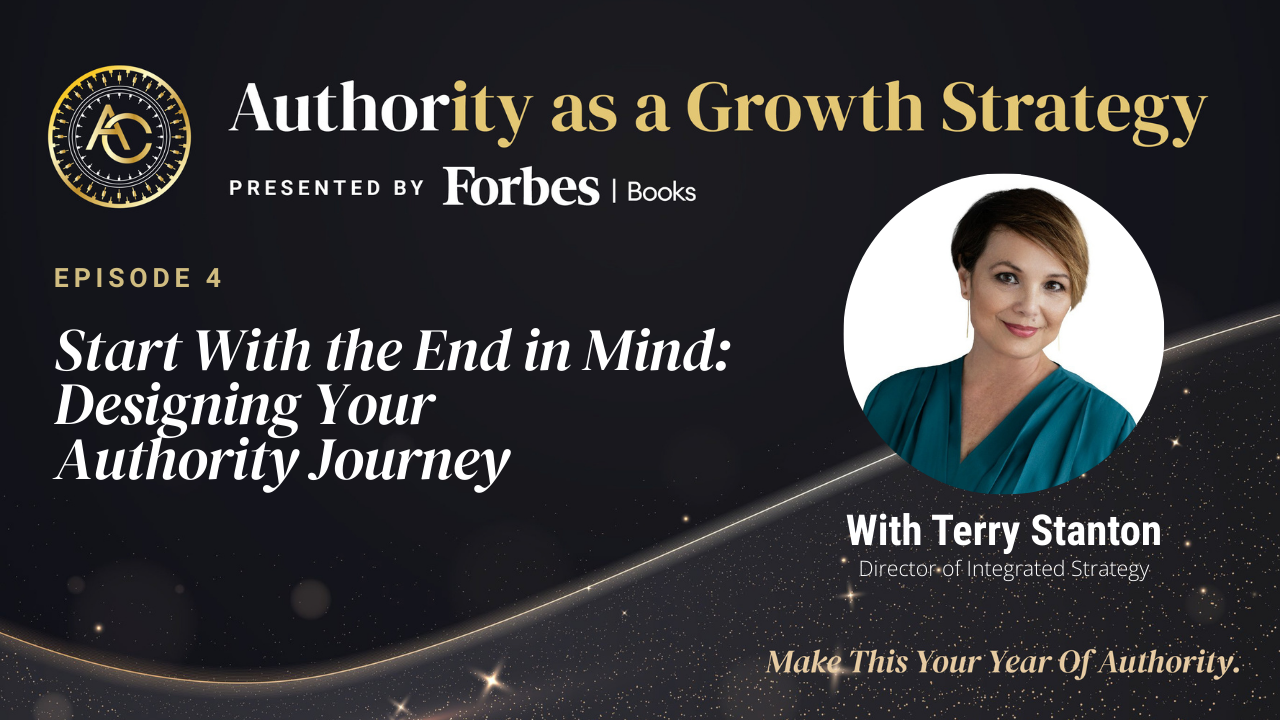
In the final episode of Authority as a Growth Strategy — our Forbes Books partnership series presented by The Covert Code — I sat down with Terry Stanton, Director of Integrated Strategy at Forbes Books, to talk about what it really means to build authority with intention.
This conversation was the perfect close to the series because it brought everything back to purpose. Authority is not something you stumble into. It is something you design. And according to Terry, the strongest authority journeys begin by looking at the long-term impact you want to create, then working backward into the strategy, visibility, and content needed to support it.
Authority Is Not About Attention
One of the most important takeaways from this episode is that authority is not about chasing clicks, followers, or attention. It is about impact.
Terry explained that leaders need to understand what problem they are solving and why their name should be connected to that solution. That purpose becomes the finish line. Without it, visibility can quickly become noise.
For leaders considering authorship, personal branding, or thought leadership, this is the foundational question: What are you building authority for?
Mission Clarity Changes Everything
Terry emphasized that mission clarity helps leaders make better decisions. Markets shift, platforms change, algorithms evolve, and AI continues to disrupt how people discover information. But when your mission is clear, you can stay steady even when the world around you is moving fast.
That clarity helps determine whether you should write a book, build a personal brand website, invest in PR, post more consistently on LinkedIn, or start with smaller thought leadership content first. The Covert Code walks through exactly this kind of strategic decision-making — helping you understand not just what to do, but when and why.
The book may be a powerful stop on the journey, but it is not always the first stop.
Know Who You Are Talking To
Another strong point from this episode was the importance of narrowing your audience. Terry said that when leaders try to talk to everyone, they end up talking to no one. The goal is not to cast the widest net possible. The goal is to identify the people you are truly meant to serve and speak directly to them.
That smaller, more focused audience often creates a bigger impact.
Vulnerability Builds Trust
We also talked about authenticity and vulnerability. Terry shared that some of the most successful thought leaders are the ones willing to be human — willing to talk about what they have learned, what they have overcome, and why their message matters.
That does not mean oversharing. It means connecting your personal experience to the mission you are trying to serve. When vulnerability supports the purpose, it strengthens credibility rather than weakening it.
Consistency Creates Credibility
Authority is built through consistency. Your website, LinkedIn profile, headshots, messaging, content, and media presence should all support the same mission. If someone finds conflicting messages across your digital footprint, trust starts to break down. But when everything aligns, your personal brand becomes easier to understand, easier to remember, and easier to trust.
Small steps matter. Buy your domain name. Update your LinkedIn. Invest in current headshots. Start posting with intention. Our free resources — including cheat sheets, brand foundation exercises, and Anna’s tips — are a practical place to start building that consistency today.
The Human Touch Still Matters
AI can help leaders create content faster, but Terry reminded us that AI alone cannot create true thought leadership. The human touch is what turns content from noise into impact. A post can be generated quickly, but a meaningful message still needs perspective, lived experience, and purpose.
That is where real authority lives. And it is one of the core themes explored throughout the Covert Code Podcast — weekly conversations with leaders who are building real authority, not just digital noise.
The Perfect Close to the Series
This episode brought the entire Authority as a Growth Strategy series full circle. Beth LaGuardia Cooper helped us understand the big picture of authority, trust, and AI. Natalie Mazzarella showed why leaders must become the face of their brand. Tyler LeBleu broke down how publishing can accelerate authority. And Terry Stanton closed the series by reminding us that authority must be intentional from the beginning.
Authority is not about being louder. It is about being trusted.
Ready to Start Your Authority Journey?
If you are ready to build your personal brand, explore authorship, or begin mapping your authority strategy, visit thecovertcode.com/forbes-books to learn more about the Forbes Books partnership and what it means to publish with authority behind your name.
Because authority is not just visibility. It is clarity, trust, and long-term impact. And if you are ready to go deeper, connect with Anna directly to explore consulting, speaking, or coaching — or get your copy of The Covert Code and start building your strategy today.
Ready to elevate your authority? Click the URL for a free digital copy of The Authority Advantage, available now for Covert Code listeners:
https://books.forbes.com/free-resources/the-authority-advantage/?rpaname=annacovert
🎧 LISTEN ON ALL PLATFORMS
Spotify: https://open.spotify.com/show/0UcnL4g…
Apple Podcasts: https://podcasts.apple.com/us/podcast…
Amazon Music: https://music.amazon.com/podcasts/d15…
iHeart Radio: https://www.iheart.com/podcast/269-th…
YouTube Music: https://www.youtube.com/@thecovertcodepodcast
🌐 FOLLOW THE COVERT CODE
Website: https://thecovertcode.com/
Instagram: https://www.instagram.com/covertcodeofficial
Facebook: https://www.facebook.com/thecovertcode
LinkedIn: https://www.linkedin.com/company/covert-code-official
📚 ABOUT HOST ANNA COVERT
Anna Covert is the host of The Covert Code Podcast and author of The Covert Code – Mastering the Art of Digital Marketing and The Solar Coaster. With over two decades of experience in digital marketing and business strategy, Anna has worked with top-tier companies like Microsoft, Apple, and IBM, and leads Covert Communication, Hawaii’s largest digital agency. Through The Covert Code Podcast, Anna brings together industry leaders, innovators, and entrepreneurs to share insights on business growth, leadership, and the strategies that drive success in today’s evolving marketplace.
ANNA’S WEBSITES
The Covert Code: https://thecovertcode.com/
Anna Covert: https://annacovert.com/
Covert Communication: https://covertcommunication.com/
Reactium: https://reactium.io/
⚠️ Affiliate Disclaimer: Some of the links above may be affiliate links, which means we may earn a small commission if you choose to make a purchase through them at no additional cost to you. We only recommend resources we genuinely believe in and personally support.
Transcript: Starting with the End in Mind – Designing Your Authority Journey
Episode: Authority as a Growth Strategy – A Forbes Books Series Presented by The Covert Code
Host: Anna Covert
Guest: Terry Stanton
Anna Covert: This Covert Code podcast is in partnership with Forbes Books. Aloha! My name is Anna Covert, and on this episode of Authority as a Growth Strategy, a Forbes Books series presented by The Covert Code, the topic is starting with the end in mind: designing your authority journey.
My very special guest is Terry Stanton, Director of Integrated Strategy at Forbes Books. Terry works with executives and authors to reverse engineer authority, starting with long-term impact and working backwards to strategy, visibility, and content relevance.
She has a rare mix of public relations, marketing strategy, content, leadership, SEO, and broadcast journalism experience, and has worked alongside iconic brands including Ashley Home Store, Nabisco, and AT&T.
Today, we’re talking about how real authority is designed, not stumbled upon. I’m really excited to dive right into this. Thanks so much for being here today, Terry.
Terry Stanton: Thank you so much, Anna. It’s my pleasure.
Anna Covert: To get started, I like to begin with the CliffsNotes version of the Terry story. You have such an interesting background and so many different things that you’ve done. How did you get to where you are now as Director of Integrated Strategy?
Terry Stanton: You know how there’s that saying, “It’s not about the destination, it’s the journey”? My communications career has absolutely been a journey with a whole lot of pit stops along the way.
I was a communications major, and I started out at a local National Public Radio affiliate in Troy, Montgomery, Alabama. That was the beginning of my journey learning the art of storytelling. I interviewed local newsmakers, then moved into local journalism at a television station in Montgomery. That’s where I learned how to tell the story really, really fast, because you only have about a minute and fifteen seconds for a package.
I did reporting, anchoring, and producing for many years, and my heart will probably always be in journalism. After that, I went into corporate video production, where I was able to take that storytelling idea and make it longer and more impactful to tell the story of a brand or product.
Then came the digital age of search engine optimization and learning how to write for discoverability. I became an e-commerce writer for Ashley Home Store and learned how to write for the customer journey. From there, I moved into public relations, where people became part of the story. It was no longer just about a brand story. It became about personal story and personal impact.
In my current role, everything I just described comes together into strategies with long-term goals in mind.
Anna Covert: That’s really interesting. I love that experience, especially starting with public radio and then moving into search engines and brand storytelling. That’s a full journey.
Terry Stanton: Absolutely. I’ve always had a burning curiosity about what’s on the other side of the fence. Maybe it’s not greener, but it’s different. So let’s go learn what that’s about. Being able to take the nuggets I picked up along the way and use them to help people make an impact is really fulfilling.
Anna Covert: I resonate with that because I’m also a truth seeker. We can sell anything and write copy for anything, but is it the truth? When someone gets the product and experiences it, what then? We live in a digital age where transparency is key.
How do you help guide someone who is interested in authorship to imagine their future self? What is the process of beginning with the end in mind?
Terry Stanton: I think it’s helping people understand that it’s not a foreign concept. No matter what you want to accomplish, you have to know where you’re going.
You’re not going to start on a road trip without looking at a map and knowing where you’re headed, how long it will take, and where you may need to stop. Authority works the same way.
Professional athletes do not practice just for fun. They practice because they have a goal in mind. Authority works that way too. Purpose sets the finish line, but you also need a mission. The mission explains why reaching that finish line matters.
In the authority space, being an expert or thought leader is not just about getting more attention, clicks, or followers. You want to make an impact. You want to know what problem you’re solving and why your name should be associated with helping solve that problem.
Anna Covert: I like that. It makes me think about why leaders struggle so much with defining this. Maybe it’s because it’s not really about ego. You don’t write a book or pursue authorship just for yourself. It has to be for something greater.
Terry Stanton: Exactly. Writing a book is not one and done. It’s something you live with. If you don’t know why you’re doing it, are you going to finish it? There are a lot of unfinished books out there.
You have to find meaning and purpose. Without purpose, why would you keep going?
Anna Covert: What are some clear steps leaders can take to begin defining their authority journey?
Terry Stanton: One of the first questions to ask is: what is one overriding problem I see people like me have, and what did I do to overcome that problem?
If you had that problem, someone else is having that problem too. That’s a good place to start. What do I want to help with? What problem have I solved that I can help someone else solve?
Anna Covert: That was my experience. I never thought I would write a business book, but there was such a need in the market. I had grown men crying on the phone to me because they had been taken advantage of so many times in digital marketing. It became clear that someone had to do something.
But for people who do not have such an obvious gap, what would you say? There are already so many books about leadership and management. How do they know their voice still matters?
Terry Stanton: Just because someone else wrote about it does not mean you can’t. That person does not have your perspective. How many love songs are there? People keep writing songs about love because everyone has their own experience.
You are looking at the situation through your lens, and your lens is yours. It is also important to know exactly who you are writing for. You have to know your audience.
Sometimes people try to cast a really wide net. They say, “I want to answer leadership questions.” But what kind of leadership questions? For what kind of leaders? If you are talking to everybody, you are talking to nobody. Define your niche. Start with your people, and then you can widen the audience later.
Anna Covert: That connects perfectly to authority as a growth strategy. A lot of people may receive your book and not read every page, but the fact that you have the book matters. It becomes part of your authority.
As we enter the Year of Authority, leaders need to think about who they are trying to reach and how a book can bridge where they are now to where they want to be.
Terry Stanton: Exactly. And remember, the book is just one stop in the authority journey. It is an important stop, but sometimes you may not be ready to write the book yet.
You may need to invest your creative energy first in short blog posts, articles, or shaping your thoughts. Jumping ahead into writing a book before you know where the journey is taking you can create problems. You need to know where you want to be and lay the groundwork first.
Do you have a website that articulates who you are to people who don’t know you? Is your LinkedIn up to date? Are you showing that you are a thought leader through blogs, articles, or contributions to reporters looking for expert sources?
Anna Covert: We are in such a rapidly changing world. AI is disruptive, and a lot of people are questioning whether they are still on the right path. What can leaders do to safeguard their investment in themselves and their journey?
Terry Stanton: It comes back to mission. Mission clarity helps you filter decisions.
Markets change fast. Platforms emerge. Old platforms change. The world does not stay static, so you have to stay steady. Your mission has to be clearly defined so you can create the level of impact that makes you a true thought leader.
Anna Covert: Let’s talk about authenticity. If you want people to listen and trust you, you have to be willing to share personal stories and connect more deeply. How do you work with leaders to pull out things that might be personal but meaningful?
Terry Stanton: Some of the most successful thought leaders we’ve worked with are the ones willing to be vulnerable. Vulnerability is hard, but it shows that you are human.
People crave connection. When you share your failures, successes, what you learned, and how you picked yourself up, those stories resonate with someone. They add authenticity and connection.
Anna Covert: A lot of people worry that being vulnerable may make them lose credibility. How do you help a thought leader understand what is enough to share without losing focus?
Terry Stanton: I don’t think you can convince someone to become vulnerable if they don’t want to. It goes back to mission. If a person’s mission is clear, vulnerability becomes easier because they understand it is part of creating connection and impact. They have to want to do it.
Anna Covert: What does your process look like when you work with authors or executives to back out the strategy, visibility, and content relevance from their end goal?
Terry Stanton: Everybody is different. I always ask: what do you want? What does success look like for you?
If they can define success, it becomes easier to create the strategic path to get there. They also need to have an open mind.
One question we get is, “I have a corporate website. Why do I need a personal brand website?” The answer is that people do not buy corporate in the same way. Trust comes from personal connection. People want to know there is a person behind the corporate face.
We look at whether the person has the assets that build authority, credibility, and trust. Is there a personal brand that shows who they are? Does LinkedIn correspond to the personal brand? Every place this person has a digital footprint should highlight the mission they are on. Conflicting messages create confusion, and confusion does not lead to trust.
Anna Covert: Consistency is critical. One thing leaders can do right away is invest in great headshots so their profiles look current and consistent. They can also buy their domain name and make sure their profiles match.
Terry Stanton: Absolutely. If you think you may write a book in two years, look at your LinkedIn now. Start posting now. The more history you have, the more credibility and trust you can build.
Get your personal brand URL. Make sure you own your name. It is never too soon to take those steps.
Anna Covert: How do you prevent storytelling from becoming oversharing or content noise?
Terry Stanton: Most of the time, we have more issues with people not sharing enough. They post for a while, then stop, and long gaps appear. The real challenge is consistency.
Anna Covert: AI can make it easier to get started with social content. You can write out your thoughts and ask AI to help shape it into a LinkedIn post. But the human element still matters.
Terry Stanton: AI is an essential tool, but you have to put the human factor into it. A post can become noise if it lacks thoughtfulness. When it has the human touch, it can become something that creates impact and supports your thought leadership journey.
Anna Covert: Can you share an example of helping an author clarify their purpose?
Terry Stanton: One example was a doctor who wanted to make an impact with young doctors and medical students. At first, he wanted to talk to everyone. We helped narrow the field and focus on who he really wanted to reach.
Through an earned media campaign, PR, and some speaking, he was able to get a column in medical journals, which allowed him to speak directly to the medical students he wanted to reach.
We’ve also worked with authors who had beautiful books and unique concepts but wanted to speak to the entire world, even when their credentials did not support a PR campaign in that way. Sometimes the better path is to start in social, build credibility there, and then move toward media later.
Anna Covert: That was my experience too. I self-published my second book, but what I appreciated from Forbes Books was the ability to see past my own bubble. When I first wrote my book, the first chapters were about how I accumulated my knowledge. The team helped me realize readers cared more about the result than how I got there.
That was revolutionary because it helped me let go of the baggage and focus on what mattered.
Terry Stanton: For some people, the book is a bucket list item. They think, “I wrote my book, and I’m done.” But if they want the impact to continue and create new opportunities, then they need a strategy that includes PR, a cohesive website, aligned social platforms, and a clear message that ties back to the book.
You are not just writing a book to hear yourself think. You want it to help someone, open someone’s eyes, and support your mission.
Anna Covert: In Hawaii, we call that kuleana. It is your responsibility and connection. If you can help someone else not suffer, it becomes your responsibility to share what you know.
Terry Stanton: That is beautiful. There is something noble about saying, “This is what I know. This is what I have mastered.” Once you become a master at something, there is an obligation to share it.
Anna Covert: It is a privilege and a responsibility. You don’t always realize where the journey will take you. I just finished the 100th episode of The Covert Code Podcast, and I cried because of how many wonderful people I’ve gotten to meet through this journey.
You don’t have to know everything. You just have to know the destination of who you want to help and what you want to lead. The rest starts to fall into place.
Anna Covert: How can people get ahold of you and learn more?
Terry Stanton: I’m on LinkedIn as Terry Stanton, and people can reach me there.
Anna Covert: If people are interested in starting this journey, they can go to thecovertcode.com/forbesbooks. We have a way to reach out, learn more, and start the leadership blueprint process.
This has been so much fun. Thanks for being here, Terry, and I hope everyone has had a wonderful time learning with her like I have. I’ll see you at the next episode. Aloha.
Anna Covert: And that’s a wrap. Terry reminded us that authority has to be intentional, starting with long-term impact and working backwards to strategy, visibility, and market relevance.
Throughout this series, we’ve explored how authority is shaped through clarity, execution, and purpose. Authority isn’t about being louder. It’s about being trusted, because trust is what turns influence into long-term impact.
This has been Authority as a Growth Strategy, a Forbes Books series presented by The Covert Code. If you’re ready to start on your personal brand journey, visit thecovertcode.com/forbesbooks.
I hope to see you soon. Aloha!