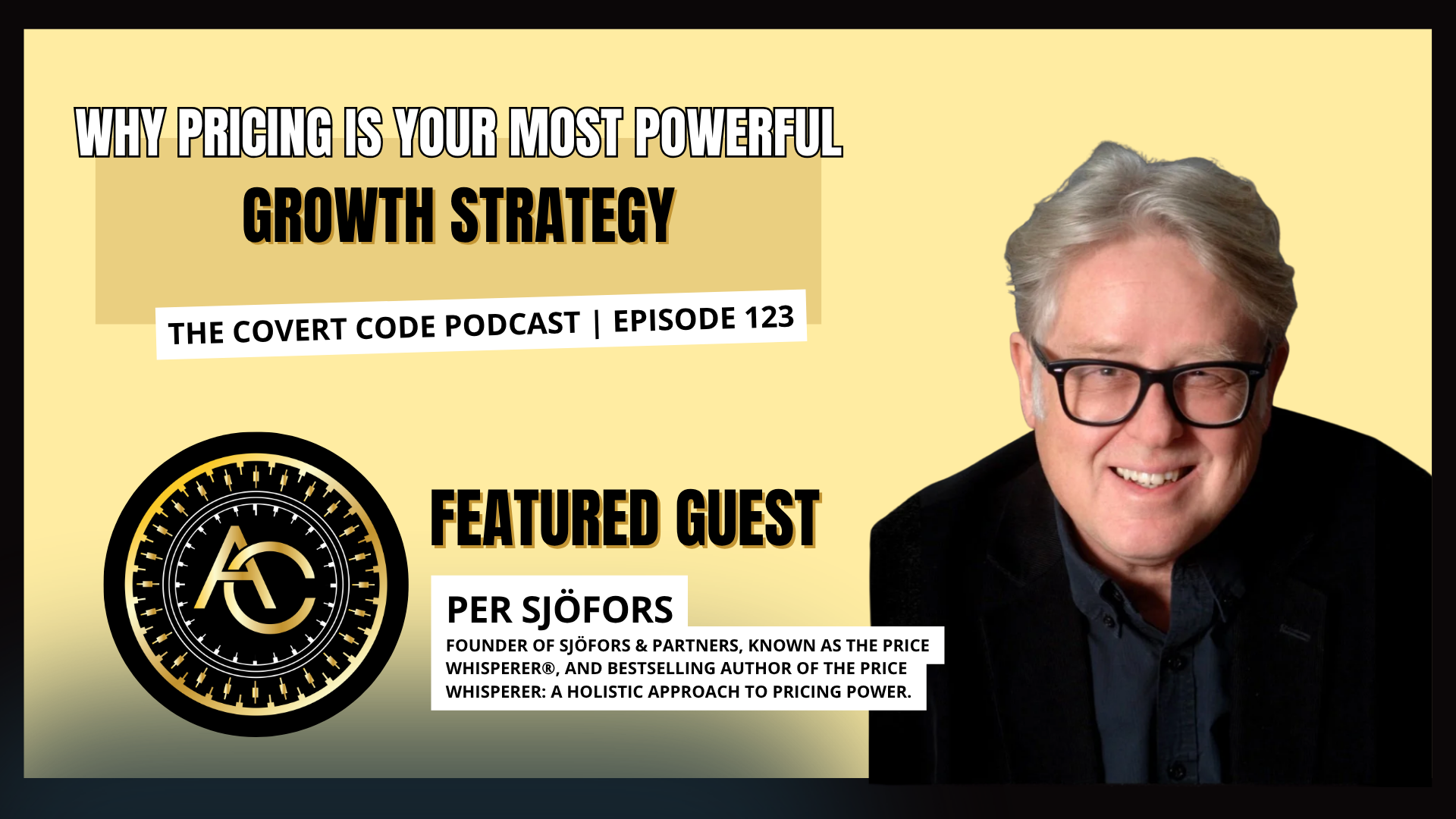
Why Pricing Is Your Most Powerful Growth Strategy
Most businesses focus their growth efforts on generating more leads, increasing sales volume, improving marketing, or reducing operating costs.
However, they frequently overlook one of the fastest and most powerful ways to improve profitability: pricing.
In Episode 123 of The Covert Code Podcast, Anna Covert speaks with pricing expert Per Sjöfors about behavioral economics, pricing psychology, differentiation, discounting, customer expectations, and the strategies businesses can use to increase both revenue and profitability.
Meet Per Sjöfors, The Price Whisperer
Per Sjöfors is the founder of Sjöfors & Partners and the author of The Price Whisperer: A Holistic Approach to Pricing Power.
Before becoming a pricing consultant, Sjöfors served in several CEO roles in Europe and the United States. During that time, he experimented with different pricing strategies.
Some experiments produced dramatic revenue increases. Others failed completely.
The inconsistency led him to a larger question: Why did certain pricing changes work while others did not?
Sjöfors concluded that traditional pricing models were often too theoretical. Business leaders needed a more practical approach based on how real customers make purchasing decisions.
That realization led him to behavioral economics.
Pricing Is More Than a Financial Calculation
Many companies calculate prices by adding a standard profit margin to the cost of producing a product or delivering a service.
Others simply review competitor prices and attempt to remain slightly higher or lower.
Neither method fully accounts for customer psychology, perceived value, brand positioning, differentiation, or purchasing behavior.
According to Sjöfors, pricing should not be treated as a simple mathematical exercise. It should be treated as a strategic growth function.
When a company understands why customers buy, what they value, and what increases their willingness to pay, it can develop prices that improve sales volume, profitability, and customer satisfaction.
Sjöfors calls this the paradox of price.
The One Percent Pricing Challenge
One of the most striking lessons from the episode is the potential impact of a seemingly minor price increase.
Sjöfors explains that, for an average company, a one percent increase in price may lead to an approximately 11.3 percent increase in profit.
The exact result varies based on the company’s existing margins, costs, and financial structure. However, the larger lesson remains important.
A small improvement in pricing can have a disproportionately large effect on profitability.
Sjöfors calls this the one percent challenge. He asks business leaders whether they have ever been unable to change something in their business by only one percent.
The question forces executives to reconsider whether their current pricing is truly optimized or simply familiar.
For several small public companies Sjöfors examined, a one percent increase in price would have produced profitability increases ranging from approximately five percent to more than twenty percent.
How Expectation Bias Influences Purchasing Decisions
One of the most important concepts discussed in the episode is expectation bias.
Expectation bias occurs when the price of a product influences what a customer expects from it.
When a price appears unusually low, customers may question the quality of the product or service.
They may wonder:
- Why is this so inexpensive?
- Is something wrong with it?
- Will it provide the results I need?
- Is this company experienced or trustworthy?
A low price does not always increase demand. In some situations, it can reduce demand by creating an expectation of inferior quality.
A higher price can create the opposite expectation. Customers may associate a premium price with superior quality, exclusivity, expertise, or better results.
This does not mean that companies should arbitrarily raise prices. It means that pricing communicates information, whether the business intends it to or not.
Purchasing Decisions Are Emotional
Sjöfors explains that purchasing decisions are largely emotional.
Consumers may believe they make purely rational decisions, but emotional responses frequently occur first. The rational mind then develops reasons to justify the decision.
This is why value perception, trust, presentation, branding, and expectations play such important roles in pricing.
A customer is not merely evaluating a number. The customer is evaluating what that number implies about the product, the company, the experience, and the expected outcome.
For marketers and business leaders, this means the pricing conversation cannot be separated from the overall customer experience.
As Anna frequently discusses through her work in digital marketing and business strategy, every element of the customer journey shapes perception. Pricing is part of that journey.
The Magnetic Middle
When companies offer three choices, customers frequently gravitate toward the middle option.
This is often described as the magnetic middle.
Customers may not want the cheapest option because it appears incomplete or inferior. They may also hesitate to select the most expensive option.
The middle option feels balanced and safe.
Businesses can use this behavior by creating a good, better, and best pricing structure in which the middle package is designed to be the most attractive choice.
Sjöfors recommends carefully managing the distance between the three prices. The middle option should make the premium option feel attainable while still appearing meaningfully better than the lowest-priced choice.
The goal is not to manipulate customers. The goal is to present choices in a way that makes differences in value easier to understand.
Price Anchoring Changes What Appears Affordable
Price anchoring occurs when the first price a customer sees becomes the reference point for every price that follows.
Sjöfors uses the example of a luxury retail store. After looking at four-thousand-dollar handbags, a six-hundred-dollar wallet may suddenly seem inexpensive.
The wallet did not become cheaper. The customer’s reference point changed.
Apple used a similar strategy when it introduced an Apple Watch priced at approximately $17,000 alongside a much less expensive version.
The extremely expensive watch generated attention, but it also made the standard version appear more affordable by comparison.
This strategy can be used in:
- Website pricing tables
- Business proposals
- Restaurant menus
- Service packages
- Software subscriptions
- Retail merchandising
Sjöfors recommends presenting the highest-priced option first. In many Western markets, customers read from left to right and top to bottom. The first price they encounter becomes the anchor.
Instead of presenting good, better, and best, companies may benefit from presenting best, better, and good.
Communicate Value Before Revealing the Price
Another major mistake occurs when companies display the price before explaining the value.
When a customer sees a price first, that number can dominate the entire purchasing decision.
The customer may never fully consider:
- The problem being solved
- The expected outcome
- The company’s expertise
- The quality of the service
- The included support
- The risk being reduced
- The long-term financial value
This is especially important in business-to-business sales.
Sjöfors recommends presenting proposals rather than simply emailing them.
When a proposal is sent without a presentation, the buyer may immediately turn to the pricing page. The seller then loses the opportunity to explain the strategy, value, differentiation, and results behind the investment.
The price should be revealed in the context of value.
Differentiation Creates Pricing Power
Pricing power is the ability to increase prices without experiencing a corresponding loss in sales volume.
According to Sjöfors, meaningful differentiation is one of the primary drivers of pricing power.
When a company appears interchangeable with every competitor, customers naturally focus on price.
When a company offers something distinct and valuable, customers have more reasons to choose it beyond cost.
Differentiation does not always require inventing an entirely new product.
A company selling a physical product can add services. A service provider can add tools, resources, products, training, guarantees, or support.
In the episode, Sjöfors discusses Hilti, a professional tool company that differentiates itself through services such as fleet management, calibration, certification, and customer support.
The tools are important, but the ecosystem surrounding them helps justify the premium price.
Even Commodities Can Be Differentiated
Businesses sometimes assume they cannot differentiate because they sell a commodity.
Sjöfors provides several examples that challenge that belief.
One company sold truck tires. Tires can appear highly interchangeable, but the company also offered rapid roadside service. When a commercial driver experienced a tire problem, assistance could arrive quickly.
That service created value beyond the tire itself.
Another company rented steel plates used to cover road trenches.
A steel plate may appear to be the ultimate commodity. However, this company sent two people with each delivery truck. One person drove while the second person directed the placement of the plates.
Because the plates were extremely heavy, accurate placement saved customers time, labor, frustration, and risk.
The company also provided safety training, which helped position it as an industry authority.
According to Sjöfors, the company achieved a dominant market share while charging approximately twenty-five percent more than competitors.
The lesson is clear: Even when the underlying product is similar, the customer experience does not have to be.
Measure What Customers Value
Businesses often rely on intuition when developing marketing messages.
They promote the qualities they personally find important rather than the outcomes customers value most.
Sjöfors shares the example of a Swedish takeaway coffee chain that emphasized organic and sustainably grown coffee.
Research revealed that a different message was significantly more compelling: The coffee tasted better than the coffee customers made at home.
That message focused on the immediate customer benefit.
After changing the positioning, the company doubled sales volume without changing the underlying product.
The lesson is not that sustainability lacks value. The lesson is that companies must identify which value proposition most strongly influences the purchasing decision at the moment it occurs.
Structured willingness-to-pay research can help businesses determine:
- What customers are willing to pay
- Which features increase willingness to pay
- Which messages increase purchase intent
- Which customer segments perceive the most value
- Which payment models reduce friction
- Which differentiators increase satisfaction
Reduce Purchasing Risk During Uncertain Times
Economic uncertainty does not necessarily stop people from purchasing. It can, however, extend the amount of time they need to make a decision.
During uncertain periods, businesses should focus on reducing sales friction and perceived risk.
Strategies may include:
- Clear guarantees
- Better warranties
- Free trials
- Try-before-you-buy programs
- Flexible payment plans
- Responsive customer service
- Easy returns
- Transparent cancellation policies
Fear of making the wrong choice can be more influential than the expected benefit of making the right one.
Reducing that fear can increase conversion without reducing the price.
Customer-Friendly Subscriptions Build Trust
Subscriptions provide companies with predictable recurring revenue, which can be attractive to executives and investors.
However, a subscription strategy must also serve the customer.
When companies make subscriptions difficult to pause or cancel, they may generate short-term revenue while damaging long-term trust.
Anna explains that consumers should be able to withdraw their consent or change their communication preferences as easily as they provided them.
This applies to subscriptions, email marketing, text messaging, phone calls, and other customer relationships.
A customer-friendly system may ultimately improve retention because people feel comfortable subscribing when they know they remain in control.
The Hidden Cost of Discounting
Discounting is one of the most misunderstood strategies in business.
A five percent discount sounds minor to a customer. It may not be minor to the company.
Sjöfors explains that, for an average business, a five percent discount may eliminate approximately fifty-seven percent of profit.
The company may then need to more than double sales volume to produce the same total margin.
Most discounts do not generate that level of increased demand.
Frequent discounting can also train customers to wait.
When buyers know that a company discounts at the end of every month, quarter, or year, they delay purchasing until the discount appears.
The company has effectively taught the market not to pay full price.
Discounting should be intentional, limited, and tied to a larger strategic objective.
Use Bundling Instead of Reducing the Core Price
Bundling can provide customers with additional value without directly reducing the perceived value of the primary product.
Instead of offering ten percent off, a business might include:
- An additional product
- A consultation
- Training
- Priority support
- Extended service
- Free delivery
- A complementary accessory
The additional item may have a relatively low delivery cost while carrying meaningful perceived value for the customer.
This protects the core price while still creating urgency and incentive.
Pricing Should Be a Company-Wide Strategy
Pricing does not exist in isolation.
It is affected by marketing, sales, brand positioning, product design, customer experience, service, payment options, guarantees, and communication.
A pricing test that ignores these variables may produce incomplete or misleading results.
The strongest pricing strategies examine the complete customer decision.
Business leaders should ask:
- What outcome does the customer truly value?
- What creates trust?
- What creates hesitation?
- What makes the company meaningfully different?
- What price creates the appropriate expectation?
- What options make the decision easier?
- What can reduce risk without reducing price?
These questions connect pricing with the larger growth strategy.
The Most Important Takeaway
Many companies attempt to grow by selling more while continuing to underprice what they already sell.
They spend more on advertising, hire more salespeople, offer additional discounts, and increase production without first determining whether their prices accurately reflect customer value.
Pricing deserves the same level of research, strategy, and attention as marketing and sales.
A small improvement can create a meaningful increase in profitability. A poorly designed discount can erase that profitability just as quickly.
The businesses with the strongest pricing power are not necessarily the cheapest. They are the businesses that understand their customers, communicate value clearly, reduce risk, and create meaningful differentiation.
Watch the Full Episode
Watch Episode 123 of The Covert Code Podcast to hear Anna Covert and Per Sjöfors discuss pricing psychology, behavioral economics, discounting, customer satisfaction, and the strategies companies can use to turn pricing into a powerful engine for growth.
Learn more about The Covert Code Podcast and explore additional conversations with entrepreneurs, authors, executives, and business leaders.
Learn more about Per Sjöfors and his work through Sjöfors & Partners.
Discover The Price Whisperer: A Holistic Approach to Pricing Power through The Price Whisperer book page.
🎧 LISTEN ON ALL PLATFORMS:
Spotify: https://open.spotify.com/show/0UcnL4g4J2DckqMpZg4DdB?si=NKAFJcRMSdOJlP5iebBxoA&nd=1&dlsi=50d6d5c5753a499b
Apple Podcasts: https://podcasts.apple.com/us/podcast/the-covert-code/id1733326615
Amazon Music: https://music.amazon.com/podcasts/d15bb709-a4df-43bb-9284-9e479c8574a7/the-covert-code
iHeart Radio: https://www.iheart.com/podcast/269-the-covert-code-269144900/
YouTube Music: https://music.youtube.com/channel/UCSU2Anqu1_yzb_D6IFd7i_Q
🌐 FOLLOW THE COVERT CODE:
Website: https://thecovertcode.com/
Instagram: https://www.instagram.com/covertcodeofficial
Facebook: https://www.facebook.com/thecovertcode
LinkedIn: https://www.linkedin.com/company/covert-code-official/
📚 ABOUT HOST ANNA COVERT:
Anna Covert is the host of The Covert Code Podcast and the author of The Covert Code – Mastering the Art of Digital Marketing and The Solar Coaster. With over two decades of experience in digital marketing and business strategy, Anna has worked with top-tier companies like Microsoft, Apple, and IBM and leads Covert Communication, Hawaii’s largest digital agency.
ANNA’S WEBSITES:
The Covert Code: https://thecovertcode.com/
Anna Covert: https://annacovert.com/
Covert Communication: https://covertcommunication.com/
Reactium: https://reactium.io/
⚠️ Affiliate Disclosure: Some links included may be affiliate links, which means we may earn a commission if you choose to make a purchase through them at no additional cost to you.
Why Pricing Is Your Most Powerful Growth Strategy with Per Sjöfors
The Covert Code Podcast, Episode 123
Host: Anna Covert
Guest: Per Sjöfors, The Price Whisperer
Anna Covert [00:00:04]:
Aloha. My name is Anna Covert, and I am coming to you from the beautiful island of Oahu.
This week on The Covert Code, the topic is why pricing is the most powerful growth strategy.
My very special guest is Per Sjöfors, founder of Sjöfors & Partners. He is known as The Price Whisperer and has a bestselling book, The Price Whisperer: A Holistic Approach to Pricing Power.
He is a Forbes Business Council thought leader and a member of the C-Suite Hero Club. He has also been recognized by Inc. Magazine as one of the top ten most visionary leaders of our time and by Thinkers360 as a top global thought leader in sales.
He knows his stuff, and today we will uncover why pricing is one of the most overlooked and powerful growth strategies in business.
Tack så mycket, which means thank you in Swedish, to Per for being my guest today.
Per Sjöfors [00:01:05]:
Thank you. It is a pleasure to be on the show. It is a little unusual that we both have this Swedish heritage.
Anna Covert [00:01:16]:
We will jump right into it. Give me the CliffsNotes version of your very interesting story. What is your background, and how did you get to where you are now?
Per Sjöfors [00:01:31]:
The story of why I got into pricing began when I had the opportunity to run a couple of companies in Europe, one in Switzerland and one in the United Kingdom. That was before I came to the United States.
I came here to found and develop a business unit for a fairly large public company. After that, I had another four CEO positions.
In all of these companies, we conducted experiments with pricing because it was an area that interested me. Some of those experiments were very successful. The following quarter, revenues might increase by 25 or 30 percent. Other experiments were complete disasters.
What I learned about pricing in business school was, first, very limited. Second, it was too academic and theoretical. It was not something you could practically use as a business leader.
When I decided to set out on my own, I took that interest in pricing and asked myself what I would have needed as the CEO of those companies to make pricing an engine for growth.
What was I missing? Why could we not determine why some pricing experiments worked while others failed?
What I eventually concluded was that, to use pricing as a growth lever, you must leverage behavioral science, particularly the subset of behavioral science known as behavioral economics.
Several Nobel Prize winners have developed a deep understanding of how buyers make purchasing decisions. When you understand how people make those decisions, you can influence them.
When you influence purchasing decisions in the right way, using behavioral science, you can increase sales volume, increase prices, and increase customer satisfaction at the same time.
That is the paradox of price.
Most companies do not approach pricing this way. They say, “My cost is X, and the standard profit margin in my industry is Y, so that becomes my price.” Alternatively, they look at a competitor that did the same thing.
Anna Covert [00:04:45]:
We see that all the time. Coke and Pepsi are the classic business school example. Every other week, one of them is on sale.
That brings the entire industry down.
Per Sjöfors [00:05:02]:
Definitely.
For an average company, although no company is truly average, a one percent increase in price leads to an approximately 11.3 percent increase in profit.
I jokingly call this the one percent challenge.
I ask the CEOs I speak with, “Have you ever failed to change something by one percent?”
Anna Covert [00:05:45]:
That seems so nominal.
Per Sjöfors [00:05:49]:
Exactly.
To entertain myself, I went online and selected four relatively small public companies so I could access their financial information.
I calculated what a one percent price increase would do for each company. One would experience a five percent increase in profitability. One would experience a sixteen percent increase. Two would experience approximately a twenty-one percent increase in profitability.
Anna Covert [00:06:34]:
Is that based on the average sales price of the product to the consumer? Does it matter whether it is a large-ticket item?
Per Sjöfors [00:06:42]:
It is based on the resulting EBITDA and profit margin.
This is a lever that many companies do not understand.
They also do not understand the paradox of price. As human beings, we are imperfect and malleable. When you know how to influence a purchasing decision, you can achieve higher prices, higher sales volume, and higher customer satisfaction at the same time.
Anna Covert [00:07:21]:
Let us dive into that. What is one behavioral science principle we can discuss?
Per Sjöfors [00:07:29]:
I will explain two of the most important principles.
The first is expectation bias.
When we are presented with a price, that price itself creates an expectation about the quality and benefit of the product or service we are considering.
When the price is too low, we might say, “I want to buy this, but at this price, it probably will not be good enough.”
Anna Covert [00:08:14]:
Why is it so cheap?
Per Sjöfors [00:08:18]:
Exactly. Why is it so cheap?
I explain this to CEOs, and then they return to their companies and reduce prices by another fifteen percent.
One side of expectation bias is that when a price is too low, we assume the product is not very good. When the price is high, we tend to assume it is good.
A university study in Chicago placed participants in functional MRI machines and gave them wine. Participants were presented with a six-dollar wine and a one-hundred-dollar wine.
When researchers gave them the inexpensive wine but told them it was expensive, the pleasure centers in their brains lit up. When they gave them the inexpensive wine and said it was cheap, the pleasure centers did not respond in the same way.
The same expectation applied to the expensive wine. The participants’ perceived enjoyment was influenced by the price they believed they were paying.
Purchasing decisions are emotional.
Because we are supposed to be rational beings, we use our prefrontal cortex to add rational explanations to an emotional decision already made by the limbic system.
Sellers can leverage this in ways that are good for both the seller and the buyer.
Anna Covert [00:10:34]:
It reminds me of another one of my favorite behavioral science strategies, the magnetic middle.
When you have three options, one higher, one lower, and one in the middle, most people gravitate toward the middle. They do not want the most expensive or the cheapest option.
The middle should be the product you most want people to buy, and the other options should be priced so that the middle becomes their natural choice.
Per Sjöfors [00:11:01]:
I can tell you more about that.
If you have a good, better, and best structure, the middle option should be approximately two-thirds of the distance between the cheapest and most expensive options.
That structure means very few people purchase the cheapest option, while quite a few say, “For just a little more, I can purchase the most expensive one.”
This connects to another important principle in behavioral science, the anchoring effect.
Consider this example: If you have been in a Prada store looking at four-thousand-dollar handbags, a six-hundred-dollar wallet near the checkout appears to be a bargain.
The four-thousand-dollar price becomes the anchor in your mind, making six hundred dollars seem inexpensive by comparison.
One of the most successful or extreme examples I have seen occurred when Apple introduced the Apple Watch.
Apple had a $349 watch that it wanted to sell in volume, but it also offered a $17,000 version. The primary difference was that the more expensive watch had a gold case.
Every journalist covering the product launch wrote about the audacity of Apple selling similar electronics for either $349 or $17,000.
The point was not necessarily to sell a large number of $17,000 watches. The point was to make the $349 watch appear more affordable.
That is price anchoring.
If you have good, better, and best options, the anchor should be the most expensive option. Since people in Western markets generally read from top to bottom and left to right, the most expensive option should be the first price they see.
It should be presented as best, better, and good, rather than good, better, and best.
You can see this strategy on some websites.
For example, a platform might present a premium service for approximately $300 and then show a lower option for around $15. The premium option may not be intended to sell in large quantities. Its role may be to drive significant sales of the lower-priced service.
Anna Covert [00:14:40]:
That is a great tip.
Per Sjöfors [00:14:43]:
This applies to almost everything.
If you sell business-to-business through proposals, you should also have good, better, and best options. Those options should be presented in reverse order so the most expensive option is the first price the potential customer sees.
Likewise, a restaurant can place an extremely expensive special in the upper-left area of the menu. That makes everything else appear more affordable.
Anna Covert [00:15:27]:
You choose that location because it is one of the first things people see.
I now realize that in many high-end restaurants, the prix fixe menu, which is often the most expensive option, is presented first. The à la carte options appear afterward.
Per Sjöfors [00:16:19]:
Exactly.
Another common mistake occurs when businesses present a price before they communicate value.
Whenever you present a price, you must ensure the buyer understands the value before seeing that price.
Many consumer websites put the price at the top and the value description underneath it.
That is backward.
It encourages people to make decisions primarily based on price because they may never read the value description.
Anna Covert [00:17:23]:
That is important to consider with clothing and other products. On an overview page, perhaps you should not show only the product title and price. You may want the customer to click into the product, understand it, and then see the price.
Per Sjöfors [00:17:39]:
Definitely.
When selling business-to-business through proposals, you should present the proposal. You should never simply send it.
What happens when someone receives a proposal? They often immediately turn to the last page and ask, “Is this price reasonable?”
The entire point of developing the proposal is to explain your uniqueness, features, benefits, and value. When the buyer jumps directly to the price, their decision becomes driven by that number rather than the value you created.
Anna Covert [00:18:28]:
The price sets their expectation.
We have discussed expectation bias, anchoring, and the magnetic middle. What else is critical?
Per Sjöfors [00:18:47]:
A high price can create an expectation of value, quality, and exclusivity.
For a technical example, I have spent some time around the high-end audio industry.
You can buy a small USB cable online for approximately five dollars. You can also purchase an audiophile-grade cable for three thousand dollars.
There may be very little technical difference in the digital signal. However, someone who pays three thousand dollars for a three-foot USB cable may genuinely believe they hear a difference because they expect one.
As a result, they may be happy and satisfied customers.
That is another example of the paradox of price. You can increase price, customer satisfaction, and sales volume at the same time, but you must understand what matters to the customer.
You cannot rely only on directly asking customers because customers do not always accurately describe what drives their decisions.
Anna Covert [00:20:32]:
Absolutely.
Per Sjöfors [00:20:35]:
I speak with CEOs who agree that customers do not always tell the full truth. Then, in the next sentence, they say, “We talk to our customers all the time,” and they believe everything those customers say.
Another critically important factor in pricing is differentiation.
Differentiation is what gives companies pricing power.
Pricing power is a term Warren Buffett has used to describe a company’s ability to increase prices without losing sales volume.
Anna Covert [00:22:01]:
That connects to the elasticity of demand.
Per Sjöfors [00:22:04]:
Yes, although the straight-line demand curves taught in many economics classes do not accurately reflect reality.
We have already established that when a price is too low, sales volume can decrease because the low price creates an expectation of inferior quality or benefit.
Traditional straight-line demand curves assume that as the price falls, sales volume continually increases. That does not always happen.
Elasticity also changes at different price points.
There are psychological price points where a small pricing change can create a significant change in sales volume. Between those price points, demand may remain relatively flat.
I call these psychological thresholds price walls.
Suppose one price wall is at one hundred dollars and the next price wall is at one hundred and fifty dollars. If demand is relatively stable between those points, you would want to price as close to one hundred and fifty dollars as possible without crossing the next wall.
Anna Covert [00:24:37]:
That makes sense.
Per Sjöfors [00:24:46]:
We conducted work for a coffee chain in Sweden that sold takeaway coffee.
The company promoted its organic and sustainably grown coffee. That was its primary marketing message.
We found that changing the message to “This coffee tastes better than the coffee I make at home” doubled sales volume.
By moving away from a message chosen through intuition and instead measuring what increased willingness to buy and willingness to pay, the chain doubled in size.
From the company’s perspective, that message was counterintuitive.
From the customer’s perspective, however, coffee that tastes better than what they can make themselves is extremely valuable.
At the moment someone wants coffee, they may not care as much about whether it is organic. They care that it tastes better than the coffee they could make at home.
That can be measured.
This is not merely testing. It is measurement.
Online willingness-to-pay studies can measure what people are willing to pay, what motivates them to pay more, and what increases satisfaction.
Anna Covert [00:26:49]:
Returning to pricing power, how can listeners apply this? How can they determine whether they have pricing power?
Per Sjöfors [00:27:17]:
You cannot know without conducting the proper measurements.
If you test price alone, you are testing pricing in a vacuum.
Everything a company does affects customers’ willingness to buy and willingness to pay. That includes marketing, customer targeting, product variations, sales channels, payment options, and messaging.
Suppose you wanted to test six price points, three marketing channels, six marketing messages, three product variations, four payment structures, and three sales channels.
You could quickly end up with tens of thousands of possible combinations. You cannot realistically test every combination in the marketplace.
However, you can measure those variables through structured research in a couple of weeks.
In the coffee example, the company differentiated itself through marketing. It did not change the product or the location. It changed the message and doubled sales volume.
Anna Covert [00:29:01]:
They connected with what the customer expected to receive and what that outcome was worth.
Another challenge I frequently see across different industries is that companies do not fully understand what it costs to produce and deliver their product throughout the entire chain.
They do not account for contingencies, supply changes, or sudden shifts in demand.
During COVID, for example, the demand for toilet paper suddenly increased. Companies throughout the supply chain increased production, but by the time additional products reached the market, that unusual demand had disappeared.
Do you discuss how companies can monitor global supply and the factors that affect their ability to price correctly?
Per Sjöfors [00:30:11]:
That is not the primary focus of my book.
The book focuses on understanding customers and influencing their willingness to pay and willingness to buy.
We are living in a turbulent world. Tariffs change, energy markets shift, and people debate whether a recession or market decline is coming.
During turbulent periods, people do not necessarily stop purchasing, but their decisions take longer.
Anna Covert [00:31:20]:
That makes sense.
Per Sjöfors [00:31:21]:
Companies can respond by reducing sales friction.
According to behavioral economics, fear of making the wrong purchasing decision can be significantly more influential than the expected benefit of making the right one.
Anna Covert [00:32:01]:
That connects to loss aversion.
Per Sjöfors [00:32:03]:
Absolutely.
During turbulent periods, companies must consider how they can limit risk or the perception of risk.
That might include better warranties, trial periods, payment plans, improved customer service, guarantees, or free trials.
Not every company offers these protections.
Anna Covert [00:32:36]:
Some companies do the exact opposite. They make products difficult to return.
Everything now seems to have a subscribe-and-save feature. That can be useful, but some companies make subscriptions very difficult to cancel.
I believe that is a mistake.
A customer may simply want to pause a subscription or cancel before another charge. Making the process difficult can make that customer unwilling to purchase again.
Per Sjöfors [00:33:30]:
Many companies move toward subscriptions because predictable recurring revenue can increase shareholder value.
Investors generally appreciate subscription businesses because the revenue is predictable.
Anna Covert [00:33:48]:
Subscriptions can also be good for the customer when they are easy to control.
I like using Amazon subscriptions because I can easily pause, modify, or cancel them. I may want the discount and convenience, but if I am traveling for a month, I do not want more products arriving and being wasted.
I am a strong proponent of privacy and consumer protection. It should be as easy for people to withdraw their interest as it was for them to provide it.
If someone no longer wants texts, emails, or calls, or wants to change their preferences, companies should not make that difficult.
Per Sjöfors [00:34:43]:
For all its faults, Amazon does place the customer at the center.
It tries to make purchasing, returning products, and canceling subscriptions as easy as possible.
That intense customer focus helped Amazon become what it is today. It was not even the first company in the space, but it now dominates online sales.
Anna Covert [00:35:24]:
Let us talk about the illusion of Amazon Prime Day and discounting.
Many companies do not understand the power of discounts or how frequent discounting trains customers to value products less.
If a business runs an offer every week, customers learn not to purchase at full price. They know another discount is coming.
During events such as Prime Day, prices may be adjusted beforehand so that the later discount appears larger. There is an entire orchestration occurring behind the scenes.
What are your thoughts on discounting? When should companies use it, and when should they avoid it?
Per Sjöfors [00:36:16]:
When I give presentations to CEOs, I sometimes ask whether they know that prices often rise before Black Friday so they can later appear to fall.
Many people are surprised.
Let us return to the one percent price increase.
If a one percent increase can create a substantial increase in profitability, consider what a five percent discount can do.
For an average company, a five percent discount can eliminate approximately fifty-seven percent of profit.
To generate the same total margin after that discount, the company may need to increase sales volume by approximately 120 percent.
Is a five percent discount likely to double sales? Probably not.
Discounting should be used strategically, such as encouraging customers to move toward a more expensive product. It should not simply be applied across the board.
Companies should also avoid predictable end-of-quarter or end-of-year discounting.
In my previous career, I spoke with customers in April who told me, “I am going to buy from you, but I will wait until the final week of June because you will give me a better price.”
Buyers learn company discounting patterns and wait.
The company then leaves money on the table because of a purchasing delay it created itself.
Discounting can be a powerful tool, but it must be used with great care.
Anna Covert [00:39:26]:
Scarcity matters too. A promotion should feel meaningful and legitimate.
Many companies offer fifteen percent off a first order. Customers then begin to expect ten or fifteen percent off every order.
If they do not receive it, they may unsubscribe and resubscribe or use a different email address.
That creates additional costs for email marketing, text messaging, call centers, and data storage.
Per Sjöfors [00:40:19]:
There are alternatives to discounting, including bundling.
When you bundle products, you can add value for the customer.
You may take a small margin reduction, but it is often much smaller than the loss caused by directly discounting the primary product.
The cost of providing two complementary products can be significantly lower than the revenue loss created by a broad discount.
Many businesses do not understand how much additional volume they need to compensate for even a small discount.
Anna Covert [00:41:12]:
When you discuss the one percent challenge, are you recommending an increase of one percent each year or each quarter?
Per Sjöfors [00:41:21]:
The one percent challenge is primarily intended to wake people up to the power of pricing.
If a one percent increase makes such a significant difference in profitability, why not investigate whether the business could increase prices by three or five percent?
Anna Covert [00:41:54]:
That reminds me of a case study from business school about couponing.
Suppose I have one million bags of chips in a warehouse. I know what I paid for them and what my margin is. I distribute a buy-one-get-one coupon in magazines.
The promotion may be profitable while I am clearing existing inventory. However, once that inventory is gone, I must purchase more products while coupons are still circulating and being redeemed.
At that point, every redemption may begin reducing profitability.
Businesses frequently overlook the full financial implications.
What other pricing recommendations would you give business owners?
Per Sjöfors [00:43:01]:
There are many additional recommendations in my book.
Fundamentally, it returns to differentiation.
Differentiation gives companies pricing power.
If you sell something that is a commodity or appears to be one, you can differentiate a physical product by adding services. If you sell a service, you can add products.
One example I use is Hilti, a company that makes professional hand tools.
Hilti is based in Liechtenstein, a small country between Switzerland and Austria. It is not a low-cost place to operate.
Hilti makes very good tools, but the company also offers a wide range of services, including fleet management, calibration, certifications, and other forms of support.
Those services help justify higher prices compared with lower-cost tools that may include little or no customer support.
Hilti differentiates itself through quality and services that competitors may not offer.
Understanding meaningful differentiation is extremely important.
We also worked with a company that sold truck tires, which can appear to be a commodity.
The company operated service vehicles along major roads. When a truck driver had a flat tire or another tire problem, a service vehicle could often arrive within approximately fifteen minutes.
The company made money from that service, but the service also differentiated its tire business.
Another company rented steel road plates used to cover trenches.
Steel plates are highly commoditized. However, this company differentiated itself by sending two people in each delivery truck.
One person drove. The other stood outside and directed the driver to place the heavy steel plates in the exact location where the customer needed them.
Competitors sent one driver who might leave the plates wherever that person thought was appropriate.
Because the plates are extremely heavy, placing them incorrectly can create a significant problem.
The company also provided safety training for workers digging trenches, positioning itself as a thought leader in the industry.
As a result, the company achieved approximately sixty-five to seventy percent market share while charging prices approximately twenty-five percent higher than competitors.
That is the power of differentiation.
Anna Covert [00:48:09]:
That is really interesting. Where can people find your book?
Per Sjöfors [00:48:12]:
Because I have an unusual Swedish name, the easiest way is to search for “The Price Whisperer.”
I write frequently, and I also have a YouTube channel and other resources available online.
Anna Covert [00:48:43]:
We will have to do a book swap. I will send you mine, and you can send me yours.
Per Sjöfors [00:48:46]:
Absolutely.
I love talking about pricing. With your marketing background, you understand this better than most.
Anna Covert [00:49:01]:
Thank you.
I will include links to Per’s information in the episode description.
Thank you to everyone listening. If you have not already done so, please subscribe to this channel.
We recently reached 200,000 subscribers, and it is because of you and your support. Thank you for sharing this content with your friends and family so I can continue attracting brilliant guests like Per to share their wisdom with us.
I will see you next week in the pixels. Aloha.
Per Sjöfors:
Thank you so much, Anna. It was a pleasure.